

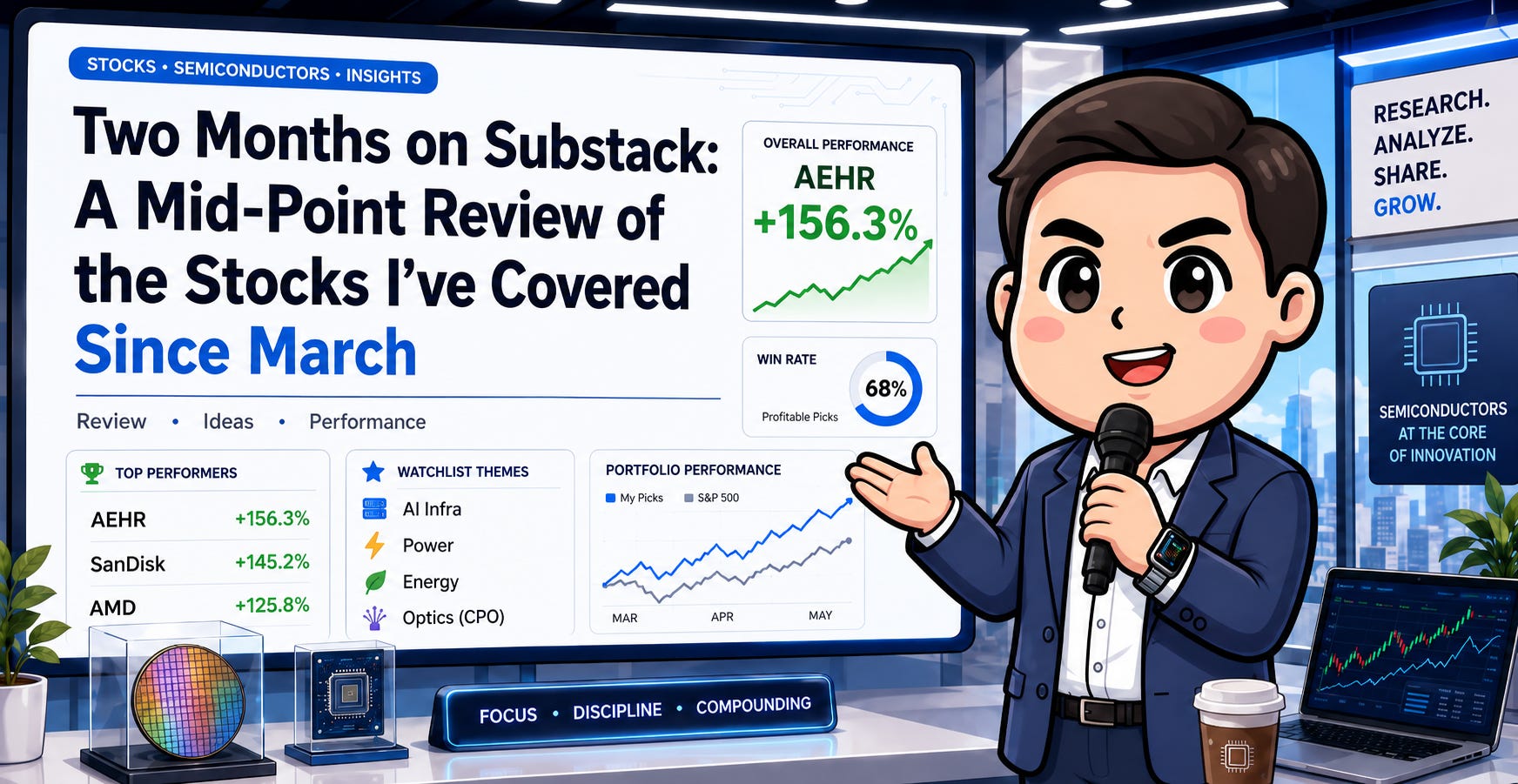
I’ve been writing technology articles on X since the start of this year.
On March 15, I started writing on Substack in earnest.
I've been fortunate enough to receive a lot of support.
Just two months in, the Substack has grown to 9,000 subscribers and sits at #15 in the Technology category.
Today I want to look back at the individual stock analyses I’ve written and give them a real review.
Before I get into it.
This post is not a victory lap.
Most of the high returns here are clearly driven by a strong market.
That’s exactly why I want to do this review.
The point is to separate what I actually read correctly from what was just lucky, and to see which theses really worked. I also want to check what I missed.
Beyond the companies below, I’ve shared views on plenty of other names through investment map articles and sector pieces.


The full company deep-dives, though, I save for the names I have real conviction in.
For that reason, I treat small caps with extra caution. Even if a company is up tens of percent in a short stretch, if I don’t see a real technical moat, I won’t write about it. It doesn’t fit my investment style, and trade-driven names sit in a domain I can’t play well.
None of my writing is a buy or sell recommendation. The main reason I write is to help investors who aren’t deep in semiconductors understand the technology and the trends in plain language, so they can build their own strategy. Being in the industry gives me a little more conviction on direction than someone watching from the outside.
If my writing saves readers time on understanding a name or a sector, and if that helps them earn better returns than I do, that’s enough for me.
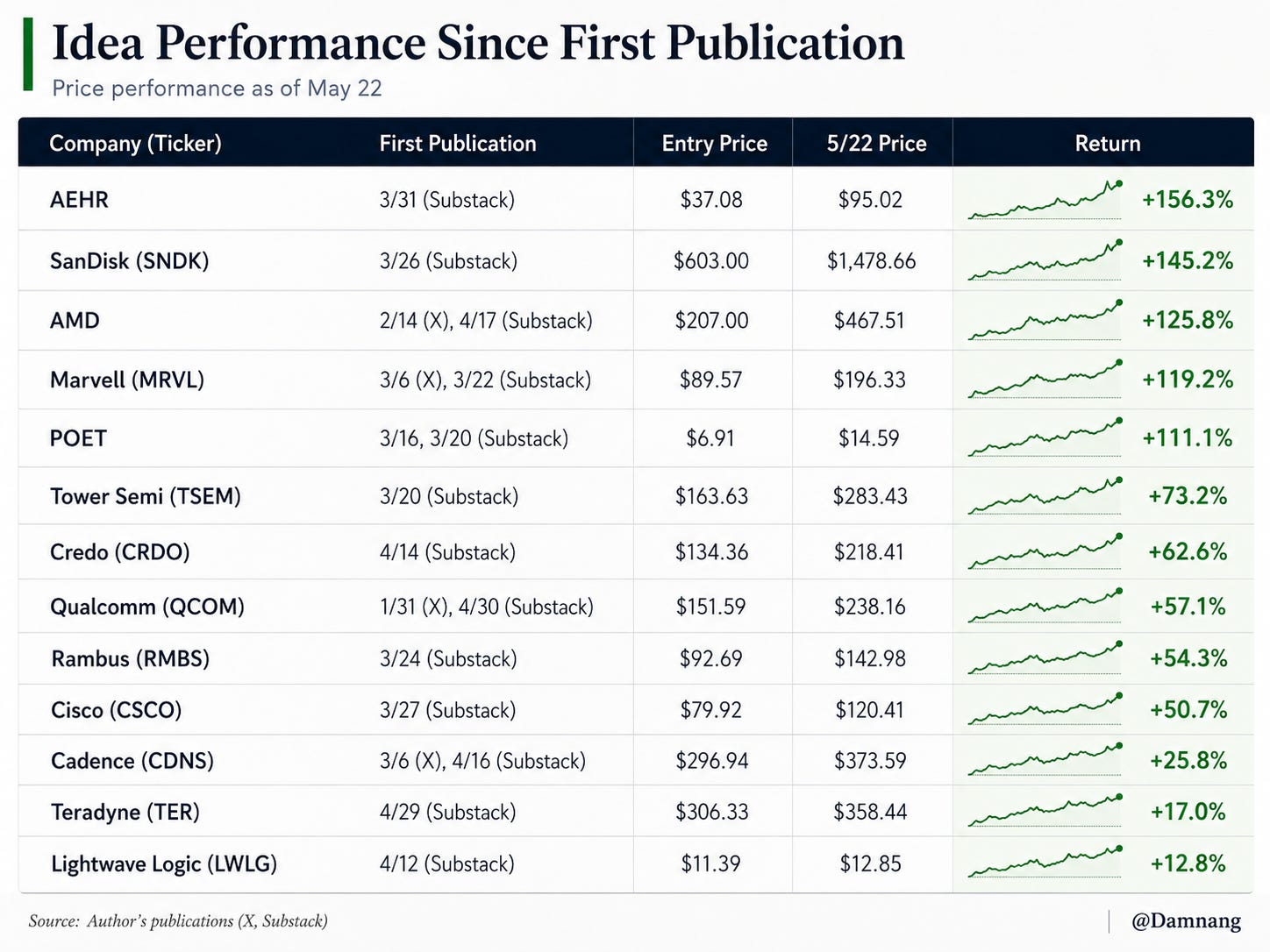
Stock Scorecard (X + Substack)
Returns are measured from the earliest publication date, on X or Substack, whichever came first.
Company by Company
AEHR (+156%). March 31 piece. This was one I really wanted to write. Burn-in is becoming more important as the test stack evolves, and I wanted readers to feel that. The thesis was AEHR’s near-monopoly position in SiPh test and burn-in, plus the inflection point as the revenue cliff was ending. Small-cap test names carry heavy customer-concentration risk, but once a fresh design-in lands, revenue gets pumped again. This past quarter confirmed it.

SanDisk (+145.2%). March 26 piece. Back then, Google’s TurboQuant announcement was crushing memory names, and the chorus calling memory dead was getting to me. So I wrote it. The result? You probably know better than I do.

AMD (+125% from 2/14, +68% from 4/17). February 14 on X, April 17 on Substack. I wrote this one because I wanted to clear up the way people misread AMD. If you just see them as the runner-up who can’t beat NVIDIA, you’ll never build real conviction here. The point I wanted to stress: once the market starts seeing AMD as a full-stack player rather than a GPU second source, the multiple moves again.

Marvell (+119.2% from 3/6, +117.8% from 3/22). March 22 piece. The thesis was the custom silicon (ASIC) cycle and Marvell’s position in optical DSP. With datacenter revenue mix crossing 50%, that mix shift became the core valuation driver. Not a cyclical recovery story. A case where the business structure itself changed.

POET (+111%). Written twice, on March 16 and 20. Optical engine and SiPh interposer thesis. As a small cap, volatility was severe. Along the way, several big swings came from CFO-related issues rather than technology. A reminder of how much non-technical risk can hit a stock.

Tower Semiconductor (+73%). The core of the March 20 piece was Tower’s SiPh foundry positioning and its strength in RF/analog. Once the optical cycle turned, the market priced the thesis in fast. Pure-play foundries with real SiPh capability are scarce, and that scarcity translated directly into multiple expansion.

Credo (+63%). April 14 piece. Covered Credo’s positioning in AEC and PCIe retimers, plus what the DustPhotonics acquisition means. Still a name I’m watching closely. One regret: I was so locked in on Credo that I didn’t give Astera Labs a proper look. ALAB ran 84% over the same window.

Qualcomm (+57.1% from 1/31, +33% from 4/30). January 31 on X, April 30 on Substack. From conversations with former Qualcomm colleagues, I’d confirmed they had a datacenter entry strategy built on a new LPDDR-based architecture, and wrote about it. The rally has kept going since, on multiple signals: the ASIC business push and the CPU strength story. Speaking as a Qualcomm alum, both the strengths and the risks here are clear, which puts it firmly on my watchlist.

Rambus (+54%). March 24 piece. HBM controller IP and the memory interface licensing model. As the HBM4 cycle kicks in, the leverage in the IP royalty structure is becoming visible. On top of that, there was a Silicon Valley business story that only paid subscribers got to see. Another one to keep watching.

Cisco (+51%). March 27 piece. The thesis was hyperscalers re-evaluating enterprise networking. The core was 800G/1.6T pluggable optics and Silicon One positioning. Legacy names move hardest when the narrative flips. AI infrastructure was exactly that trigger. I think there’s still room for further re-rating from here.

Cadence (+25.8% from 3/6, +22% from 4/16). April 16 piece. Covered Cadence not just as an EDA powerhouse but as a company morphing into an ASIC player. The headline return looks smaller than the others, but on a risk-adjusted basis, given the revenue visibility EDA carries, this was the steadiest stretch of the bunch.

Teradyne (+17%). April 29 piece. Despite very strong revenue at the time, the stock dropped more than 8%. That mismatch is what pushed me to write it on short notice. Test is the area I know best, and I continue to believe the strongest bottleneck ahead lies in test, which keeps Teradyne on my list. That said, equipment companies aren’t built for explosive moves, and that’s worth keeping in mind.

Lightwave Logic (LWLG, +13%). April 12 piece. I flagged the structural challenges in the EO polymer commercialization path. The technical limits of polymer still look clear to me, but the stock spiked to $18 on excitement around Marvell’s Polariton acquisition, only to come back down to the $12 range. Like POET, there’s no current revenue, so the swings are extreme.

Three Things I Learned in Two Months
First, the thesis that the optical and AI infrastructure cycles were entering their main leg held up.
Most of the 13 names are exposed, directly or indirectly, to some layer of optical or AI infrastructure. Even the memory cycle, as SanDisk showed, ended up being another axis of the same AI infrastructure cycle.
Second, multiples move hardest when the market’s frame on a company shifts.
Cisco was a legacy enterprise networking name, and once it got re-evaluated through the AI infrastructure narrative, it gave +51%. Marvell got re-rated from a cyclical semi to a datacenter mix-shift story and ran to +119%. AMD’s multiple moved again once the market started seeing it as a full-stack player rather than a GPU second source. The fundamentals themselves don’t change. The biggest re-ratings happen the moment the market’s frame on a company shifts. That’s why, when I write a thesis, I always check first whether there’s a narrative that could flip the frame. These last two months confirmed the pattern again.
Third, the market is always an unpredictable creature.
I pointed out the technical limits of polymers in the LWLG article, but a single Marvell Polariton acquisition narrative sent the stock to $18 before bringing it back down to the $12 range. Confirmation through price takes time, and structural risks become clearer once the cycle cools. POET is another case. Even with strong-looking technology, a hard-to-predict CFO risk dropped the stock more than 40% in a single day. Rambus was no different. These were events that reminded me again that beyond technology and conviction, there are many external variables you have to watch.
What I’m Looking At Next
The companies I want to focus my research on going forward are clear in my mind.
Names in spots most people aren’t looking at, where the short-term returns might not be flashy but I can hold them steadily for the long run. Companies with clear technical moats that are unlocking the real bottlenecks in the cycle. Not a one-quarter chase game, but companies I can hold on a 2-to-3-year horizon.
Chasing small-cap momentum names ripping tens of percent in a session isn’t my game. Trade-heavy names don’t suit my style, and I can’t play them well. What plays to my strengths is being in the industry, picking up signals a step earlier than most, and digging deep into companies with real technical moats.
Going forward, I’ll focus more on power and energy, AI datacenter infrastructure, and within optics, CPO and memory optics. My personal read is that the market’s strong move can keep working through the end of the year.
The one thing to watch is the large IPOs still coming this year. SpaceX, OpenAI, and Anthropic hitting the public market are the biggest variables. If companies adding up to more than a trillion dollars in value hit the market at once, capital could rotate toward them, and existing semiconductor names could see temporary outflows. This could be a top signal for the AI cycle, or it could be the trigger that pushes the AI capital cycle one rung higher. Either way, it will be a volatility-making event, and which thesis you’re holding at that moment will be the inflection that separates the next cycle from the last one.
Crazy work for two months 👏👏
I wrote this article regarding ALAB, which may have greater potential than CRDO. You could check it here: https://phylins.substack.com/p/astera-labs-alab-should-not-be-valued?r=776nxd&utm_medium=ios&utm_id=97757_v0_s00_e233_tv0