



On May 1, 2026, a post on X hit 6.5 million views. It was from @InTheAssembly.
The gist was simple. “A 25-year-old turned $225M into $5.5B in 12 months. He didn’t buy NVIDIA. He didn’t buy Microsoft. Instead, he bought Bloom Energy, Lumentum, SanDisk, CoreWeave, IREN. AI infrastructure picks.”
The return figures were even more provocative. Bloom Energy +1,422%, Lumentum +1,331%, SanDisk +3,130%, CoreWeave +166%, IREN +583%.
It’s not hard to see why this went viral. The narrative was too good. A young genius who left OpenAI, a 165-page AI thesis, one person betting on infrastructure while everyone else was chasing model companies and mega-caps, and the jaw-dropping returns to show for it. Every ingredient social media loves was there.
But pull the numbers apart and the story shifts.
The first publicly disclosed 13F from Leopold Aschenbrenner’s fund, Situational Awareness LP, was dated December 31, 2024. It held 6 positions with a total market value of roughly $254.8M. The most recent 13F, dated December 31, 2025, showed 29 positions with a total market value of approximately $5.52B.
On the surface, that looks like a 22x return in one year. But you can’t read the number that way. According to Form D filings, about $1.76B in new capital flowed into the onshore fund alone, and options positions accounted for roughly 30% of the total book. The growth in 13F book size is a blend of investment returns, new money, and leverage, not pure alpha.
Still, it would be a mistake to write this off as pure viral exaggeration. The numbers were inflated, but the way he looked at the market was clear. He wasn’t trying to pick the winning AI model company. He was following the physical bottlenecks that AI needs to actually run.
Copy the Reasoning, Not the Portfolio
To reconstruct his perspective, you have to go back to the original Situational Awareness paper. Compress 165 pages into one sentence and you get this: the winners of the AI era are more likely to be the companies that own physical bottlenecks than the model companies themselves.
The reasoning that leads to this conclusion runs through four stages.
First, trend extrapolation.
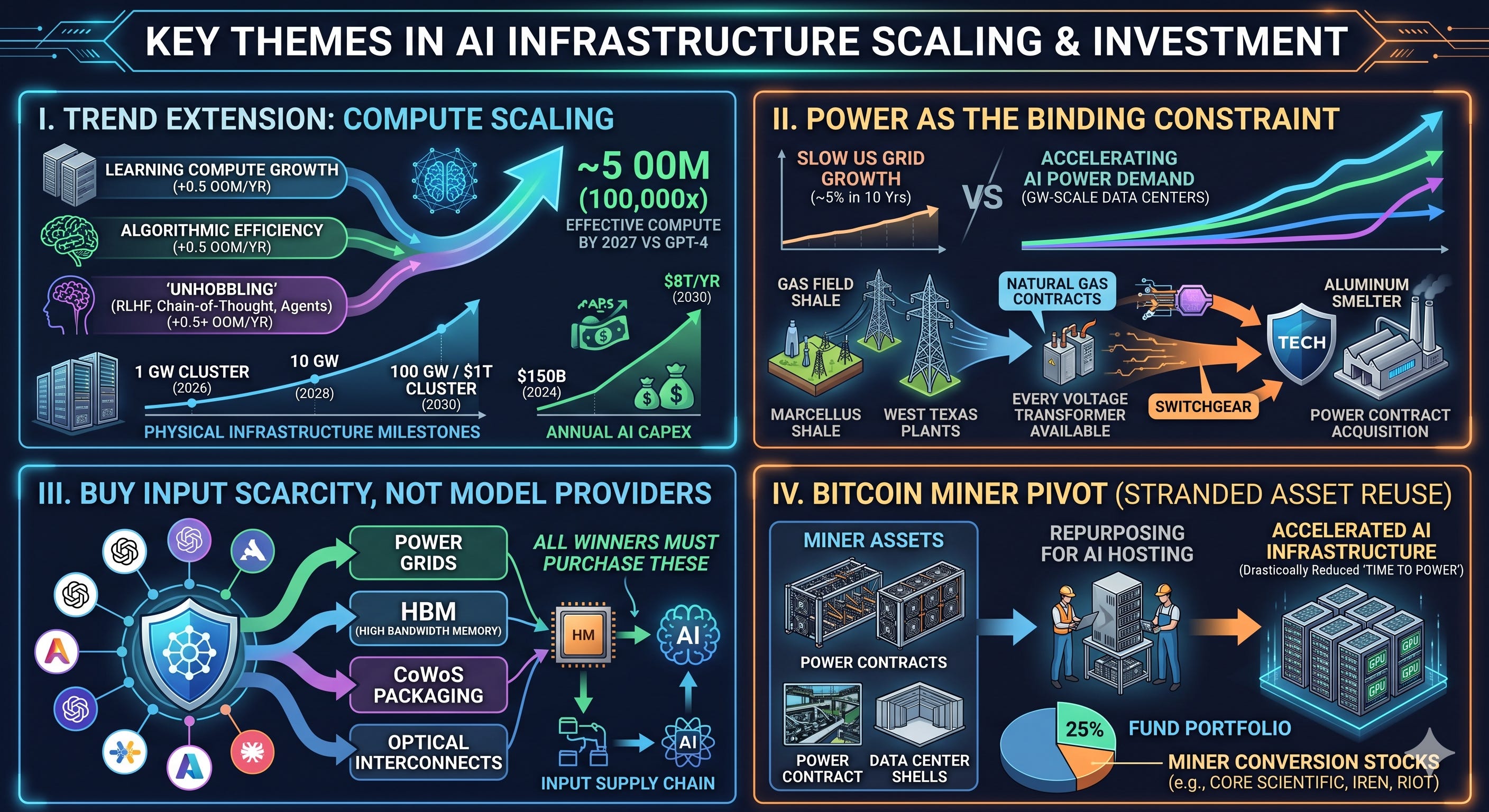
Aschenbrenner projected that training compute was growing at roughly 0.5 OOM (order of magnitude, i.e. 10x) per year, algorithmic efficiency was contributing another 0.5 OOM/year, and “unhobbling” factors like RLHF, chain-of-thought, and agents added 0.5+ OOM/year on top.
Multiply the three together and you get roughly 5 OOM, or 100,000x, in effective compute relative to GPT-4 by 2027. Whether this is right or wrong, what matters is that he worked out the physical requirements to sustain this trend: approximately 1GW clusters by 2026, 10GW by 2028, 100GW/$1T clusters by 2030. Annual AI CAPEX scaling from roughly $150B in 2024 to $8T/year by 2030.
Second, the recognition that power is the binding constraint.
Total U.S. electricity generation grew only about 5% over the previous decade. Layer hundreds of GW of data center demand on top of that, and you get a scramble for natural gas contracts, transformers, and switchgear.
He explicitly mentioned Marcellus shale gas, West Texas combined-cycle plants, and “every power transformer you can get your hands on.” He even floated the idea that tech companies might buy aluminum smelters just to acquire their GW-scale power contracts.
Third, the principle of buying input scarcity rather than picking model winners.
No matter which AI company wins, power is required. HBM is required. CoWoS packaging is required. Optical interconnects are required. Don’t try to pick the winner. Buy what every winner has to purchase.
Fourth, something revealed through his actual fund management: treating Bitcoin miners as “recycled stranded power assets.”
Miners that already hold power contracts and data center shells can pivot to AI hosting, dramatically cutting the “time to power,” the lag between committing to a project and having electricity flowing.
In his latest 13F, miner-conversion plays like Core Scientific, IREN, Applied Digital, Cipher Mining, RIOT, Bitdeer, HUT 8, CleanSpark, and Bitfarms make up roughly 25% of the book. This is the direct expression of that logic.
So if you want to apply the same reasoning today, you don’t mechanically copy his old holdings. You look at where the bottleneck has moved one step forward. What’s interesting is that most of the 6 positions in his very first 13F (Marvell, Vistra, Vertiv, Talen, Constellation, Modine) were sold within a year.
He himself didn’t hold the same names. That’s why you follow the reasoning, not the portfolio.
What Changed Between 2024 and 2026
Run the same logic in May 2026, and the landscape looks quite different.
What Played Out
The physical buildout has confirmed nearly all of Aschenbrenner’s predictions, and in some cases has outpaced his timeline.
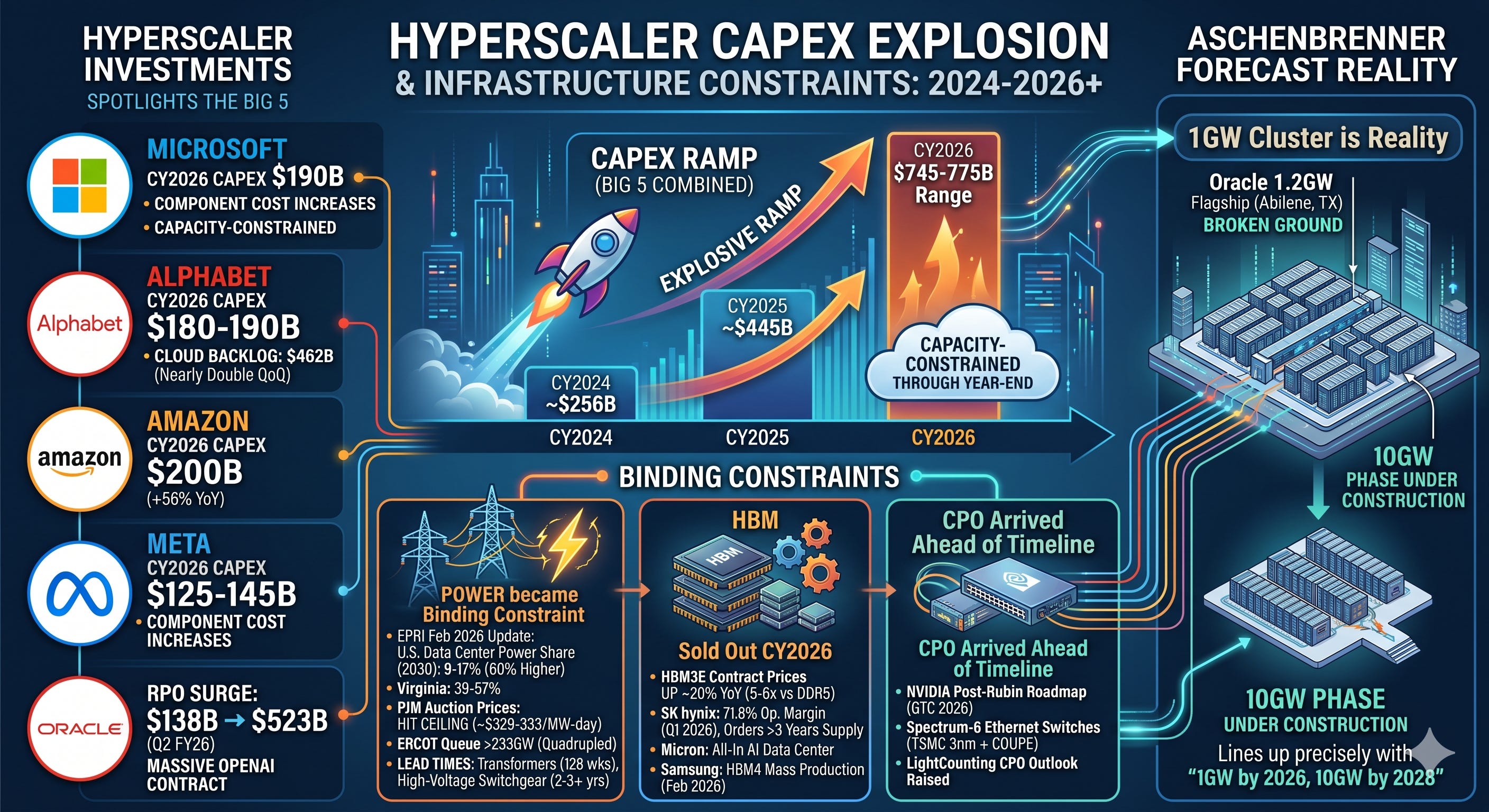
Hyperscaler CAPEX is the clearest evidence. The combined CY2026 CAPEX guidance from the Big 5 (Microsoft, Google, Amazon, Meta, Oracle) is in the $745-775B range. That’s up from roughly $256B in 2024 and $445B in 2025, an explosive ramp.
Microsoft’s April 29 earnings call set CY2026 CAPEX at $190B, noting that about $25B reflects component cost increases. The phrase “capacity-constrained through year-end” came on the same call.
Alphabet raised its figure to $180-190B on the same day, with cloud backlog hitting $462B, nearly doubling quarter-over-quarter.
Amazon guided $200B (+56% YoY).
Meta raised its range to $125-145B in late April, citing “component cost increases.”
Oracle’s RPO (remaining performance obligations, contracted revenue not yet recognized) jumped from $138B to $523B in Q2 FY26, with a massive OpenAI contract among others driving the surge.
The IEA noted that the combined CAPEX of these five companies now exceeds global upstream oil and gas investment.
Power became the binding constraint exactly as Aschenbrenner predicted. EPRI’s February 2026 update raised its estimate for U.S. data center power share by 2030 to 9-17%, which is 60% higher than its 2024 estimate. Virginia alone is projected at 39-57%.
PJM capacity auction prices hit the ceiling in 2025, with the July auction clearing at $329.17/MW-day and the December auction reportedly around $333/MW-day, with data centers accounting for the bulk of projected peak load growth. ERCOT’s large-load interconnection queue quadrupled in 2025 to over 233GW.
Power transformer lead times are running at roughly 128 weeks, and high-voltage switchgear is 2-3 years or more.
The 1GW cluster is already reality. Oracle’s 1.2GW flagship in Abilene, Texas has broken ground, and the 10GW phase is under construction. This lines up precisely with Aschenbrenner’s “1GW by 2026, 10GW by 2028” forecast.
HBM is sold out across all three vendors for CY2026. HBM3E contract prices are up roughly 20% YoY, carrying a premium of about 5-6x per GB versus DDR5. SK hynix posted a 71.8% operating margin in Q1 2026, and disclosed that HBM orders exceed three years of supply.
Micron divested its consumer memory business in December 2025, going all-in on AI data center. Samsung began mass production of HBM4 in February 2026 and re-entered as an NVIDIA-certified vendor.
CPO (co-packaged optics) arrived ahead of Aschenbrenner’s timeline. NVIDIA laid out CPO across its post-Rubin networking roadmap at GTC 2026, pushing Spectrum-6 Ethernet switches (TSMC 3nm + COUPE) toward commercialization.
LightCounting subsequently raised its CPO outlook, significantly pulling forward commercialization timelines versus its 2024 baseline.
What Didn’t Play Out
While the physical buildout has largely been confirmed, the political and cognitive half of his predictions has lagged noticeably.
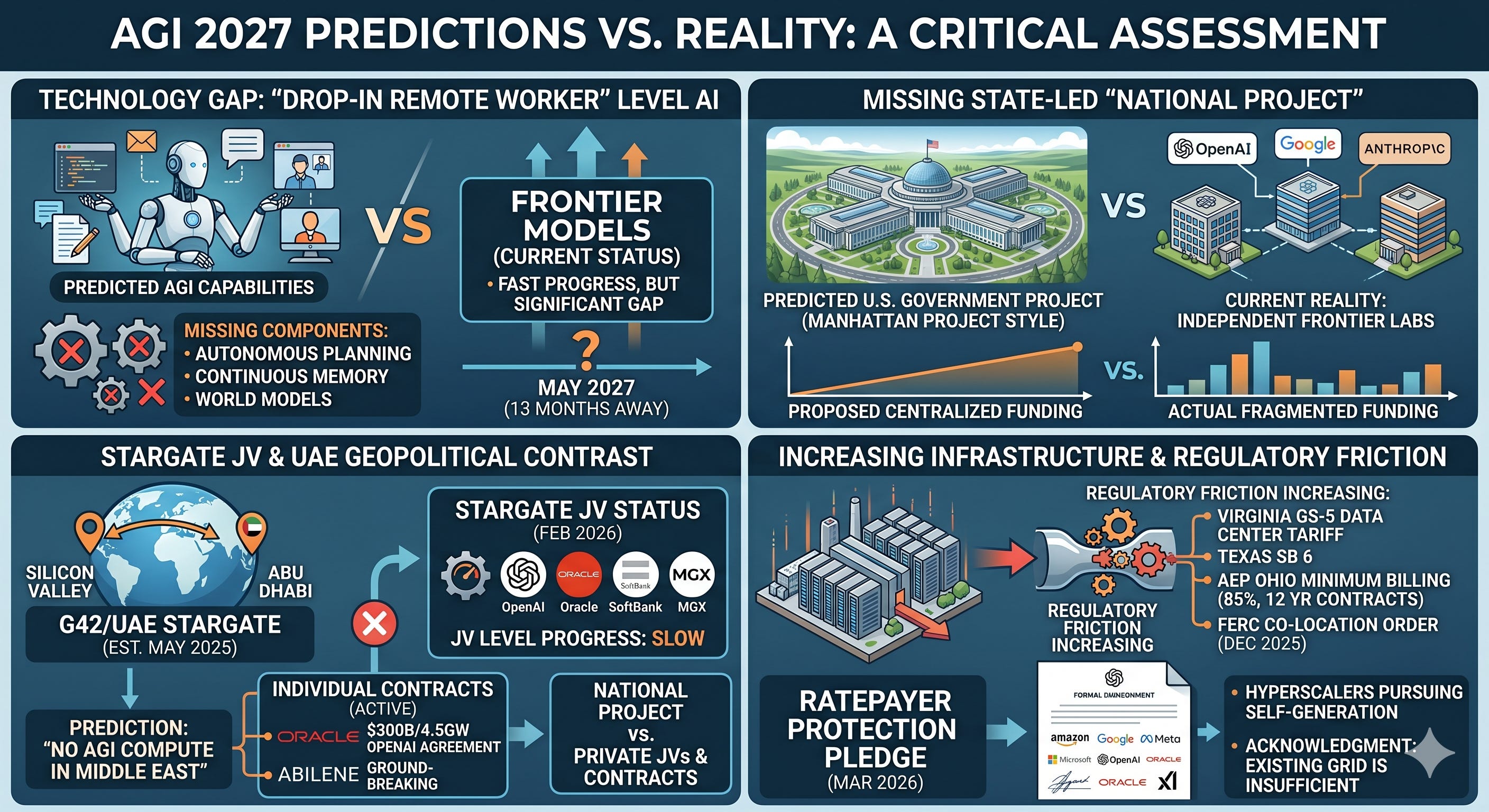
AGI by 2027 is still a debate. With 13 months until May 2027, the “drop-in remote worker” he described, an AI capable of directly replacing a remote human worker, doesn’t exist yet. Frontier models are improving rapidly, but they remain a long way from agents with autonomous planning, persistent memory, and world models.
The U.S. government “project” he predicted, a Manhattan Project-scale nationally directed AI effort, hasn’t materialized. Frontier labs are still operating independently.
The closest thing is the $500B Stargate JV (OpenAI/Oracle/SoftBank/MGX), which as of February 2026 is stalled at the JV level. Individual contracts (Oracle’s $300B/4.5GW OpenAI deal, Abilene groundbreaking) are moving, but they’re different in character from a national project.
More striking is the fact that Stargate launched in the UAE, a jurisdiction he explicitly wrote should be banned from hosting AGI compute. The G42 UAE Stargate kicked off in May 2025. This directly contradicts his position that “AGI compute must never be placed in the Middle East.”
Regulatory friction has increased rather than eased. Virginia’s GS-5 data-center-specific rate structure, Texas SB 6, AEP Ohio’s 85% minimum billing/12-year contracts, and FERC’s December 2025 co-location order all add friction to infrastructure buildout velocity.
The “Ratepayer Protection Pledge” signed in March 2026 by Amazon, Google, Meta, Microsoft, OpenAI, Oracle, and xAI is a commitment to self-generation, which in practice is an admission that grid-based power procurement has hit its limits.
Variables Nobody Expected
The biggest variable that didn’t exist in 2024 is the speed of efficiency improvement.
DeepSeek V3/R1 achieved GPT-4-level performance in January 2025 at 1/18th the inference cost. Efficiency gains are clearly accelerating. After DeepSeek, the market saw that equivalent performance could be delivered at dramatically lower cost. The IEA’s April 2026 report also acknowledged that energy consumption per AI task is declining rapidly.
But the same report’s conclusion matters more. Jevons’ paradox is winning. According to the IEA, AI-focused data center power demand grew 50% in 2025, and total data center power demand was up 17%. Revenue from major model providers grew 5x, and their CAPEX rose 75%. Efficiency is redistributing compute from training to inference, not reducing total demand.
This weakens Aschenbrenner’s “single 100GW cluster” scenario but actually strengthens the aggregate buildout thesis.
Where This Logic Points Through 2028
Apply Aschenbrenner’s reasoning to May 2026 data, and you can see where the bottleneck has moved.
In 2024, what he saw was “generation.”
That’s why Vistra, Constellation, and Talen Energy were in his first 13F. By 2026, generation contracts are getting signed.
Oracle’s 2.8GW data center power agreement, AEP’s $2.65B/1GW commitment, Google’s $4.75B acquisition of a power company. Generation is now a question of “who has secured it,” not “whether it’s possible.”
The same line of reasoning then produces its next question: what is constraining the process of getting that generated electricity into the data center and connecting it to servers?
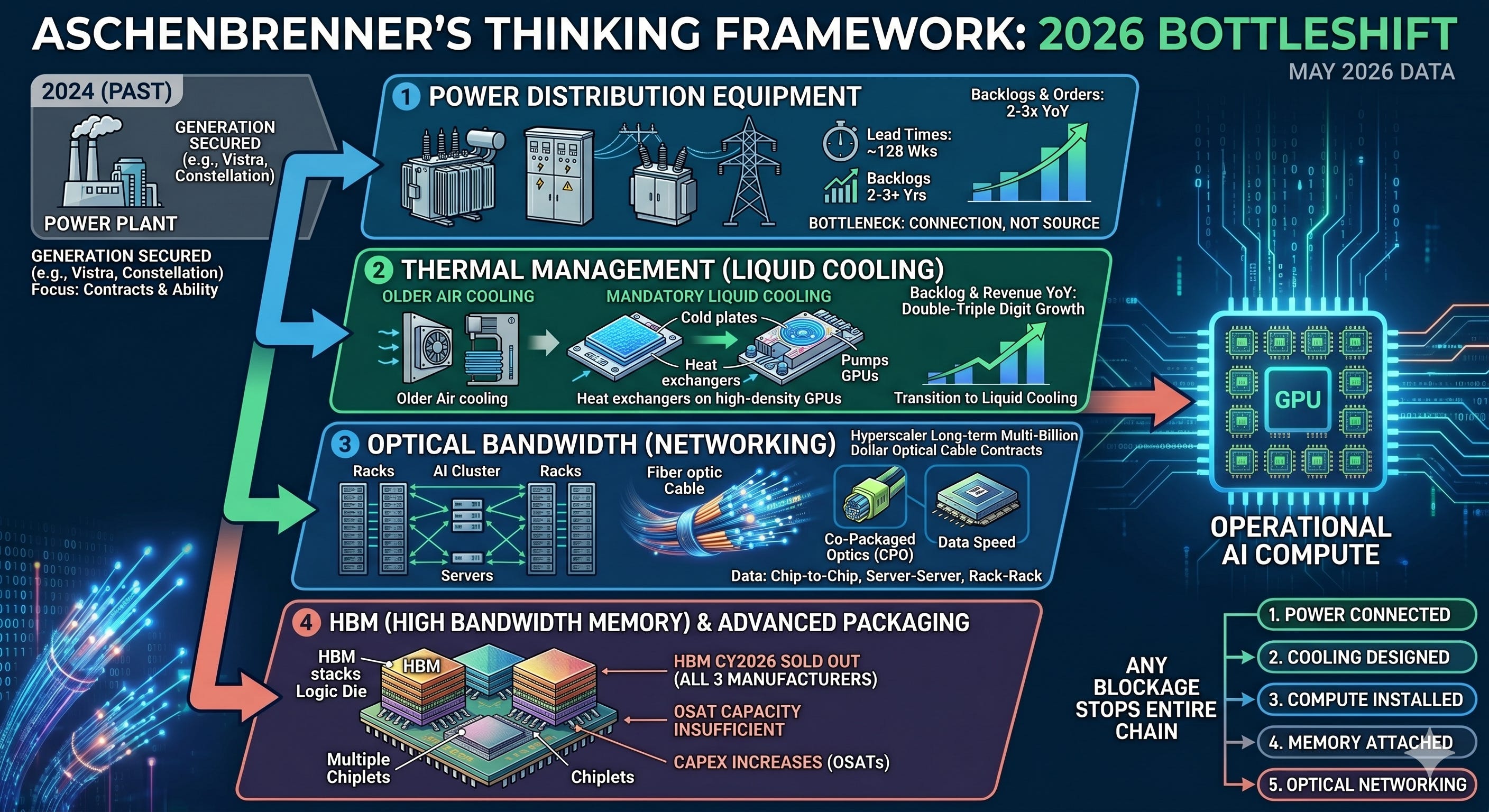
The first bottleneck is power distribution equipment. Power transformer lead times of roughly 128 weeks. High-voltage switchgear, 2-3 years or more. Situations where power plants are built but the electricity can’t be connected are actually happening. The market pays more attention to generation and GPUs, but what determines when a data center actually goes live is the power interconnection layer: switchgear, distribution panels, medium-voltage equipment.
The fact that major electrical equipment companies are seeing data center bookings grow 2-3x YoY, with backlogs hitting all-time highs, is evidence that this bottleneck is real and binding right now.
The second bottleneck is thermal management. As GPU density rises, cooling is no longer an accessory; it moves to the center of the design process. Existing air cooling cannot handle the thermal density of next-generation GPUs, and the transition to liquid cooling is being effectively forced. The double-digit to triple-digit YoY growth in backlog and data center revenue at cooling infrastructure companies shows this transition is already underway.
The third bottleneck is optical bandwidth. As AI clusters scale, the speed of data movement between chips, between servers, and between racks determines overall system performance. CPO has entered the commercialization phase earlier than previously expected, driving a surge in demand for optical components and fiber cable. The fact that hyperscalers are now signing multi-billion-dollar long-term fiber contracts signals their belief that this bandwidth will remain scarce for years.
The fourth bottleneck is HBM and advanced packaging. AI chip performance is no longer determined by transistor shrinks alone. Stacking HBM on logic die and integrating multiple chiplets into a single package through advanced packaging is what actually sets the performance ceiling. HBM is sold out across all three vendors for CY2026, and advanced packaging capacity cannot keep pace with demand, with overflow being outsourced. Memory companies are exiting consumer businesses and pivoting entirely to AI, and OSAT firms are multiplying their CAPEX several times over. The scale of these moves directly reflects the scale of this bottleneck.
These four bottlenecks are not independent. They follow a sequence. Power must be connected before cooling can be designed. Cooling must be designed before compute goes in. Compute must go in before memory is attached. Memory must be attached before optical connections tie it all together. If any one step in this sequence stalls, everything behind it stops. Apply the same reasoning, and just as you needed to look at generation stocks in 2024, in 2026 you need to look at these four axes.
What This Logic Says to Buy
Disclaimer
This section is not a recommendation to buy or sell any specific stock. It is a thought experiment: applying the “follow the physical bottleneck” logic from Aschenbrenner’s Situational Awareness to data available as of May 2026, and seeing what conclusions emerge. Actual investment decisions should be based on your own risk tolerance, portfolio context, and market judgment.
Aschenbrenner’s core principle is “as AI gets better, what must it need more of?” Ask this question again in May 2026, and the answers come in a specific order.
Data centers are built following the sequence of physical processes. Power must be connected before cooling can be designed. Cooling must be designed before compute goes in. Compute must go in before memory is attached. Memory must be attached before optical connections tie it all together. If any one step in this sequence stalls, everything behind it stops.
This matters because investing should follow the same sequence. The bottleneck at the front of the line is the first to generate returns. In 2024, Aschenbrenner bought generation stocks (Vistra, Constellation, Talen) because generation itself was the bottleneck at the front. By 2026, generation contracts are being signed, and the bottleneck has shifted one step back. What’s stalling at the front of the line now is power distribution equipment.
This logic produces three tiers.
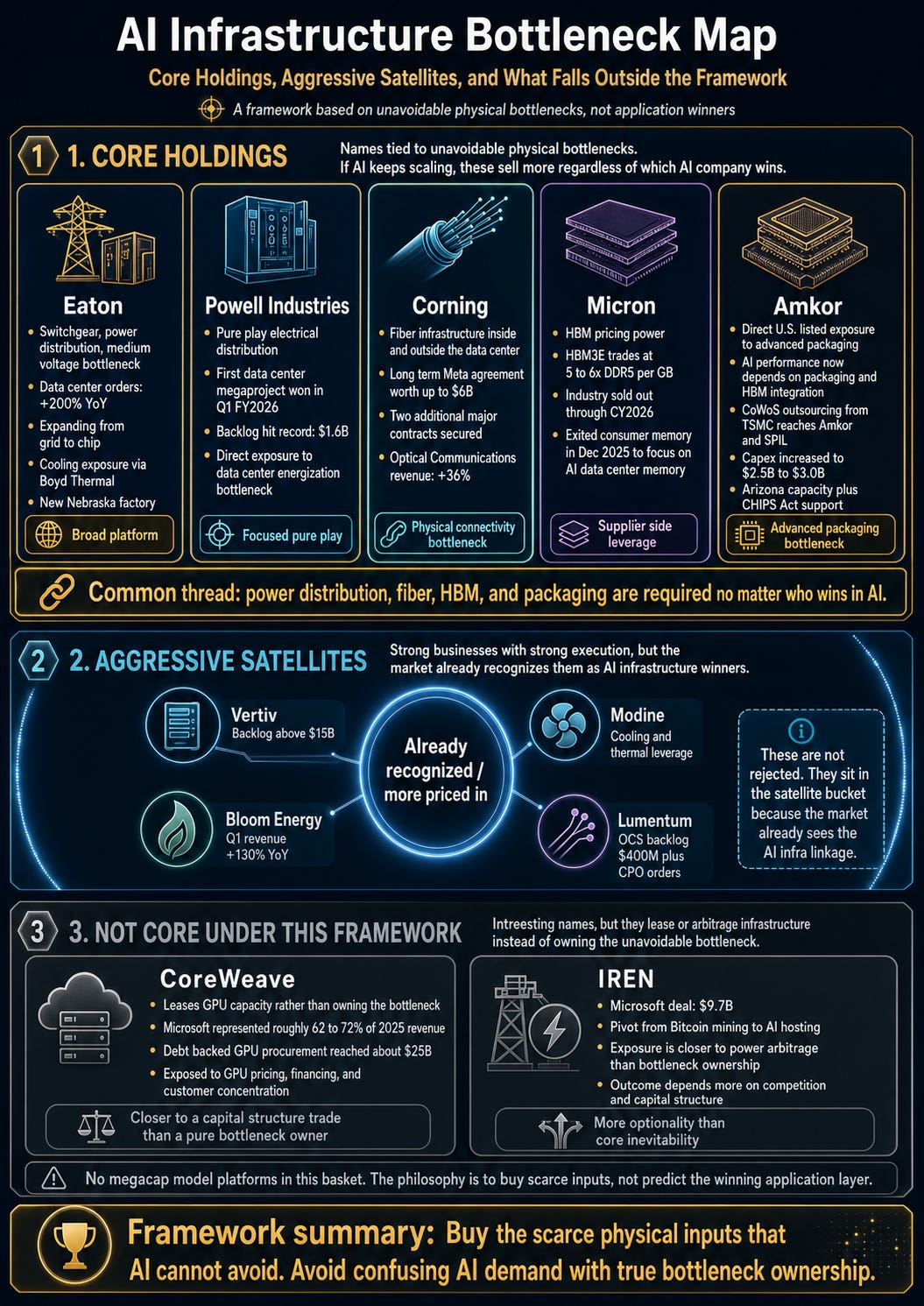
First, the core. Companies that hold the physical bottlenecks most difficult to bypass as AI continues to build out.
Eaton and Powell Industries sit at the front of this tier. The reason is the sequence described above. The market pays more attention to generation and GPUs, but on the ground, it’s switchgear, distribution panels, and medium-voltage equipment that determine when a data center actually goes live.
Power plants are being built but can’t get their electricity connected, because transformer lead times are 128 weeks and high-voltage switchgear takes 2-3 years or more.
Eaton is a large-cap with broad coverage. It doesn’t just do distribution; it’s bundling cooling through the Boyd Thermal acquisition, building a new factory in Nebraska, and seeing data center-related orders at YoY +200%. It’s a company trying to cover the entire power path from grid to chip.
Powell is closer to a smaller pure play. It booked its first data center megaproject in Q1 FY2026, and its backlog hit an all-time high of $1.6B. As a power distribution equipment specialist, it is the most direct recipient of data center demand. If you’re looking at the same bottleneck, these names occupy the same position in 2026 that generation stocks occupied in 2024.
Corning is a different kind of bottleneck. Fiber optic cable inside and outside data centers is less glamorous but absolutely necessary. As AI cluster scale grows, fiber demand between servers, racks, and buildings scales proportionally. Unlike semiconductors, which get replaced with each generation, fiber is physical infrastructure that lasts decades once installed.
The up-to-$6B long-term deal with Meta means hyperscalers are locking in fiber supply years in advance. Two additional large contracts prove this demand isn’t limited to Meta alone. The 36% increase in Optical Communications revenue is already showing up in the numbers.
Micron holds pricing power in the HBM bottleneck. HBM3E trading at a 5-6x premium per GB versus DDR5, with all three vendors sold out for CY2026, means demand is structurally exceeding supply.
The key signal is that Micron divested its consumer memory business in December 2025. That’s a directional declaration: a commitment to exit the commodity NAND and DRAM cycle and pivot to AI data center. If this succeeds, Micron’s earnings volatility itself changes structurally. Unlike commodity memory, HBM runs on long-term contracts with pricing power on the supplier side.
Amkor is virtually the only U.S.-listed name that gives direct exposure to advanced packaging. Why this matters: AI chip performance is no longer determined by transistor shrinks alone. Stacking HBM on logic die and integrating multiple chiplets into a single package through advanced packaging has become the real performance bottleneck.
TSMC’s CoWoS is the symbol of this bottleneck, and TSMC itself can’t handle the volume, outsourcing roughly 240K wafers to Amkor and SPIL. Amkor tripling its CAPEX to $2.5-3.0B is an investment to absorb that outsourced demand. On top of that, its Arizona fab adds CHIPS Act subsidies and the geopolitical dimension of securing advanced packaging capacity on U.S. soil.
What these five names share is that they satisfy Aschenbrenner’s original criterion: “things that sell more no matter what, if AI succeeds.” Regardless of which AI company wins, distribution equipment is needed, fiber optic cable is needed, HBM is needed, and packaging is needed.
Second, aggressive satellites. Names where the direction is right but the market already recognizes them as direct AI infrastructure beneficiaries. Vertiv, Bloom Energy, Modine, Lumentum.
These four are satellites not because their fundamentals are weak. Their fundamentals are actually more dramatic than many core candidates. Vertiv’s backlog exceeds $15B. Bloom’s Q1 revenue exploded YoY +130%. Lumentum has OCS backlog above $400M plus additional CPO orders.
The issue is that the market already knows all of this. Bloom ran from $10-12 in mid-2024 to $292. Lumentum hit an ATH of $985. The core of Aschenbrenner’s logic is buying bottlenecks the market hasn’t fully recognized yet. Loading core weight into names already widely rediscovered as AI infrastructure plays means applying the philosophy while missing its essential point. So these four go into the satellite tier based not on directional conviction but on the degree to which that conviction is already priced in.
Third, what drops out of this framework.
CoreWeave and IREN are interesting, but stress-tested against Aschenbrenner’s own principles, they’re not “unavoidable bottlenecks.” These businesses don’t own physical bottlenecks; they lease them. Microsoft accounted for 62-72% of CoreWeave’s 2025 revenue, and debt-financed GPU procurement stands at roughly $25B. Jim Chanos’s critique hits the mark: “Even generously assuming a 10-year GPU lifespan, the return on capital is roughly 0%.” This means CoreWeave’s returns are directly exposed to GPU price declines and customer churn.
Transformers take 2-3 years to procure, but GPU cloud is a market competitors can enter. IREN’s $9.7B Microsoft contract is impressive, but the pivot from Bitcoin mining to AI hosting is fundamentally power arbitrage, not ownership of a physical bottleneck. Apply the test “things that sell more no matter what if AI succeeds,” and these names land closer to “things whose outcomes can swing significantly based on competition and capital structure, even if AI succeeds.”
Viewed through the same lens, they belong as optionality positions rather than core holdings.
This basket contains no mega-cap model platforms. Not because those companies are bad, but because the core of the Aschenbrenner approach is buying input scarcity rather than trying to pick application-layer winners. For the same reason, GPU cloud rental businesses and miner-conversion plays sit at the periphery, not the center.
Why This Framework Could Be Wrong
The biggest counterargument is efficiency improvement. The IEA’s April 2026 report noted that energy consumption per AI task is declining rapidly. DeepSeek delivering equivalent performance at 1/18th the cost is a signal that total compute demand may not ramp as steeply as Aschenbrenner drew it.
For now, Jevons’ paradox is winning: usage is growing faster than efficiency improves. But if efficiency flips at some point, the window of excess returns for infrastructure names could be shorter than expected. Ultimately, AI infrastructure investing requires not just that demand grows, but that demand growth outpaces efficiency gains.
The second counterargument is regulatory and social pushback. The EPRI projection that data centers could consume 39-57% of Virginia’s power simultaneously implies that the political cost could explode.
Project approval delays, cost-shifting debates, and slower infrastructure buildout are all realistic risks. The fact that hyperscalers signed the “Ratepayer Protection Pledge” is itself an admission that a grid-dependent strategy has hit its limits.
The third is structural risk within Aschenbrenner’s own fund. As Capitalists Substack pointed out in February 2026, the fund’s net AUM per ADV filings was $383M against a $5.5B 13F book, implying roughly 14:1 leverage.
This conflicts with the $9.28B regulatory AUM from the March ADV, so it’s unconfirmed, but if directionally correct, this strategy isn’t “concentrated long-only infrastructure” but “high-leverage single-thesis momentum bet.”
That’s why over the next two years, the signals to watch are backlog, sold-out dates, expansion CAPEX, new power contracts, and contracted data center capacity, not stock prices.
Bloom’s Oracle contract expansion, Lumentum’s OCS and CPO orders, Micron’s HBM supply being sold out, Powell’s data center megaproject bookings, GE Vernova’s electrification orders: they all point to the same signal. The direction of these indicators matters far more than social media notifications.
Conclusion
If you really want to follow Aschenbrenner, don’t buy his old stocks. Follow his question. “As AI gets better, what must it need more of?”
As of May 2026, the answers are power distribution equipment, liquid cooling, optical connectivity, HBM, and advanced packaging. The core built on this logic is Eaton, Corning, Micron, Amkor, and Powell. The aggressive satellites are Vertiv, Bloom, Modine, and Lumentum.
If the AI investment boom continues through 2028, the biggest money is more likely to come from these physical bottlenecks than from chatbot brands.
Take his reasoning, make it your own, and build your own alpha.
So many tickers to consider and they all have rallied so hard already.
Great article Damnang!
While many of the names have picked up already, in my view this has mostly been due to the strongly improving underlying fundamentals and not the market pricing the necessity of these inputs as bottlenecks. Micron is a great example, trading at ~5.5x forward earnings while HBM proves absolutely critical to AI infrastructure.