

“Can AMD beat NVIDIA?”
It’s the question people around me keep asking.
The day the OpenAI 6GW deal was announced, “AMD Finally Catches NVIDIA” was plastered everywhere.
The day the Meta deal broke, “The End of the AI Chip Monopoly” led the front pages.
When Helios was unveiled at CES 2026, “NVIDIA NVL72 Killer” stories poured in.
The stock swung ±7% on a single headline, and analysts revised their price targets weekly.
Yet after reading all those headlines, the question people around me ask me hasn’t changed. “So can AMD beat NVIDIA or not?”
Whenever I hear this question, a line from my favorite Korean film “Oldboy” comes to mind.
“You keep asking the wrong question, so of course you’ll never get the right answer.”

In this article, I want to walk through how to actually look at AMD to see the real picture.
Why Lisa Su never puts the word “beat” in her mouth, what strategy sits in that empty space, and how an investor should read that strategy.
The 12GW supply contract, the 20% warrant equity, the Helios rack, Zen 6 Venice.
The news that’s poured out over the past six months is actually pieces of one picture, and this article lays out what that picture is.
Table of Contents
What’s happened over the past six months
The tech stack: how far has AMD caught up
Rumors and open questions in the market
What the 20% warrant really means: not a discount, a joint investment
The real market Helios is aiming at
ROCm: not trying to beat CUDA
The CPU bottleneck in the agentic AI era: a rare card AMD holds
If this reading is right: why I like Lisa Su’s strategy
Structural risks, and getting back to the real question
Disclaimer
This article is based on publicly available information and my own interpretation. It does not draw on confidential information, customer data, internal documents, design materials, roadmaps, pricing terms, or supply contracts obtained from past or current employment, and I have not shared any information at a level that could identify specific companies or individuals in violation of NDAs or trade secret obligations.
This article is also not investment advice, a buy or sell recommendation, or a price target. Views on companies, products, and market outlooks reflect my observations and interpretation at the time of writing, may differ from the facts, and can easily change depending on future circumstances. Investment decisions are entirely your own responsibility, and you should check official filings and professional advice separately.
1. What’s Happened Over the Past Six Months
Let me lay out the news flow up to the point of this article.
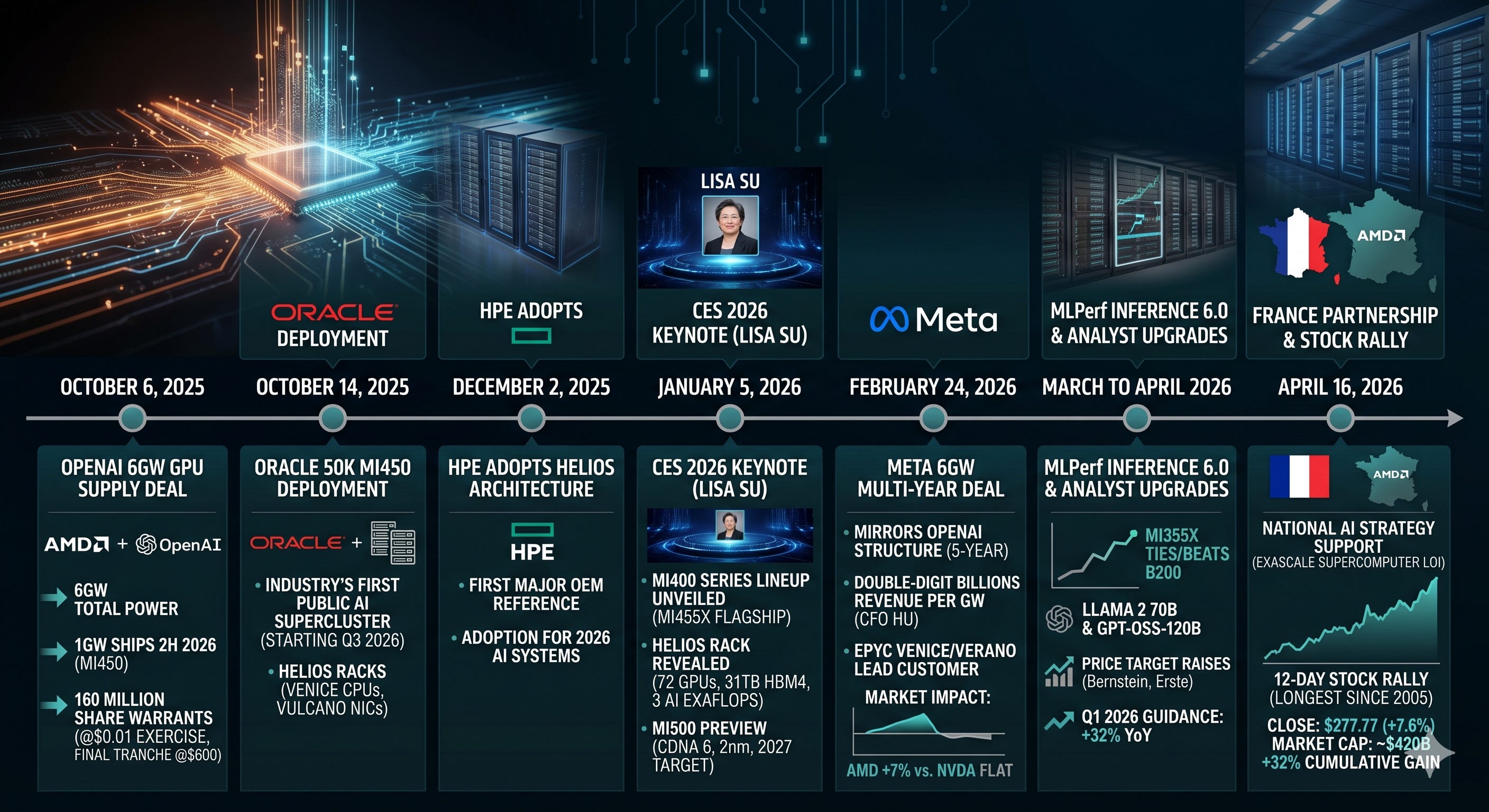
October 6, 2025: OpenAI 6GW deal
AMD and OpenAI signed a 6GW GPU supply contract. The first 1GW ships in 2H 2026 on MI450. AMD granted OpenAI warrants for 160 million shares at an exercise price of $0.01. Vesting is tied to shipment milestones and AMD stock price thresholds, with the final tranche at $600.
October 14, 2025: Oracle 50K MI450 deal
Oracle announced it would deploy 50,000 MI450 units starting Q3 2026. It’s the industry’s first publicly accessible AI supercluster of its kind, built on Helios racks with Venice CPUs and Vulcano NICs.
December 2, 2025: HPE adopts Helios
HPE officially announced it would adopt AMD’s Helios rack-scale architecture for its 2026 AI systems. It’s the first major OEM vendor reference for Helios.
January 5, 2026: CES 2026
At her keynote, Lisa Su unveiled the full MI400 series lineup. MI455X (flagship), MI440X (enterprise 8-GPU), MI430X (sovereign/HPC). The Helios rack was revealed (72 GPUs, 31TB of HBM4, 43 TB/s scale-out, 260 TB/s UALink, 3 AI ExaFLOPS per rack). AMD also previewed the MI500 series (CDNA 6, TSMC 2nm, HBM4e, targeting 2027).
February 24, 2026: Meta deal
Almost identical structure to the OpenAI deal. 6GW, five-year multi-year contract. AMD CFO Jean Hu said on the earnings call that revenue would be in the “double-digit billions of dollars per gigawatt” range, and the WSJ reported the total deal could reach up to $100B. Lisa Su declined to disclose the specific total. Meta received warrants for 160 million shares at $0.01. Meta is the lead customer for EPYC Venice (6th gen) and Verano (next-gen). On the announcement day, AMD was up 7% while NVDA stayed roughly flat. BofA estimates revenue of $17.5B to $20B per gigawatt based on the OpenAI deal.
March to April 2026
In MLPerf Inference 6.0, MI355X tied B200 on Llama 2 70B Offline, came in at 119% on Interactive, and even beat B200 on GPT-OSS-120B. Bernstein SocGen and Erste Group raised their price targets. Q1 2026 earnings are due May 5, and the company has already guided +32% YoY.
April 16, 2026: France government partnership and 12-day stock rally
AMD and the French government officially signed a multi-year letter of intent (LOI). It covers support for France’s national AI strategy, participation in the Alice Recoque exascale supercomputer, and building out the AI innovation ecosystem. On the same day, TSMC posted a record Q1 2026 profit, and AMD rallied for 12 straight days (its longest streak since May 2005). The close was $277.77 (+7.6%), putting market cap at roughly $420B. The cumulative gain over those 12 days came to about 32%.
Tie these headlines together in one line, and you get “AMD is starting to take share from NVIDIA.” Is that actually true?
2. The Tech Stack: How Far Has AMD Caught Up
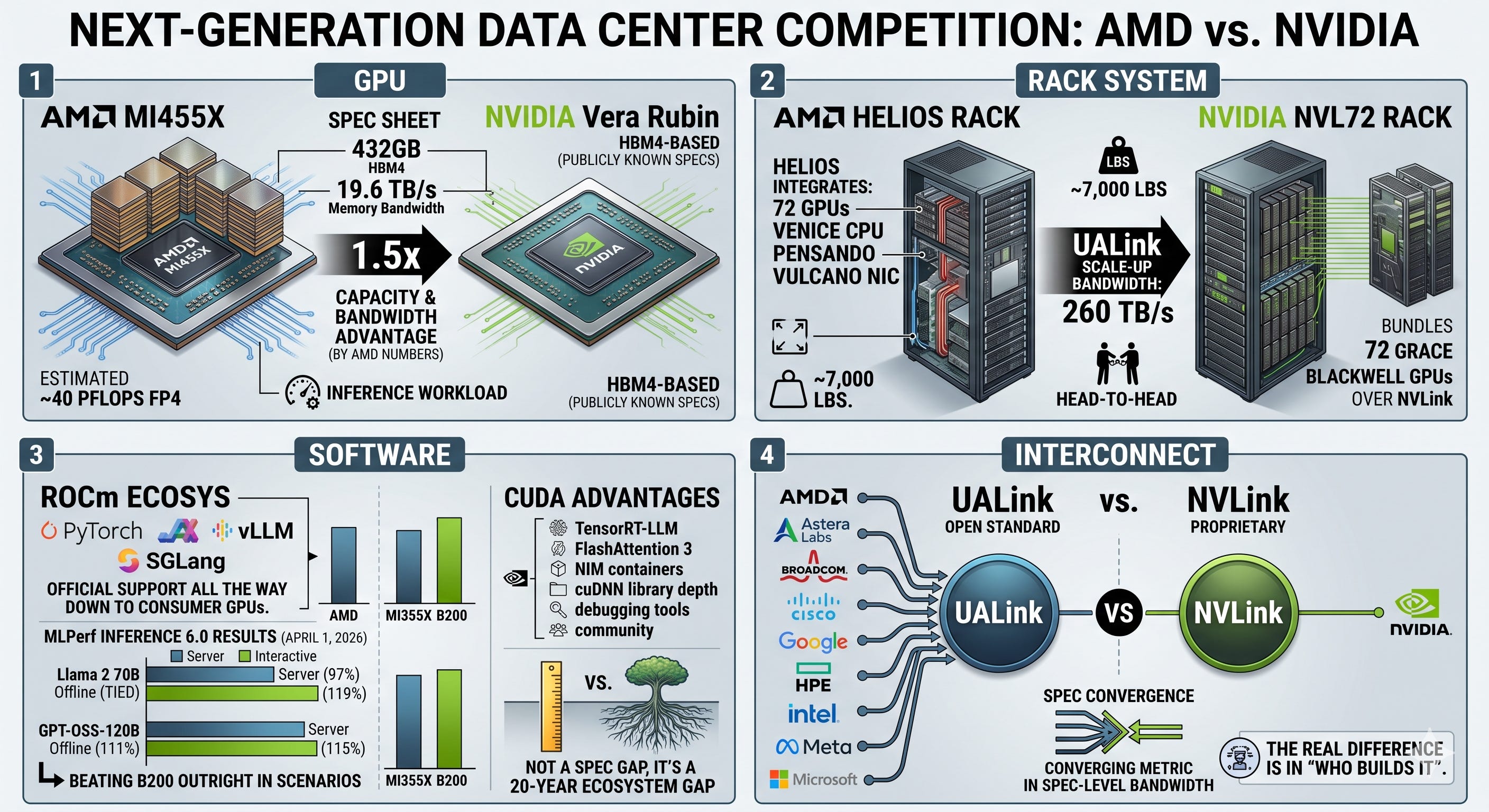
GPU
The MI455X carries 432GB of HBM4 with 19.6 TB/s of memory bandwidth. FP4 throughput is estimated at around 40 PFLOPS based on AMD’s claims. NVIDIA Vera Rubin is HBM4-based within what’s publicly known, and on memory capacity and bandwidth alone, the MI455X is roughly 1.5x ahead by AMD’s numbers. Since many inference workloads are memory-bound, that number translates directly into real performance.
Rack system
Helios integrates 72 GPUs, a Venice CPU, and a Pensando Vulcano NIC into a double-wide rack. It weighs roughly 7,000 lbs and delivers 260 TB/s of UALink scale-up bandwidth. It goes head-to-head with NVIDIA NVL72, which bundles 72 Grace Blackwell GPUs over NVLink.
Software
ROCm 7.x officially supports PyTorch, JAX, vLLM, and SGLang. AMD extended official support all the way down to consumer GPUs. In the MLPerf Inference 6.0 results released on April 1, 2026, MI355X tied B200 on Llama 2 70B Offline, hit 97% on Server, and pulled ahead at 119% on Interactive. On GPT-OSS-120B, it posted 111% on Offline and 115% on Server, beating B200 outright in some scenarios. The areas where CUDA still dominates remain: TensorRT-LLM, FlashAttention 3, NIM containers, cuDNN library depth, debugging tools, community. It’s not a spec gap, it’s a 20-year ecosystem gap.
Interconnect
UALink is an open standard with AMD, Astera Labs, Cisco, Google, HPE, Intel, Meta, and Microsoft participating. NVLink is NVIDIA proprietary. Spec-level bandwidth is converging to similar numbers, and the real difference is in “who builds it.”
Specs and inference benchmarks have caught up. Yet share hasn't moved.
The AI accelerator market is still NVIDIA in the 80% range and AMD hovering around 10%.
The gap closed on specs and the gap showing up in share are moving on different tracks. That disconnect is the central debate in the AMD story right now.
3. Rumors and Open Questions in the Market
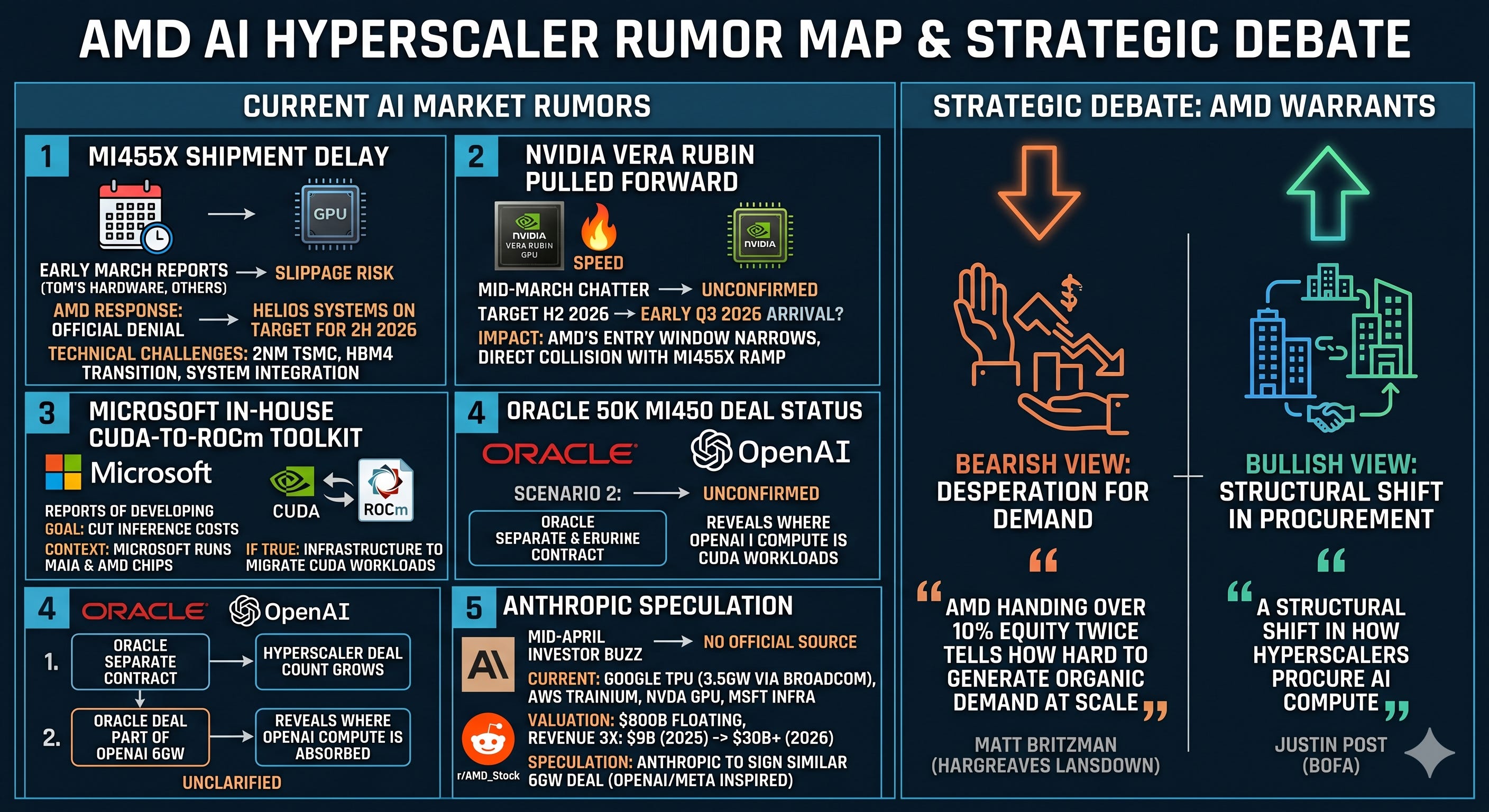
Rumor 1: MI455X delay
In early March, Tom’s Hardware and a few other sources reported that MI455X shipments could slip. AMD officially pushed back with “Helios systems on target for 2H 2026.” It is a technically demanding launch with 2nm TSMC, HBM4 transition, and system-level integration all happening at once.
Rumor 2: NVIDIA Vera Rubin pulled forward
Since mid-March, there’s been chatter that Rubin could land earlier than expected. There’s no official confirmation. If true, AMD’s entry window narrows. If Rubin arrives in early Q3 2026 instead of H2 2026, it collides directly with the MI455X ramp.
Rumor 3: Microsoft CUDA-to-ROCm conversion toolkit
There are reports that Microsoft is developing an in-house toolkit to convert CUDA code to ROCm. No official source. The reading is that it’s aimed at cutting inference costs. It’s already public that Microsoft runs its own Maia chips alongside AMD. If they actually have infrastructure in place to migrate CUDA workloads to AMD on top of that, it matters a lot.
Rumor 4: Does the Oracle 50K MI450 deal fall under the OpenAI 6GW
Oracle has a separate large-scale infrastructure contract with OpenAI, and it’s never been officially clarified whether those 50K MI450s are part of the OpenAI 6GW or a separate deal. If they’re separate, AMD’s hyperscaler deal count grows by one. If they’re included, it reveals where the OpenAI 6GW is actually being absorbed.
Rumor 5: Investor speculation that Anthropic is next
Since mid-April, investor communities like Reddit’s r/AMD_Stock have been buzzing with “Anthropic could sign an AMD deal too.” No official source. Right now Anthropic runs on Google TPUs, AWS Trainium, NVIDIA GPUs, and Microsoft infrastructure. AMD isn’t on that list. But Anthropic’s run-rate revenue tripled from $9B at the end of 2025 to $30B+ in 2026, with valuations being floated at $800B. The thinking goes that after watching OpenAI and Meta each lock in compute with 6GW deals, Anthropic might be considering a similar structure. That’s the level of speculation.
Split interpretations on the warrants
Matt Britzman of Hargreaves Lansdown read it as “AMD handing over 10% of its equity twice tells you how hard it is to generate organic demand at this scale.” BofA’s Justin Post saw it as “a structural shift in how hyperscalers procure AI compute.” The same deal gets read as a bearish signal on one side and a structural bullish signal on the other. This split sits at the center of the current AMD story.
Faced with all this news and rumor, the market keeps asking the same question.
“So can AMD beat NVIDIA or not?”
As I said at the top, we can’t answer that question. Because it’s the wrong one.
So what’s the right question?
What kind of game is Lisa Su actually setting up?
The clues to the picture she’s drawing fall into four areas.
The 20% warrant structure, the Helios rack, ROCm positioning, and the CPU card
Let me walk through them one by one.