

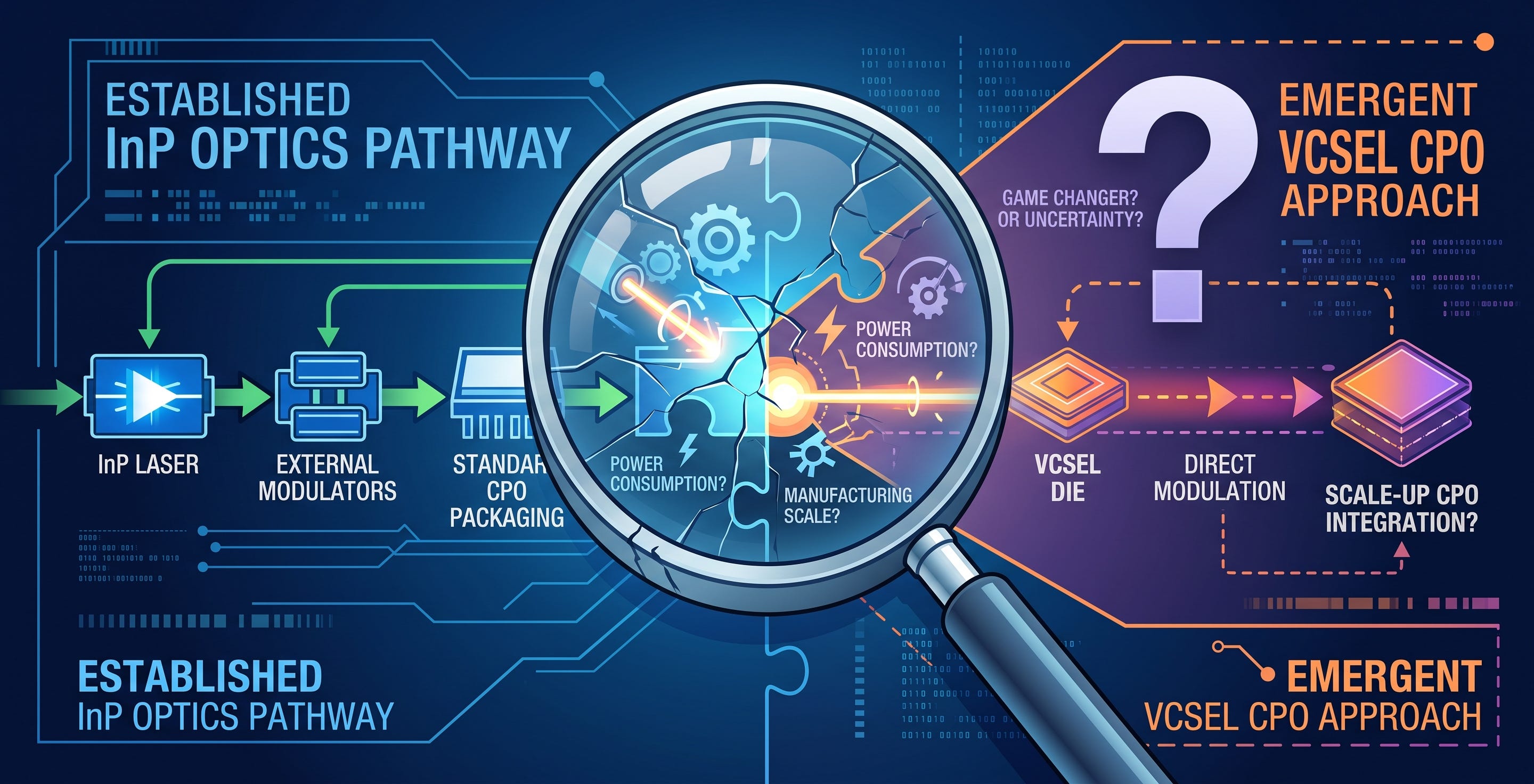
Ashkan Seyedi, who led silicon photonics products at NVIDIA, has moved to ams OSRAM to run its optical interconnect business. ams OSRAM is a company with a long history in VCSELs.
At a moment when InP laser supply is a serious bottleneck, a key figure from the mainstream InP silicon photonics camp has crossed over to a company built on a different light source material, and into an optical interconnect role rather than a sensing one. That is what caught the industry’s attention. One hire alone does not prove that VCSEL CPO is taking off, but it clearly raises the question of whether a settled board might be starting to crack.
So let me put the question directly.
CPO (Co-Packaged Optics) today is being built around InP lasers, but is doing it with VCSELs technically feasible? What limits still stand in the way? And if the scale-up network does shift to VCSELs, what happens to the companies and the investment landscape as they stand now? This piece sets the two light sources side by side and follows those questions.
Contents
The two light sources, compared
VCSELs are already in service as light sources
Does VCSEL CPO make sense?
Will it actually happen? Coexistence, not replacement
Where investment should be heading
Conclusion
Disclaimer
Everything here is personal analysis based on public materials, reporting, analyst research, and industry networks. It draws on no NDA-protected information from any current or former employer. It is not a recommendation to buy or sell any security, and it is not investment advice. The figures and share prices cited reflect public information at the time of writing and may change afterward. All investment decisions and their consequences rest with the investor.
1. The two light sources, compared
The two light sources part ways in how they make light.
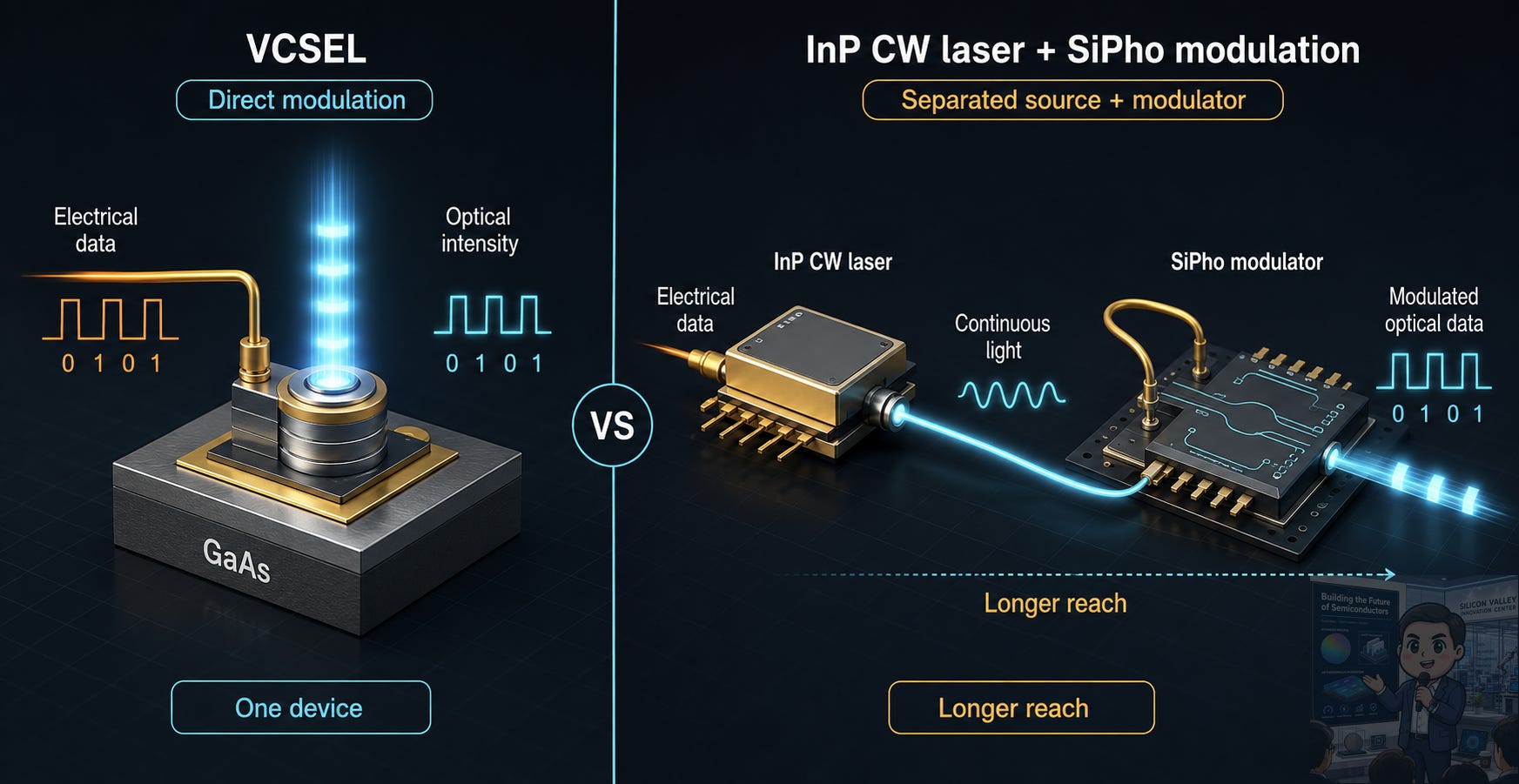
A VCSEL (Vertical-Cavity Surface-Emitting Laser) is a small laser grown on a GaAs (gallium arsenide) substrate.
A single device both generates the light and carries the signal on it. Switch the current running through the laser on and off quickly and the light’s intensity follows, and that flicker itself becomes the ones and zeros of data. No separate light source, no separate device to modulate the light. The parts count stays lean, and that simplicity is what turns into an edge in power and latency.
The other side is a laser grown on an InP (indium phosphide) substrate, and here a distinction matters.
In pluggable transceivers the mainstream is the EML (Externally Modulated Laser), a device that integrates the laser and an electro-absorption (EA) modulator onto a single chip.
In CPO the structure changes.
The InP laser serves only as a light source, emitting light continuously (continuous wave, CW), while the job of modulating data onto it falls to a modulator sitting on a silicon photonics (SiPho) chip. The light source (InP) and the modulator (silicon) are physically separated. So the InP family is integrated as an EML in pluggables and split into an external CW laser plus a SiPho modulator in CPO. Either way there are more parts and more complexity, but that is also what lets it carry signals reliably over longer distances.
Put simply, a VCSEL is a single device doing both the emitting and the modulating, while the InP family divides emitting and modulating across more parts but reaches farther.
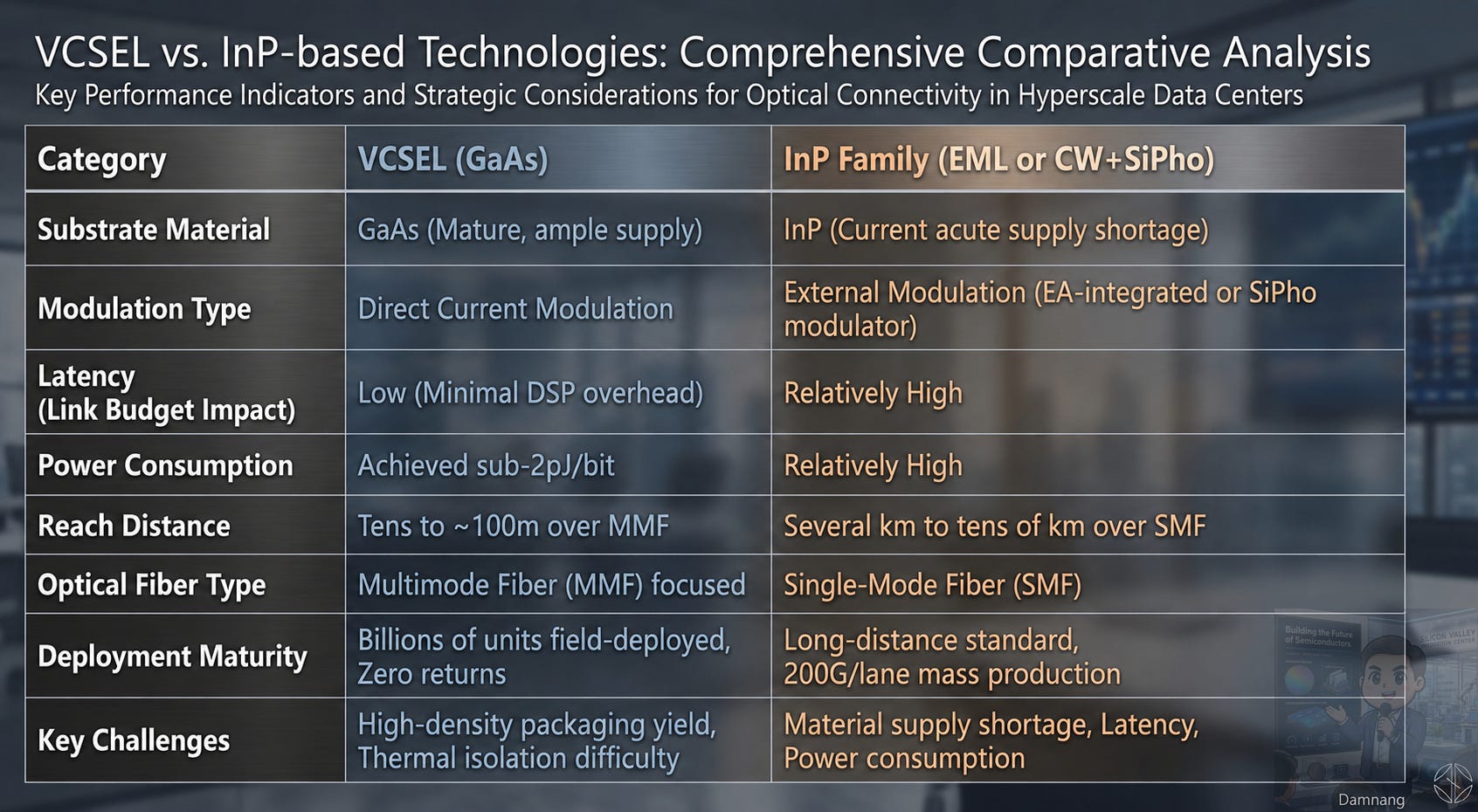
The point is that the two light sources are optimized for different battlefields. The InP family is strong where reach matters, in scale-out and long-haul, while VCSELs are strong at short reach where latency and power are what count.
The War of Light, A Laser Shortage

On March 2, 2026, NVIDIA invested $2B in Coherent and another $2B in Lumentum. Both companies make lasers. The two announcements came on the same day and included “multi-billion dollar purchase commitments” and “future capacity access rights.” Jensen Huang wasn’t just buying lasers. He was locking up the ability to make them.
2. VCSELs are already in service as light sources
VCSELs are not a lab-stage technology. Even now, they are being used as light sources at massive volume.
Start with everyday devices.
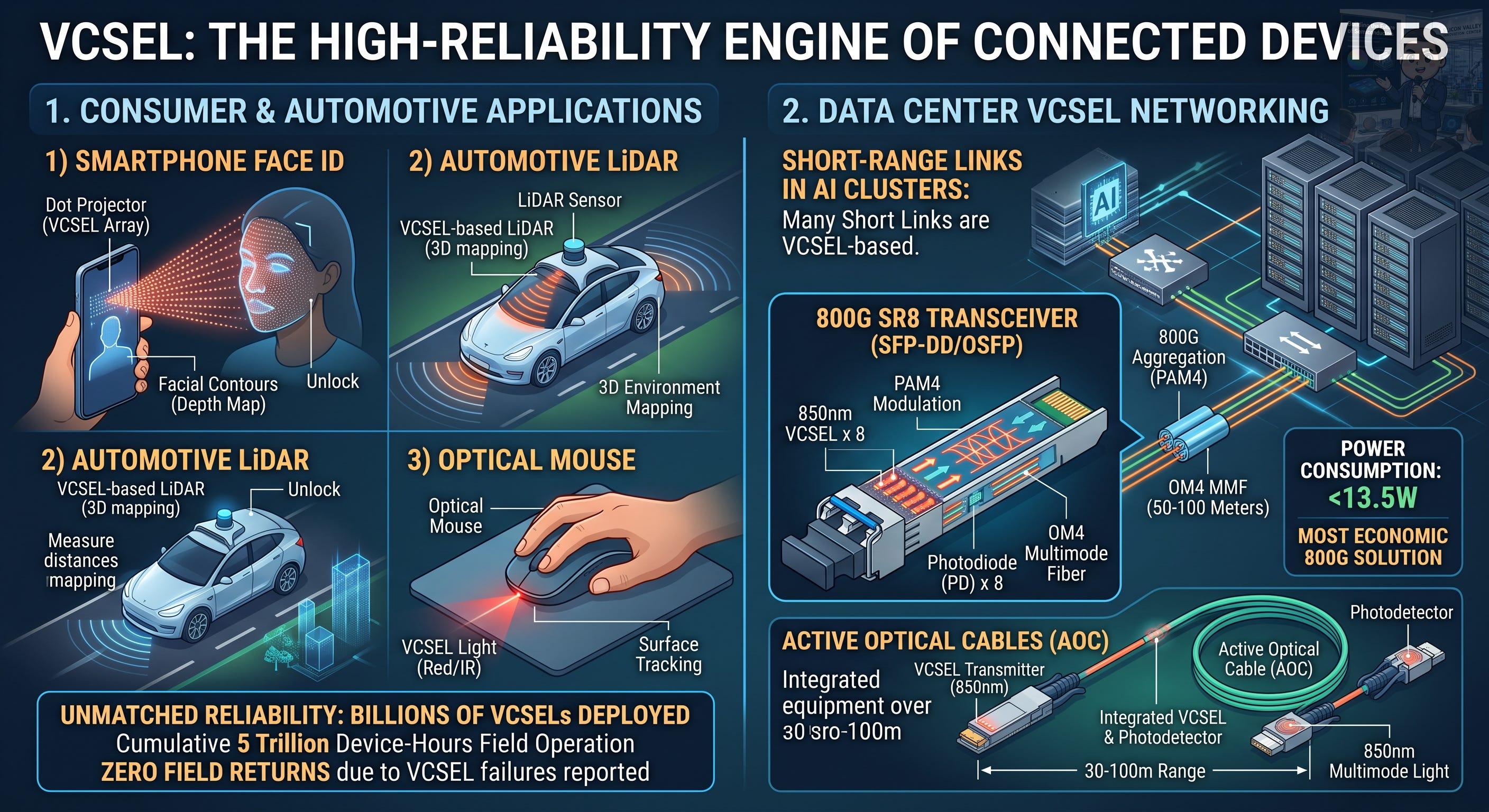
When your phone’s Face ID reads the contours of your face to unlock, that is a VCSEL array projecting infrared structured light. When automotive LiDAR builds a 3D map, a VCSEL-based structure is doing the work. The glowing dot under an optical mouse is usually a VCSEL too. Billions have already shipped into consumer devices, 50G and 100G VCSEL channels have logged more than five trillion device-hours in the field, and there are no reported field returns attributable to VCSEL reliability.
The data center is no different. A large share of the short-reach links in today’s AI clusters are VCSELs. The 800G SR8 transceiver is the classic example. An 850nm VCSEL with PAM4 modulation carries data over 50 to 100 meters of OM4 (Optical Multimode 4, the standard multimode fiber grade) fiber at under 13.5W. It has become the most economical 800G option for connecting servers and switches within a rack and between adjacent racks.
Active optical cables (AOCs) do the same, putting a VCSEL transmitter and a photodetector at each end to span 30 to 100 meters over 850nm multimode light.
The way VCSELs are used today, though, is entirely pluggable, that is, as modules you plug into and pull out of a switch. It is not CPO, where the optical engine is integrated into the same package as the ASIC.
AI data centers are racing from 800G to 1.6T and on to 3.2T, pushing per-lane speed from 100G to 200G, and at this point the old approach of plugging modules into a switch runs into a wall of power and integration density. The very structure of sending a signal down a long electrical trace out to a module and back is inefficient at high speed.
The answer that emerged is to pull the optical engine right up next to the switch silicon, and then into the same package. This is CPO. Whatever the light source, this integration has become an unavoidable direction, and this is where a new question arises.
Is that light source InP-based or VCSEL-based?
The Illusion of CPO [CPO Special Final]
![The Illusion of CPO [CPO Special Final]](https://substackcdn.com/image/fetch/$s_!G3Jr!,w_1300,h_650,c_fill,f_webp,q_auto:good,fl_progressive:steep,g_auto/https%3A%2F%2Fsubstack-post-media.s3.amazonaws.com%2Fpublic%2Fimages%2F38e4d7e9-c2cf-4c1e-9cf0-1052e0c4f9a7_2848x1504.png)
These days, you can’t have a conversation about semiconductors or AI infrastructure without CPO (Co-Packaged Optics) coming up.