

This article is free and open to all, given the relevance of today’s events.
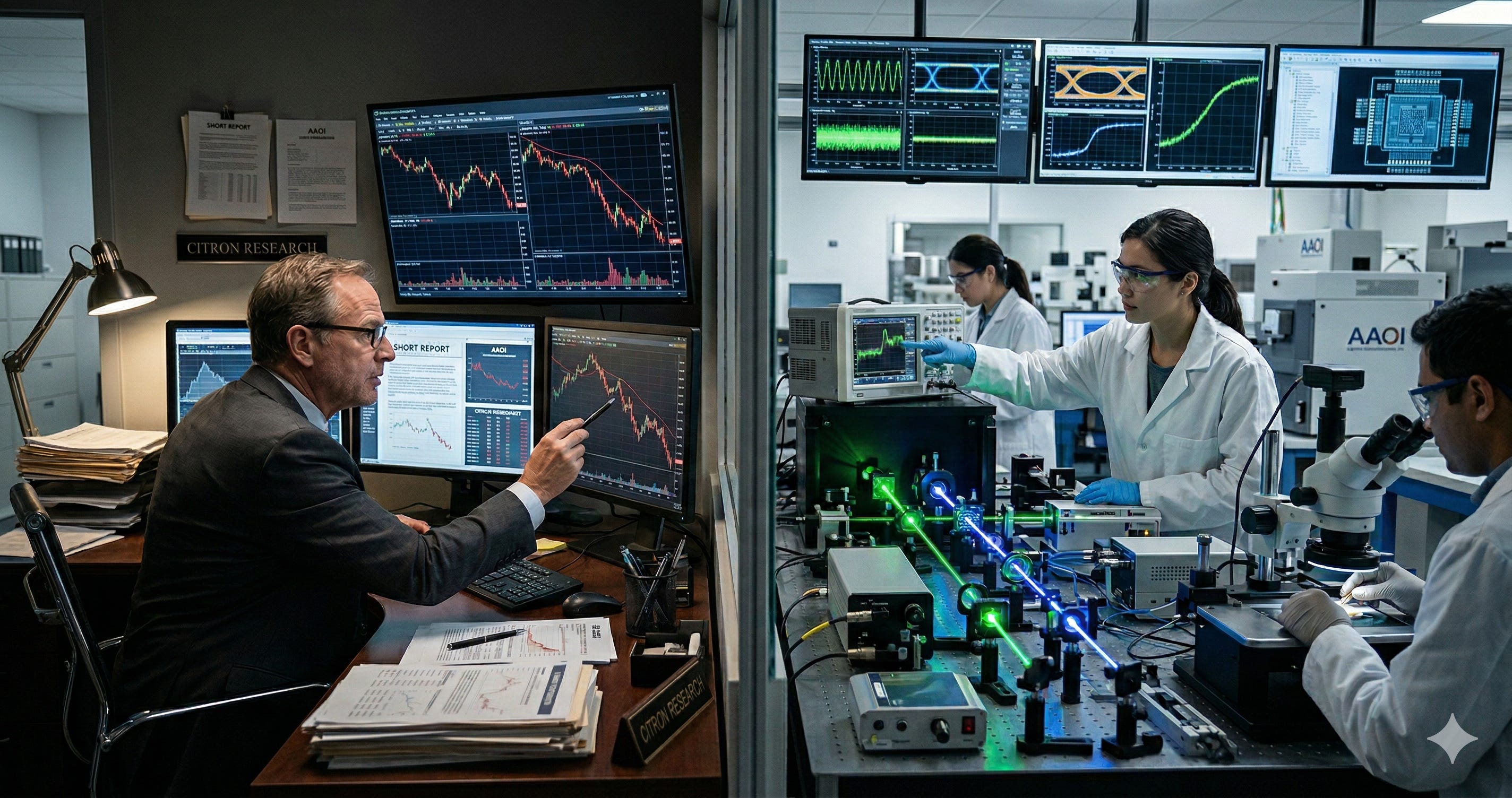
This morning, April 10, Andrew Left of Citron Research posted his short position on AAOI to X.
The stock is “delusional,” the recent rally is overheated, and the whole thing was built on the back of a “random press release.”
This kind of attack plays well in the market.
The numbers hit hard, the sentences are short, and fear spreads fast.
To be fair, I get it up to a point. Looking at a stock that ripped 73% in two weeks and flagging valuation pressure is exactly what a short seller is supposed to do. High forward P/E, a margin profile that hasn’t been fully proven out, customer concentration risk, execution risk. If you line up just those keywords, Citron’s thesis holds together.
The problem is what comes after. This report didn’t stop at a valuation call. It effectively labeled AAOI as a “commodity economics” business. And that’s where it gets thin.
Reading a chart and comparing multiples is one thing. Understanding the technical architecture of an optical components company is something else entirely. Citron’s report looks comfortable with the former, but surprisingly lazy on the latter.
AAOI is not a company that buys off-the-shelf lasers and bolts together modules like boxes on an assembly line. It designs and fabricates its own lasers and optical subassemblies in house. And the optical communications industry right now is moving in a direction that makes those capabilities more valuable, not less.
In LPO, the removal of the DSP raises the quality bar across the entire analog link.
In CPO, the importance of external light sources and package-level optical integration only grows.
Citron barely touched this axis, the one that matters most.
So let me be clear about what this article is not.
It is not an argument that AAOI is cheap.
It is not a claim that the current stock price is automatically justified.
It is not a victory lap dunking on a short seller.
What it is: a case that reducing AAOI to “commodity hardware” in a single word is technically sloppy and fails to reflect where this industry is actually heading.
Citron showed they can read a chart. But at least in this report, they didn’t show they can read a laser. Here’s why that matters, and why framing AAOI as a commodity is a technically hollow interpretation.
1. What Does AAOI Actually Make
The first reason Citron’s analysis falls short is that it treats what AAOI builds with very little depth.

An optical transceiver is a component inside a data center that connects servers to servers and switches to switches. Inside a computer, data moves as electrical signals, but as soon as distance increases even slightly, electrical signals start losing integrity to attenuation and interference. Beyond a certain reach, you need to convert electrical signals into light, send them through fiber, and convert them back to electrical on the other end. The optical transceiver handles that conversion. Think of it as a translator between the electrical world and the optical world.
In the AI era, this component has become far more critical. Training large models requires thousands to tens of thousands of GPUs operating in lockstep, and those GPUs exchange enormous volumes of data continuously throughout the training run. Compute alone doesn’t determine cluster performance. What ultimately sets the ceiling is how fast and how reliably you can move data. The mainstream speed today is 800G, and the next generation is 1.6T. When NVIDIA invested $2 billion in Lumentum, bundled with multi-year purchase commitments and capacity access rights, it was to address exactly this kind of optical component bottleneck. It doesn’t matter how good the GPU is if the optical links connecting them can’t keep up.
AAOI operates in exactly this market, shipping 800G and 1.6T transceivers to hyperscale customers. The company reported roughly $456 million in revenue for 2025 and has indicated it expects to exceed $1 billion in 2026. Whether that number materializes is a separate question. But the market this company is targeting is clearly not legacy module replacement. It is the core interconnect layer of AI data center infrastructure.
2. Why the Laser Is the Core
The most important component inside an optical transceiver is the laser. It is the light source that converts electrical signals into optical signals. How stable the output is, how fast it can be modulated, how well the wavelength and power hold across temperature swings: all of this determines the module’s performance, power consumption, reach, and signal quality. At 800G and above, it is not an exaggeration to say the laser sets the ceiling for the entire module.
The War of Light, A Laser Shortage

On March 2, 2026, NVIDIA invested $2B in Coherent and another $2B in Lumentum. Both companies make lasers. The two announcements came on the same day and included “multi-billion dollar purchase commitments” and “future capacity access rights.” Jensen Huang wasn’t just buying lasers. He was locking up the ability to make them.
Most transceiver companies buy their lasers externally and assemble them into modules. Assembly efficiency and supply chain management are what make them competitive. AAOI is different. The company has been manufacturing its own high-speed telecom-grade lasers in house, including DFB and EML types built on InP (indium phosphide).
But the real point about AAOI isn’t just that it “makes its own lasers.”
It’s that the company reaches all the way back to epitaxy. Epitaxy is the process of growing semiconductor layers atom by atom on a substrate. The thickness, composition, and doping profile of the laser’s active layers are all determined at this stage, and those parameters ultimately govern output power, wavelength stability, modulation characteristics, and device lifetime. A laser is not an assembled product. It is the cumulative result of process engineering. That is why buying the same equipment doesn’t automatically produce the same performance. Yield, cost, and reliability are separated by accumulated process know-how.
AAOI has stated it operates both MBE and MOCVD systems, which is uncommon. MBE offers higher precision but is slow and expensive. MOCVD is better for throughput but demands careful process control. The point is not which method is superior. The point is that running both and accumulating real production recipes across them is itself a barrier to entry. This is a fundamentally different kind of asset than what a pure module assembler brings to the table.
That is the first reason AAOI is difficult to classify as a commodity player. The company’s differentiation comes from its ability to control light source quality and yield internally. And that difference is about to matter even more.
The reason is LPO.
3. Why Analog Quality Matters More in LPO (Linear Pluggable Optics)
A traditional optical transceiver includes a DSP. High-speed electrical signals get distorted, pick up noise, and lose timing alignment during transmission. The DSP digitally corrects all of that before driving the laser, and the same correction happens in reverse on the receive side. In other words, the legacy architecture gives you a safety net: even if something in the optical link degrades slightly, the DSP absorbs much of it.
The problem is that the DSP burns a lot of power. In an 800G transceiver, DSP power consumption can represent a large share of the total module power. For a single transceiver, the difference might seem small. But inside an AI cluster, you’re deploying thousands, sometimes tens of thousands simultaneously. At that scale, a few watts per transceiver adds up to tens or even hundreds of kilowatts across the data center. For hyperscalers, transceiver power isn’t just an electricity bill issue. It’s a rack density and cooling capacity problem.
LPO removes the DSP.
Instead, it relies on analog circuitry like linear drivers and TIAs to carry the signal. With less digital correction, power drops and processing latency shrinks. Industry estimates for power savings range from roughly 20% to 50%, depending on the implementation. But the number itself isn’t the key takeaway. What matters is the structural shift.
Once the DSP is gone, you need to produce a signal clean enough that it doesn’t need correction in the first place.
And this isn’t just about the laser. The quality requirements go up across the entire analog link: the laser, the driver, the TIA, the host SerDes, the optical engine, and the packaging. Laser RIN, linearity, temperature drift, driver waveform quality, TIA noise characteristics, channel loss management. All of it becomes simultaneously more critical. LPO is not a stripped-down product built to be cheap. It is an architecture that trades away the digital safety net in exchange for demanding a higher standard from the entire analog front end.
This is where AAOI's vertical integration earns its weight. A company buying lasers externally has to design its module around whatever optical characteristics the supplier delivers. AAOI, because it controls the laser and the upstream process internally, has more room to co-optimize the light source with the rest of the analog chain. Of course, this alone does not confirm AAOI has the upper hand. Chinese players are shipping LPO products quickly. But the direction is clear: as reliance on digital correction decreases, the value of co-optimizing the light source and the analog link increases. And that direction runs head-on into Citron's commodity framing.
4. Even If CPO (Co-Packaged Optics) Arrives, the Laser Doesn’t Lose Its Value
The broad direction of optical interconnects is moving from pluggable to NPO and then toward CPO. As speeds increase, the electrical path from the switch ASIC to the pluggable module carries a growing burden of signal loss and interference. Naturally, the push to bring optics closer to the package is accelerating. CPO, ELSFP, and OBO came up repeatedly at OFC 2026 for exactly this reason.
![Why CPO Is Becoming Inevitable? [CPO Special Part 1]](https://substackcdn.com/image/fetch/$s_!9bf7!,w_1300,h_650,c_fill,f_webp,q_auto:good,fl_progressive:steep,g_auto/https%3A%2F%2Fsubstack-post-media.s3.amazonaws.com%2Fpublic%2Fimages%2F30766732-0379-47eb-bc82-ff73fa8b10d1_900x491.jpeg)
But moving toward CPO does not diminish the value of a laser company. If anything, the opposite is true. Module housing and some assembly content may shrink, but the importance of external lasers, PICs, fiber attach, thermal management, and serviceability only increases. Silicon photonics is strong at integrating optical circuits, but silicon itself cannot produce an efficient laser. So even in SiPh-based architectures, an external light source is still required, and InP-based lasers retain their value.
This is why AAOI’s OFC 2026 demos matter. The company showed a 25 dBm, roughly 400 mW ELSFP and a 6.4T OBO, positioning them as the foundation for high-power light sources and high-density optical connectivity in next-generation AI infrastructure. The emphasis on hot-swappable design and serviceability follows the same logic. In a system where tens of thousands of GPUs are interconnected, a single external laser failure is not just a component swap. It becomes a system-level operational issue.
This does not mean AAOI has already won in CPO. It is still early stage, and strong competitors including Lumentum and Coherent are in the mix. But the reality the industry faces right now is that InP laser supply itself is the bottleneck. Coherent ramping a 6-inch InP wafer platform and Lumentum acquiring Cloud Light to re-enter datacom are both responses to this same laser shortage.
In a market where lasers are abundant, the value of owning your own fab is limited. But in a market where lasers are scarce, a company that can manufacture from epitaxy up is structurally difficult to dislodge. As the industry moves further toward CPO, the value of the laser and light engine capabilities AAOI has built only goes up. Citron’s short report contained not a single line of analysis on this technology trajectory.
5. Why the “One Innolight Price Cut and It’s Over” Argument Is Weak
Now let’s translate the technical picture into business logic.
The most problematic claim in Citron’s report is the framing that AAOI is ultimately a commodity hardware company whose margin structure would collapse with a single price cut from someone like Innolight. For that argument to hold, AAOI and Innolight would have to be competing in exactly the same market, with exactly the same product, under exactly the same conditions.
The real market is not that simple.
First, there is qualification and switching cost.
When a hyperscaler deploys a specific transceiver into its network, it doesn’t end with plugging a box into a slot. The validation process spans switch firmware, SerDes behavior, thermal profiles, and network stack compatibility. Swapping out a qualified vendor over a few percentage points on price carries real operational risk. In AI infrastructure especially, time itself is a competitive asset. If qualifying a new vendor takes a few extra months, that’s a few extra months before a cluster expansion goes live.
Second, the cost structures are different.
AAOI can manage the cost of the single most important BOM item, the laser, internally. The company has laid out a long-term gross margin target of 35% to 40%, underpinned by the internalization of the laser and key optical components. Whether that target is fully achieved remains to be seen. But treating AAOI with the same economics as a pure module assembler sourcing its light source externally is too simplistic.
Third, customer segmentation and product positioning aren’t identical either.
Microsoft was AAOI’s largest data center customer in 2025, and Oracle appeared in filings as a 12.4% revenue contributor in 2024. In other words, this is not a company that can be reduced to a single Oracle thesis, as Citron’s framing implies. Meanwhile, the NVIDIA merchant ecosystem operates under a different supply and competitive dynamic altogether. The point is that this market is not simply a race to the lowest price. It is a market where qualification structures and supply relationships are tangled differently across each customer.
To sum it up:
I’m not saying Innolight’s pricing has zero impact on AAOI. Price competition is a permanent feature of the optical module market. But the frame of “one price cut and it’s over” barely accounts for in-house light source economics, qualification friction, and the structural differences in how each customer’s supply chain works.
6. There Are Risks Where Citron Is Right
Customer concentration risk is real. AAOI’s largest data center customer in 2025 was Microsoft, accounting for 28.8% of revenue. When a single large customer’s ordering pattern shifts, earnings volatility follows. The company itself flags this risk in its filings. Citron is right on this one.
The financial concerns around Oracle aren’t conjured from nothing either. As of February 28, 2026, Oracle’s senior notes and other long-term borrowings stood at roughly $130.9 billion, while cash and cash equivalents were about $38.5 billion and marketable securities roughly $677 million. On the other side, remaining performance obligations were approximately $552.6 billion. If Citron isolates only the debt numbers to manufacture fear, the picture tilts one way. If someone else waves only the RPO to claim everything is fine, that’s also an overstatement. The balance sheet has clearly gotten more aggressive, but the backlog and long-term contract base have grown alongside it.
And one more. The reports Citron referenced about adjustments to the Texas Abilene expansion are real. But there is a difference between some projects being adjusted and Oracle’s broader AI buildout thesis collapsing. Citron used the former to imply the latter, without presenting direct evidence that Oracle is structurally pulling back on AI capex.
The Amazon angle also deserves careful framing. AAOI has entered into a transaction agreement and warrant structure that reflects a commercial relationship with Amazon. The remaining warrant vesting is tied to whether discretionary purchases by Amazon and its affiliates reach a cumulative $4 billion. This is a strategically significant arrangement, but it is not the same thing as a confirmed $4 billion backlog. Even if you’re writing the bullish narrative, the language needs to be precise.
So yes, Citron’s short position is understandable.
High valuation, execution risk, customer concentration, short-term overheating. All four are real risks.
What I’m pushing back on is not the existence of those risks. It’s the interpretive leap from those risks to the conclusion that AAOI is just another commodity optical module company.
Conclusion
There are things Citron may be right about. Two weeks of rally could be short-term overheating. A high valuation may not adequately price in execution risk. Customer concentration is a real vulnerability. The short position itself is understandable.
But what Citron missed on the technical side is also clear. Classifying AAOI as a commodity. Failing to recognize that LPO is a structure that raises the quality bar across the entire analog link. Putting companies that own their laser and epitaxy in the same frame as those that don’t. And assuming the CPO transition automatically erases the value of the laser. On the public record alone, there is a 1.6T volume order exceeding $200 million and $124 million in 800G orders.
Whether a report that calls all of this a “random press release” was written with any understanding of the technology is something each reader can judge for themselves.
The core of this debate comes down to this. AAOI is not a risk-free company. It might look expensive. But that does not make it a commodity optical module company. Reading a chart and reading the technology are two different skills. Both are necessary for investing.
Citron showed today that they can read a chart.
They did not show they can read a laser.
This article is not investment advice. The author does not hold a position in AAOI. All investment decisions should be made at your own discretion and risk.
Andrew Left went to jail for a bit, didn’t he? They are classic short and distort
nothing like a short report to present nice buying moments :)