

Disclaimer
This material is general research opinion based on public information and is not investment advice tailored to any individual. Future contracts, capacity targets, ARR and secured power are conditional figures, and actual outcomes may differ depending on financing, permitting, utility schedules, supply chains, customer acceptance and demand.
A neocloud, put simply, is a company that rents out GPUs for AI.
AI companies need large scale compute to build models, but securing the latest GPUs and building data centers takes enormous capital and time. Neoclouds build the power, the data center, the NVIDIA GPUs, the high speed network and the operating software first, then rent that stack to customers. Instead of building their own AI factory, customers buy compute capacity that is ready to use.
The reason to look at this industry now is that neoclouds are growing from a stopgap for temporary GPU shortages into an independent supply layer of AI infrastructure.
On its FY27 second quarter call, NVIDIA projected that installed capacity at its neocloud partners would grow from roughly 3 GW at the end of 2025 to 8 GW at the end of 2026. Beyond AI startups and enterprises, hyperscalers that operate their own data centers are also using AI clouds to supplement capacity they lack.
This layer may also persist after GPU supply normalizes. GPU generations turn over quickly, but grid connections, substations, cooling and data center sites can be reused by the next generation of equipment. Even when customers change, a standardized NVIDIA cluster can be redeployed to other AI workloads.
The core asset a neocloud holds is therefore not one generation of GPUs but the power and the operating capability to keep taking in new GPUs and running them.
This article is a technology and investment guide for anyone considering the three listed neocloud names, CoreWeave, Nebius and IREN.
The three sit in the same industry, but how they make money and what risks they carry are different.
How much of the power and data center they own directly, what kind of capital they use to secure GPUs, and whether the numbers they announce are still secured megawatts or capacity that has already passed customer acceptance all change the investment call.
The article first explains what a neocloud is and what a megawatt means, then compares the technical strengths, economics, capital structure and execution risk of the three companies, and finally sets out how to approach each name at current prices.
A neocloud rents out AI compute, not just GPUs
What the customer buys is not the GPU itself but an AI computing environment that is ready to use. A neocloud bundles power, the data center, thousands of NVIDIA GPUs, a high speed network and operating software, and rents that bundle out.
Capability is not determined by GPU count alone.
Thousands of GPUs have to behave as a single computer. If the network congests, if cooling wavers, or if the software that splits the work stalls, even expensive GPUs fail to earn properly. What matters is less how many GPUs a company holds than how reliably and how quickly it finishes customer jobs.
Where general clouds such as AWS, Azure and Google Cloud sell storage, databases and business software as well, neoclouds concentrate on AI compute. They can install the latest GPUs faster, but capital intensity is high and dependence on a small number of large customers is easy to fall into.
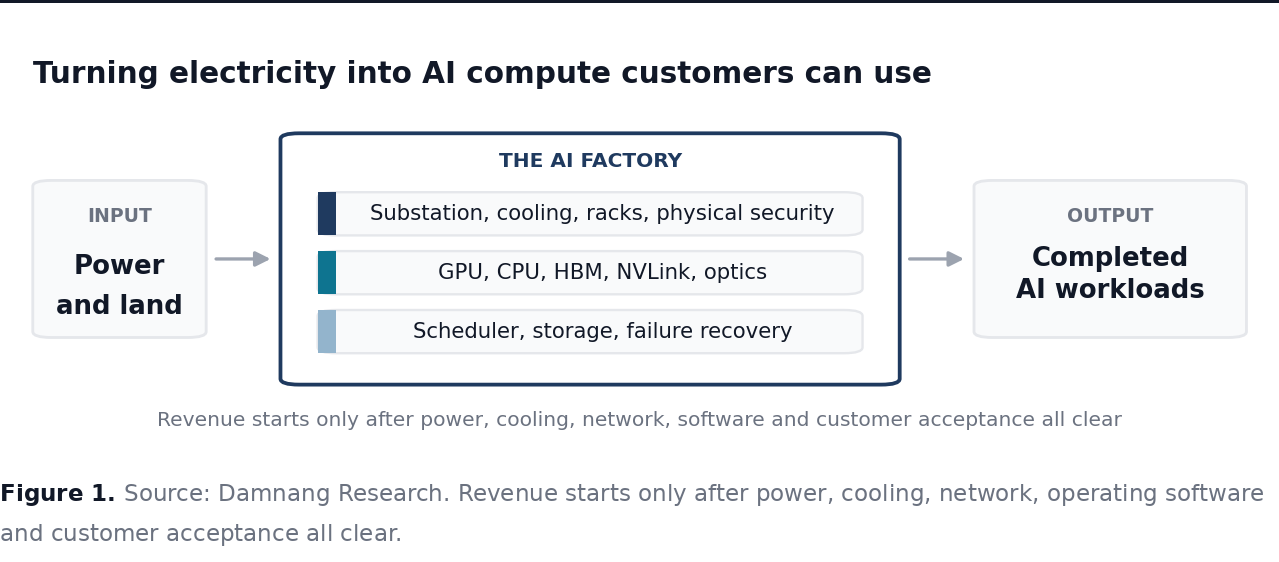
A megawatt is the size of the power a data center can draw
MW (a megawatt) is the amount of power a data center can use at a point in time. One MW is one million watts. Used continuously for a year, that consumes 8,760 MWh. GPU models keep changing, but grid connections and cooling capacity do not expand easily. That is why neoclouds describe the scale of their business in megawatts.
The same megawatt figure can be measured on different bases.
Facility MW is the power the whole site draws, while IT MW is the power that actually reaches GPUs, CPUs, storage and the network. Cooling and power conversion take the rest, which creates the gap.
Note that if a company does not state which basis it used, two companies cannot be placed side by side. In other words, what matters is less the megawatt figure itself than the basis and the method used to compare.
MW 101
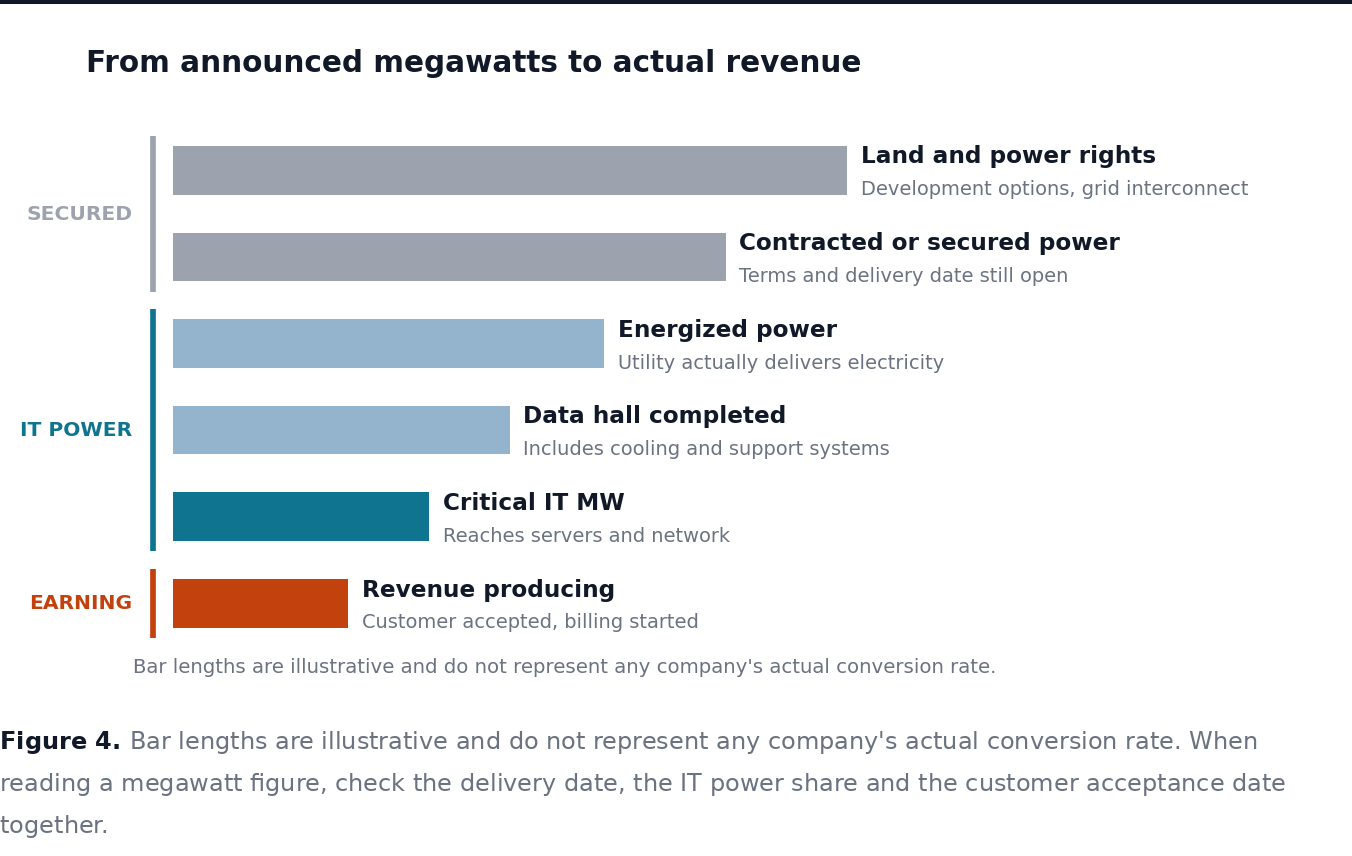
Moving from secured power to a completed data center, to IT power delivered to servers, to capacity that has passed customer acceptance, the megawatts that can actually be used shrink at every step. What remains then meets a contract and becomes operating ARR, and passes through utilization and costs to become shareholder cash flow. The further along the chain, the smaller the number but the higher the certainty that it turns into revenue.
CoreWeave leads on installation and bring-up speed and on large scale production operating experience.
Nebius aims to raise revenue per MW by selling software alongside compute.
IREN controls its own power and land, but still has to complete facilities on schedule and pass customer acceptance.
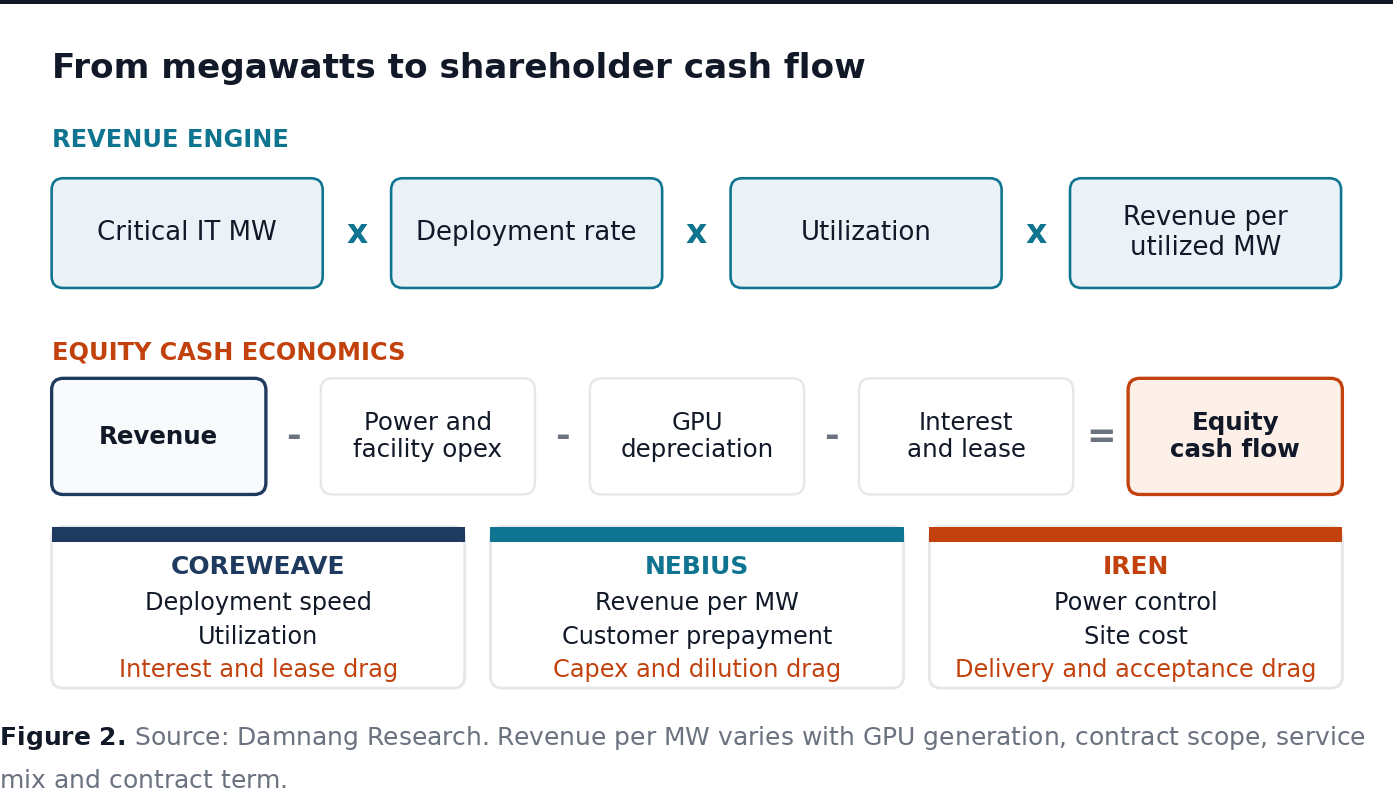
Secured megawatts and earning megawatts are not the same thing
The megawatt figures companies announce are best read in three stages. The first is power secured so that it can be developed at some point. The second is IT power that will actually be delivered to the data center and the GPUs. The third is operating power that has passed customer acceptance and started earning. The earlier the stage, the larger the number and the greater the uncertainty.
The megawatts the three companies announce also point to different stages.
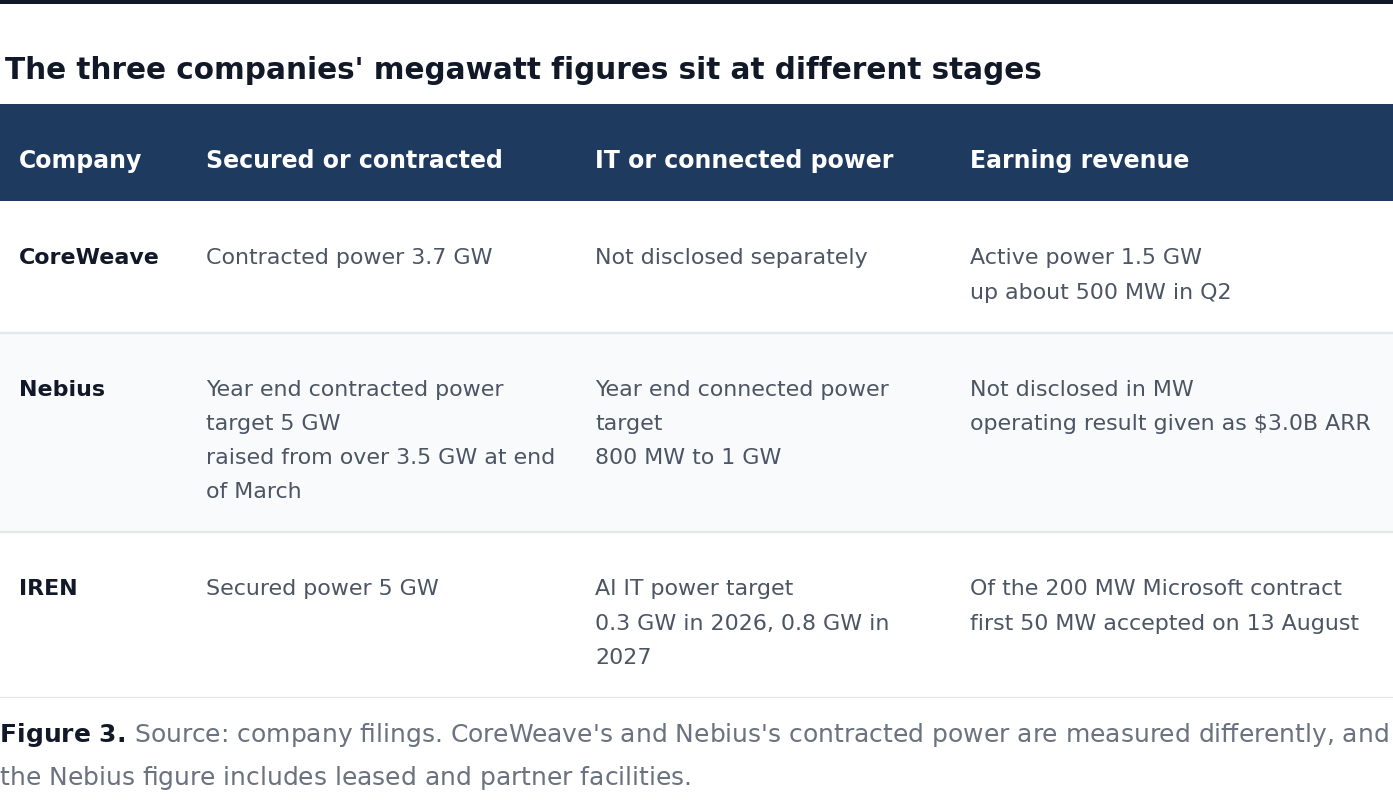
Placing the three companies’ megawatts on one line therefore risks a wrong read of how far each business has actually progressed.
When secured power actually arrives differs by site and by utility contract. Rather than relying on a target year, three things are worth checking.
First, when the utility contract was signed and what delivery start date it specifies.
Second, whether the site is already receiving electricity or is still building its substation.
Third, whether the quarterly increase in active power a company reports is running at a pace consistent with the target schedule.
Dividing the quarterly increment by the remaining period, as with CoreWeave adding roughly 500 MW in a single quarter, gives a rough sense of whether the target is achievable.
What NVIDIA has actually committed to the neoclouds
As described above, a neocloud has to commit large capital to power, buildings, cooling and GPUs before any revenue starts. Several years pass between securing power and customer acceptance, and during that period there is no revenue while interest and depreciation accrue.
NVIDIA intervenes in that window in three ways. It buys compute capacity from the neoclouds directly, it connects financial institutions to widen funding channels, and it attaches guarantees to some projects. The structure is one where NVIDIA buys back services run on the very GPUs it sold. For the operator, a minimum level of demand exists even during the construction period with no revenue, and that contract supports borrowing at a lower rate.
The market has taken this as a sign that the funding problem for neoclouds has been solved.
It is therefore worth checking, against the filings, how much NVIDIA actually guaranteed, to whom, and on what terms.
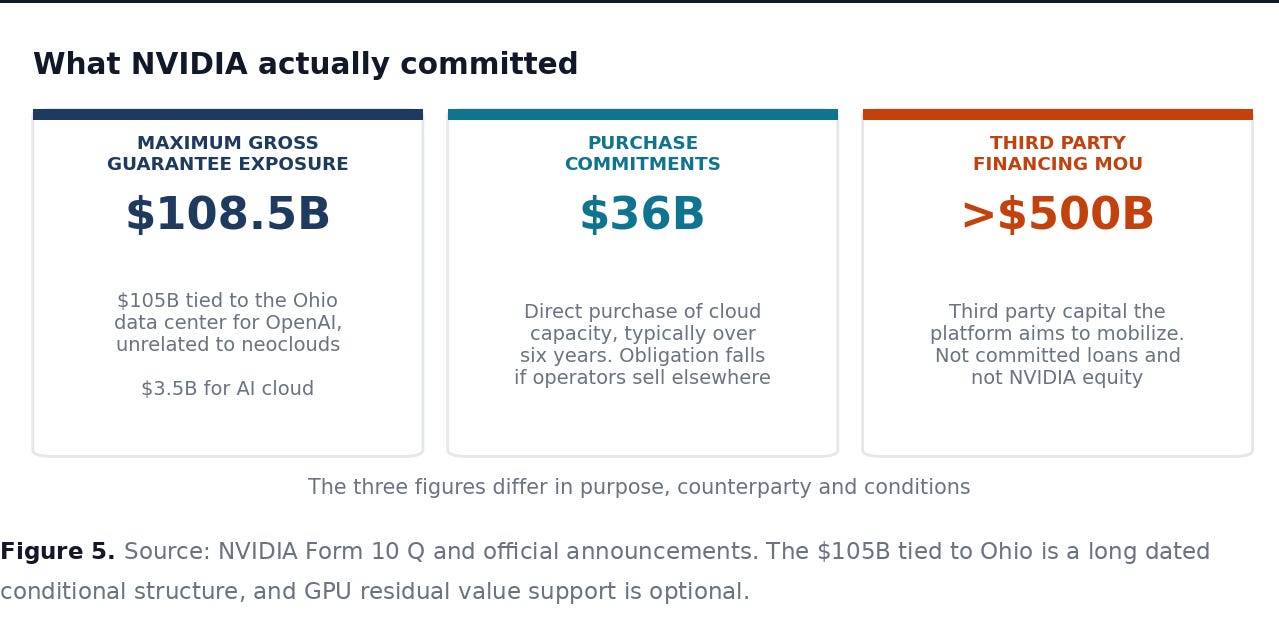
In the 10 Q filed on 26 August, NVIDIA’s maximum guarantee exposure was $108.5B.
Of that, $105B relates to the roughly 4.25 GW project SB Energy is developing in Ohio, connected to an OpenAI affiliate, and is unrelated to the neoclouds. AI cloud related guarantees total $3.5B.
That figure, however, is disclosed as an aggregate guarantee for select AI cloud partners, and public disclosure alone does not establish that it is allocated to CoreWeave, Nebius and IREN.
Separately from guarantees, NVIDIA agreed to buy cloud capacity from these operators directly. The commitment totals $36B, typically over six years. Where a guarantee is a ceiling against default, this is a capacity purchase commitment that converts into revenue when the conditions are met. That said, if operators sell that capacity to other customers, NVIDIA’s purchase obligation falls accordingly, so the full $36B is not fixed revenue.
The third form of support is the funding channel. On 10 August, NVIDIA announced a compute financing platform with Apollo, BlackRock, Blackstone, Brookfield, Goldman Sachs and KKR aimed at mobilizing over $500B. The structure supplies capital against AI infrastructure as collateral, and the market read it as a sign that the neocloud funding constraint was easing.
It is, however, a memorandum of understanding with large financial institutions rather than committed capital, and individual projects still have to be underwritten separately. NVIDIA may support the residual value of some GPUs, but there is no disclosure guaranteeing the price of all equipment.
Even with NVIDIA’s help, power and bring-up remain each company’s own work
The risk NVIDIA has removed is concentrated in funding and early demand. Bringing power in, completing the data center, stabilizing the GPUs and passing customer acceptance all remain with the operator. This is where results diverge even when the three companies buy the same NVIDIA equipment and receive the same support.
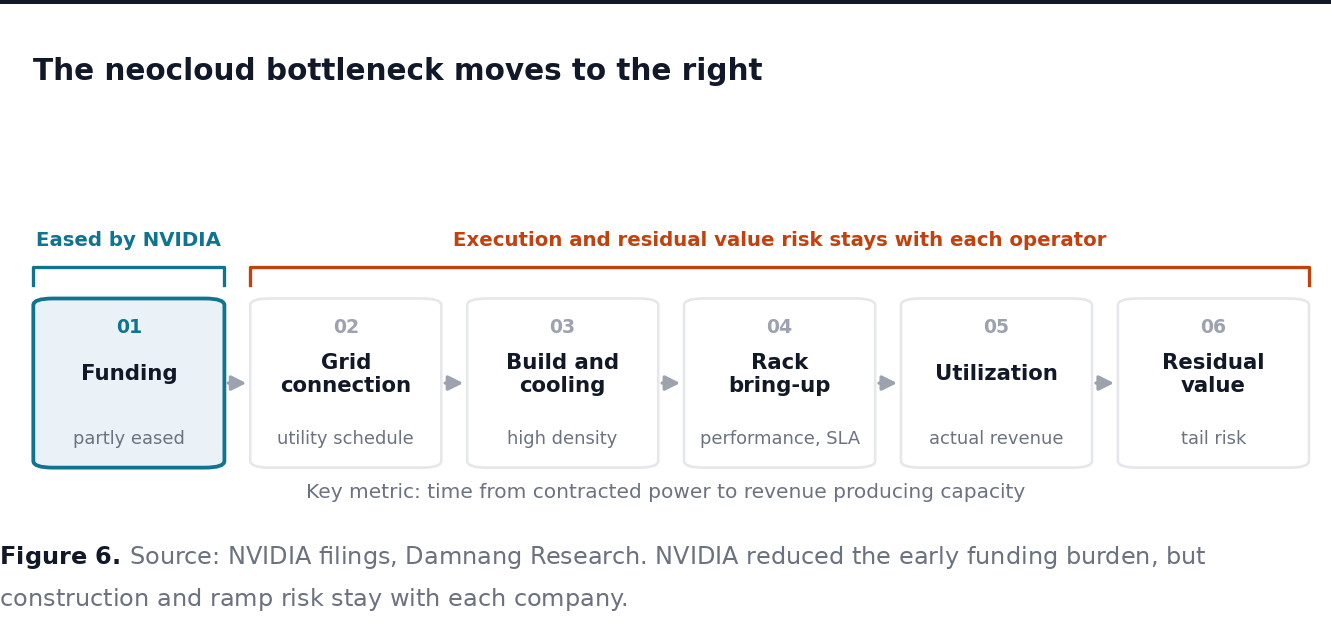
The first source of that remaining risk is equipment delivery. NVIDIA stated in its most recent 10 Q that Rubin and Blackwell supply is constrained and that the complexity of data center systems can cause production delays and lower yields. Even with funding secured, racks arriving late push the schedule back by the same amount.
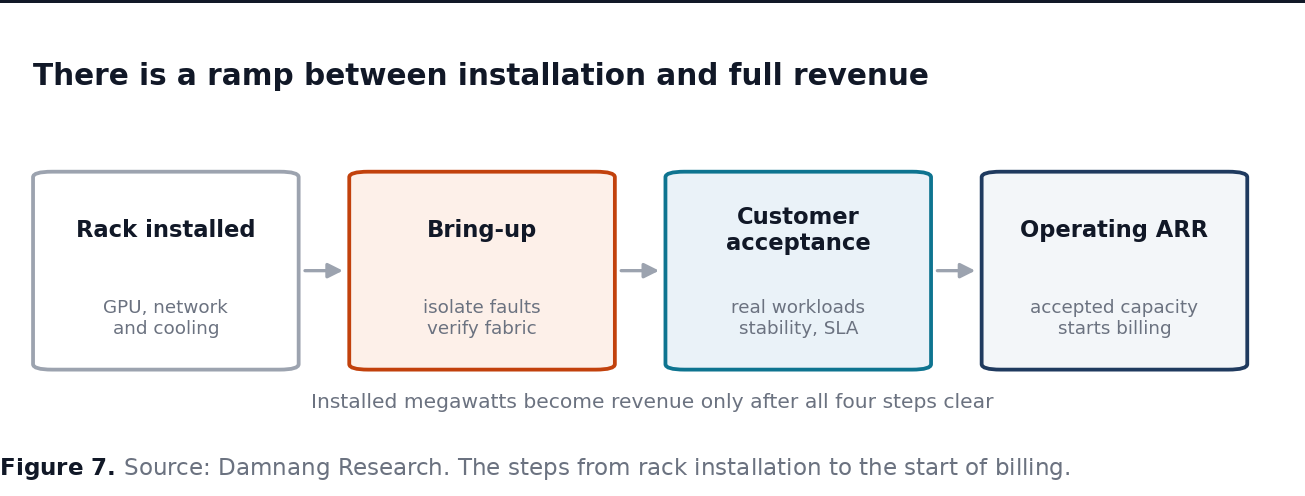
Revenue does not begin the moment the racks arrive either. A new generation cluster has to stabilize power and cooling, isolate faulty nodes, and verify network and storage before customer workloads confirm performance and stability. During this bring-up period a gap opens between installed MW and the MW a customer can actually use, and the revenue start date slips by that gap.
Bring-up time differs by company and shrinks from batch to batch within the same company, because the failure modes and inspection procedures found in the first cluster can be reused in the second and third. That repeated experience is what separates how fast secured power turns into revenue.
So where do the three neoclouds stand now, and what should be watched most closely?
That covers the basics of what a neocloud is.
Below, the same standards are applied to the three companies. The article then sets out why CoreWeave’s RPO, Nebius’s ARR and IREN’s contracted ARR cannot be compared on the same yardstick, breaks down what survives beyond a single GPU generation across five axes, and closes with a detailed investment view and approach for each name.