

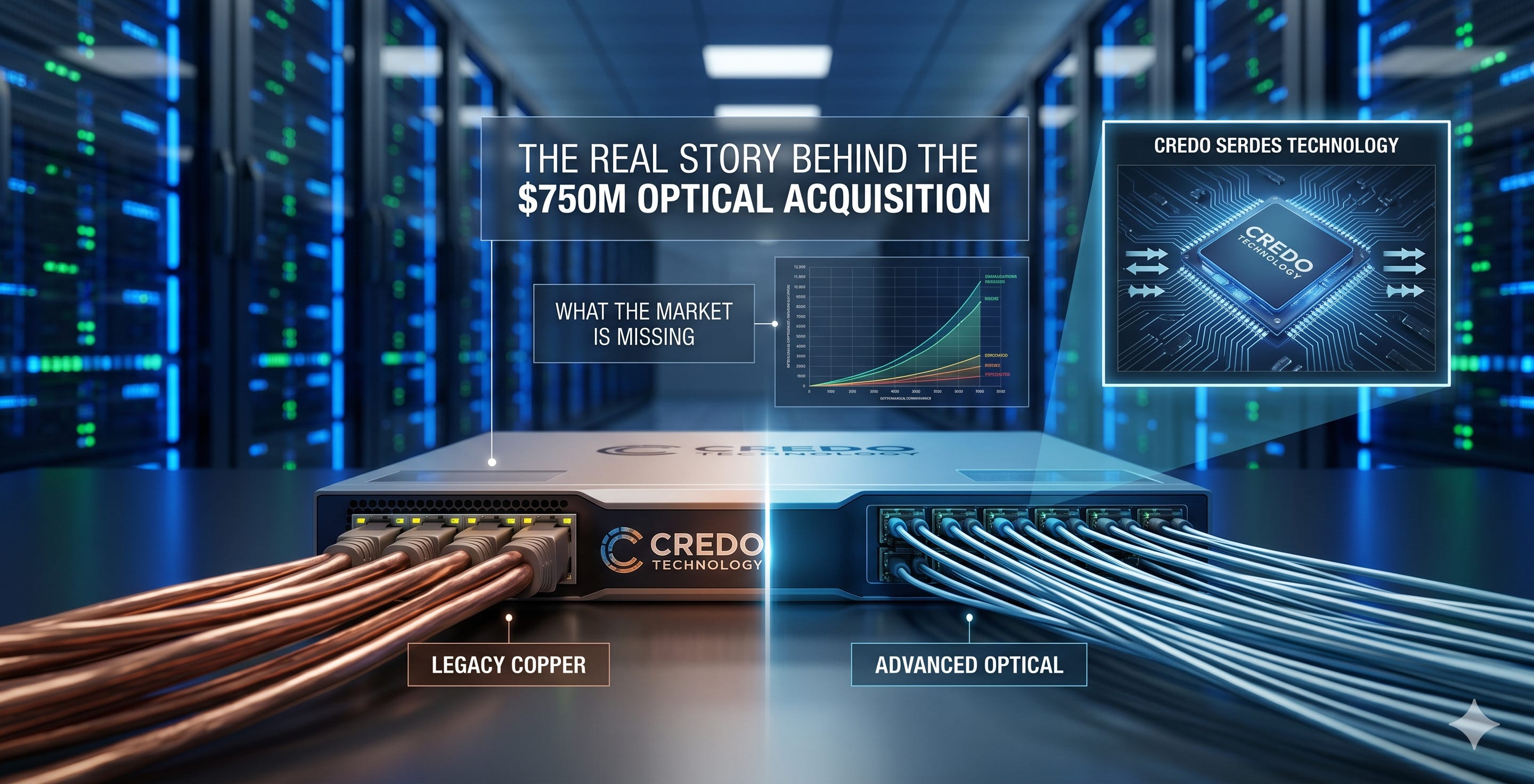
Credo Technology (CRDO) keeps setting new revenue records every quarter. In FY26 Q3, the company posted $407M in revenue, up 201% year over year. The stock once ran as high as $213, cratered to the $80s, and has since bounced back to around $157. Throughout all of this, the market’s read on the company kept shifting. For a while, Credo was just a copper cable company. After the DustPhotonics acquisition, the narrative started to change, with investors beginning to see it as an optical expansion story.
But if you look at this acquisition as simply “they bought an optical company,” you are going to miss what actually matters about Credo. The important thing is not that Credo is moving into optical. The real question is: what has this company always been good at, what kind of technical moat has it built its business on, and what does the DustPhotonics deal actually mean within that structure? You need to see how Credo’s existing technology and DustPhotonics’ assets fit together, and why that combination creates a picture that looks fundamentally different from its competitors. Only then does the weight of this deal become clear.
In this article, I will start by laying out what Credo’s technical moat actually is. From there, I will explain why the DustPhotonics acquisition matters, what bigger picture Credo is building toward, and how the company’s structural strengths compare to competitors like Astera Labs and Marvell.
Table of Contents
Credo’s Technical Moat: Everything Starts with SerDes
The Stock Crash, and the Rebound
The Bigger Picture Behind the DustPhotonics Acquisition
Who Else Is Playing This Same Game?
How I See Credo
This article does not recommend buying or selling any specific stock and does not constitute investment advice. All investment decisions and their outcomes are the sole responsibility of the investor. Figures and projections cited are based on publicly available information as of April 14, 2026.
1. Credo’s Technical Moat: Everything Starts with SerDes
The first thing to understand about Credo is not what products they sell. What matters more is where this company repeatedly generates competitive advantage.
In Credo’s case, the starting point is clear: SerDes IP.
SerDes: Where Every Connection Begins
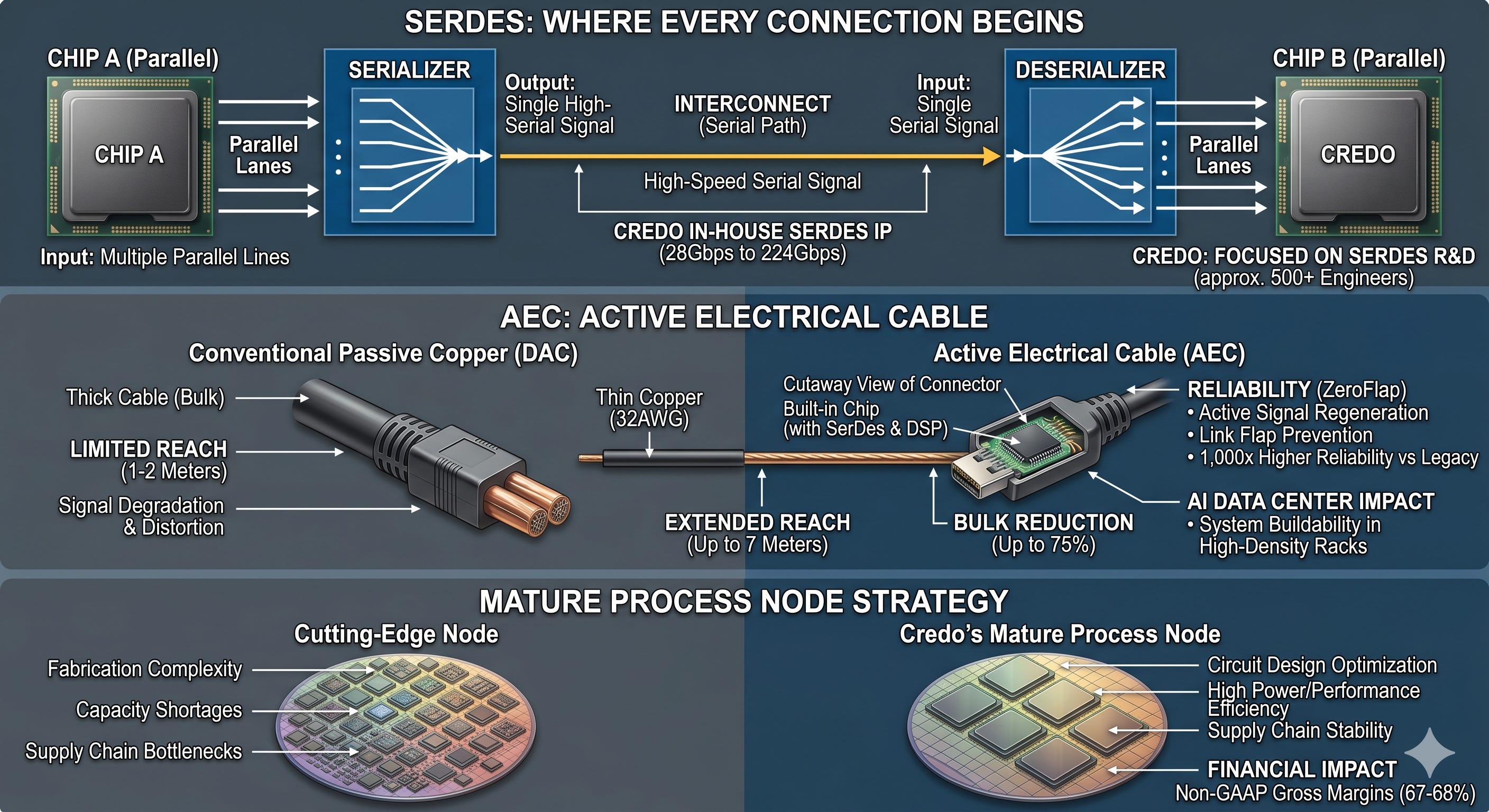
Inside a data center, data is constantly moving. GPU to GPU, server to switch, rack to rack. Inside the chip, data travels simultaneously across dozens or hundreds of parallel lines. But the moment it needs to leave the chip, you run into problems. Routing hundreds of lines out of a chip makes the cables too thick, and electrical interference between the lines becomes severe.
The solution is to combine multiple parallel signals into a single high-speed serial signal (Serialize), send it, and then unpack it on the receiving end (Deserialize).
The circuit block that handles this conversion is the SerDes (Serializer/Deserializer). Everywhere a “connection” exists inside a data center, SerDes is involved.
Credo designs its own SerDes IP in-house across every generation, from 28Gbps all the way up to 224Gbps. Other large semiconductor companies have their own SerDes too, but for those companies, SerDes is just one component among dozens of product lines. For Credo, SerDes is the entire reason the company exists. Out of 622 total employees, roughly 500+ are engineers, and that R&D firepower is focused squarely on SerDes.
AEC: The Market Credo Created
The first product Credo built on top of this SerDes IP was the AEC (Active Electrical Cable).
The most basic way to connect servers and switches inside a data center is copper cabling. As speeds moved to 800G and beyond, conventional “passive” copper cables started falling apart. Signals degrade and distort over distance. You can make the cable thicker to compensate, but then it gets as thick as a finger, and you are limited to 1 to 2 meters of reach.
Credo solved this problem in a completely different way. They put a small chip inside the connector at each end of the cable. That chip contains Credo’s SerDes and a DSP (Digital Signal Processor, a processor that mathematically restores distorted signals). Because the chip regenerates the signal mid-path, you can use thin copper wire (32AWG) and still transmit up to 7 meters, while cutting cable bulk by up to 75% compared to DAC.
That is the AEC, or “active electrical cable.” Credo created this product category, and they still dominate it.
In an AI data center, cutting cable volume by 75% is not a nice-to-have. In 120kW and 200kW racks where liquid cooling pipes and cables compete for the same physical space, this is the difference between being able to build the system or not.
But the real strength of AEC is not the size reduction. It is reliability.
Credo calls this “ZeroFlap.” A link flap is a momentary connection drop caused by signal instability. In an AI fabric with tens of thousands of GPUs and link counts in the hundred-thousand range, even a single unstable link can wreck an entire training run. Millions of dollars in training costs gone in an instant. Credo claims its ZeroFlap solution delivers up to 1,000x higher reliability compared to legacy interconnect solutions, and real deployment data from hyperscaler customers backs that up.
Mature Process Node Strategy: Why Credo’s Margins Are High
Another key technical advantage is Credo’s manufacturing strategy. The company deliberately fabricates its chips on mature process nodes rather than cutting-edge ones. With the AI boom creating chronic capacity shortages at leading-edge fabs, Credo is relatively free from supply chain bottlenecks.
This works because the SerDes design capability itself is strong enough. When you can squeeze performance out of circuit design optimization, you do not need the latest process node to hit competitive power/performance ratios. Non-GAAP gross margins in the 67 to 68% range are partly a product of this strategy.
2. The Stock Crash, and the Rebound
A company with this kind of technical moat saw its stock drop from $213 to the $80s. Revenue was hitting all-time highs (FY26 Q3 revenue of $407M, up 201% YoY) and the stock fell nearly 60%. The reason boils down to one thing:
the market reclassified Credo as a “copper company.”
In early 2026, Jensen Huang emphasized the importance of optical interconnects at NVIDIA’s GTC, and NVIDIA made $4B in strategic investments in Lumentum and Coherent. The market built a “the copper era is ending” narrative, and Credo, whose revenue comes mostly from AEC, took a direct hit. On top of that, you had the valuation overhang of 100x+ forward P/E, insider selling, high volatility at a beta of 2.72, and macro headwinds piling on.
But from the $80s, Credo has come all the way back to $157.
That is a 67% bounce from the March low of $94 in just two weeks.
Jefferies initiated coverage with a Buy rating and the stock jumped 12% in a single day. After the DustPhotonics acquisition was announced, it popped another ~20%. This is not just a technical bounce. The “copper company” narrative is starting to crack.
Most analysis stops here.
Evaluate Credo through the “copper vs. optical” lens, call the DustPhotonics acquisition a signal of optical expansion, and move on.
But the way I see it, the market is missing something bigger.
AEC was just the first product Credo built on its SerDes IP. On top of that same SerDes IP sit six product lines in total: optical DSP, PCIe retimer, memory gearbox, optical transceiver, and active LED cable.
The portfolio covers every connection distance from chip-to-memory (inches) to long-haul data center links (kilometers). And with yesterday’s DustPhotonics acquisition bringing Silicon Photonics PIC in-house, the vertical integration from copper to optical is now complete. Very few connectivity-focused companies have this kind of structure.
What exactly DustPhotonics’ SiPho PIC is, and why Credo spent $750M on it right now. The difference between a company that only has DSP and one that also owns PIC on the road to CPO (Co-Packaged Optics). Why Credo has structural advantages over Astera Labs and Marvell during the optical transition, and where its biggest vulnerability lies. These are the structural differences that most Wall Street reports fail to explain. I will break them down below.