

Since starting my Substack, I get asked for stock picks all the time.
“Could you pick the three best names in optics?” “Which stock will make the most money in the next three months?”
Questions like these honestly leave me a little embarrassed.
Think about it.
If I actually knew which stock would rise the most in the next three months, what would I have done? I would have gone all in with everything I own, gotten rich, and retired already. (If only I had put it all into SanDisk last year instead of buying a house….)
So I don’t make stock recommendations on my Substack. I believe the value I can offer lies elsewhere. Then what is it that I do best? For the semiconductor companies, technologies, and industry dynamics sitting at the bottlenecks of the AI era, it comes down to three things.
Breaking down the technical challenges in the simplest terms possible
Passing along what I hear on the ground in Silicon Valley
Explaining how all of it connects to actual investment angles
That, I believe, is what I do best.
And what I ultimately hope for is that readers of my articles learn to analyze technology and investment value on their own, and build their own investment methodology.
Still, I am an investor too.
Not on the level of the great professional investors, but I have my own perspective and my own principles. Today I want to share them.
Let me be clear up front. This article is not a buy or sell recommendation for any specific stock, and it is not a foolproof method for making money.
It is the AI infrastructure and semiconductor investment philosophy of one Substack writer who happens to be an engineer with a passion for market analysis.
I write it hoping it helps my subscribers build their own methodologies.
Disclosure
I currently hold shares in some of the companies mentioned in this article and may buy or sell them at any time without notice. Unless otherwise stated, I have received no money or other compensation from any company mentioned in connection with this article.
This article is personal research and opinion written for a general audience. It is not investment advice and does not take into account any individual reader’s investment objectives, financial situation, or risk tolerance. All investment decisions and their consequences rest with the reader. Assessments of companies and industries are based on information available at the time of writing and may change as new information emerges.
Step 1. Conviction in a Sector
Before I look at any individual stock, I think about which sector to invest in.
The biggest theme of our time, as I see it, is AI infrastructure and semiconductors, and within that theme I break things down into the following sectors.
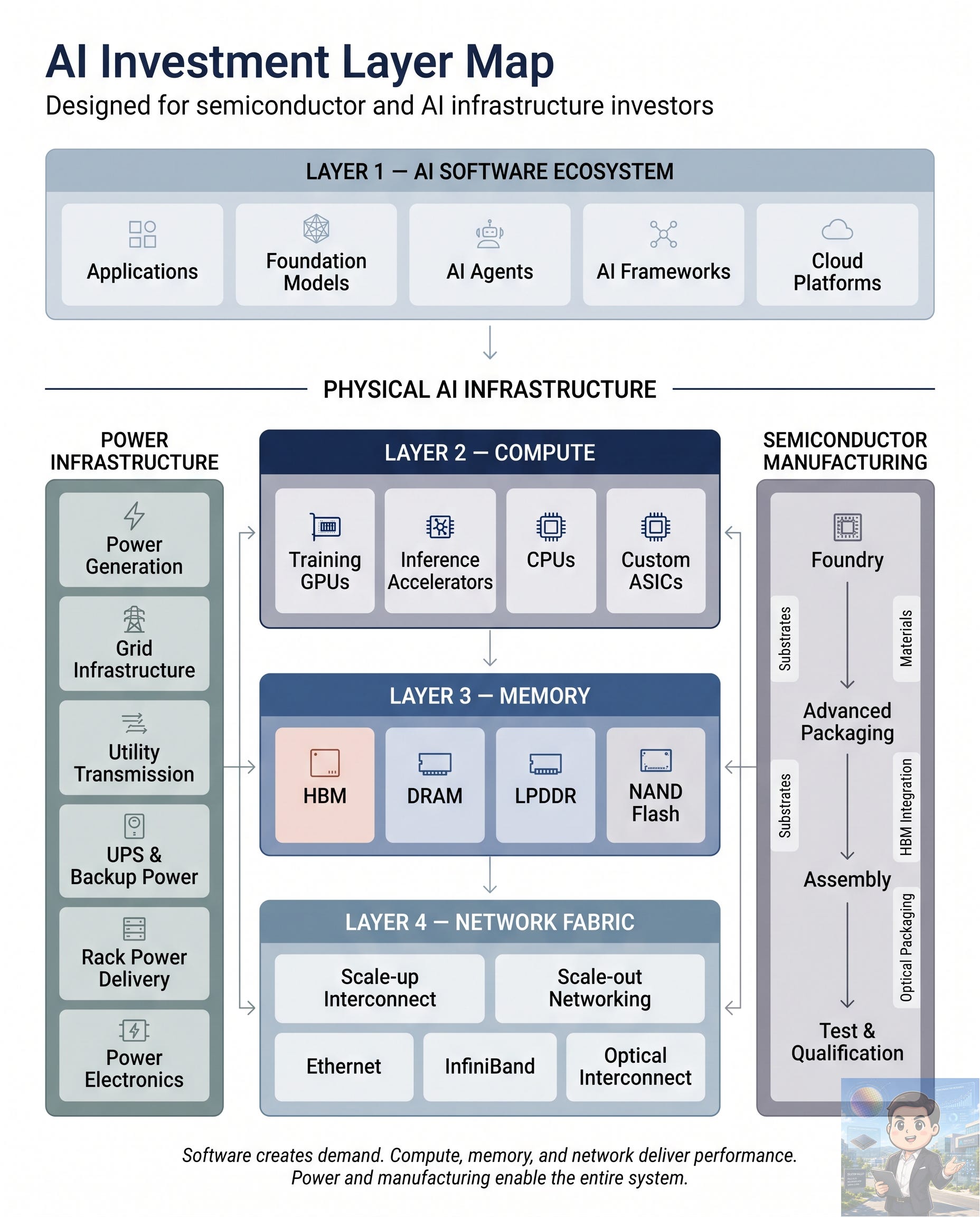
My goal on Substack is to raise readers’ technical understanding of each sector and help them form their own conviction.
That is why I focus my articles on the sectors where I hold the strongest conviction. I keep researching and studying, and I share the results in articles written to be as accessible as possible. My hope is that subscribers use that research as raw material for building sector conviction of their own.
Step 2. Drawing an Investment Map of Each Sector
Once the big picture of a sector is in place, the next step is to break it down. How does the sector divide into themes, and which companies belong to each one?
Take the compute sector, which is about as simple as it gets.
GPUs mean NVIDIA and AMD.
CPUs mean Intel, AMD, ARM, Qualcomm, and so on.
If you want to stretch the sector a bit further, you can extend it to the custom ASIC firms that help hyperscalers design their own chips, the startups building inference chips, and the foundries, equipment makers, and OSATs (outsourced assembly and test providers) that actually manufacture all of it.
Some sectors, on the other hand, are genuinely complicated.
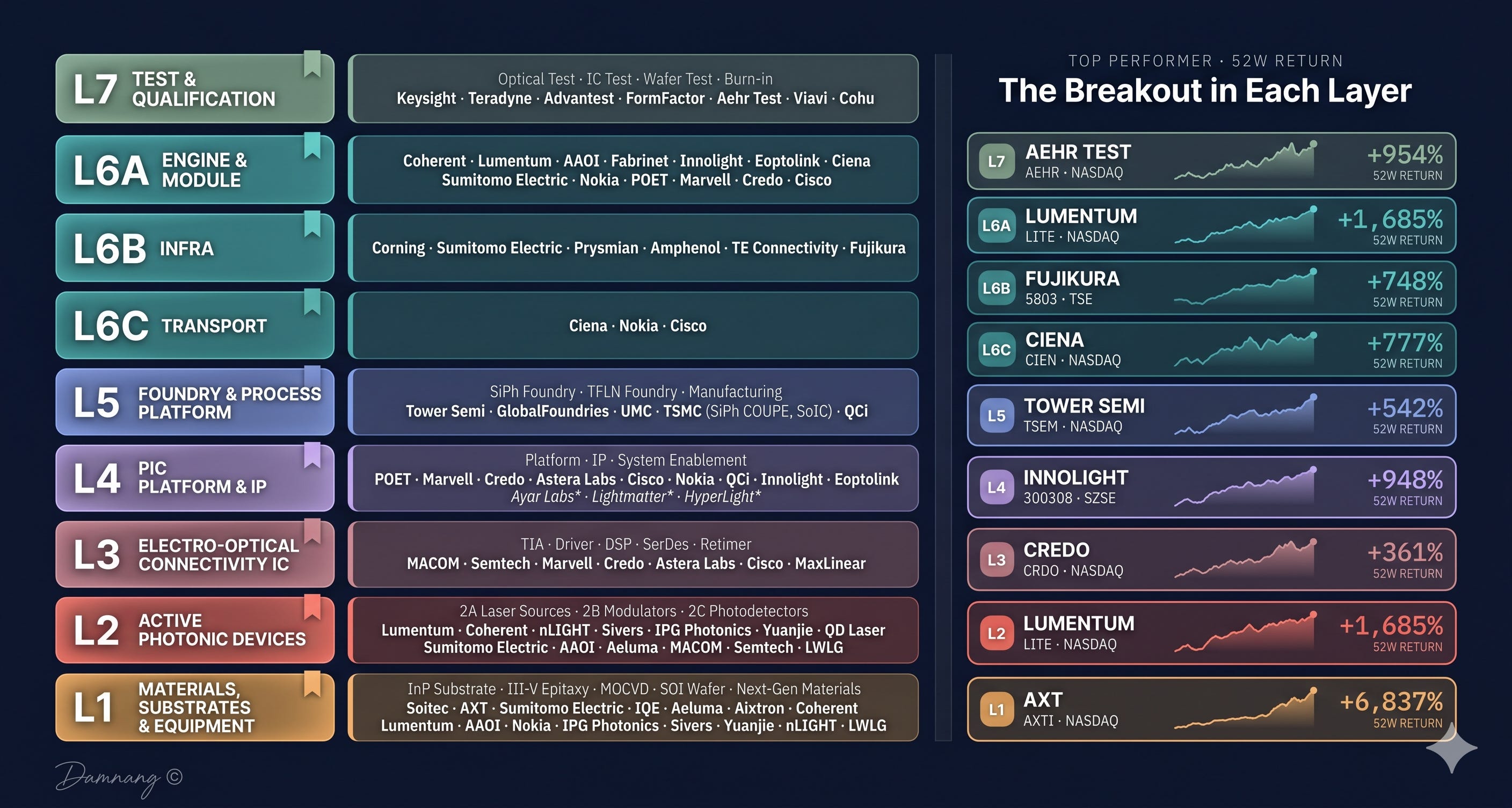
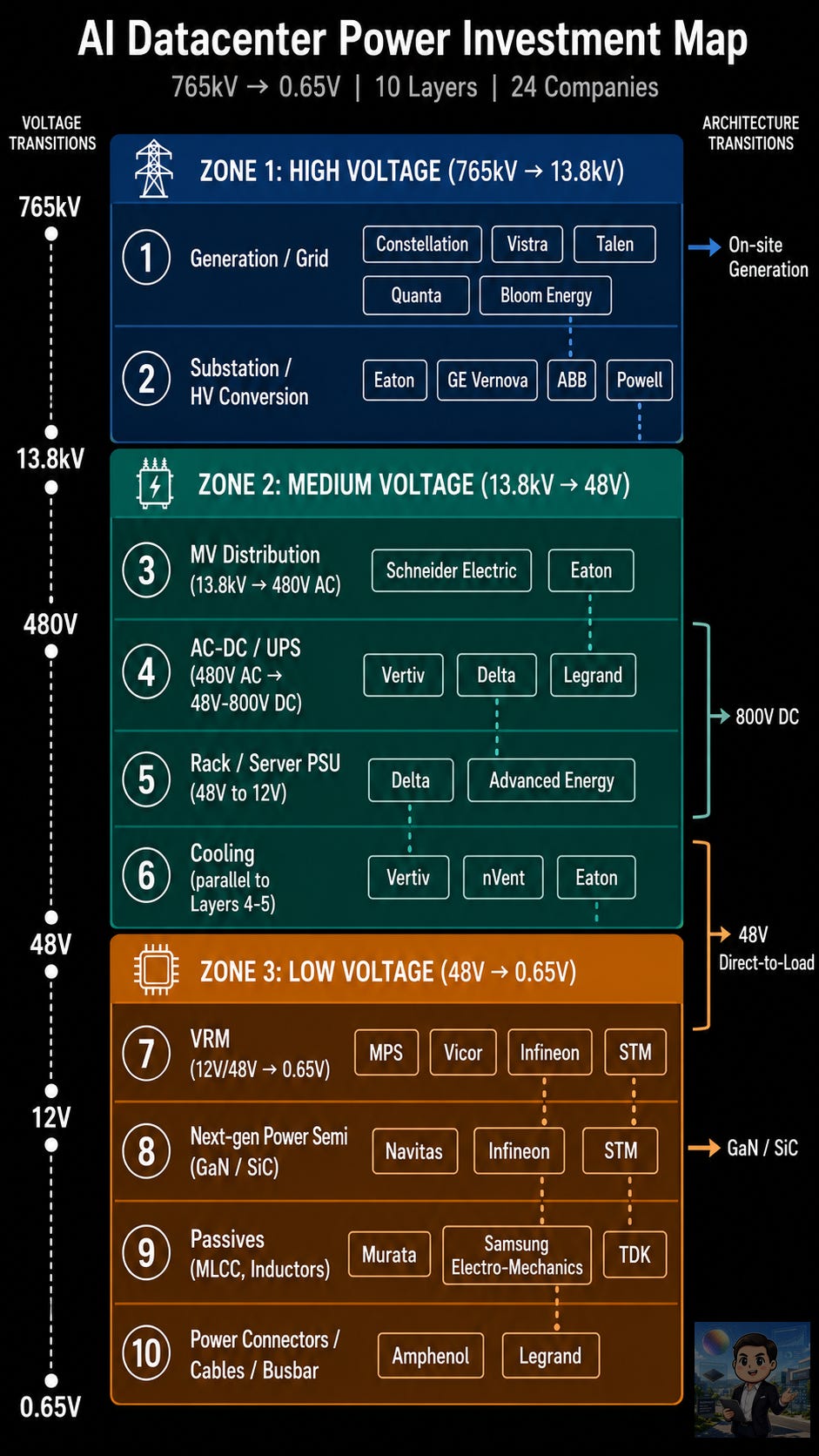
Optics and power are the prime examples.
For sectors like these, it is hard to draw an investment map in one sitting without real technical understanding of the field. That is why I have written investment map articles for them. I like to think they have been useful for investors who found it hard to know where to start.
Of course, no classification is perfect. But if you keep practicing this way of organizing an industry, you eventually develop the ability to draw your own maps and define your own sector themes.


Step 3. The Five Factors
Once the sector homework is done and it is time to pick stocks, I run through five factors, phrased as questions I ask myself.
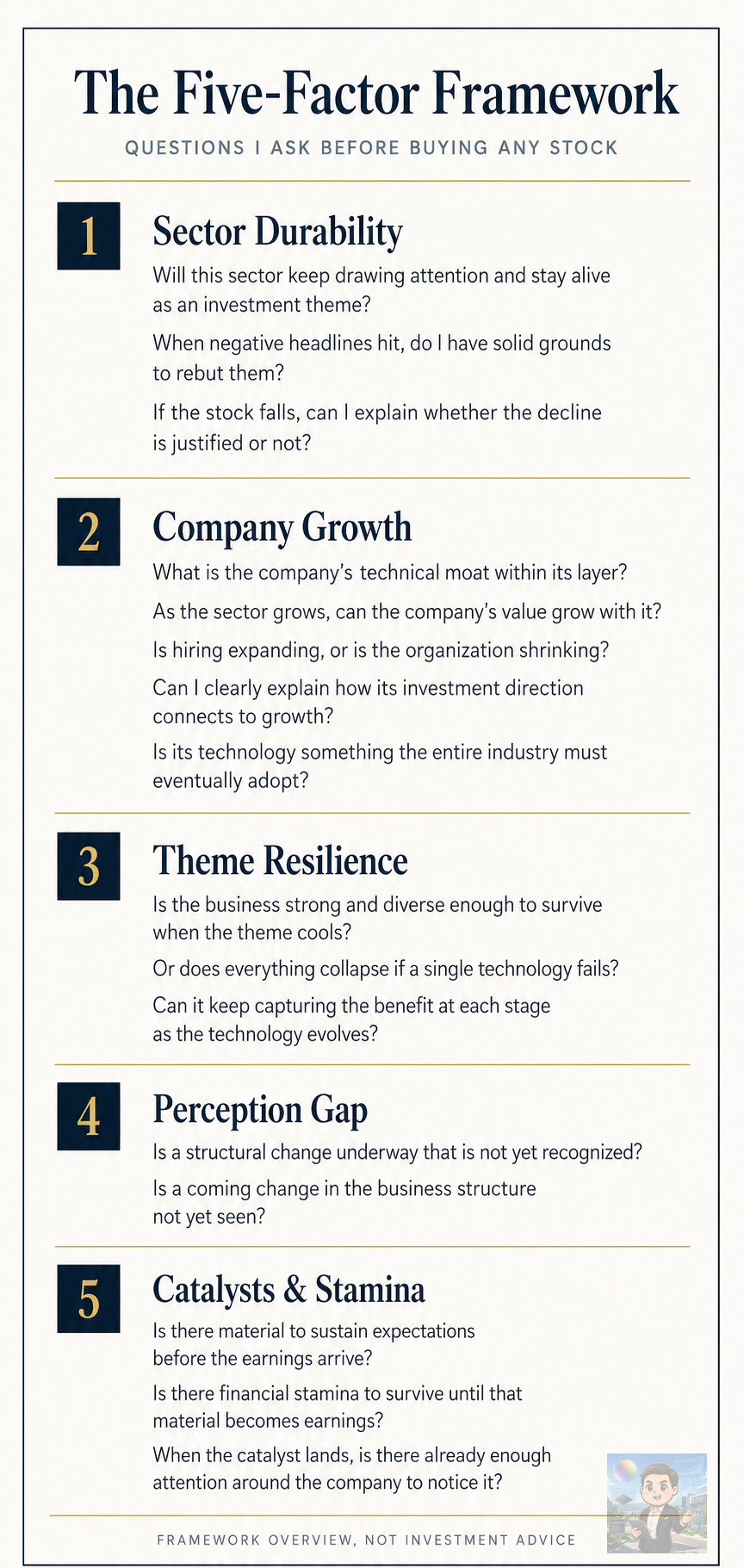
How I Analyze Stocks, With Real Cases
In this section I want to share my actual thought process. Why do I build conviction in certain stocks, and how do I size up risk in others?
My calls have not always been right, but the cycle of analyzing, deciding, and revising has done a great deal to harden my conviction over time.
The analysis below reflects my own criteria, so treat it as reference material and settle on your own approach. All assessments are as of July 10, 2026.
What INTC Taught Me
I was bearish on Intel starting last year. (This was also before I had built the systematic approach to investing described here.)
Every time I talked with engineers working at Intel here in Silicon Valley, I heard discouraging things about the company, such as the recurring layoffs and the rigid culture.
On top of that, as a former foundry engineer, I knew how brutally hard it is to catch up on leading-edge process nodes. I could not picture Intel suddenly leapfrogging TSMC and Samsung Foundry on yield and winning customers. The CPU business was steadily ceding server share to AMD, and with the center of gravity in data center spending shifting to GPUs, I did not see how CPUs alone could carry a growth story.
But as everyone knows by now, INTC went from around $20 to briefly above $140, and even after the recent pullback it is still up roughly five times.
Watching that unfold taught me the following lessons. Those lessons went a long way toward shaping the five factors above, and they continue to guide how I set my investment criteria.
Let me share them.
When the entire pie is growing, the number two or number three player does not have to become number one. The portion flowing to second and third place grows on its own. This is why Factor 1 asks about the sector before it asks about the company.
Stocks directly tied to government and policy attract flows that have nothing to do with fundamentals. The US government’s equity stake and strategic investments from SoftBank and NVIDIA were announced in quick succession, and a purely technical lens misses that force entirely. This is why Factor 5 asks separately about catalysts outside of earnings.
Design talent and technology accumulated over decades become an investment asset in their own right when demand takes off. (Factor 2)
The same was true of packaging. Even while Intel was written off on leading-edge nodes, packaging assets like EMIB and Foveros kept compounding. As AI chip competition expanded into a system-level packaging race that binds HBM and chiplets together, those assets emerged as a meaningful option in the re-rating of Intel’s foundry business. (Factor 4)
Never underestimate a CEO like Lip-Bu Tan. Layoffs are painful for employees, but investors often read them as a sign the cost structure is getting healthier. Sitting where I sit, listening to engineers, I read that same news only one way, and it was the wrong way. (Factor 5)
Looking back, my analysis was buried entirely in the competitiveness of a single company. I underestimated what happens to the number two and three players when the whole pie expands, and how powerful catalysts from outside the income statement can be.


AMD
AMD is one of the stocks where my investment has worked out so far, and one of the reasons it worked was precisely the Intel lessons above. I am still bullish on AMD, and here is why, mapped onto the factors.
AMD has outstanding chip design talent across CPUs, GPUs, and FPGAs, all relevant to AI. Chip design talent remains a severe bottleneck. As Intel lesson 3 taught me, in a demand surge that accumulation is an asset in itself. (Factor 2)
The AI era is creating a CPU bottleneck, and AMD, with its strong moat in CPUs, stands to benefit. Its server CPU share keeps climbing. (Factors 1, 2)
The same goes for data center GPUs. AMD’s share is small next to NVIDIA’s, but when demand itself explodes, the overflow inevitably lands with the number two player. This is Intel lesson 1 applied directly. Second place does not have to become first. (Factor 1)
The question hanging over AMD is always “Can it beat NVIDIA?” But AMD has a more urgent goal. Can it grow fast enough to absorb the demand exploding right now? The gap between those two questions is exactly where the investment opportunity sits. (Factor 4)
Never underestimate a CEO like Lisa Su, who took a company from the edge of bankruptcy to where it stands today over the course of a decade. This is the same line item as Intel lesson 5. (Factor 5)
On top of all this, CPUs, GPUs, and FPGAs each serve independent demand, so even if the accelerator race disappoints, the company does not fall apart. That floor (Factor 3) is what makes this a position I can hold for a long time.

MRVL
Marvell is another stock I have been analyzing and watching closely for months. Here is why I like it.
The AMD frame applies to Marvell too. It does not need to be number one in custom ASICs. With every hyperscaler racing to build its own chips, Marvell’s DSP-based ASIC business captures the expansion of the pie directly. (Factor 1)
Marvell has been quietly widening its scope. People still call it a custom ASIC company, but in reality it has been expanding into a data infrastructure semiconductor company that designs custom compute together with scale-up networking and optical interconnect. I judged there was still time before that gap fully closed, and that was the investable window. (Factor 4)
NVIDIA’s investment was decisive. NVIDIA has repeated a pattern of putting equity directly into the supply chain it cannot do without, and Marvell joining that list signaled a bigger role for the company in optics and interconnect. Once I understood why NVIDIA invested, my conviction hardened another notch. (Factor 5)
Marvell has been hiring at a staggering pace lately. Reading the direction of the job postings, the company appears to be preparing to run multiple hyperscaler custom programs in parallel while integrating optics. Hiring is a signal that moves several quarters ahead of earnings. (Factor 2)


Stocks I Watch Through the Same Lens
Here are some of the names I follow with interest. Most of them I have already covered in depth in individual articles, so if you want the full analysis, I encourage you to look those up. Here I will only note which factors put each one on my list.
QCOM. Longtime readers of my articles will know this one well. People still call it a smartphone chip company, but in reality it is expanding into data center accelerators and custom silicon (Factor 4). The diversification is also attractive, with data center being added as a new growth axis on top of handsets, automotive, and IoT (Factor 3).
That said, while the data center strategy and product roadmap are now official, meaningful revenue contribution has yet to show up. This is a stock where I build conviction quarter by quarter as customer wins convert into actual revenue.


CSCO. The image of an aging network equipment company hides what Cisco has become. It owns an AI infrastructure stack across multiple layers, from its own networking silicon (Silicon One) to the optics internalized through the Acacia acquisition to security (Factors 2, 3). And it has in fact been hiring aggressively in exactly these directions lately.
What matters is that the time it takes for that image to catch up is itself the investment opportunity (Factor 4).

MU. I believe the change HBM has brought to the memory profit structure is a structural shift that outlasts the cycle (Factor 1). Growing HBM share and capacity investment point in the direction of growth (Factor 2), and being the only DRAM producer manufacturing in the United States adds policy-driven flows on top (Factor 5).
The business is concentrated in memory alone, so theme resilience (Factor 3) is low. But for someone with strong conviction in the memory sector, that concentration is the appeal. The catch is that this conviction is sustained only by continued study of the sector, and keeping up that study is the precondition for owning a stock like this.


LITE & COHR. The starting point is the judgment that lasers and InP capacity are the bottleneck relative to AI bandwidth demand (Factor 1), and NVIDIA’s investments and purchase commitments were the catalysts that arrived ahead of the earnings (Factor 5). Their laser portfolios are diversified across EML, CW, and VCSEL, so whether the technology goes pluggable or CPO (co-packaged optics), their lasers are needed either way. Indeed, Lumentum has announced laser capacity expansion including a new US production facility, and Coherent is also expanding its manufacturing capacity and R&D investment (Factor 2).
Still, these are companies concentrated in the single layer of optics (Factor 3), so as with Micron, continuous study of the sector is essential.


CRDO & ALAB. These are interconnect names structured so that you do not have to call the direction of the technology (Factor 3). Their hedges run along different axes, though. Credo straddles both sides of the media debate, copper through AECs (active electrical cables) and optics through its optical DSPs, so it benefits however the argument resolves. Astera Labs sits where a new product slot opens with every protocol generation, from retimers to switches to scale-up standards.
Because both are small companies, their stamina to survive gaps between catalysts (Factor 5) is something I verify every quarter.


NOK. There is a wide gap between the old name, a telecom equipment vendor, and what Nokia is today after vertically integrating the optical stack through the Infinera acquisition (Factor 4). On top of that, NVIDIA paired an equity investment with an AI-RAN partnership. Putting AI compute into the radio access network (RAN) means telecom infrastructure itself could be redefined as AI infrastructure, an option entirely separate from optics. The investment is the catalyst, and the cash flow from the telecom business is the stamina (Factor 5).
But optics and AI are still a modest share of the whole company, so the pace of the transition (Factor 2) has to be checked quarter by quarter.

STM. Spread across analog, power, sensors, and MCUs, it has the highest theme resilience (Factor 3) on this list. It holds meaningful positions in individual themes like SiC power semiconductors and silicon photonics, but each business is a small enough share of total revenue that no single theme can carry the stock on its own.
In June of this year, however, the company raised its 2026 data center revenue target to roughly $1 billion, citing AI infrastructure demand and progress on capacity ramp-up, and indicated revenue could double again in 2027 if current customer engagements hold (Factor 5). What I hear on the ground points the same way. With broad, evenly distributed businesses providing stability and an industry tailwind now on top, it is well suited to the role of dampening portfolio volatility.

Let me say it once more.
The examples above exist only to show the algorithm I use to build conviction in a stock from an investment perspective. They are not recommendations. And the fact that a stock does not appear here does not mean I view it unfavorably.
Step 4. Buying and Selling
Once the sector and stock assessments are done, I set my own rules for buying and selling. As I said in the introduction, this article is not a stock or portfolio recommendation, so I will not be disclosing my positions. What I want to show instead is the algorithm, with examples, of how I think about buying and selling and by what criteria.
Position size is set by the factors.
Only stocks in sectors where I hold firm conviction earn a large position.
For me, that is the memory sector.
Conversely, even with conviction in the sector, for stocks where only one or two factors check out, or where the volatility exceeds what I can absorb, I never commit serious money no matter how hot the theme.
Small optical component names like Sivers are an example.
The durability of the optics sector (Factor 1) is clear and the technology is interesting, but revenue is small, the business leans on a handful of customers and partnerships, and the financial stamina to survive delayed catalysts (Factor 5) is unproven.
A company like that can be right about the theme and still not live long enough to see the theme become earnings. So when I do enter, I either keep the position small or treat it as a short-term trade.

Once you start sizing positions by expected return, you get the inversion where the riskiest stock gets the most money. Size should be set by conviction, not by hope.

Never buy in a hurry.
I believe the market always offers another chance. With a position bought in a chase, out of fear of missing out, the bad cost basis is a problem, but the bigger problem is that you end up holding it in an anxious state. A high cost basis makes you flinch at every small dip, and the moment you start flinching, price takes over the judgment that the factor assessment should be making.
In the recent big correction across semiconductors, I waited. All I did on the way down was check whether any factor assessment had changed, and once I concluded nothing had, I rebalanced part of the portfolio and actually added to my highest-conviction names. For anyone who keeps assessment and price separate, a correction is a discount window.
I do look at charts for timing. Not as a believer, but every so often I have AI run a chart analysis to see whether the trend is intact and where the meaningful price levels sit, and I treat that as one input among several.
When do I sell?
I sell when the answers to the factors deteriorate. That means my judgment on sector durability has changed, or the company has stopped hiring and investing in the direction of growth. If any of those breaks, I cut the position regardless of the price. Conversely, if the assessment is intact and only the price has fallen, that is closer to a buying opportunity.
There is one more case. When the perception gap has fully closed in the good direction, meaning everyone now tells the same story about the company, my edge is gone. Then I trim, even if nothing has gone wrong.
Stop losses work the same way. I sit through declines as long as the factor assessment holds, but a sharp drop is my alarm to re-examine everything. If the second look reveals something I had missed, meaning the price knew before I did, I cut without hesitation. A stop loss is the cost of admitting you were wrong, and trying to avoid paying it can cost you both your account and your judgment. The reference point when cutting is the current factor assessment, never the cost basis. What you paid has nothing to do with the company’s future.
Rebalancing happens alongside the quarterly factor review. The principle is simple. Check whether each position’s weight matches the size of my conviction, and fix it where it does not. Names that have run up beyond their conviction get trimmed, and the proceeds move into names whose assessment is unchanged but whose price is depressed.
The rebalancing I did in the recent correction was this principle in action. The result is that you end up selling what got expensive and buying what got cheap, not because you predicted the market, but as the automatic byproduct of keeping conviction and weight aligned.

Closing Thoughts
Let me stress once more that I am not a professional investor.
I am still learning, watching and studying the many excellent professional investors ahead of me. What I have written here is simply how I analyze sectors and stocks and how I invest, grounded in the areas where I am confident, which are technology and industry analysis.
The factors and principles laid out here are not finished either. With every earnings report, every new organization, every published standard, the assessments keep moving, and my method will keep getting patched every time it turns out to be wrong.
I hope this article becomes the start of many discussions with my subscribers, where we learn from each other’s perspectives. If, through that process, each of you ends up building an investment methodology of your own, this article will have done its job.
I am an investor who has had to work really hard to learn the semi space. For that reason, among others, I find your Substack to be invaluable.
With that said, I do lead an investment group where we do a LOT of research to build conviction within sectors as well as among specific companies.
The framework I approach it from is based on my studies of elite traders who have built fortunes in the stock market.
Basically, I am looking for a structural trend that I can ride through the greater part of its move.
If I can be right about the structural move, my biggest task as a stock operator is to have the emotional discipline to manage the campaigns (we call them campaigns and not trades) through the volatility.
From my experience, that is where the big money is made.
In addition, we are not against adding 'trading shares' in these companies that can be acquired during drawdowns (the "buy opportunities" you referenced) as long as the structural uptrend is still in tact and the longer-term line of least resistance is higher.
These trading shares can be sold for profit when the aggregate market, the sector or individual stocks get extended (we monitor charts constantly to determine those situations).
While position sizing can vary depending on the near-term line of least resistance in the overall market, the sector or the stock, IMHO the key is to have the emotional mastery to hold the core position without trying to time tops and bottoms.
IMO, picking tops and bottoms in a really tough game and you often risk missing the greater move if you don't time it correctly.
That is why we say if you want to partake in that exercise then use trading shares and not your core positions.
In the case of the current AI cycle, we have advocated holding core positions in key names we have identified and the key "tell" as to whether or not the structural trend remains in tact is the CapEx spending of the bigger companies.
This is something we monitor rigorously and with great vigilance because when that spending decelerates then the overall thesis changes and the structural trend is invalidated.
At the end of the day the following quote attributed to Jesse Livermore substantiates this approach:
"It never was my thinking that made the big money for me. It always was my sitting. Got that? My sitting tight!...I've known many men who were right at exactly the right time, and began buying or selling stocks when prices were at the very level which should show the greatest profit. And their experience invariably matched mine--that is, they made no real money out of it. Men who can both be right and sit tight are uncommon.”
Just my 2 cents and my apologies for the long post.
I am a retired engineer having worked in embedded software during the time of the early CPU wars (Intel, Motorola, Mos, Zilog, etc) way before the ARM1 was released (many years ago, lol).
My life long career allowed me to accumulate some wealth and just only very recently (few years ago) I started to invest /actively/ in the stock market.
So I am also an early subscriber of your substack with I genuinely find very useful.
There is however one single concern that I have, that I also shared with other authors. The point is that we need to acknowledge that the recent excitement on the semiconductors theme and the fast development of everything related with GPUs, Memory, Networking, etc, is ultimately paid by the known hyperscalers (Google, Amazon, Meta, etc) through unprecedented data center capex.
They are expending that much money because they believe at some point it will be highly profitable. Or let me put it in more detailed terms: the tech industry expects a massive surge in enterprise AI adoption so huge revenues will eventually come. Yet there are some famous contrarian viewers who have put it into doubt, and have even shorted semiconductor stocks.
This is I guess part of the "sector durability" factor, but my question to you is whether you have thought about covering not only the hardware theme, but also go into software applications or companies that may help to justify the long term continuation of the hyperscaler capex which currently benefit the hardware companies.
Thanks !