

Market cap around $1 billion. Last quarter’s revenue: $298,434.
Put those two numbers side by side and most investors will do a double take. What exactly is the market seeing in a company whose quarterly revenue doesn’t clear a Silicon Valley engineer’s annual salary?
On March 12, just before OFC 2026, part of the answer came into focus.
The OCI MSA is a declaration by AMD, Broadcom, Meta, Microsoft, NVIDIA, and OpenAI to jointly develop open specifications for AI scale-up optical interconnects.
The XPO MSA is a 12.8 Tbps-class liquid-cooled pluggable standard championed by Arista with participation from more than 40 optical vendors.
The Open CPX MSA aims to standardize CPO optical engine sockets and form factors for cross-vendor compatibility.
The War of Light Has Begun

On March 12, 2026, three separate optical-related MSAs dropped on the same day. That does not happen by coincidence. It means the entire industry has converged on the same conclusion: the physical layer of AI infrastructure needs to change, and it needs to change now. Call it the opening shot of the Optical War.
The message is unambiguous. The copper era is fading, and the future of AI infrastructure is optical. This is no longer a prediction. It is a fact signed by the largest companies in the industry.
POET Technologies, however, is not at that table. The company is not writing the standards; it is one of the players that will need to conform to them. Whether that played a role or not, the market sent POET’s stock from the $6 range up to $7.70 within a week, then pulled it back 7.5% in a single session on March 13.
Why does this pattern keep repeating? This article is not a rundown of POET’s technology stack. It is an attempt to dissect the structure of expectation and reality that surrounds the company.
Why POET Absorbs Retail Investor Excitement
POET Technologies is a small-cap silicon photonics company headquartered in Toronto, Canada, with operations in Singapore and Penang, Malaysia. The company’s centerpiece is a platform called the Optical Interposer, which integrates electronic and photonic components on a single substrate to reduce the cost and assembly complexity of optical interconnects.
The reason POET commands such a strong presence in retail investor communities is not simple.
POET carries nearly every attribute the current market rewards.
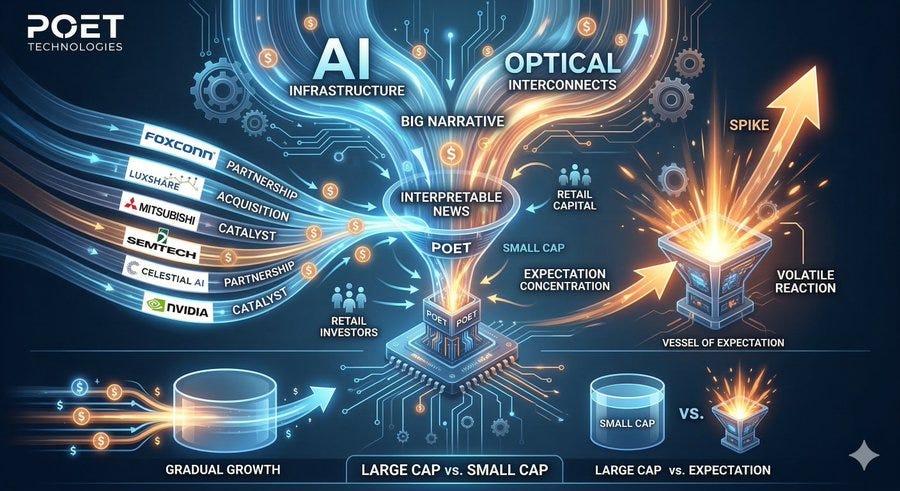
First, the narrative is big.
As the understanding has spread that the next bottleneck in AI infrastructure after GPUs is optical interconnects, optics has naturally become the next thematic trade. POET sits squarely in the middle of that story, or at least appears to.
Second, the market cap is small.
When a large theme moves, that same wave of expectation gets concentrated onto a much smaller float. Large caps move slowly; small caps react with far more force.
Third, the company generates interpretable news rather than confirmed results.
Names like Foxconn, Luxshare, Mitsubishi, Semtech, Sivers, NTT, and Quantum Computing Inc. appear repeatedly across partnership and development announcements. Because actual revenue is minimal, the market tends to read these names as harbingers of future contracts rather than evidence of current ones.
Real catalysts have contributed to this dynamic as well. In December 2025, Marvell moved to acquire Celestial AI, which was an official POET customer. POET had publicly announced a collaboration with Celestial AI on its Optical Interposer and Starlight platform back in 2022. The market read the acquisition as a signal that POET’s technology could find its way into a major player’s supply chain.
Then in early March 2026, when news broke that NVIDIA was strengthening its optical supply chain relationships, POET surged even though no direct connection exists. This is why capital keeps flowing into POET every time a major headline drops across the optical interconnect sector.
For now, POET is less a direct beneficiary of the optical wave than a small vessel into which that expectation gets poured with disproportionate intensity.
Reddit Rumor Map: How Market Sentiment Flows
Observing the POET subreddit over the past several months, the recurring narratives converge around a few familiar themes.
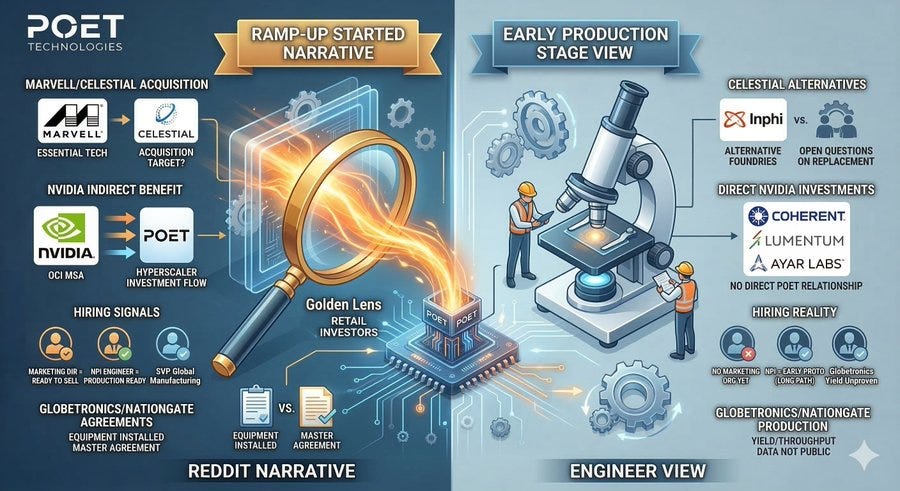
The biggest one is the Marvell/Celestial AI acquisition. It starts from the reasonable claim that “Celestial’s Photonic Fabric cannot function without POET,” then stretches all the way to the conclusion that “POET itself is an acquisition target.” The starting point has a documented basis, but whether Marvell will continue using POET at volume production or replace it with in-house capability through the Inphi acquisition remains an open question.
The indirect NVIDIA beneficiary thesis follows a similar pattern. The $4 billion investment and NVIDIA’s participation in the OCI MSA get combined into the argument that “every hyperscaler will eventually invest in optics, and that creates opportunities for smaller suppliers like POET.” There is no officially confirmed relationship of any kind between NVIDIA and POET. NVIDIA’s direct investments have gone to Coherent, Lumentum, Ayar Labs (via VC participation), and Scintil Photonics (a modest $58 million Series B participation). None of them are POET.
Job postings continue to be read as production signals.
The current POET careers page lists several open roles:
Senior Director of Marketing (U.S. West Coast)
Director of Research and Development (Singapore)
Principal Engineer for External Manufacturing (Singapore)
NPI Program Manager (Singapore).
On Reddit, the marketing director posting is read as “they’re ready to sell product,” and the NPI engineer posting as “volume production ramp is underway.” Add in the SVP of Global Manufacturing hire from May 2025, the NationGate Solutions Master Agreement in June, and the completion of Globetronics equipment installation, and there is enough material to build a “ramp has begun” narrative.
From a working engineer’s perspective, though, some of this is being stretched.
A 56-person company just now hiring a senior marketing director means the marketing function still does not exist as an organization.
Equipment installation and a pilot line being operational are prerequisites for production, not production itself.
There is no publicly available data confirming that yield and throughput at contract manufacturers Globetronics and NationGate have been validated.
And NPI, by definition, means the very earliest stage of production introduction, which often signals that volume production is still a long road away.
POET’s Technology: What Is Legitimate Expectation and What Is Not
To understand the backdrop to these rumors, you need a sharper technical picture of what POET actually builds and where that technology actually stands.
The Problem with Conventional Optical Modules
Moving data between GPUs in an AI datacenter requires high-speed optical interconnects. The current mainstream approach uses a packaging process for pluggable transceivers known as “Gold Box.” Individual components including lasers, lenses, isolators, and mirrors are aligned at micron-level precision using either skilled technicians or expensive active alignment equipment, electrically connected via wire bonding, and subjected to individual testing and burn-in. The process is slow, expensive, and yields losses are significant. As speeds climb to 800G and 1.6T, the complexity compounds.
POET’s Approach: The Optical Interposer
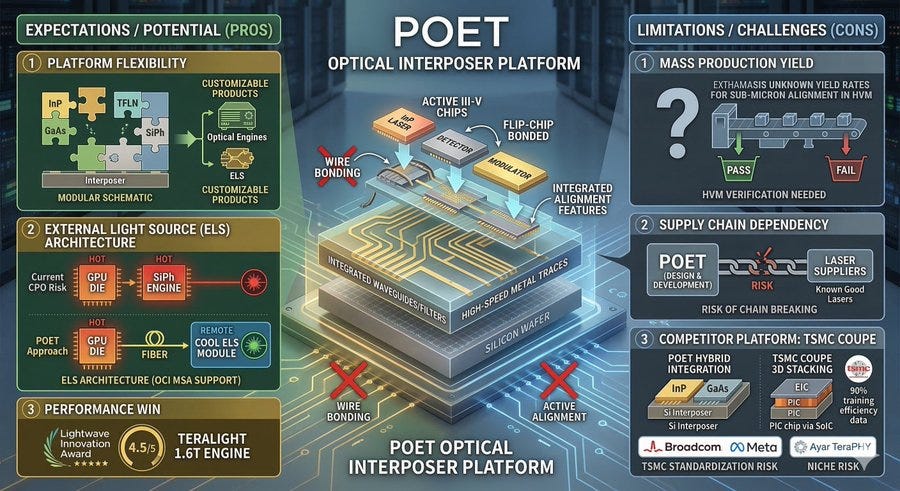
POET addresses this from a fundamentally different angle. Using CMOS-compatible processes on a standard silicon wafer, the company forms an optical layer (waveguides, filters, gratings) and an electrical layer (high-speed metal routing) simultaneously. Active components such as III-V material lasers (InP), detectors, and modulators are then attached via flip-chip bonding.
The first key differentiator is passive alignment. Conventional processes require active alignment, where laser light is steered in real time to hit the waveguide precisely. POET embeds alignment features directly into the Interposer structure so that components placed by pick-and-place automatically achieve optical axis registration. If this holds at volume, it means producing optical modules with the automation characteristics of a semiconductor process.
The second is the elimination of wire bonding. At 800G and above, wire bonds are a primary source of RF crosstalk and signal degradation. POET’s Interposer removes them structurally through flip-chip bonding. This is part of why the Teralight 1.6T engine received a 4.5-point score (top tier) at the Lightwave Innovation Awards.
The third is the External Light Source (ELS) architecture. In co-packaged optics, placing a laser directly adjacent to a GPU die exposes it to kilowatts of thermal energy that degrades performance sharply. Silicon has an indirect bandgap, which makes it unsuitable for efficient light emission, leaving thermally fragile InP and GaAs lasers as the only options. POET’s answer is to isolate those lasers in a separate module (Starlight, Blazar) positioned where it can be cooled, and deliver light to the engine via fiber. The OCI MSA announced on March 12 formally supports this ELS architecture.
The product line breaks into two streams: optical engines (800G Wavelight/Infinity, 1.6T Teralight) and ELS modules (Blazar, Starlight). A next-generation engine based on a 3.2 Tbps TFLN modulator is also in joint development with Quantum Computing Inc.
The point that gets investors excited is that the Interposer is a platform, not a single product. A single substrate can be reconfigured across different speeds and form factors, and the design is agnostic to materials, allowing InP, GaAs, and SiPh components to be selected as needed. If that flexibility proves out, it creates leverage across multiple customer segments.
That said, the technology has real limitations at this stage.
The biggest unknown is production yield. There is a world of difference between passive alignment working in a lab and sustaining consistent yield at tens to hundreds of thousands of units per month. Sub-micron alignment tolerances are required across optical components, and there is no publicly available data confirming that wafer-level processes have achieved this at scale. As one analyst put it, “if you cannot bring down yield loss and test time, even the best optical engine design cannot generate profit in production.”
One important aspect of POET’s positioning is that this company is not primarily a laser manufacturer in the way Coherent or certain traditional optical vendors are. POET is closer to a platform integrator, assembling optical engines on its Interposer using components sourced from external suppliers. The company has consistently described itself as a design and development company and has publicly outlined a model where known-good lasers from external suppliers feed into its optical engines. This structure offers flexibility and customization advantages, but it also introduces supply chain exposure if InP laser availability becomes constrained.
The most significant competitive threat is TSMC’s COUPE platform. COUPE (Compact Universal Photonic Engine) uses SoIC 3D stacking to place a Photonic IC directly on top of an Electronic IC. Broadcom’s Davisson was built on this platform, and Meta has reported a 90% training efficiency improvement from a real-world deployment. Ayar Labs is also transitioning its next-generation TeraPHY to COUPE. These are silicon photonics implementations where modulators and detectors are formed directly on silicon with only the laser sourced externally. This is architecturally distinct from POET’s hybrid integration approach, where III-V active components are placed on top of silicon.
Both paths have genuine technical trade-offs, but if standardization and production ramp proceed first around COUPE, POET’s proprietary Interposer risks being pushed into a niche. The “flexibility” argument only lands if production yield and cost competitiveness are validated first. Get the sequence wrong, and flexibility becomes irrelevant.
What Is Actually Plausible for POET
Set aside the rumors and wishful extrapolation. Here is what the confirmed facts and reasonable inference actually support.
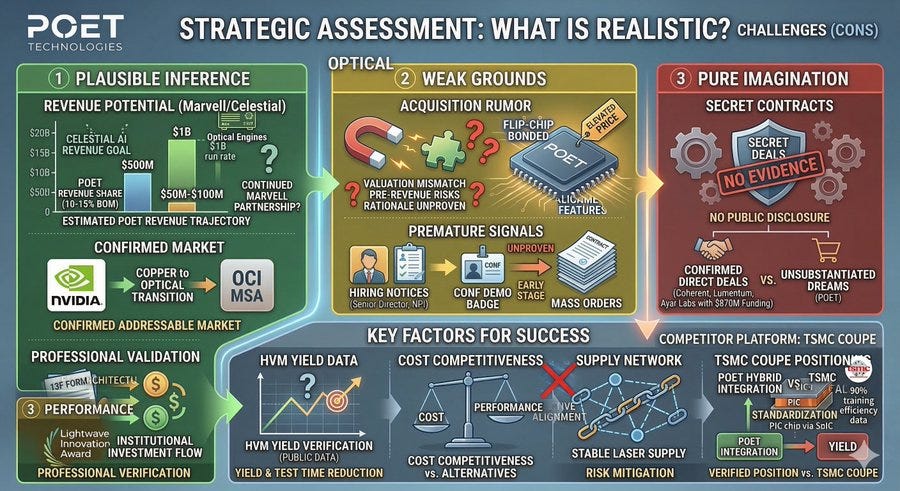
Claims that hold up: Marvell is targeting $500 million in Celestial-related revenue in the second half of 2028 and a $1 billion run rate in 2029. If light source BOM is 10 to 15 percent of that, POET could be looking at $50 to $100 million in annual revenue from that relationship. The prerequisite is that Marvell continues to rely on POET. The OCI MSA formalizing the copper-to-optical transition confirms that the addressable market POET is targeting is real.
Claims that lack grounding: Acquisition speculation. Justifying an acquisition premium on a pre-revenue company at close to a $1 billion market cap is a difficult case to make. Reading job postings or conference demos as imminent large-scale order signals is also premature.
Claims that are essentially wishful thinking: Secret contracts with NVIDIA, Amazon, or other hyperscalers. No public evidence exists. The parties NVIDIA has committed serious capital to are Coherent, Lumentum, and Ayar Labs, which has raised $870 million and carries a $3.75 billion valuation. None of them are POET.
The Risks: Good Technology Is Not Enough
Q3 2025 revenue was $298,434. Trailing twelve months revenue is approximately $760,000. Price-to-sales ratio exceeds 700x. There is a $5.6 million production order on the books, but shipment is not expected until the second half of 2026. This company is not yet generating meaningful revenue.
Dilution is not just a sentiment issue; it is a structural risk. The $300 million cash position buys two to three years of operating runway, but there is no guarantee that cash converts to revenue.
The competitive field is operating at a different scale. In the same ELS/CPO market, Ayar Labs carries a valuation more than 3.7 times POET’s market cap and is demonstrating a rack-scale CPO system at OFC 2026 with Wiwynn. Broadcom is already conducting hyperscaler pilot shipments of Davisson. Coherent and Lumentum, into which NVIDIA channeled $4 billion, have vertically integrated capabilities from InP epitaxy through packaging. On market access, capital, and hyperscaler relationships, POET’s competitors are ahead across the board.
“Partnership” and “volume production shipments” are entirely different things. In the semiconductor industry, a design win is a starting line. The path from there to qualification, yield stabilization, supply chain stability, and volume production eliminates far more technologies than it advances. Treating technical merit as equivalent to market capture certainty is the most common mistake retail investors make.
The short interest ratio is rising, now at 16.64%. Institutions are entering and exiting. Retail concentration is amplifying volatility in both directions.
The Price Tag on Expectations
POET is not a fraud. The technology is real, the partnerships are official, and the Marvell/Celestial AI acquisition provides indirect validation of its technical positioning. The OCI MSA is the largest companies in the industry confirming the central thesis that POET is built around.
But a $1 billion market cap is not the price of “good technology.” It is an option on the entire scenario in which this technology successfully transitions to production, competes against incumbents who already have seats at the table, and generates meaningful revenue. The OCI MSA confirmed the size of the optical market, but it also put on full display who is competing for it.
OFC 2026 runs from March 16 to 19. POET will demonstrate Blazar and Starlight, and will collect the Lightwave Award. Q4 2025 earnings arrive on March 26. These two events will write the next chapter.
The question is not whether POET has impressive technology. The question is whether that technology makes it inside the production lines of large customers. The market is waiting on that answer, and the cost of that wait is already priced into the market cap.
This article is based on public records, SEC filings, official company announcements, and Reddit/X community discourse. It does not constitute investment advice or a recommendation regarding any specific security. All investment decisions are the sole responsibility of the reader.