

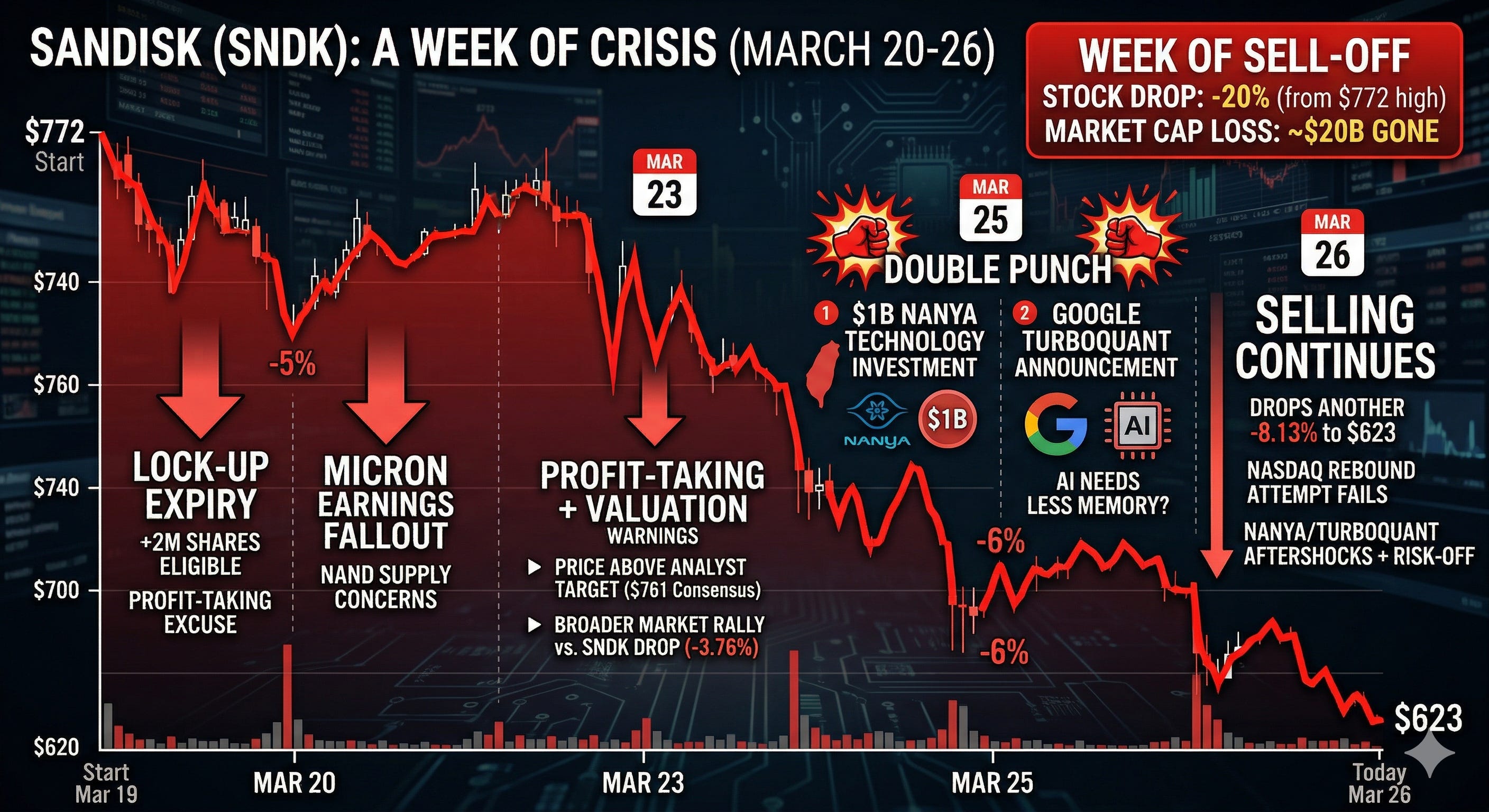
Yesterday it dropped 6%. Today another 8.13%.
Two straight days of freefall. When a stock that’s gone up 25x in a year drops 20% in a week, the word “correction” doesn’t quite capture it. Roughly $20B in market cap evaporated in five trading days. A lukewarm reaction to the $1B Nanya investment, the “AI needs less memory” panic triggered by Google’s TurboQuant, supply glut fears after Micron’s capex announcement, lock-up expiry selling. The bad news hit all at once.
The Nasdaq rallied as high as +1.6% intraday before rolling over into the red. On a day when the broader market was already shaky, SanDisk cratered 8%. A stock with a beta of 2.74 getting hit by both market weakness and sector-specific headwinds simultaneously. The question is whether this is a memory sector problem or a SanDisk-specific problem. Whether the structural story of NAND supply tightening has broken, or whether this is simply the inevitable pullback in a 25x stock. BofA, in the middle of this selloff, raised its price target from $850 to $900. The market and the analysts are looking in opposite directions.
In this piece, I’m going to tear apart each of the past week’s catalysts one by one. I’ll separate noise from real risk, and assess whether the fundamentals are actually impaired, from the perspective of a semiconductor engineer.
Disclaimer
This article is not a buy or sell recommendation for any specific stock and does not constitute investment advice. The author does not hold a position in any of the stocks mentioned. The information contained herein is based on publicly available data and represents personal analysis only, with no guarantee of accuracy or completeness. All investment decisions and resulting gains or losses are solely the responsibility of the investor.
What Happened This Week
Feb 17–18 (background): WD secondary offering. Western Digital executed a secondary offering of its remaining SanDisk stake. Roughly 5.82 million shares were priced at $545 per share, with the deal closing on February 19. SanDisk received none of the proceeds. The ownership structure shift had already begun.
March 20: Lock-up expiry. Separately from the February offering, a lock-up period expired on March 20, making over 2 million insider-held shares eligible for sale. The stock slipped from $772 to below $740. Given that the stock had rallied 25% in the same week, the lock-up expiry became a convenient excuse for profit-taking.
March 20: Micron earnings fallout. On the same day, Micron reported quarterly results and highlighted its capex plans. Concerns about increased NAND supply spread across the entire memory sector. SanDisk fell 5%.
March 23: Profit-taking + valuation warnings. With the stock price above the average analyst target of $761, the perception that “it’s more expensive than consensus” took hold. The broader market rallied on geopolitical developments (Iran tensions), but SanDisk moved in the opposite direction. Down 3.76%.
March 25: Double punch. First, SanDisk announced a $1B equity investment in Taiwan’s Nanya Technology. Down 6%. Second, Google announced TurboQuant. “Does AI need less memory now?” The entire memory sector sold off.
March 26 (today): Selling continues. Far from recovering yesterday’s losses, the stock dropped another 8.13%, hitting $623. The Nasdaq briefly attempted a rebound intraday before rolling over again, and SanDisk caught both the broader market weakness and memory sector dumping at the same time. The aftershocks of the Nanya deal and TurboQuant hadn’t faded, and a broader risk-off move piled on top. Down 20% from the $772 high. Roughly $20B in market cap gone in one week.
Now let’s figure out what’s noise and what’s real.
Noise: Lock-up, Profit-Taking, Nanya
Lock-up expiry and profit-taking are supply events. Short-term traders exiting a 25x stock is natural. It’s not structural change. The stock is still well above its 50-day moving average of $593.
The Nanya investment deserves a closer look. The market knocked the stock down 6% on this deal, so let’s be precise about what actually happened.
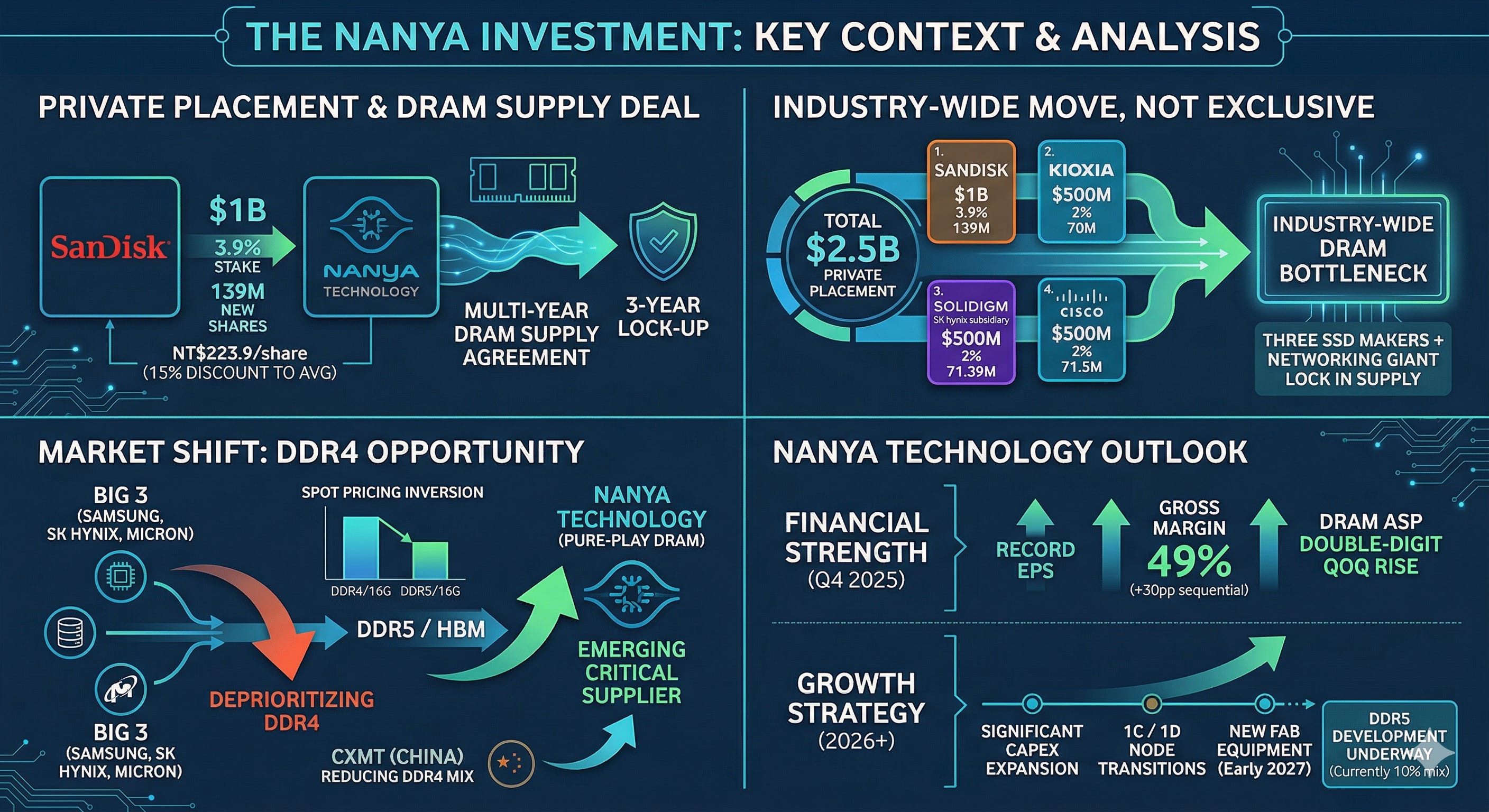
SanDisk, through its subsidiary SanDisk Technologies, acquired a 3.9% stake in Taiwan’s Nanya Technology for $1B. The deal involved roughly 139 million newly issued shares at a 15% discount to Nanya’s 30-day average price, structured as a private placement. Under Taiwanese securities law, there’s a 3-year lock-up. Alongside the equity investment, SanDisk and Nanya signed a multi-year strategic DRAM supply agreement.
One important piece of context. SanDisk wasn’t the only participant in this private placement.
It was part of a $2.5B (NT$78.7B) round that included SanDisk at $1B (roughly 139 million shares, 3.9%), Solidigm (SK hynix subsidiary) at $500M (roughly 71.39 million shares, 2%), Kioxia at $500M (70 million shares, 2%), and Cisco at $500M (71.5 million shares, 2%). All at the same price of NT$223.9 per share. This wasn’t an exclusive SanDisk deal. It was an industry event where the three major NAND players (SanDisk, Kioxia, Solidigm) plus a networking giant (Cisco) simultaneously locked in DRAM supply. All three SSD makers signed separate DRAM supply agreements with Nanya.
Three SSD manufacturers locking in DRAM sourcing at the same time sends a strong signal: the entire industry recognizes a DRAM bottleneck.
Why Nanya? Nanya Technology is a Taiwan-based pure-play DRAM maker. As Samsung, SK hynix, and Micron have shifted resources toward DDR5 and HBM, deprioritizing DDR4 production, Nanya has emerged as a critical supplier in the DDR4 market. TrendForce spot pricing shows DDR4/16G trading above DDR5/16G, an inversion. The older-generation DDR4 costs more because the big three have structurally reduced DDR4 output.
Nanya’s Q4 2025 results reflect this trend. Per Nanya’s own disclosures, the company posted record quarterly EPS, with gross margin climbing to 49% (up roughly 30 percentage points sequentially). DRAM ASP also rose by double digits QoQ. The company plans to significantly expand 2026 capex year over year, pushing 1C/1D node transitions and new fab equipment installation (targeting early 2027). DDR5 still accounts for only about 10% of total shipments, but next-generation DDR5 product development is underway.
According to industry reports, China’s CXMT has been moving to reduce its DDR4 production mix, a trend that is further strengthening Nanya’s position in the DDR4 market.
The market’s negative reaction makes sense. $1B exceeds last quarter’s adjusted free cash flow of $843M. Cash on hand was $1.54B, so there’s still $500M+ left after the investment, but it raises questions about short-term financial flexibility. The “why is a pure NAND company putting $1B into a DRAM company?” reaction is understandable. A 3.9% minority stake doesn’t give you much of a voice in management either.
But from an engineering standpoint, this deal has logic. Three angles.
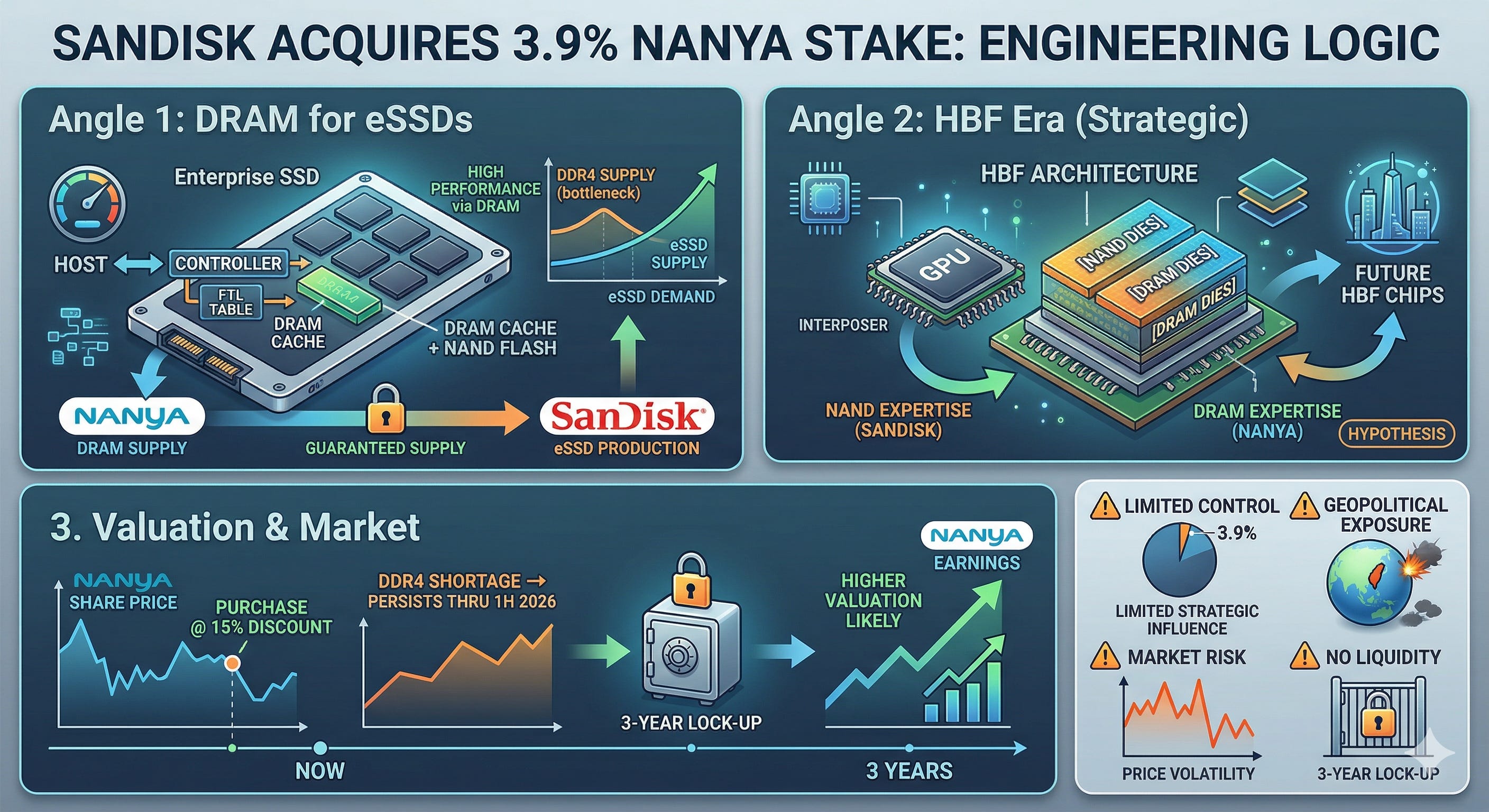
First, DRAM cache is critical for high-performance enterprise SSDs. Enterprise SSD controllers keep the FTL (Flash Translation Layer) mapping table in DRAM to deliver random read/write performance. If DRAM supply is constrained, it creates a bottleneck for high-performance eSSD production. In the current environment of structurally tight DDR4 supply, locking in multi-year DRAM sourcing is a practical move to protect eSSD production continuity.
Second, and this is a strategic interpretation rather than confirmed fact, it could be groundwork for the HBF era. HBF stacks NAND dies like HBM and places them on an interposer next to the GPU. In this architecture, the ability to work with both DRAM and NAND becomes important. SanDisk securing a DRAM supply relationship through Nanya could serve as the foundation for a DRAM-side partnership when HBF reaches commercialization. SanDisk hasn’t officially drawn this connection, so treat this as a hypothesis for now.
Third, the valuation angle. They bought Nanya shares at a 15% discount to the 30-day average. Nanya’s earnings are surging, and DDR4 supply shortages are expected to persist through at least the first half of 2026. There’s a 3-year lock-up, but Nanya’s enterprise value is likely to be higher in three years than it is today.
Let me also flag the risks. A 3.9% minority stake means limited strategic control. There’s Taiwan geopolitical exposure. If DRAM prices roll over, the value of the Nanya stake drops. The 3-year lock-up means zero liquidity.
If it doesn’t, the “why did they spend $1B?” discomfort lingers.
All three of these (lock-up, profit-taking, Nanya) are predominantly short-term supply dynamics. Lock-up and profit-taking are temporary selling pressure. Nanya is a strategically rational deal that suffered from poor market communication. Based on currently available information, none of these events have directly impaired SanDisk’s NAND business fundamentals.
Half Real: Micron Capex and Supply Concerns
Micron’s aggressive capex announcement deserves more serious consideration. The market’s worry goes like this: “Micron pours money into NAND, supply increases, prices drop, SanDisk margins collapse.”
But the narrative the market is running with and the message Micron itself delivered point in opposite directions. On the same earnings call, Micron said that “data center NAND demand exceeds supply for the foreseeable future” and projected industry NAND bit shipment growth of roughly 20% for 2026. They also noted that initial output from their new Singapore NAND fab won’t come until the second half of 2028. In other words, Micron itself is saying “even with our capex increase, supply tightness persists for the time being,” while the market looked at the capex number in isolation and panicked about oversupply.
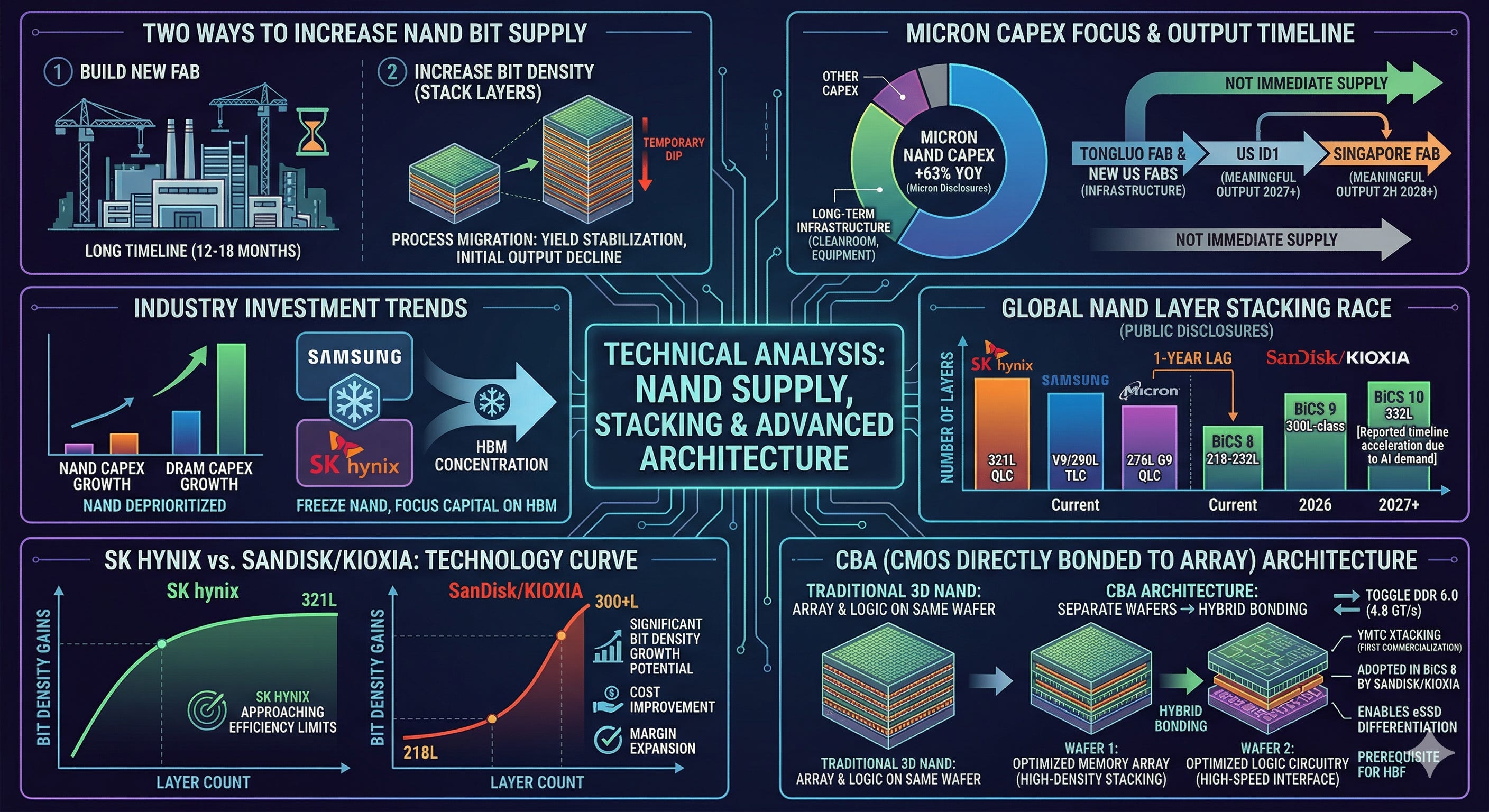
Let’s also look at this from a technical standpoint. There are only two ways to actually increase NAND bit supply. Build a new fab, or stack more layers in existing fabs to increase bit density per die. The first takes 12 to 18 months. The second requires a process node migration, and during the transition, yield stabilization and validation can actually cause bit output to temporarily decline.
Looking at the composition of Micron’s NAND capex increase (+63% YoY), per Micron’s own disclosures, the bulk of the increase goes toward cleanroom and equipment spending for the Tongluo fab and new US fabs. This is long-term infrastructure investment, not something that translates into immediate bit output growth. The US ID1 fab won’t produce meaningful output before 2027, and the Singapore fab won’t before the second half of 2028.
The current situation across manufacturers: Samsung and SK hynix are either reducing or freezing NAND investment while concentrating capital on HBM. According to industry research (TrendForce and others), 2026 NAND capex growth is projected in the low single digits, significantly below DRAM capex growth. NAND is being intentionally deprioritized.
The state of the layer stacking race also matters. Based on each company’s public disclosures: SK hynix is in mass production at 321-layer QLC, Samsung is producing V9 (290-layer class) TLC, Micron is shipping 276-layer G9 QLC. SanDisk/Kioxia are in production with BiCS 8 (218 to 232 layers), with BiCS 9 (300-layer class) targeted for 2026 and BiCS 10 (332 layers) originally scheduled for the second half of 2027, though there are reports (Nikkei, unofficial) that AI demand is pushing the timeline forward.
It’s true that SanDisk/Kioxia trail SK hynix by roughly a year on layer count. That means a cost-per-bit disadvantage and potentially weaker positioning in eSSD price competition. But flip it around: the 218-layer to 300+ layer transition gives them significant room to increase bit density per die. When this technology transition executes, the same fabs produce more bits, cost per bit improves, and margins expand. SK hynix at 321 layers is approaching the limits of how much additional efficiency it can extract, while SanDisk/Kioxia still have steps left to climb.
This is where CBA (CMOS directly Bonded to Array) matters. In simple terms, it’s a technology that fabricates the memory array and logic circuitry on separate wafers, then bonds them together using hybrid bonding. Traditional 3D NAND built both on the same wafer. CBA separates them so each can be optimized independently. The array for high-density stacking, the logic for high-speed interfaces. This architecture enables high-speed interfaces like Toggle DDR 6.0 (4.8 GT/s). YMTC commercialized this first under the name Xtacking, and SanDisk/Kioxia adopted it starting with BiCS 8. It directly enables eSSD performance differentiation and, as I’ll discuss later, serves as a technical prerequisite for HBF.
Bottom line: Micron’s capex increase gave the market a narrative for supply concerns, but Micron itself says demand exceeds supply, and new fab output won’t arrive until 2027 at the earliest. This doesn’t change the 2026 supply-demand picture.