

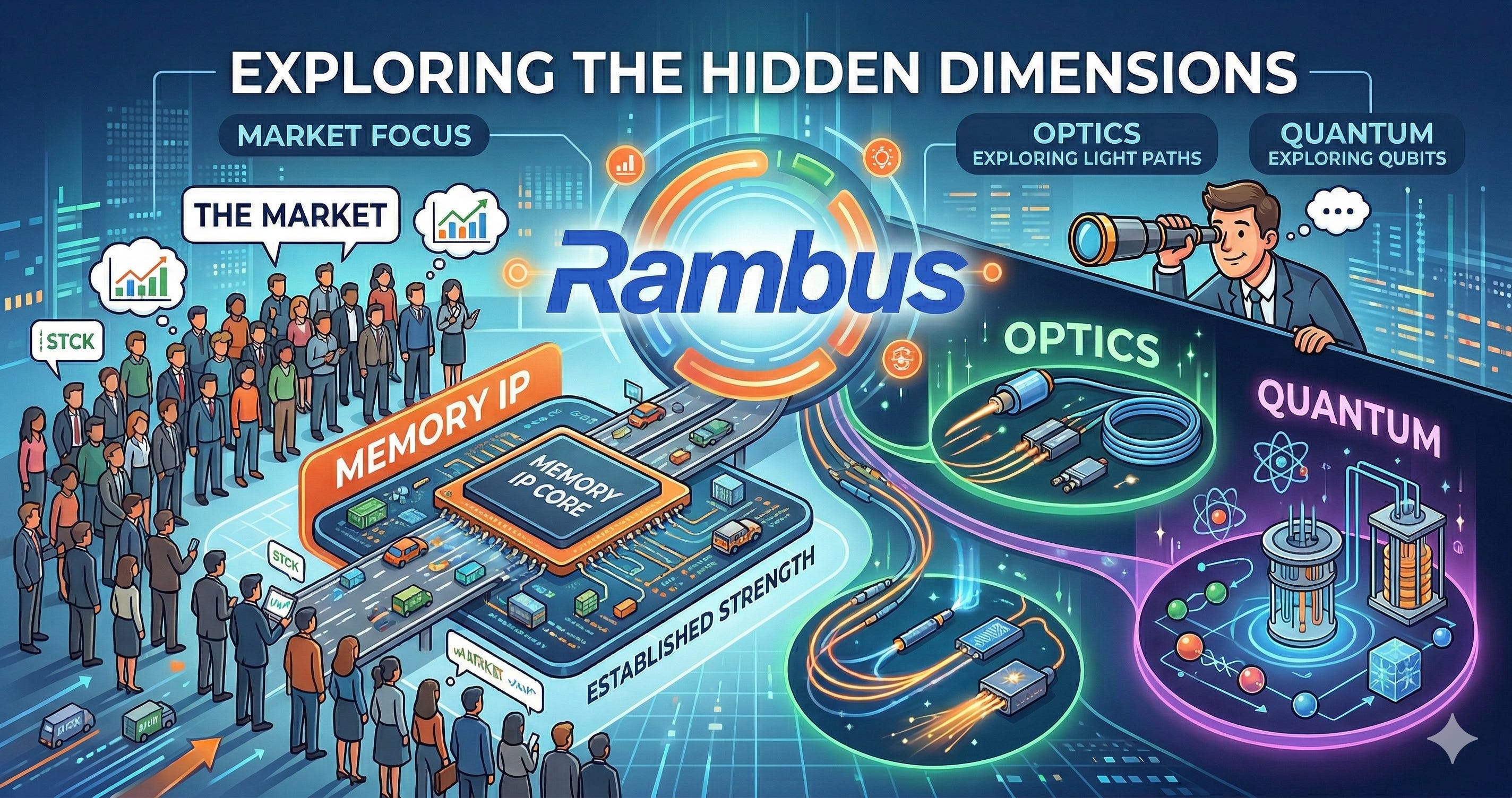
When people think AI semiconductors, the usual names come up. NVIDIA, AMD, Broadcom, Marvell. For memory, it’s Samsung, SK Hynix, Micron. Everyone knows those.
But there’s a company that keeps showing up across multiple layers of this entire ecosystem. Every time NVIDIA builds an AI accelerator, every time Samsung ships DRAM, every time a server gets racked in a data center, this company’s chips or IP are somewhere in the stack.
800 employees, $700M in revenue, 80% gross margin, 45% FCF margin. By any measure, this is a top-tier semiconductor business. The company is Rambus (NASDAQ: RMBS), valued at roughly $10 billion.
The market treats it as a “mid-cap semiconductor that sells DDR5 memory interface chips.” So when DRAM prices go up, Rambus gets dragged along with Samsung and SK Hynix. When DRAM prices fall, same thing. The market filed it under “memory sector” and moved on.
But if you stay with this article, I think your view of this company might shift a bit.
Line up the hottest keywords in AI infrastructure right now.
HBM, optical interconnects, quantum security, custom ASICs….
Rambus has exposure to all of them. It’s inside the custom ASIC market with HBM4E Controller IP. It’s prepping for the next generation of memory interconnects with CXL 3.1 Controller IP. It’s staking a claim on post-quantum security with Quantum-Safe Cryptography and Root of Trust IP.
And in 2024, it publicly demonstrated its own CXL Controller IP running over fiber optic cable.
Then there’s something most people haven’t caught yet, something arguably more important than any of the above: a person who joined the company in February 2026.
This is still speculation at this point, but when I started piecing together what’s been happening in Silicon Valley lately, the picture that emerged around Rambus started looking a lot more interesting than the market gives it credit for.
This article walks through Rambus’s current business, its technology stack, its financial strength, what the market is missing, and what that one person’s arrival might signal about where this company is heading. Let’s start with the business itself.
The Business Model: Three Pillars
Rambus runs on three revenue pillars. Understanding this structure explains why the company’s margins sit at the top of the semiconductor industry.
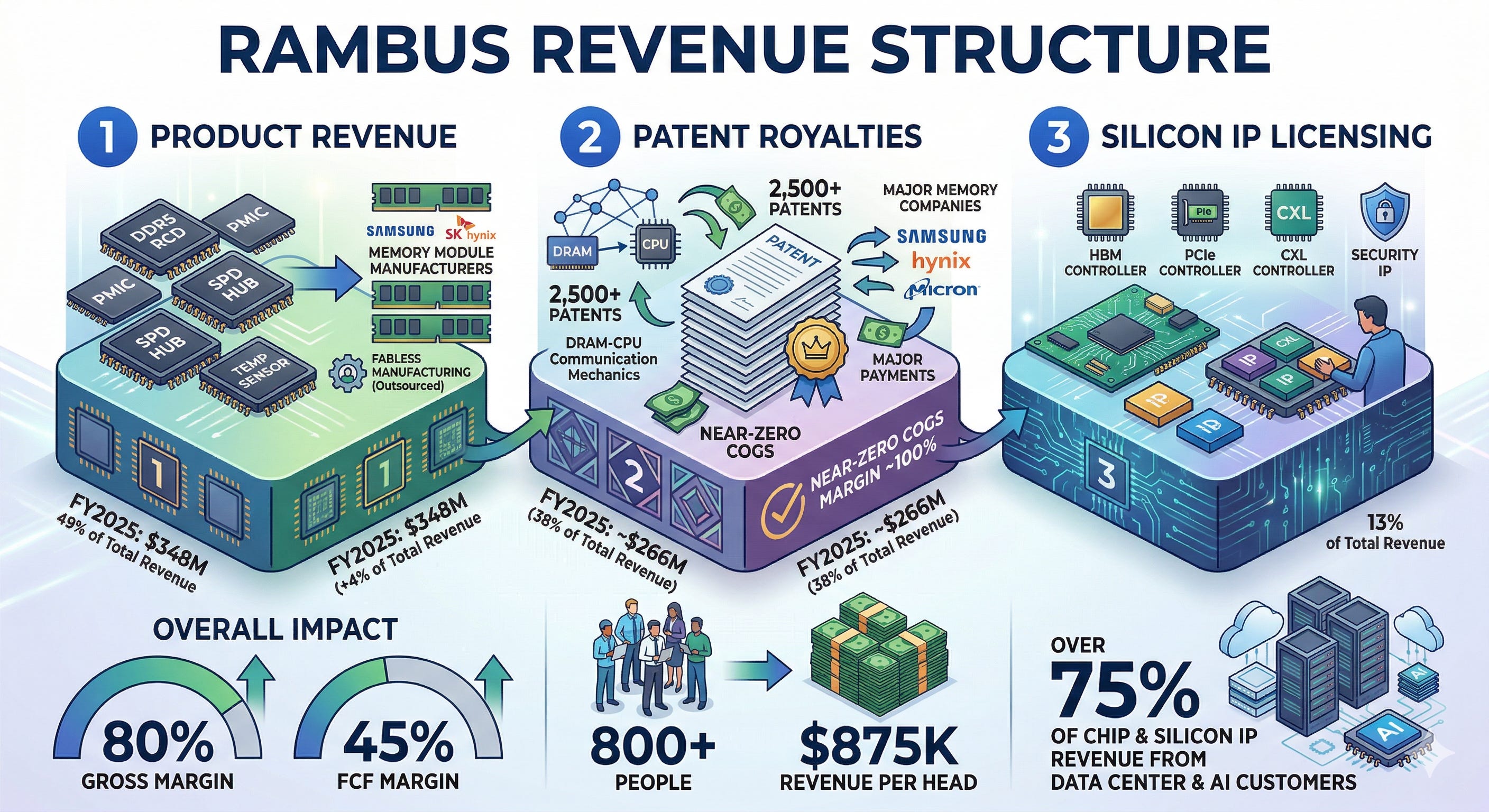
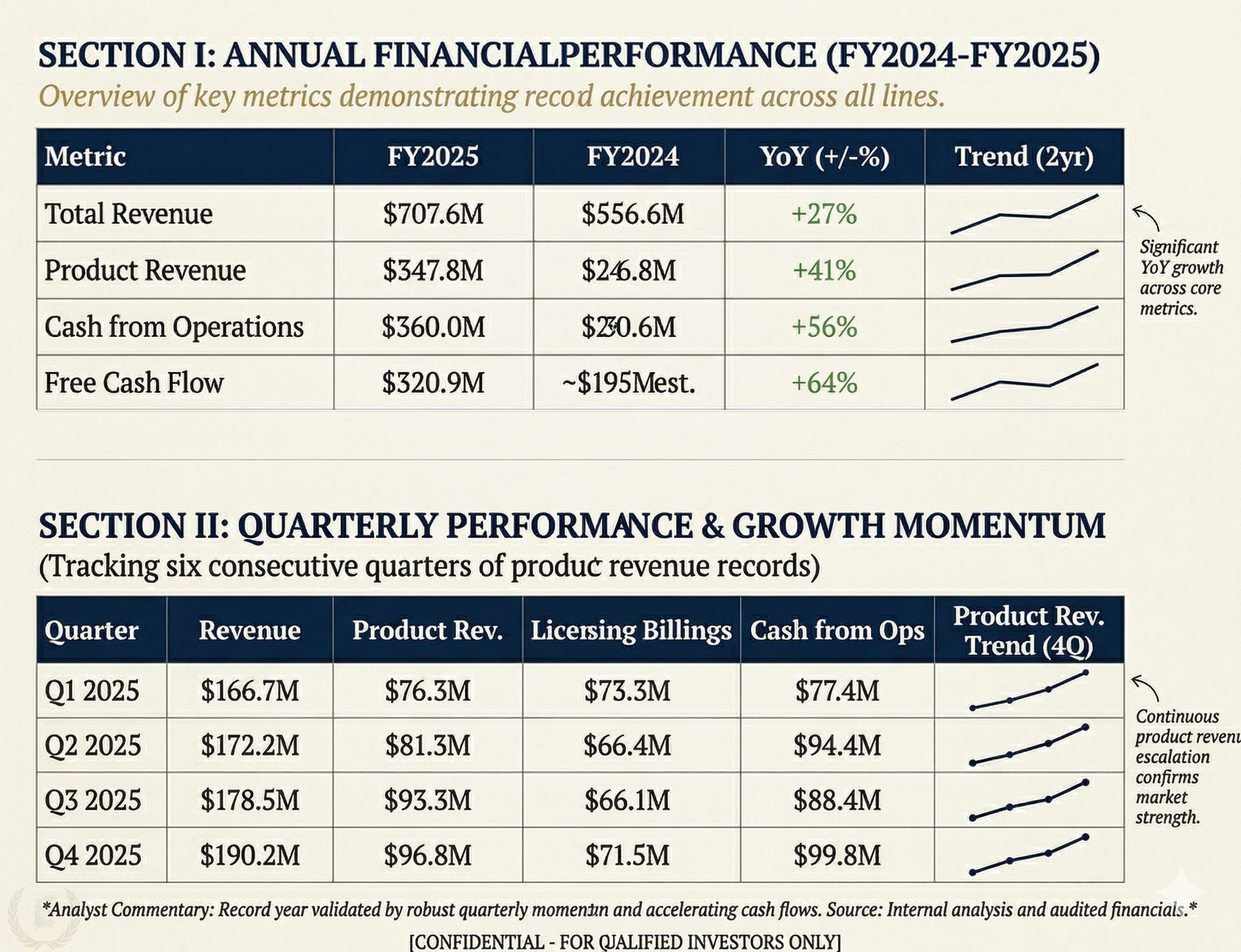
First, revenue from selling chips directly (Product Revenue). Rambus designs DDR5 RCDs and companion chips (PMICs, SPD Hubs, temperature sensors) and sells them to memory module manufacturers. It’s fabless, so manufacturing is outsourced. FY2025: $348M, up 41% year-over-year. About 49% of total revenue.
Second, revenue from patent royalties (Royalty/Licensing Revenue). Rambus holds 2,500+ patents covering the core mechanics of how DRAM communicates with a CPU. Samsung, SK Hynix, and Micron all pay royalties to use them. Near-zero cost of goods, margin approaching 100%. FY2025: roughly $266M, or 38% of total revenue.
Third, revenue from licensing design IP (Silicon IP Revenue). HBM Controller, PCIe Controller, CXL Controller, and security IP licensed to chip designers. About 13% of total revenue.
This mix produces 80% gross margin and 45% FCF margin from 800 people generating $875K in revenue per head. Over 75% of Chip and Silicon IP revenue comes from data center and AI customers.
Let’s go deeper on each pillar.
DDR5 RCD
Without a Traffic Controller, the Highway Jams
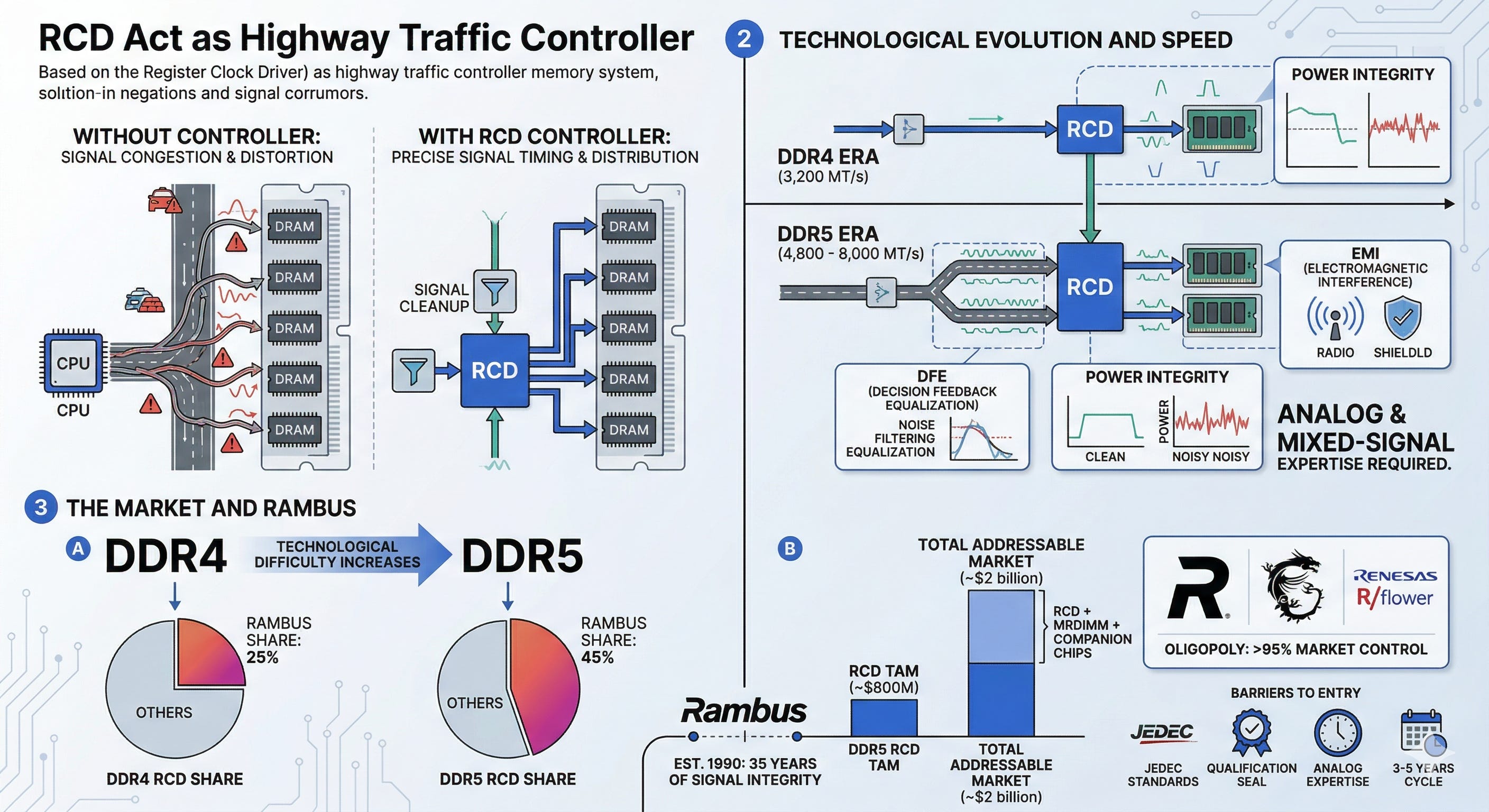
Think of a highway toll plaza. When a CPU sends a command to memory, that signal has to reach all of the DRAM chips on a DIMM at the same time. A single DIMM might have 8 to 16 DRAM chips on it, and every one of them needs to receive the same command with the same timing. As speeds increase, electrical signals start reflecting, distorting, and falling out of sync. The RCD sits between the CPU and the DRAM chips. It receives the incoming signal, cleans it up, and redistributes it to each chip with precise timing.
In the DDR4 era, speeds topped out around 3,200 MT/s, so the job was relatively straightforward. DDR5 split each channel into two sub-channels and pushed speeds from 4,800 all the way up to 8,000 MT/s. At those frequencies, you have to solve DFE (Decision Feedback Equalization), power integrity, and electromagnetic interference problems simultaneously. That requires serious analog and mixed-signal design expertise.
The Harder the Technology Gets, the Better Rambus Looks
Rambus was founded in 1990 and has spent 35 years doing one thing: high-speed signal integrity. Its DDR4 RCD market share was about 25%. By DDR5, as the technical difficulty jumped sharply, that share climbed to 45%. The harder the problem gets, the better positioned Rambus becomes.
A Three-Player Oligopoly
The two competitors are Montage Technology (China, 40-45%) and Renesas (Japan, 10-15%). Three companies control over 95% of the market. Getting in requires simultaneous JEDEC standards participation, years of qualification cycles, and advanced high-speed analog capability. From design start to qualified production takes a minimum of three to five years. New entrants are essentially locked out.
The DDR5 RCD TAM is roughly $800M. Factor in MRDIMM and companion chips, and the addressable market expands to around $2 billion.
The Second Pillar: Patent Royalties — Recurring Revenue at Near-Zero Cost
If You Make Memory, You Pay Rambus
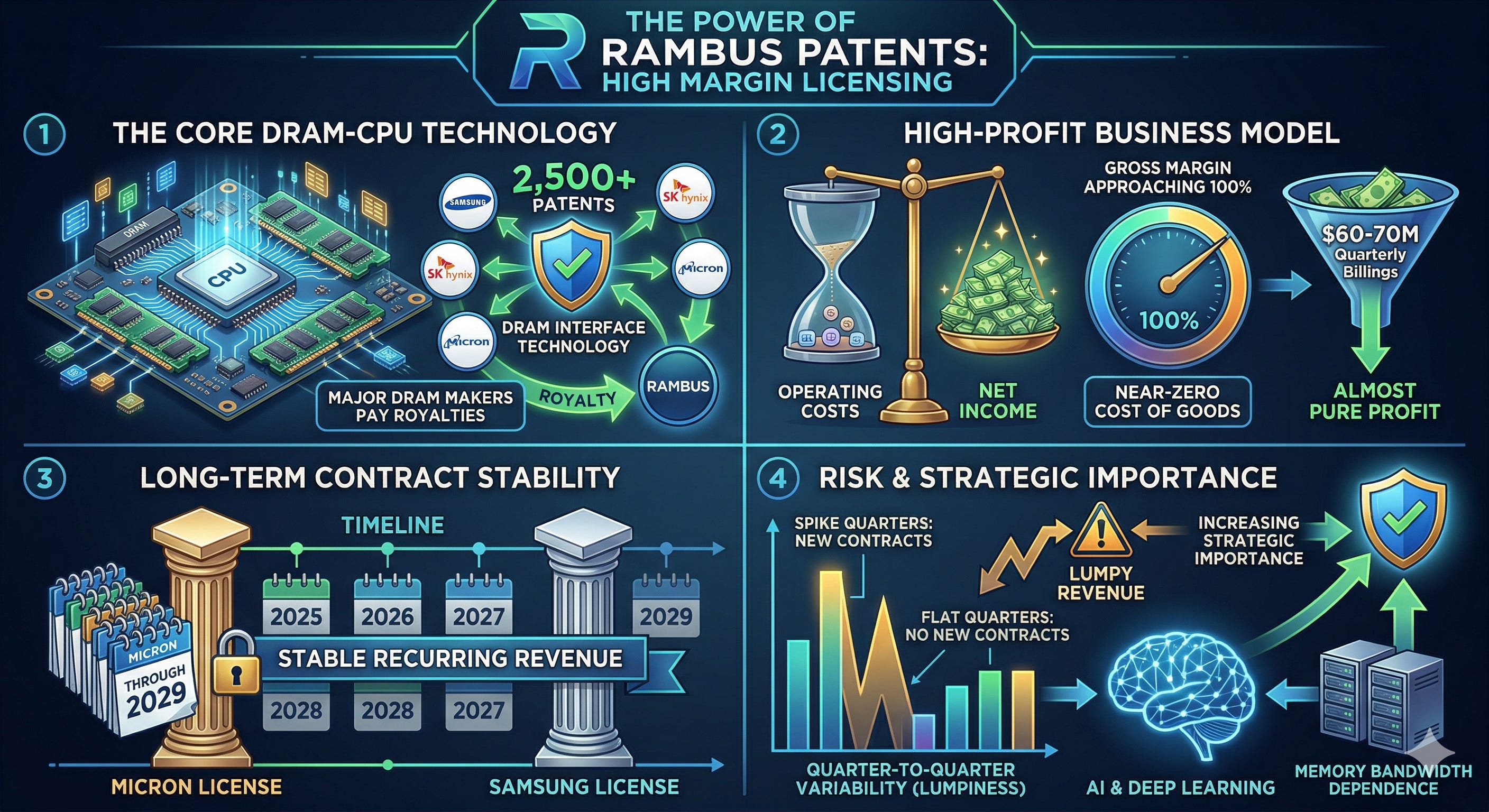
Rambus’s 2,500+ patents cover the core technology behind how DRAM interfaces with a CPU. Samsung, SK Hynix, and Micron all have to use these patents to sell DRAM, and they pay royalties for that right.
The defining characteristic of this business is that it costs almost nothing to run. Patents developed once generate money indefinitely, which is why gross margins approach 100%. Every quarter, $60-70M in licensing billings drops almost straight to the bottom line.
Micron is locked into a long-term license through 2029. Samsung has a license agreement as well. These contracts run for multiple years, so once signed, they generate stable recurring revenue.
There is a risk worth noting. The timing of contract renewals creates significant quarter-to-quarter variability. Revenue spikes in quarters when a new deal comes in, and flattens in quarters when it doesn’t. This lumpiness makes individual quarters hard to read. But the broader point stands: as AI deepens the world’s dependence on memory bandwidth, the strategic importance of memory interface technology keeps rising, and Rambus’s patent portfolio remains squarely in the middle of that.
The Third Pillar: Silicon IP — The Part the Market Is Getting Wrong
Selling Blueprints, Like ARM
ARM Holdings licenses CPU blueprints to Qualcomm and Samsung for smartphones. Rambus does the same thing for memory interfaces and security, licensing design IP to chip companies. Customers embed the IP in their own chips, and when those chips go into production, they pay additional royalties.
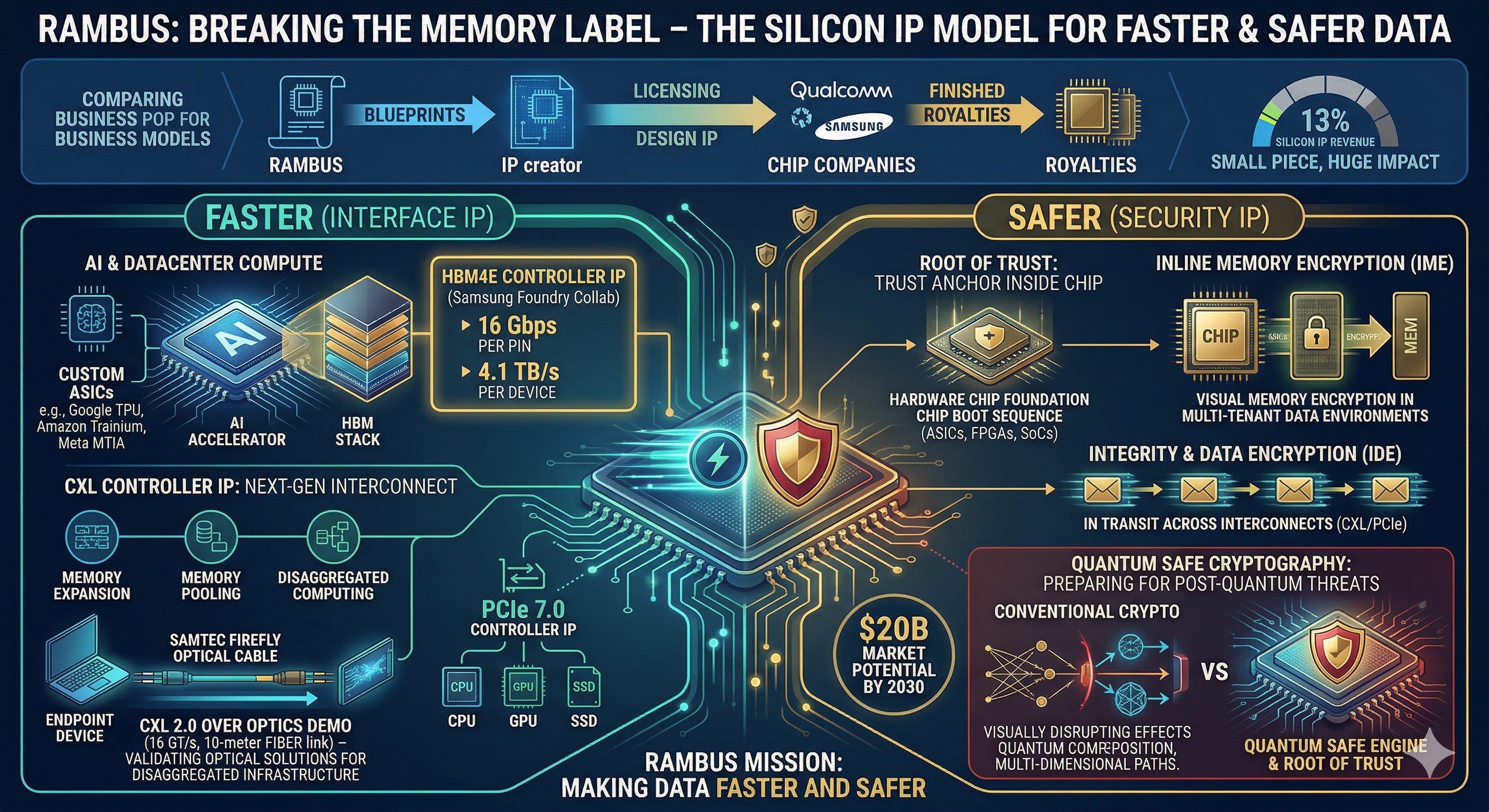
Silicon IP is about 13% of revenue, roughly $94M in FY2025. Still a small piece. But when you look at what’s inside this portfolio, the “memory chip company” label completely breaks down.
Interface IP: Every Protocol That Connects Memory to a Chip
HBM Controller IP. Every AI accelerator needs a controller to manage the HBM attached to it. Companies without the in-house capability to design one license it from somewhere else. Rambus has secured 100+ design wins for its HBM Controller IP. In March 2026, Rambus announced its HBM4E Controller IP: 16 Gbps per pin, 4.1 TB/s per device, developed in collaboration with Samsung Foundry. As custom ASICs, think Google TPU, Amazon Trainium, Meta MTIA, keep multiplying, the TAM for this IP keeps growing with them.
PCIe Controller IP. PCIe connects CPUs to GPUs, SSDs, and network cards. Rambus has Controller IP supporting up to the latest PCIe 7.0 generation.
CXL Controller IP. CXL (Compute Express Link) is the next-generation interconnect standard for tying together CPUs, GPUs, memory, and accelerators. It’s the key enabler for memory expansion, memory pooling, and disaggregated computing architectures. Rambus holds CXL 3.1 Controller IP and has been making aggressive moves in the CXL ecosystem since 2021, acquiring PLDA (CXL/PCIe digital IP), AnalogX (SerDes PHY), and Hardent (CXL SoC design) in succession.
One thing worth flagging here. At FMS 2024 in August 2024, Rambus demonstrated “CXL 2.0 over Optics.” They took an endpoint device running their CXL Controller IP, connected it over Samtec Firefly optical cable, and ran CXL 2.0 at 16 GT/s over 4 lanes on a 10-meter fiber link. It passed compliance testing. Rambus stated in their official blog that “optical interconnect solutions are essential to address the low latency and high bandwidth needs of disaggregated composable infrastructure.” They proved publicly that their IP works not just over copper, but over optical interconnect as well. The significance of that demo will come up again later in this article.
Security IP: Why Does a Memory Company Have Post-Quantum Cryptography?
Rambus’s security IP portfolio runs deeper than you’d expect.
Root of Trust. A hardware security module that establishes a trusted foundation when a chip boots up. It’s embedded inside the chip itself, creating a trust anchor that software attacks can’t reach. Used in AI accelerators, ASICs, FPGAs, and SoCs.
Inline Memory Encryption (IME). Encrypts data as it’s written to memory and decrypts it on read, in real time, with no meaningful performance penalty. Allows full memory encryption in multi-tenant data center environments where multiple customers share the same physical server.
Integrity and Data Encryption (IDE). Encrypts data in transit across interconnects like PCIe and CXL. Protects data moving between chips and between servers.
And then Quantum Safe Cryptography. This is where it gets important. Today’s public-key cryptography systems, RSA, ECC and the like, become vulnerable once quantum computers reach practical scale. Rambus already has a Quantum Safe Engine and Quantum Safe Root of Trust ready to go. Embed this IP into the secure element of an ASIC, SoC, or FPGA, and you get hardware-level security that holds up in a post-quantum world.
The exact breakdown of Security IP within Silicon IP revenue isn’t disclosed publicly. The full Silicon IP segment is 13% of revenue, split between Interface IP (HBM, CXL, PCIe) and Security IP, with Interface IP likely taking the larger share for now. But the potential market for Quantum-Safe security is projected at $20 billion by 2030.
The answer to “why does a memory chip company have quantum cryptography” is that Rambus doesn’t define itself as a memory chip company. Its stated mission is making data “faster and safer.” Faster is the RCD, HBM Controller, and CXL Controller. Safer is Root of Trust, IME, IDE, and Quantum Safe Cryptography. There are very few companies in the semiconductor industry that can claim both sides of that portfolio.
Why Does Security IP Actually Matter?
In the AI era, data is constantly moving between CPUs, GPUs, memory, and across servers. Multi-tenant infrastructure, where multiple customers share the same physical hardware, is becoming the default. In that world, security is no longer a software problem alone. Data at rest in memory, data in transit between chips, and the trust foundation at boot time all need hardware-level protection. That’s what makes Root of Trust, Memory Encryption, and Interconnect Encryption increasingly critical. Add to that the coming quantum threat to current cryptographic standards, and Quantum Safe Cryptography starts looking less like future-proofing and more like a near-term requirement.
Financials
Margin Structure
Gross margin runs 79-81%, a blend of licensing (near 100%) and product (roughly 60%). As Product revenue grows as a share of the mix, gross margin drifts slightly lower, but it stays firmly around 80%.
Non-GAAP operating margin sits at 38-40%. R&D is 27% of revenue, but the high gross margin absorbs it without much pain.
FCF margin: 45%. FY2025 FCF of $320.9M divided by $707.6M in revenue. Capex stays below $40M annually because there’s no factory to run. Since 2021, Rambus has returned 44% of cumulative FCF through share buybacks.
Cash on hand: $762M. Plenty of firepower for M&A or additional buybacks.