On May 6, the KOSPI broke through 7,000. Samsung Electronics joined the trillion-dollar market cap club. SK hynix hit an all-time high. Foreign investors net-bought over 3 trillion won in a single day.
The numbers matter less than the direction. Global investors are turning their attention to Korea. The country’s position in the AI semiconductor supply chain is being re-rated, from “memory cycle trade” to “structural pillar of AI infrastructure.”
But most investors still stop at Samsung Electronics and SK hynix. Below these two giants, dozens of companies form the supply chain across equipment, materials, test, packaging, power, and optics, each connected to entirely different demand drivers. That part is not well understood.
This article is a map that breaks that supply chain apart.
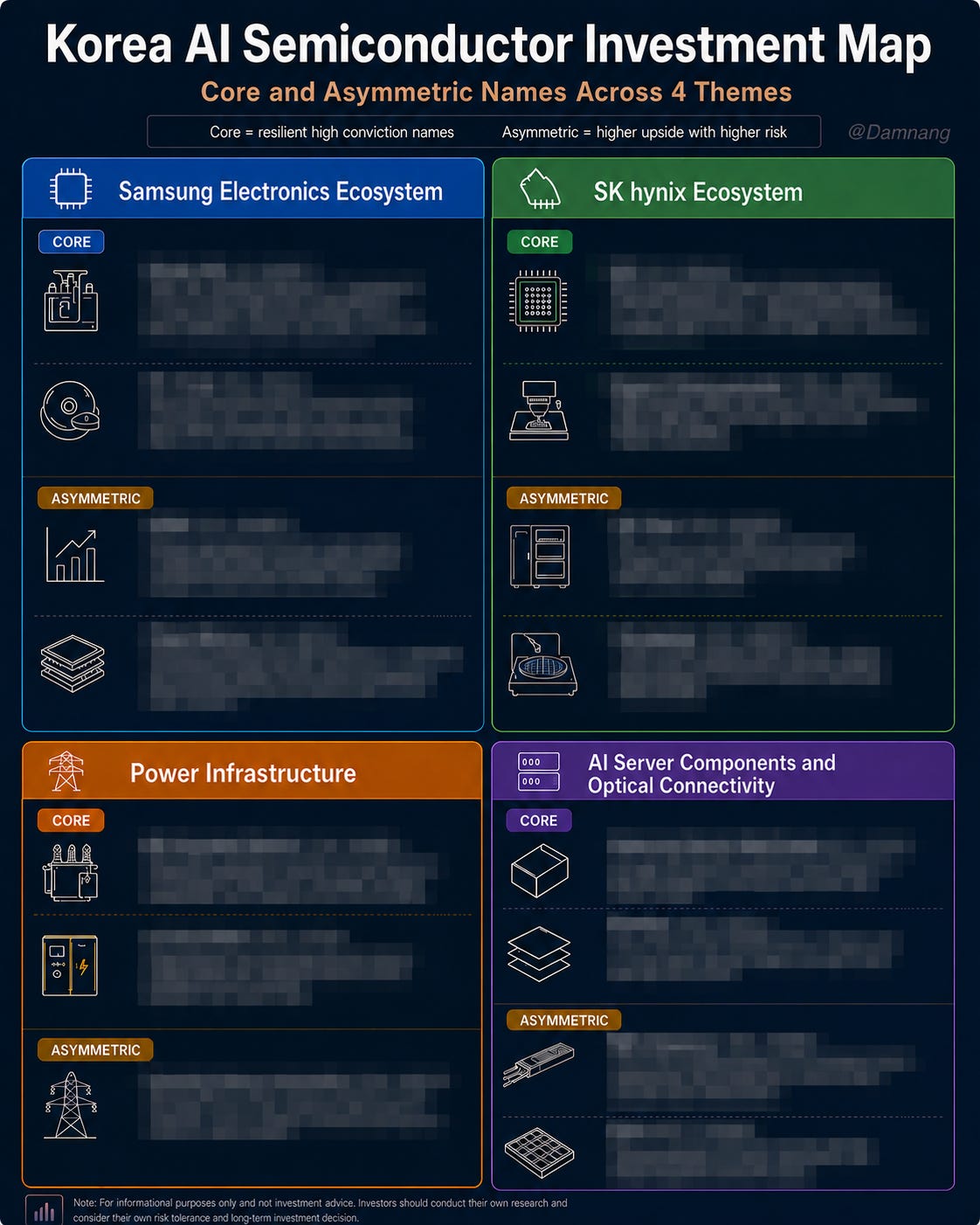
It covers why Korea is still undervalued in AI semiconductor investing, where the opportunities are, and what the market is still missing from the vantage point of Silicon Valley. It takes the single basket called "semiconductor-related stocks" and splits it into four categories, covering the story, the names, what the market is missing, and finally, the companies I am watching most closely in each category.
Disclaimer
This article is industry research analyzing technology and business structures from the perspective of a semiconductor industry professional. It is not a recommendation to buy, sell, or hold any specific stock. Earnings, stock prices, and valuations are subject to change after publication, and past performance or current analysis does not guarantee future results. All investment decisions are the reader’s own responsibility. Please consult a licensed financial professional before making any investment decisions.
Why Global Investors Are Pouring Into Korea
Earnings Have Reached the Same Tier as Global Big Tech
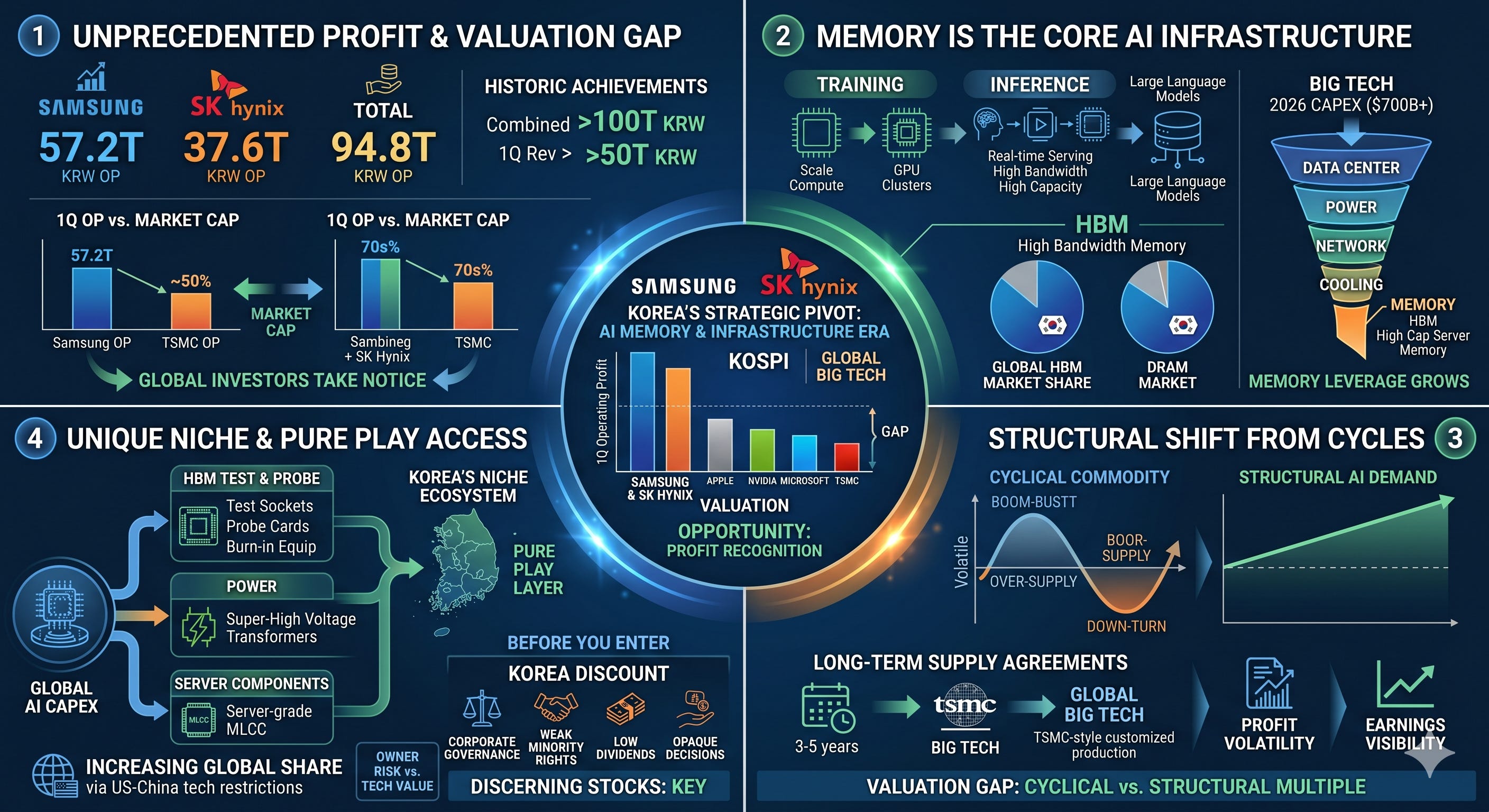
Samsung Electronics posted 57.2 trillion won in operating profit for Q1. That puts it in the same earnings tier as Nvidia, Microsoft, and Apple. It was the first time in the history of Korean corporations that quarterly revenue exceeded 100 trillion won and operating profit exceeded 50 trillion won simultaneously. SK hynix also posted a record Q1 operating profit of 37.6 trillion won at a 72% operating margin.
Combined Q1 operating profit for the two companies: 94.8 trillion won. Among major KOSPI-listed companies that have reported Q1 earnings, these two account for an overwhelming share.
And yet the valuation relative to these earnings is still low. Samsung Electronics far exceeded TSMC in Q1 operating profit. But its market cap is roughly 50% of TSMC’s.
Even combining Samsung and SK hynix, their Q1 earnings significantly exceeded TSMC’s, but as of mid-April their combined market cap was only around 70% of TSMC’s. Global investors saw these numbers and started looking at Korea again.
Memory Has Become Core AI Infrastructure
The center of gravity in AI is shifting from Training to Inference. If Training was a fight centered on massive compute, Inference brings memory bandwidth, capacity, and power efficiency into the picture as critical variables.
Serving large language models in real time requires loading tens of billions of parameters into GPU memory, and the memory needed scales proportionally with user count. That memory is HBM.
HBM is an area where Korea is overwhelmingly strong. SK hynix and Samsung Electronics combined account for well over half the global market. Looking at DRAM overall, Samsung and SK hynix are core suppliers covering the majority of global share.
The Cloud Big 4 (Microsoft, Google, Amazon, Meta) are expected to push 2026 CAPEX past $700 billion. Not all of that goes to GPUs. Data centers, power, networking, cooling, and memory all grow together. Within that, HBM and high-capacity server memory have established themselves as core components of AI infrastructure. The bigger the AI market gets, the stronger Korea’s memory companies’ leverage becomes.
Transitioning from Cycle to Structure
The most fundamental reason global investors are pouring into Korea is this: at least in HBM and high-value AI server memory, a different structure is emerging compared to the old commodity DRAM cycle.
Memory is no longer a cyclical industry.

I had the chance to attend a seminar by SK Hynix’s North America regional president at a Silicon Valley Korean semiconductor meetup today. The topic was memory in the AI era. It was only about 20 minutes, but it was packed with insight on the structural shifts reshaping the memory market, the technical roadmap for HBM, and things investors genuinely need to understand.
In the past, DRAM prices surged and crashed with supply and demand. The market learned this pattern and applied cyclical multiples to memory companies. What is happening now is different. Long-term supply agreements spanning 3 to 5 years are being signed with Big Tech.
This is an evolution toward TSMC-style order-based production. Earnings volatility is dampening and visibility is expanding. Investors are starting to recognize this, and capital is flowing in, but valuations have not fully caught up. A gap remains between cyclical multiples and the multiples appropriate for structural demand companies. The narrowing of that gap is the investment opportunity.
Things Listed Here That You Cannot Buy Elsewhere
There are many markets where you can invest in AI semiconductors. But in most of them, you only get broad exposure. Buy the GPU designer and you are betting on AI as a whole. Buy the big equipment company and you are betting on semiconductor capex as a whole.
Stocks that give you pure exposure to specific bottlenecks like “HBM test complexity increase” or “ultra-high-voltage transformer supply imbalance” exist in some other markets, but it is rare to find a market like Korea where bottlenecks around AI memory and power infrastructure are tightly mapped across multiple independent listed companies.
Korea is different.
HBM test sockets, probe cards, burn-in equipment, ultra-high-voltage transformers, AI server MLCCs. Niche companies connected to AI infrastructure bottlenecks exist as independent listed entities.
If the U.S. market is the “chip + cloud” layer of AI, Korea is the “memory + infrastructure” layer. They sit on the same AI capex but give access to a different tier, and within that tier you can pick individual bottlenecks.
The tightening of U.S. restrictions on China is also pushing up the global share of Korean companies, reinforcing this structure.
What You Need to Know Before Coming In
Money flowing in does not mean risks are absent.
The Korea Discount is real.
Chaebol governance, disregard for minority shareholder rights, low dividend payout ratios, opaque decision-making. The reason Samsung Electronics trades at a lower valuation than TSMC is not just about cycle perception. There is a governance discount baked in. Recent moves around the Value-Up Program and increased shareholder returns are encouraging, but this is not a problem that changes overnight.
You need to know this going in.
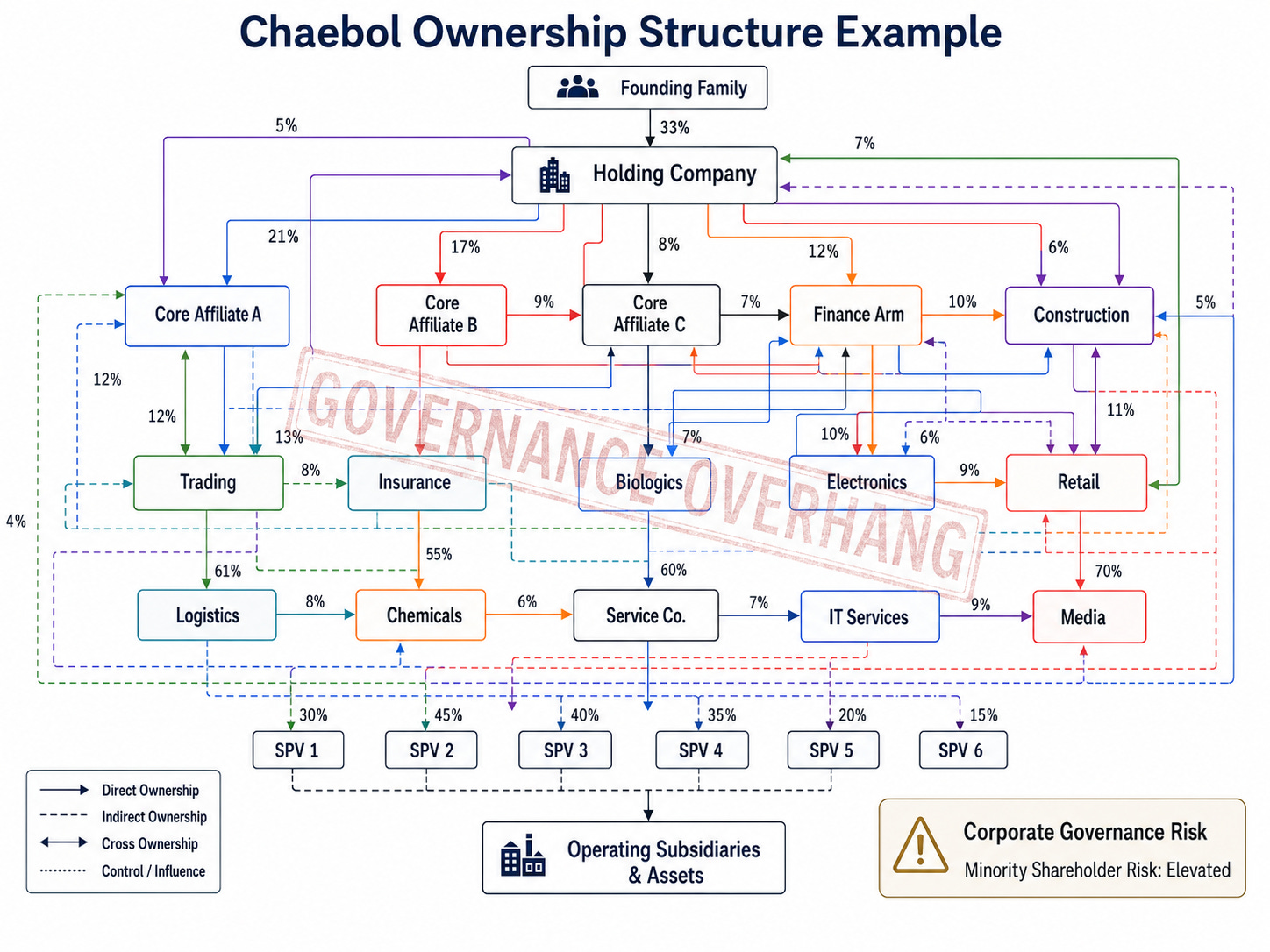
That said, the discount does not apply equally to every stock. Large conglomerates with significant owner risk and mid/small-cap equipment and component companies that live on technology carry different types of discount. So investing in Korea’s AI semiconductor space is not simply about “it’s cheap.” It is a game of understanding why it is cheap and identifying which stocks can escape that discount.
Structure of This Map
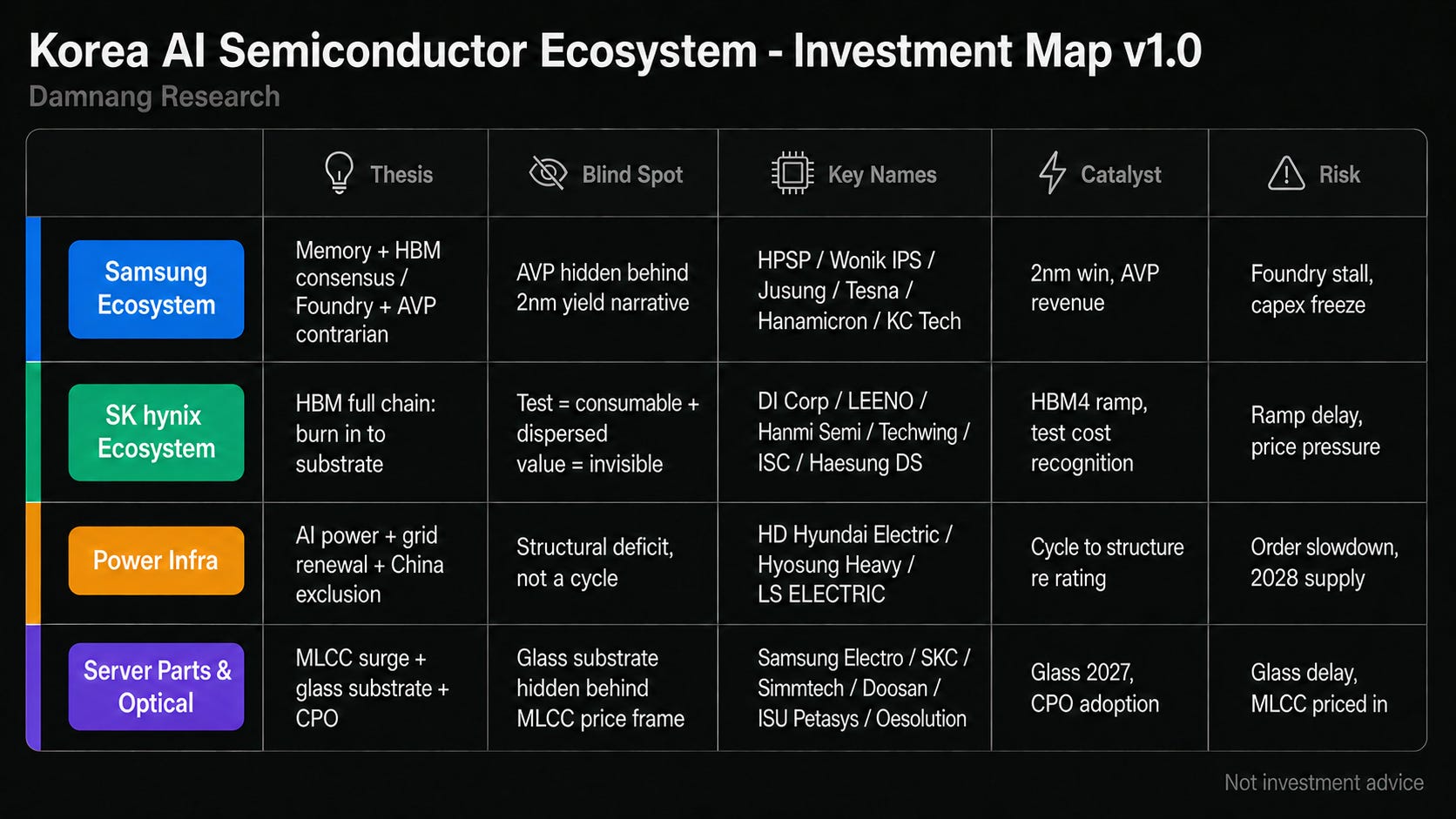
This article divides the Korean AI semiconductor ecosystem into four categories. Even stocks grouped under the same “semiconductor-related” label move at entirely different timings and in different directions depending on which demand they connect to.
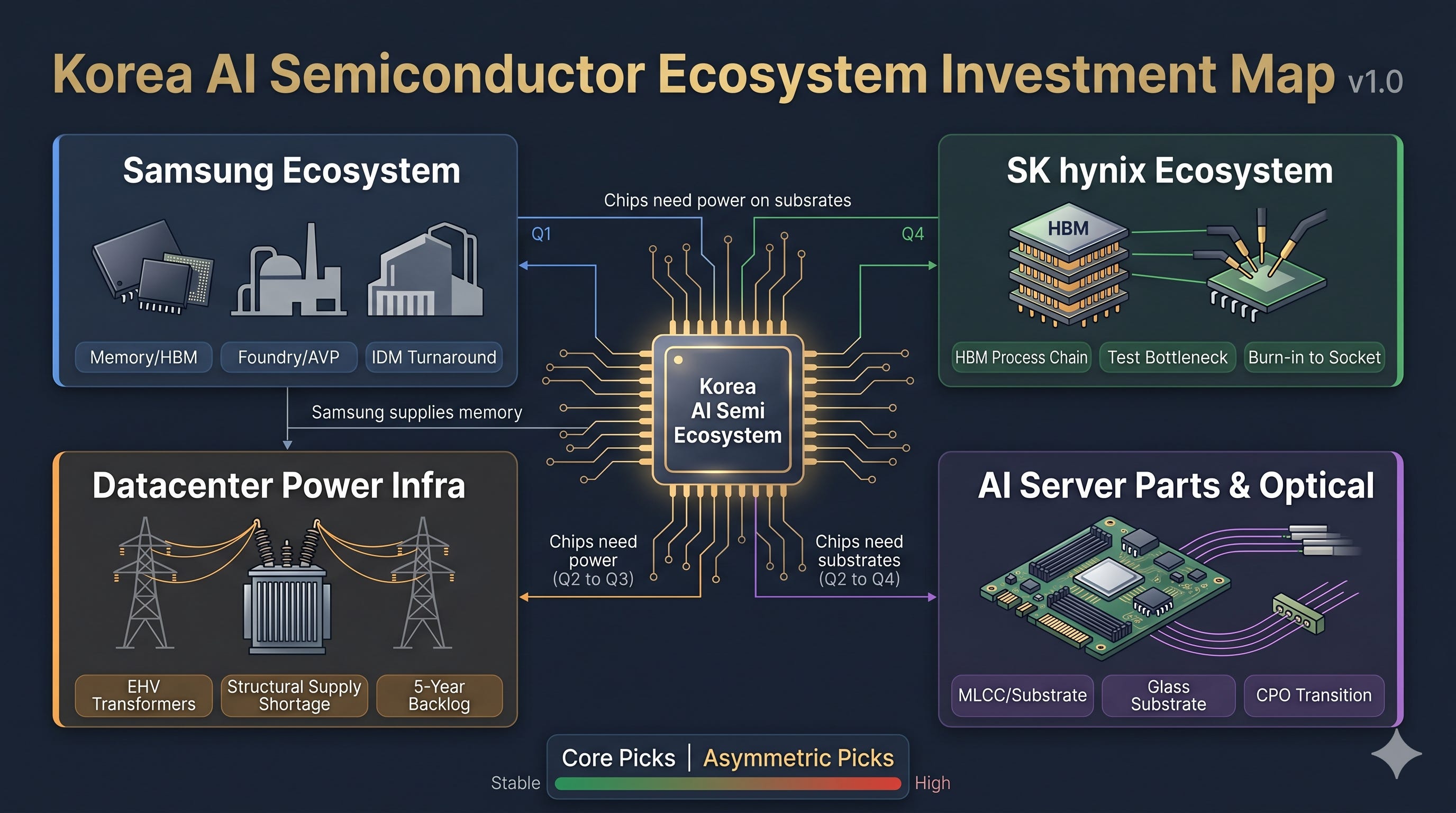
Category 1. Samsung Electronics Ecosystem.
Stocks that move when Samsung’s capex moves. This is the segment where the IDM’s power drives memory, HBM4, foundry, and AVP (Advanced Packaging) simultaneously.
Category 2. SK hynix Ecosystem.
Stocks that ride along when SK hynix’s HBM sells. TC bonding, test, substrates. Test complexity increases non-linearly as stack count rises, and the market has not yet fully priced this in.
Category 3. Data Center Power Infrastructure.
Stocks that benefit when AI data centers get built. If HBM is the bottleneck inside the server, transformers are the bottleneck before the server even turns on. The category with the highest earnings visibility in this map.
Category 4. AI Server Components & Optical Interconnects.
Stocks that rise when the components connecting chip to chip inside the server get upgraded. MLCCs, substrates, optical transceivers. Not the chip itself, but the infrastructure required for the chip to function.
Below, each category covers why this space deserves attention now, which stocks connect to which bottlenecks, what the market is missing, and the conditions under which the thesis breaks, all at once. Then, at the end, I walk through the names I am watching most closely in each category. The aim is to surface things hidden behind the market's existing frames, things that only become visible with deeper technical understanding, and use them to find investment opportunities.