

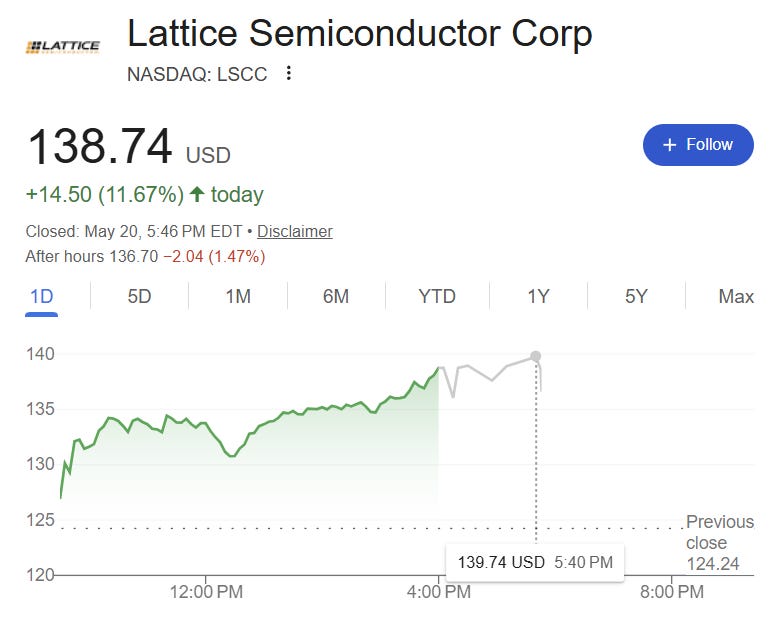
On May 20, Lattice Semiconductor stock jumped roughly 12% in a single day. The stock has nearly doubled over the past year. The direct trigger was CEO Ford Tamer reaffirming the AI demand story at the JP Morgan Global Technology Conference, but the bigger picture is that the market’s view of this company as a simple FPGA parts vendor is changing fast.
This article breaks down what Lattice actually does, what kind of technical moat it has, why the stock had to move the way it did, and whether it still makes sense to enter at these levels. After reading this, you should have a clear framework for how to treat LSCC inside an AI infrastructure portfolio.
Disclaimer
This article is for informational purposes only. It is not investment advice or a buy/sell recommendation on any specific security. All investment decisions and their consequences belong to the reader.
Section 1. The AI server control plane, and low power FPGA
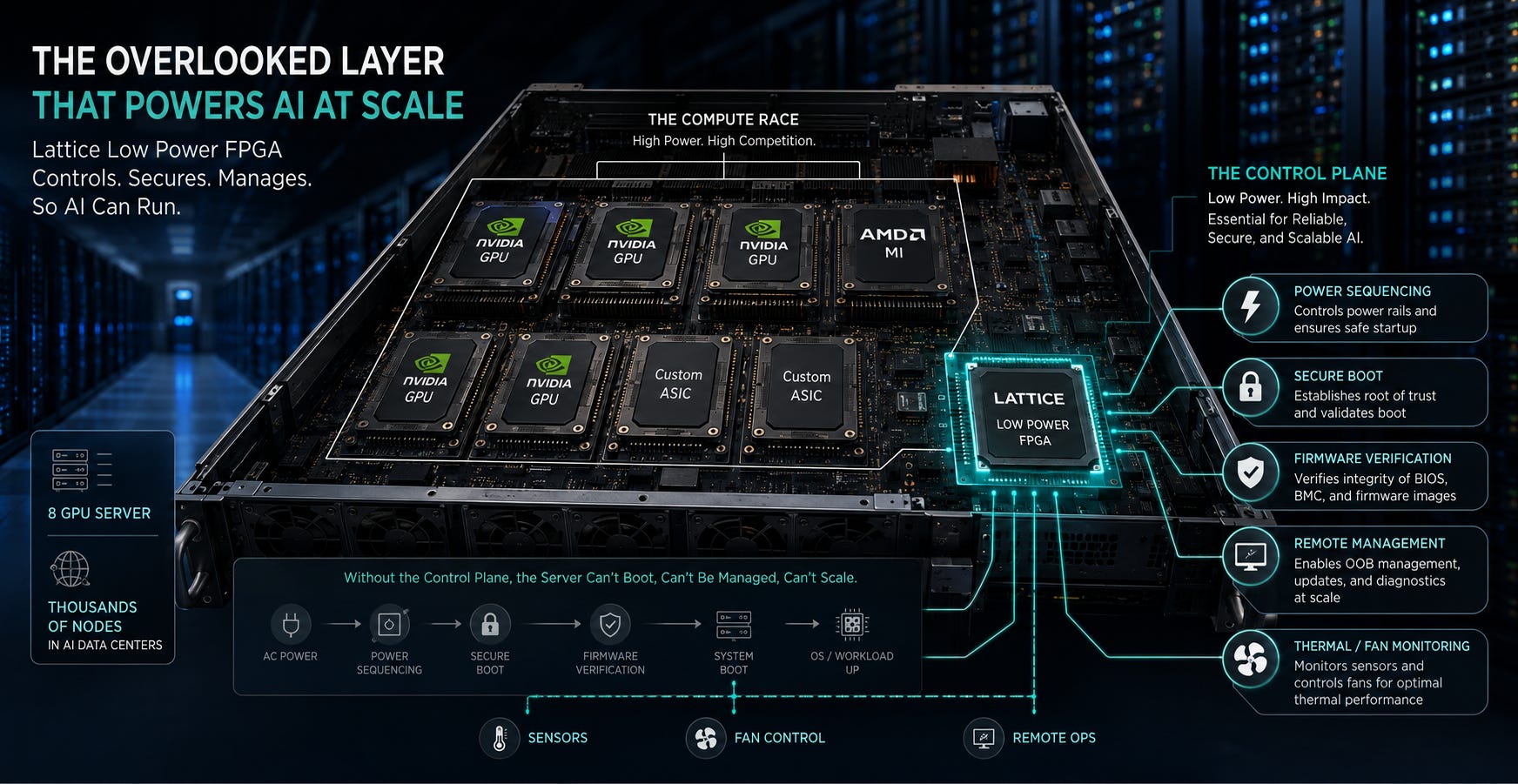
When people look at AI servers, attention almost always goes to the main chip. Will NVIDIA GPUs keep dominating, will AMD MI series take share, will hyperscalers move more workloads to their own ASICs. That is the core debate. The “AI socket war” investors talk about is really about this seat. Who takes the most important compute chip slot inside the server.
But a server does not run on the main compute chip alone. No matter how strong the GPU is, if the server does not power on reliably, if firmware gets tampered with during boot, if you cannot manage tens of thousands of boxes remotely, it is not a datacenter-grade machine.
Especially in AI datacenters, eight-GPU servers are deployed in racks numbering in the thousands or tens of thousands. Nobody walks up to each box and checks the power, reads the temperature, and diagnoses faults by hand.
That job belongs to the control plane. It sequences power on the board, validates boot code, monitors security state, watches fan speed and temperature, and lets operators recover remotely when something breaks. It is not a glamorous seat. It does not take up much of the server BOM either. But you cannot ship without it. It is involved from the first moment the server powers on through every recovery cycle afterward.
Lattice makes the low power FPGA that sits in this control plane.
FPGA stands for Field Programmable Gate Array. A chip whose internal logic connections can be redefined after manufacturing. A normal silicon chip has its circuits locked the moment it leaves the fab and cannot be restructured. An FPGA can be updated post-deployment by reloading firmware, modifying or adding functionality on the fly. In the control plane area, where every OEM has a different board layout and security standards change every year, that reconfigurability is exactly what fits.
Looked at as overall FPGA market share, Lattice is a small company. But the picture changes when you narrow the lens to the control plane seat. Start with how defensible that seat actually is.