


In March 2026, the world’s largest optical communications conference, OFC, took place. HyperLight demonstrated a TFLN-based 1.6T transceiver. OpenLight unveiled a III-V heterogeneously integrated silicon photonics PIC with lasers and modulators on one chip. China’s Liobate exhibited 1.6T and 3.2T DR8 TFLN modulator product lines.
What Lightwave Logic brought to the table during the same period was foundry-related progress. A development agreement with Tower Semiconductor, and news that its design was now available in the GlobalFoundries PDK. These announcements do matter. For nearly 30 years, one of the biggest open questions around EO polymer commercialization has been “where do you manufacture this?” For the first time, a realistic manufacturing path is taking shape.
The problem is what comes next.
A foundry announcement does not equal product adoption, and PDK availability does not equal production qualification. Yet the market treated these two pieces of news as near-equivalents of hardware commercialization. The stock surged more than 40% intraday the day after the announcement, pushing the market cap past $1.5B.
But FY2025 revenue was $236,855. The company has 34 employees.
A working transceiver has never been publicly demonstrated.
The foundry progress is meaningful. But that meaning is closer to “the door to commercialization has opened” than “commercialization has been proven.” This article analyzes where LWLG’s core technology, EO polymer modulators, actually stands technically, what the PDK news really means, where EO polymers fit in a four-way technology race, and in which products they can realistically be adopted.
Table of Contents
Background: Why Next-Generation Modulators Are Needed
EO Polymer Modulators: Where LWLG’s Technology Actually Stands
What the PDK News Actually Means
Competition: EO Polymer Is Not the Only Player in This Market
Product-by-Product Analysis: Where It Can Win and Where It Loses
So Why Did This Stock Rally? Valuation and Checkpoints
What It Takes for This Rally to Continue
This article is a technology analysis based on publicly available information and industry sources. It does not constitute a recommendation to buy or sell any security. Figures and projections reflect the time of writing and may differ from actual outcomes. All investment decisions and their consequences are the sole responsibility of the reader.
1. Background: Why Next-Generation Modulators Are Needed
Data transfer between servers in data centers happens as light traveling through optical fiber. The optical transceiver that handles this conversion contains a modulator. It takes electrical signals (0s and 1s) and changes the properties of light to encode them.
With the AI era, the speed demanded from modulators has surged. Per-lane rates are moving from 100G to 200G to 400G, and full transceiver targets are 1.6Tbps and 3.2Tbps.
The mainstream silicon modulator works by injecting or removing electrons inside a waveguide to change its refractive index (carrier plasma dispersion). Because electrons have to physically move, there’s a speed ceiling, and the modulation process absorbs light, degrading signal quality. In mainstream silicon implementations, these tradeoffs escalate sharply beyond 200G/lane. Today, DSP (digital signal processing) chips compensate for these limits, but DSPs themselves consume a lot of power.
This is where demand for next-generation modulators comes from. LWLG’s EO polymer is one of the candidates.
The War of Light, A Laser Shortage

On March 2, 2026, NVIDIA invested $2B in Coherent and another $2B in Lumentum. Both companies make lasers. The two announcements came on the same day and included “multi-billion dollar purchase commitments” and “future capacity access rights.” Jensen Huang wasn’t just buying lasers. He was locking up the ability to make them.
2. EO Polymer Modulators: Where LWLG’s Technology Actually Stands
Perkinamine
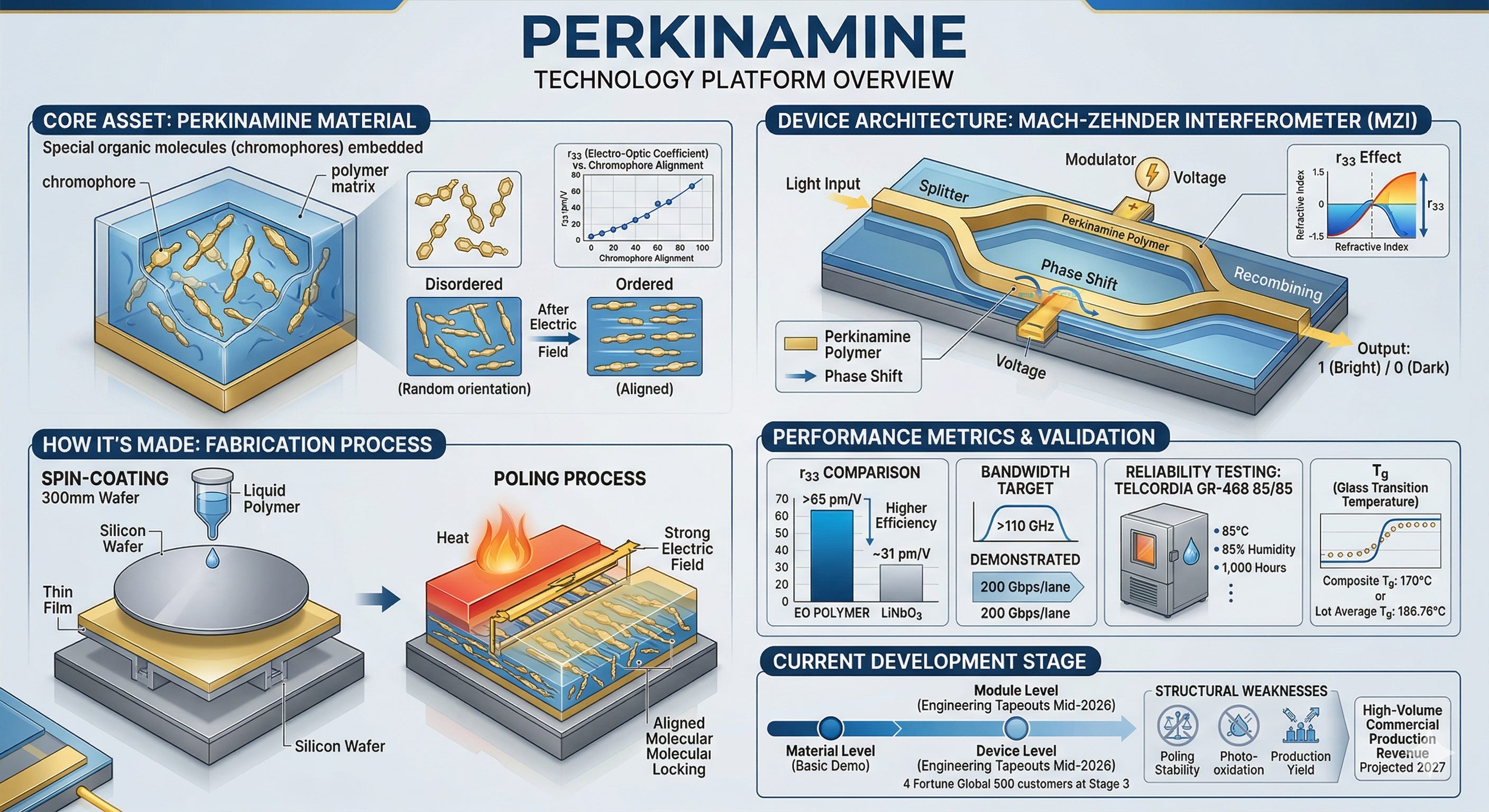
LWLG’s core asset is a material platform called Perkinamine. EO stands for “electro-optic,” meaning the material changes its optical properties when an electric field is applied. It’s a specialized organic polymer.
The actual substance consists of chromophores (specialized organic molecules that interact with light) embedded in a polymer matrix. When you apply an electric field to these chromophores, the electron distribution in the molecules shifts, which changes the speed (refractive index) of light passing through. This is called the Pockels effect. Unlike silicon modulators that physically move electrons around, the electric field itself changes the material’s properties, which makes it much faster.
The key performance metric for EO polymers is r33 (the electro-optic coefficient). It measures how much the refractive index changes per unit of applied electric field. A higher r33 means you can modulate light with less voltage, and you can achieve the same performance in a smaller device.
How It’s Made
Inside a silicon photonics chip, you create a narrow gap (slot waveguide) in the waveguide and fill it with Perkinamine. The filling method is spin-coating: you drop liquid polymer onto the wafer and spin it at high speed to spread a thin, uniform film.
After filling, a process called poling is required. This aligns the chromophore molecules in one direction. If the molecules are randomly oriented, the electro-optic effects cancel out. You heat the material and apply a strong electric field to align the molecules, then cool it down so they lock in place.
The resulting modulator operates in an MZI (Mach-Zehnder Interferometer) structure. Light is split into two paths, voltage is applied to one path to shift its phase, then the two paths are recombined. When the phases match, the output is bright (1). When they’re opposite, it goes dark (0).
The key advantage is that you can use existing silicon photonics foundry 300mm lines to fabricate the silicon waveguide, then simply add spin-coating and poling steps.
No special wafers needed.
Published Specs and Validation Status
Here’s what LWLG has disclosed about Perkinamine’s specs.
Bandwidth target is 110GHz or above, with 200Gbps/lane demonstrated. The exact r33 value is undisclosed, but academic literature reports EO polymer r33 above 65 pm/V. For comparison, LiNbO3 has an r33 of about 31 pm/V, so EO polymers are roughly 2x higher. The material does not use rare earth elements, reducing related geopolitical supply risk.
For reliability testing, LWLG announced in July 2025 that it passed Telcordia GR-468 85/85 testing: 1,000 hours at 85°C and 85% humidity. This is an accelerated life test that extrapolates long-term durability from short-term harsh conditions. It is not the same as guaranteeing 25 years of real-world operation.
The Tg (glass transition temperature, the point where the polymer softens and loses its electro-optic properties) was reported in LWLG’s 2024 technical documentation as composite Tg 170°C and lot average Tg 186.76°C.
The fact that Tg used to be undisclosed was a common criticism, so publishing these numbers is a positive step. However, this is company-reported data, not independently verified. Whether a Tg of 170°C holds up for 10 or 20 years in a data center environment can only be confirmed after actual volume production.
Current Development Stage
At the material level, basic performance has been demonstrated to some degree.
At the device (chip) level, production has not been qualified. Engineering tapeouts at Tower and GF are planned for mid-2026.
At the module (transceiver) level, no finished product has ever been shown. LWLG is a material/IP company and doesn’t build transceivers itself, but no customer-built transceiver using an LWLG modulator has been publicly shown either.
Per the company’s February 2026 update,
four Fortune Global 500 customers are at Stage 3 (prototype to product).
In the 10-K filing as of January 2026, it was three. The February 24 update brought it to four.
Roughly 15 customers are in Stages 1 through 2. Zero customers have reached Stage 4 (formal production decision).
All customer names are undisclosed.
The company projects the earliest high-volume commercial production revenue in 2027.
Structural Weaknesses
These are the problems that have blocked EO polymer commercialization for 30 years.
Tg and thermal stability.
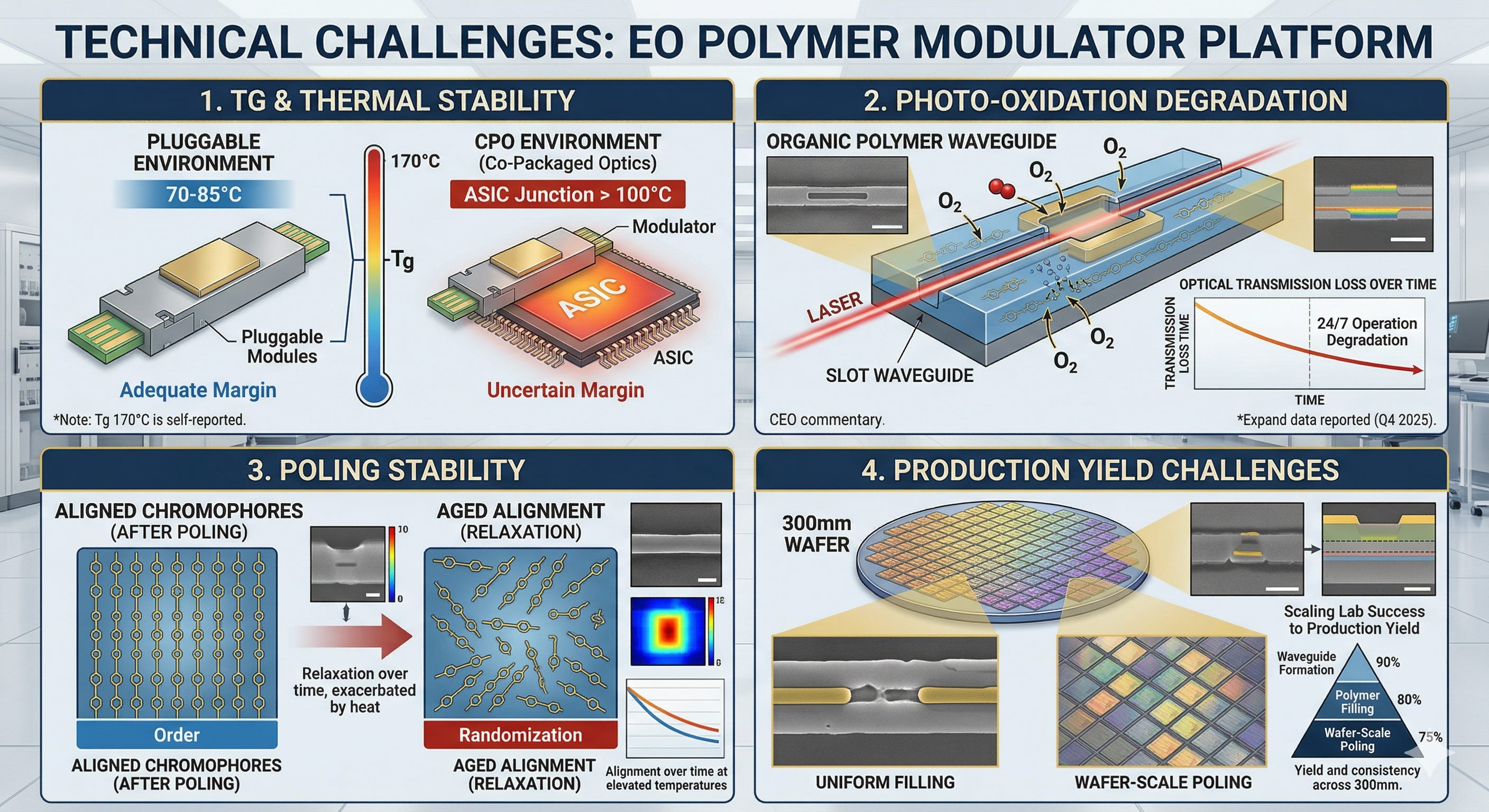
If the Tg is 170°C (per company data), there’s adequate margin for pluggable environments (70 to 85°C). But in CPO environments where ASIC junction temperatures exceed 100°C, whether a 170°C Tg provides sufficient long-term margin is a separate question. And again, this figure is self-reported, not independently verified.
Photo-oxidation.
Organic materials degrade when exposed to light over time through reaction with oxygen. Data center equipment runs 24/7. The CEO mentioned on the Q4 2025 earnings call that they had expanded data on this, but did not disclose specific numbers.
Poling stability.
The molecular alignment can relax over time, especially at elevated temperatures.
Production yield.
Uniformly filling polymer into slot waveguides and performing consistent poling across an entire 300mm wafer is a high-difficulty process. Lab-scale success and production-scale yield are entirely different problems.
3. What the PDK News Actually Means
The March 2026 news that sent LWLG’s stock soaring was the Tower Semiconductor and GlobalFoundries announcements. These were bundled together as “PDK milestones,” but the actual content reflects different stages of progress.
Tower Semiconductor: Development Agreement (March 12)
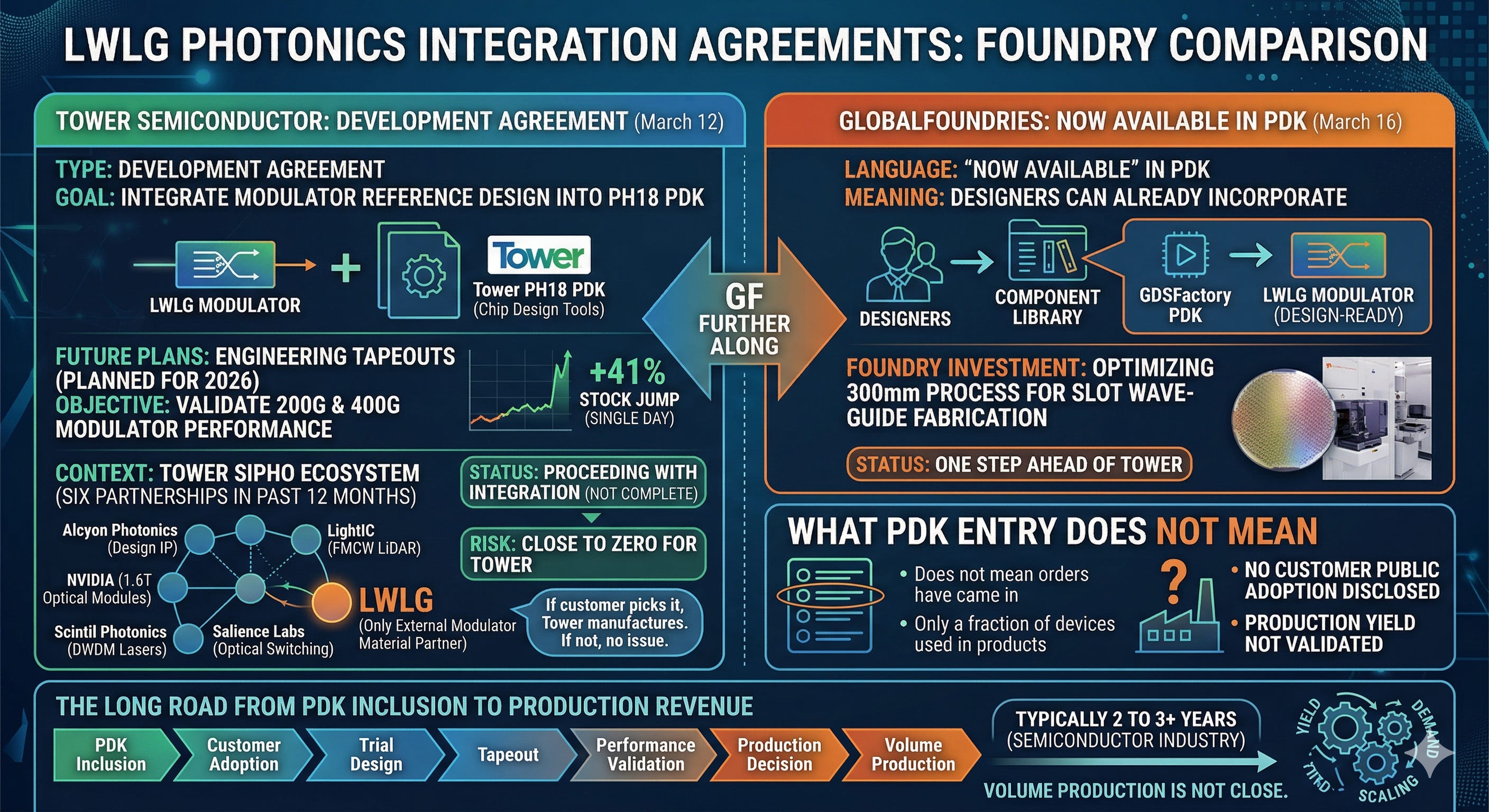
What was signed with Tower is a development agreement. The goal is to integrate LWLG’s modulator reference design into Tower’s PH18 silicon photonics PDK (the component library and design rule set that chip designers use). Multiple engineering tapeouts are planned for 2026 to validate 200G and 400G modulator performance. The stock jumped 41% in a single day.
The key point: this is an agreement to proceed with integration. It is not an announcement that integration is complete.
GlobalFoundries: “Now Available” in PDK (March 16)
The GF announcement used different language. LWLG’s modulator platform is “now available” in the GDSFactory PDK. This means designers can already incorporate the LWLG modulator into their chip designs through this PDK. The announcement also mentioned that GF is optimizing its 300mm process for slot waveguide fabrication.
This is one step ahead of Tower, and it signals foundry-level investment in the process.
What PDK Entry Does Not Mean
Being in a PDK means “it’s on the menu.” It does not mean “orders have come in.” PDKs contain dozens to hundreds of device options, and only a fraction of those end up in actual customer products. No customer has publicly disclosed adopting the LWLG modulator in a product design, and production yield has not been validated.
Tower’s PH18 platform already has its own built-in silicon modulators. Over the past 12 months, Tower has been expanding its ecosystem across the SiPho stack through six partnerships: Alcyon Photonics (design IP), LightIC (FMCW LiDAR), NVIDIA (1.6T optical modules), Scintil Photonics (DWDM lasers), and Salience Labs (optical switching). Among these, LWLG is the only external modulator material partner. But that does not mean Tower has gone all-in on EO polymers. It added one more option on top of its existing silicon modulators, something customers can reach for when they need higher performance.
Tower’s risk here is close to zero. LWLG builds the reference design and puts it in the PDK. If a customer picks it, Tower manufactures. If nobody picks it, that’s the end of it.
That said, registering a device in a PDK is not cost-free. The foundry has to verify process compatibility, write design rules, and commit engineering resources. Given that Tower is investing $920M in CapEx for its SiPho business and put LWLG into the PDK after technical due diligence, it is at least a signal that foundry-level validation of technical feasibility has been passed.
Still, the market is reading this news as “volume production is getting close,” but from PDK inclusion to actual production revenue, there is a long road ahead: customer adoption, trial design, tapeout, performance validation, and production decision. In the semiconductor industry, this process typically takes 2 to 3 years or more.
The Difference from HyperLight
During the same week (March 11 to 13, 2026), TFLN company HyperLight also announced a major partnership. Comparing the details reveals a maturity gap.
HyperLight signed a “strategic manufacturing partnership for high-volume foundry production” with UMC (a global top-5 foundry). This is not just putting a device in a PDK.
It’s a commitment to allocate 6-inch and 8-inch production lines to TFLN chiplet manufacturing. On top of that, Jabil (one of the world’s largest electronics manufacturing services companies) is handling system integration and assembly. And HyperLight has already demonstrated a 1.6T-DR8 transceiver reference module and announced a 400G/lane PIC as a product.
LWLG is at the stage of getting a design into a PDK. HyperLight has secured production lines and an assembly partner. Both made “partnered with a foundry” news the same week, but they are not at the same place.