

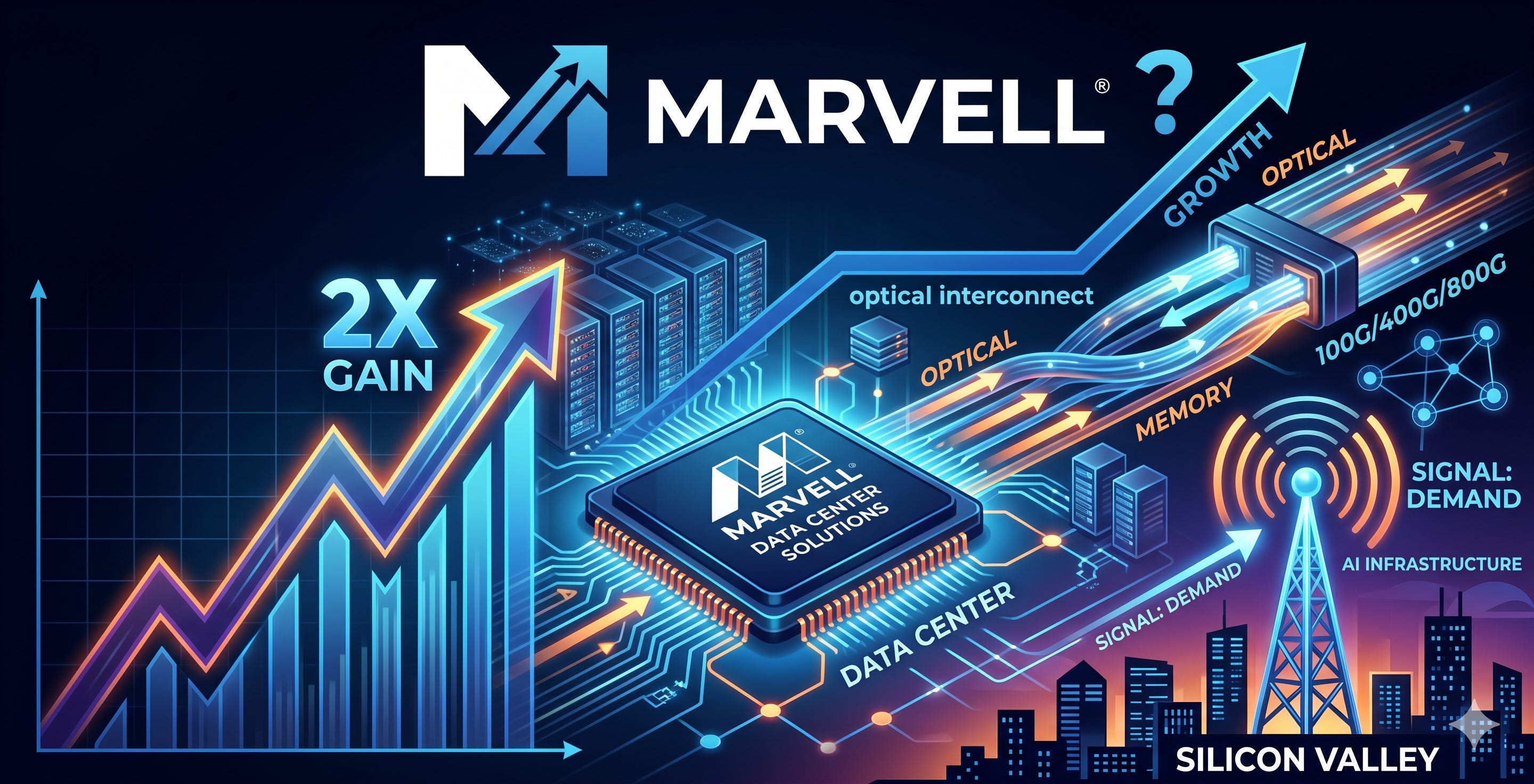
Since I wrote Part 1, Marvell has nearly doubled. I did not expect that pace.
But if you ask me whether the catalysts for further upside are still there,
my answer is still yes
with one condition.
From here on, the move has to be backed by actual revenue numbers, not narrative.
Three things in this piece.
First, what exactly the last two quarters proved. Beyond the fact that the stock moved, which data points became the basis for the multiple rerating.
Second, what cards the market has not seen yet on the technology side. Optical interconnect, memory interconnect, and the next-generation ASIC design signal coming out of Silicon Valley. I want to map where consensus has and has not priced things in.
Third, what to watch in the Q1 FY27 print on May 27, and how to judge whether there is still room to add to the Marvell bet at current levels.
A short-term checklist and a longer-term frame, side by side.
Disclaimer
This article is not a recommendation to buy or sell any security. The analysis, estimates, and scenarios in this piece are based on publicly available data and the author’s personal judgment, and accuracy or completeness is not guaranteed. The job-posting-based inference, revenue potential estimates, and analysis of unpriced cards in particular include interpretation from the author. All investment decisions and their consequences rest with the investor. The author may hold positions in securities discussed in this article or may take positions in the future.
What the two FY26 quarters proved
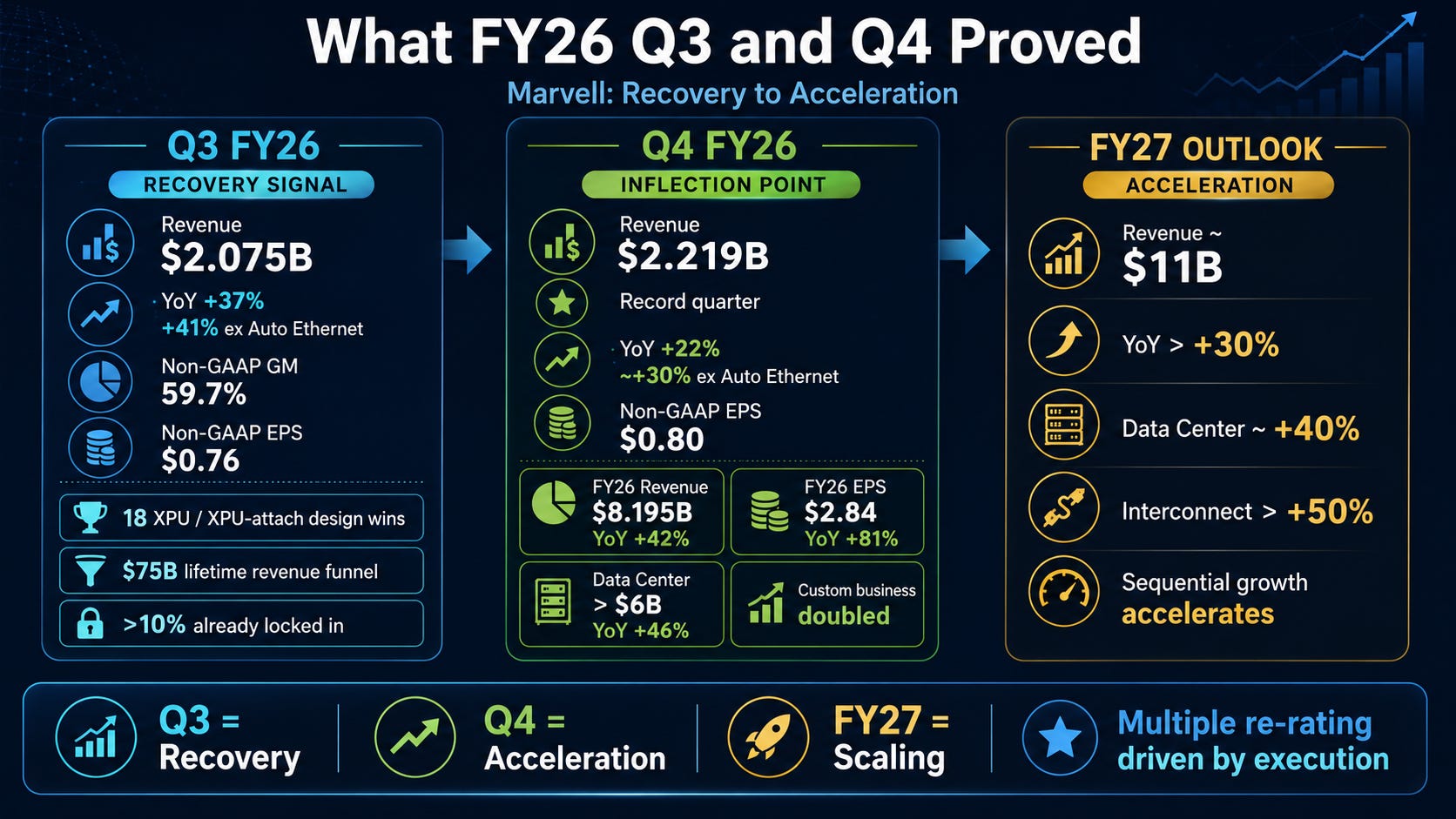
Start with FY26 Q3, reported December 2 last year.
Revenue $2.075B, beating the consensus midpoint by $15M.
YoY +37%, or +41% excluding the auto Ethernet divestiture.
Non-GAAP gross margin 59.7%. Non-GAAP EPS $0.76.
The quarter itself was fine, but what was interesting was the market reaction. Right before that print, the stock was down 17.5% YTD. So Q3 was the starting point of the recovery.
Two data points the company disclosed at that time matter.
First, 18 design wins across XPU and XPU-attach sockets, many already in production. Second, more than 10% of the $75B lifetime revenue funnel already locked in.
These two numbers are the actual reason the multiple started moving up from the next quarter.
Then the March 5 Q4 FY26 print was the real inflection.
Revenue $2.219B, another record, YoY +22%, or close to 30% excluding auto Ethernet. Non-GAAP EPS $0.80. Revenue $19M above the guide midpoint.
For the full year, FY26 came in at $8.195B, YoY +42%. Non-GAAP EPS $2.84, YoY +81%. More important than the headline growth: data center revenue crossed $6B for the first time on an annual basis, growing 46% YoY.
And the custom business doubled during FY26.
Then the FY27 guide pushed the multiple up another step. About $11B in revenue for FY27, YoY +30% or higher. Data center about +40%. Interconnect alone +50% or more. The implicit setup: sequential growth accelerates through the year.
Q3 was the recovery signal, Q4 was the acceleration declaration. The stock nearly doubled between these two quarters.
Q1 FY27 (May 27): the first test
Guide midpoint: revenue $2.4B, YoY +27%, QoQ +8%. Consensus EPS $0.79. Company guide and street consensus are nearly on top of each other.
There is a trap here.
Hitting $2.4B is the baseline.
Marvell has beaten guidance two quarters in a row, and the market has priced in another beat.
What matters is not the headline revenue but the acceleration signal.
Since I wrote Part 1, Marvell is already up more than 2x. So the natural next question: can it go higher from here?

From here on, I will first frame how far the rerating has come, then walk through the technology catalysts not yet in price, the kind only visible from Silicon Valley up close. The piece closes with a May 27 call checklist and a risk check.