

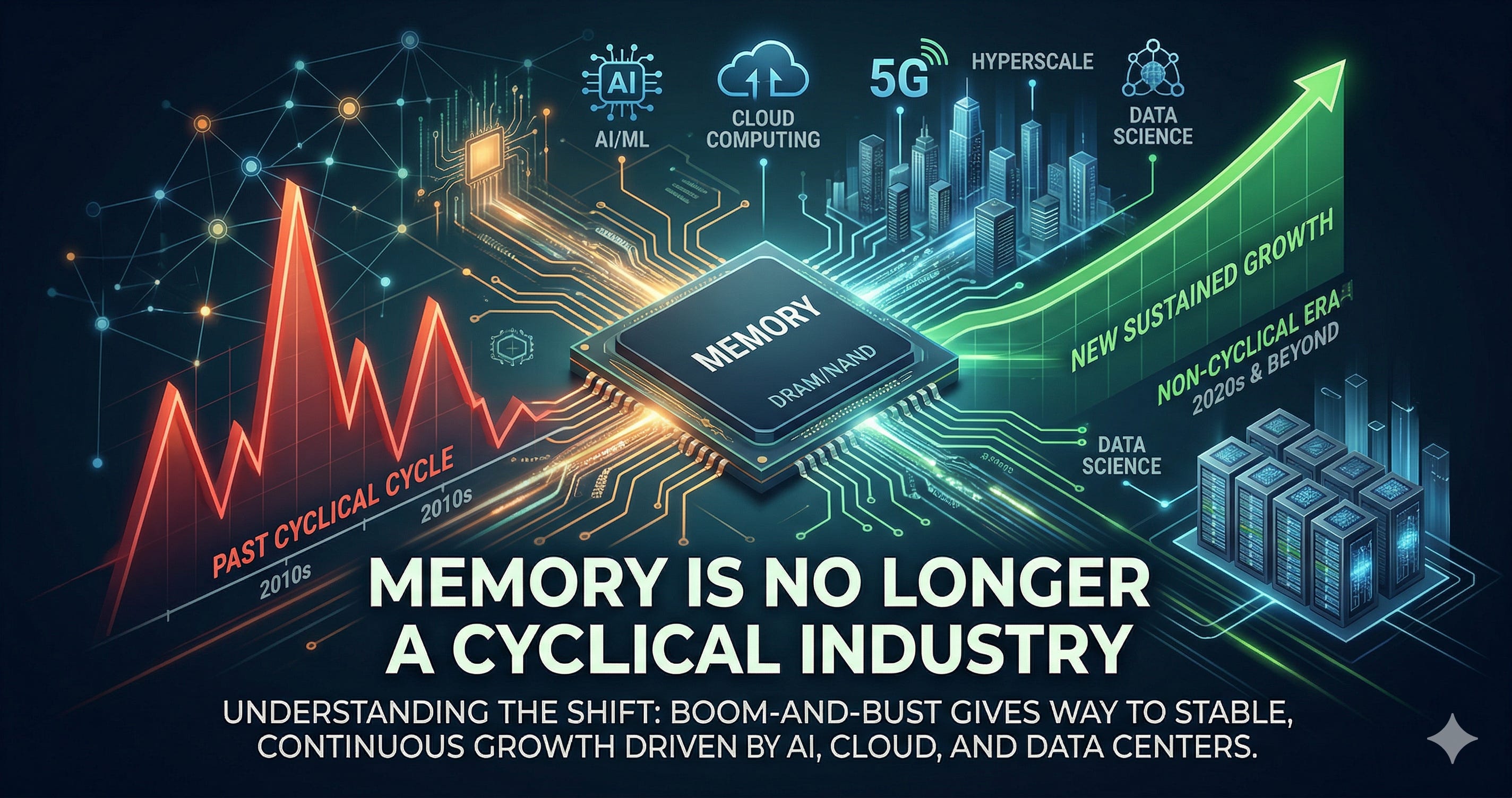
I had the chance to attend a seminar by SK Hynix’s North America regional president at a Silicon Valley Korean semiconductor meetup today. The topic was memory in the AI era. It was only about 20 minutes, but it was packed with insight on the structural shifts reshaping the memory market, the technical roadmap for HBM, and things investors genuinely need to understand.
This article pulls together what I heard at the seminar, a brief 1-on-1 conversation with him afterward, and my own read on where the memory market is heading.
Still think we’re in a memory super cycle?
You’re wrong.
More precisely: memory is no longer a cyclical industry.
Table of Contents
This Is Not a Memory Super Cycle
The Three Requirements to Buy HBM
cHBM: Memory Goes Foundry
What It Takes to Build a 1GW Data Center
Is Hybrid Bonding Mandatory for HBM?
3D DRAM and the China vs. Korea Dynamic
PIM’s Limits and Google
SK Hynix ADR, and Micron
Disclaimer
This article is based on a seminar given by SK Hynix’s North America regional president at the Silicon Valley K ASIC Seminar on March 24, 2026, and reflects my own views. It is not a recommendation to buy or sell any stock. Given that the underlying perspective comes from someone inside the memory industry, the content may lean bullish on memory. All investment decisions and their outcomes are your own responsibility.
“This Is Not a Memory Super Cycle”
The phrase “super cycle” gets thrown around a lot when people describe today’s memory market. Demand is strong, prices are up, and sentiment around HBM is running high, so the label sticks naturally. But what I heard at this seminar was a direct challenge to that framing. Super cycle is a term rooted in how people used to look at memory, and the argument is that we’ve moved into territory that framework simply can’t explain.
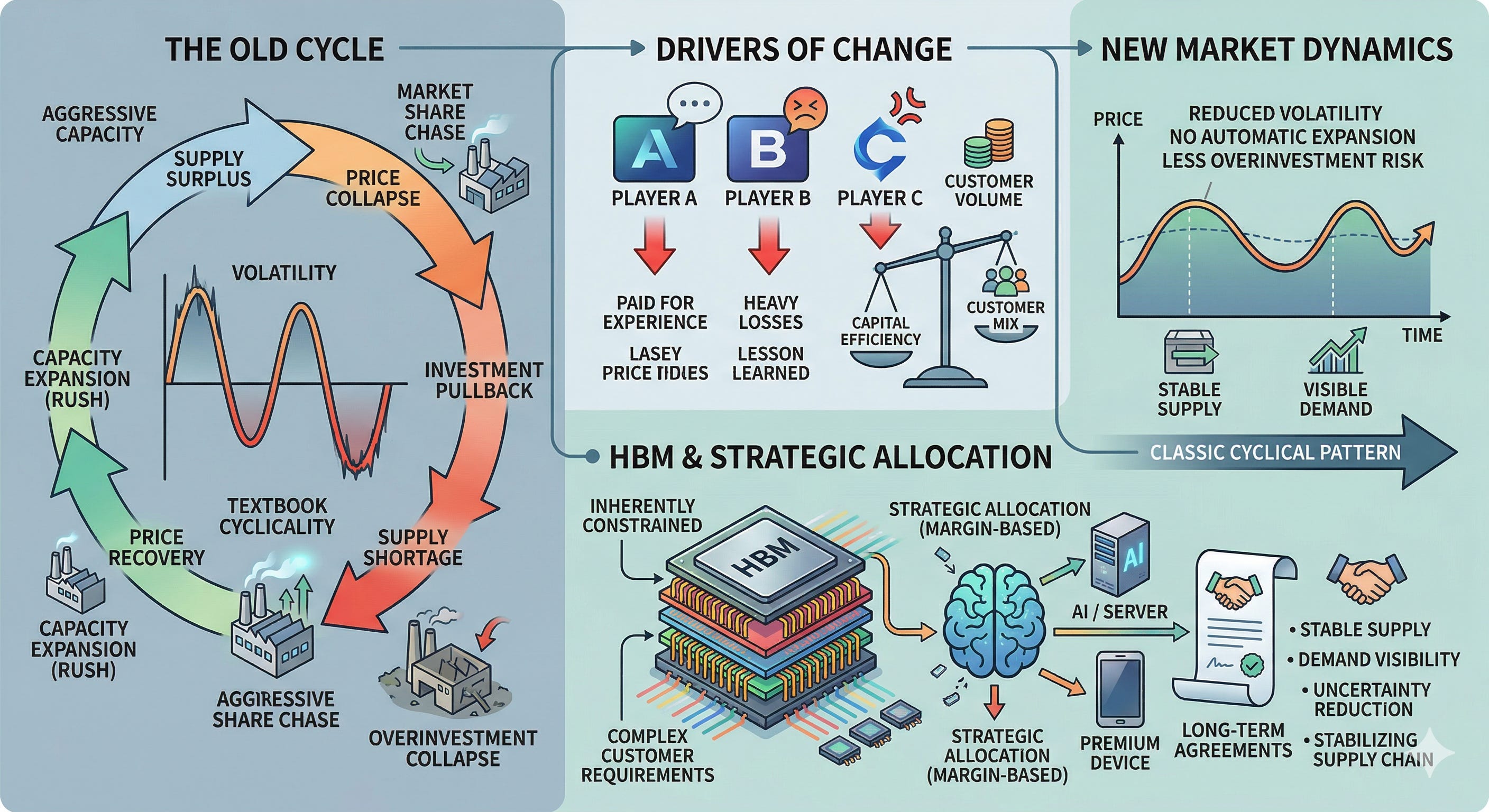
The old memory industry ran on textbook cyclicality. A slight supply surplus would crater prices. Prices fell, companies eventually cut investment. Supply tightened, prices bounced back. Prices rose, everyone rushed to add capacity again. This loop, supply glut, price collapse, investment pullback, supply shortage, price recovery, repeat, played out on a multi-year cadence. Memory earned its reputation as the quintessential cyclical industry.
But the three major players don’t move like that anymore. Strong demand doesn’t automatically trigger aggressive capacity expansion the way it once did. The reason is simple: they’ve all paid for it. They went big during the up-cycle, got hit with supply gluts and price collapses, and bled for it. That experience left a mark. Today, the priority has shifted from chasing market share through volume to profitability, capital efficiency, and customer mix.
This tendency gets even stronger with products like HBM, where supply is inherently constrained and customer requirements are complex. Memory makers can’t just route limited production capacity wherever demand appears. Deciding which customer gets allocated capacity, and for how long, is directly tied to margin. Long-term supply agreements, in this context, aren’t just about locking in volume. They’re a signal that memory companies are managing supply far more strategically than before. It’s no longer an industry where anyone can just make more and sell more when prices go up.
This is also where long-term contracts take on a different meaning. In the old memory market, spot prices and short-term deals drove the cycle. Now, with AI infrastructure buildout and surging demand for high-value memory like HBM, securing stable supply has become critical on the customer side. And for memory companies, with massive upfront investment, process transitions, and packaging resource allocation all in play, demand visibility matters enormously. Both sides benefit. Long-term contracts are becoming a mechanism for reducing uncertainty and stabilizing supply chains, not just a sales vehicle.
These structural shifts, stacking on top of each other, are pulling memory further away from its classic cyclical pattern. That doesn’t mean price volatility disappears. Memory is still subject to supply and demand dynamics and will continue to fluctuate with market conditions. But the character of that volatility is different now. The old dynamic, where a good upcycle would trigger industry-wide overinvestment and eventually collapse everything, is becoming far less likely.
The regional president’s view was clear. Memory isn’t in the middle of a super cycle that pops and resets. It’s transforming into an industry that can command structurally higher value on a sustained basis. In his words, it’s moving closer to a structural growth industry than a commodity business that just rides the macro. He said it half-jokingly, but he floated the idea that returns from memory investments could potentially outpace index returns going forward.
The key question in today’s memory market isn’t where this cycle peaks. It’s that the nature of the industry itself has already changed. Viewing it through the lens of past cycles means missing what’s actually happening. Memory is no longer an industry you analyze by the cycle. It’s one you read by understanding structural change.
The Three Requirements to Buy HBM
HBM today is not something you can just buy because you want it. According to what I heard, if you want to purchase HBM from SK Hynix, you need all three of the following at the same time.
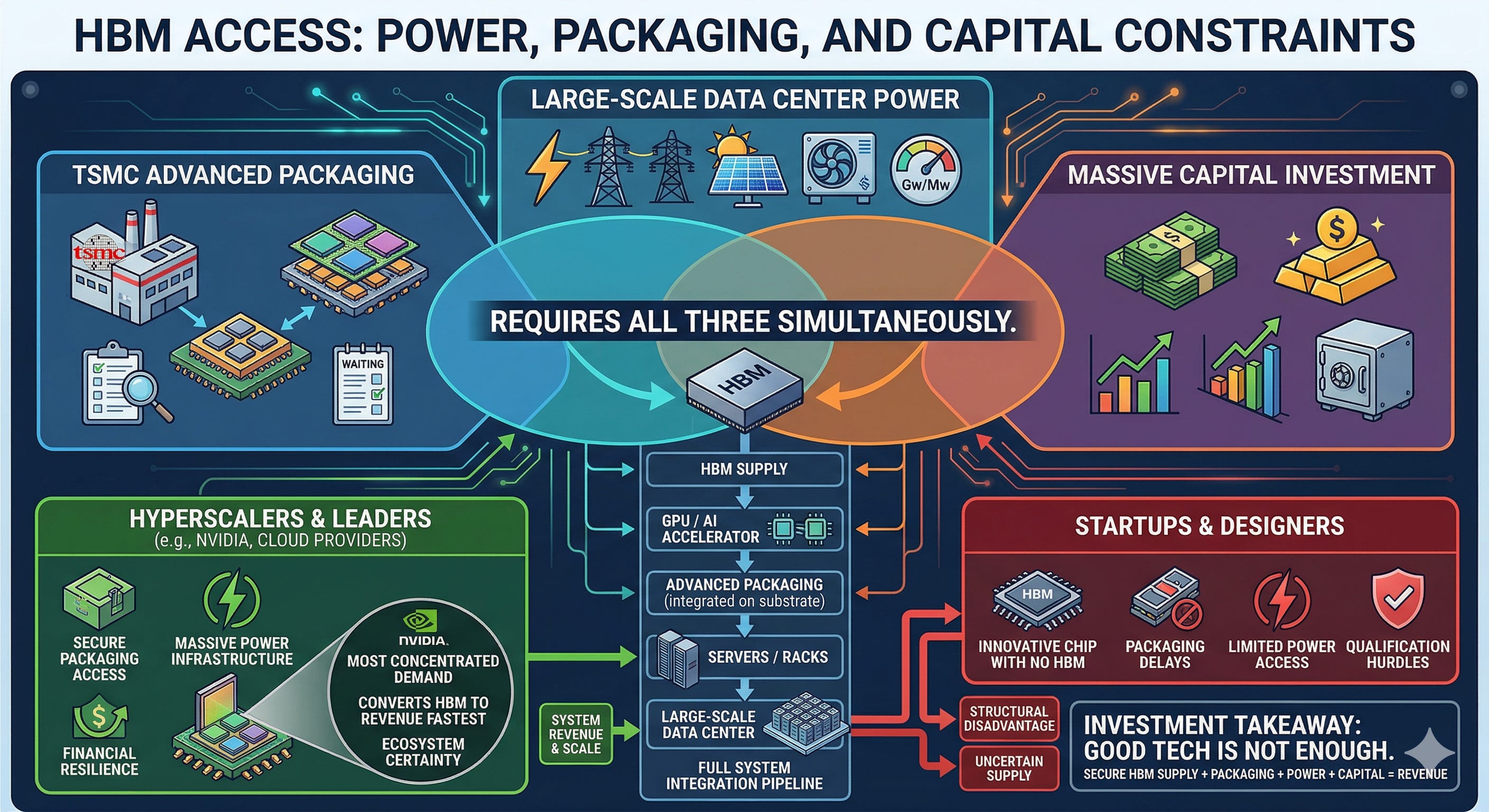
First, access to TSMC’s advanced packaging capacity.
Second, the data center power to actually run those chips at scale.
Third, the capital to fund all of it.
Each of these is hard on its own. The real problem is that you need all three simultaneously. Securing HBM is not the finish line. You still have to build the GPU or AI accelerator, package it, integrate it into servers and racks, and run it in a large-scale data center. HBM is not a standalone memory market. It’s a market where packaging, systems, infrastructure, and capital are all bound together.
That’s why the realistic pool of HBM buyers has effectively narrowed to hyperscalers and players at that tier. NVIDIA, Microsoft, Google, Amazon, Meta. Not just because their AI demand is large, but because they can actually claim TSMC packaging resources, absorb multi-billion dollar infrastructure investments, and secure power capacity that could eventually reach the GW scale. HBM is a technology market, yes, but it’s equally a market of supply chain control, infrastructure mobilization, and financial endurance.
This also explains why NVIDIA holds the position it does. NVIDIA’s dominance isn’t just about GPU performance. NVIDIA is the most concentrated source of demand, the most powerful ecosystem operator, and the most certain destination for HBM. From a memory company’s perspective, NVIDIA isn’t just a buyer of chips. It’s the player that can convert HBM allocation into system revenue fastest, at the largest scale, with the highest degree of certainty. In other words, the customer that generates the most impact per unit of supply.
AI chip startups, by contrast, are structurally disadvantaged. No matter how good the chip design, insufficient HBM access makes it nearly impossible to build a competitive system. Even after taping out, lack of TSMC packaging capacity delays product shipment. On top of that, there’s large-scale customer qualification and real-world data center power constraints to clear.
The implication is significant. In the AI semiconductor market, “good technology equals good investment” no longer holds as a simple formula. Technology is a necessary condition, not a sufficient one. What matters far more is who can secure stable HBM supply, who can claim packaging capacity, and who can mobilize power and capital to convert it into actual revenue. This is what HBM absolute supremacy looks like in practice.
cHBM: Memory Goes Foundry
Anyone who’s read my previous articles already knows this, but memory companies including SK Hynix are engaged in active cHBM co-design discussions with hyperscalers. The reason is straightforward. In AI systems, the bottleneck is no longer compute performance alone. Data movement, power efficiency, packaging area, thermal management, and system-level optimization are all becoming critical. Producing large volumes of good memory is no longer enough. The era of deeply customizing memory to fit what each customer’s system architecture actually requires has arrived.
This is where the character of the memory industry begins to shift.
In standard product-driven memory, cost reduction and yield competition were the core game. Who could make more, cheaper, more reliably was what mattered. cHBM changes the equation. The base die takes on more logic. Custom design work increases. Packaging complexity rises. Validation scope expands. That naturally inflates development costs and NRE-type expenses, and raises the share of co-design work between customer and supplier. Memory moves away from pure manufacturing logic and starts incorporating design services, advanced packaging, and system optimization as core parts of the business.
This is why I don’t read cHBM as simply “HBM getting more sophisticated.”
It’s a signal that the memory industry is moving from commodity to solution business. Beyond that, it means memory companies are beginning to behave, in certain domains, like foundries.
What It Takes to Build a 1GW Data Center
People occasionally push back with something like this: “Fine, HBM I get. But DRAM is still a commodity, and structurally memory is still a cyclical industry, isn’t it?”
It was, historically. DRAM was the textbook commodity. Supply up, prices collapse. Prices collapse, capex contracts. Supply tightens, prices recover. Prices recover, aggressive capacity expansion begins again. That’s why many people still believe that even if HBM is an exception, the broader memory market including DRAM will eventually revert to its old cyclical pattern.
Let me ask a question.
How many DRAM wafers do you think it takes to build a single 1GW data center?
According to what I heard at the seminar today, roughly 350,000 wafers.
Let that sink in.
What makes this number even more striking is that those 350,000 wafers are only the DRAM portion. Data centers don’t run on DRAM alone. You need GPUs, HBM, packaging, networking, SSDs, power infrastructure, and cooling systems, all at once. Building a 1GW data center isn’t a matter of adding a few more servers. It means simultaneously moving the entire semiconductor supply chain and the entire power infrastructure.
That’s the critical point.
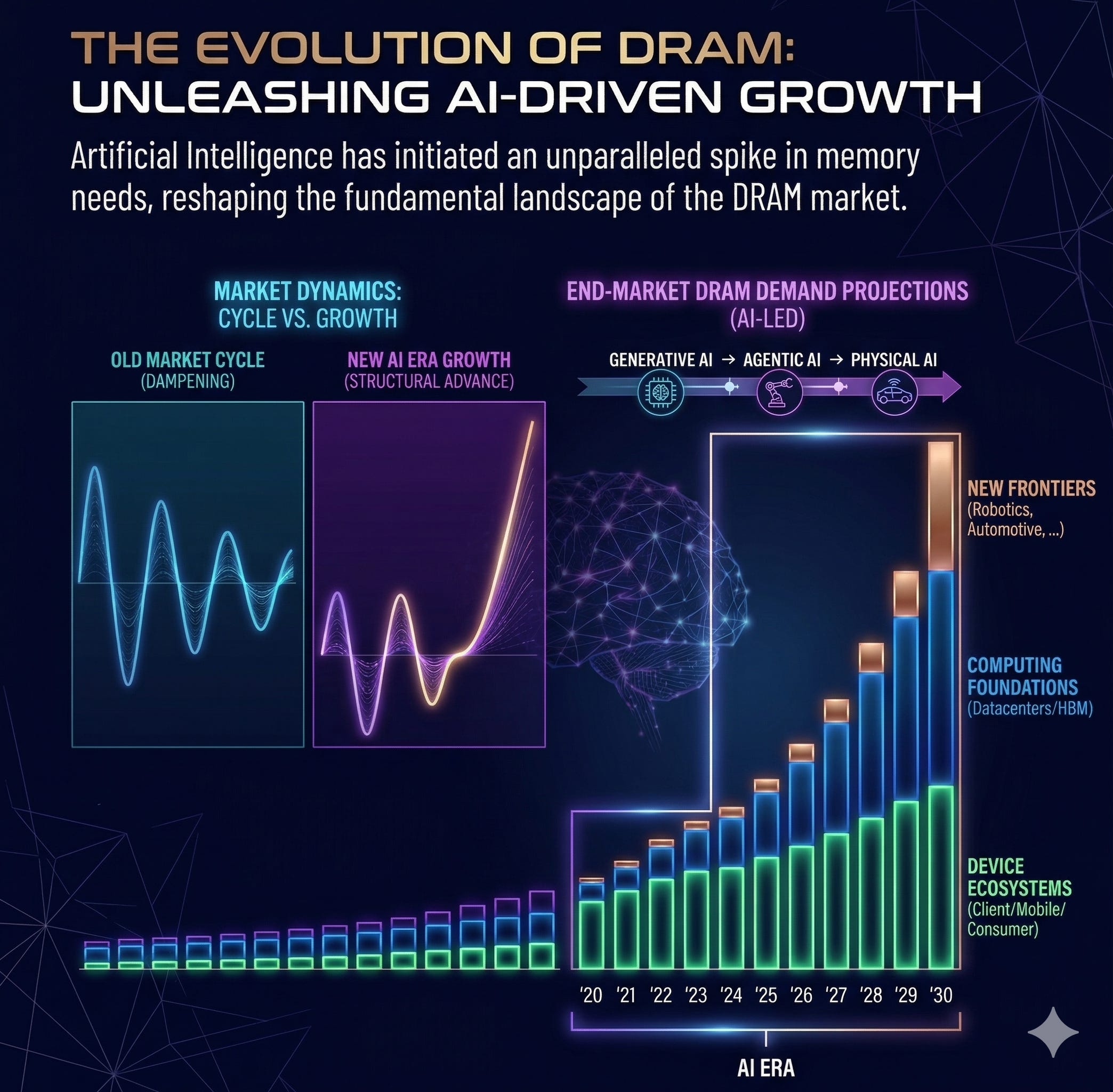
The memory cycles of the past moved within the relatively predictable boundaries of IT demand driven by PCs, smartphones, and servers. Supply fluctuated against that demand, and prices swung accordingly. AI data center buildout is a different animal entirely. The absolute scale of demand is enormous, and it’s not a one-off event. It’s tied to the long-term infrastructure investment plans of the largest companies in the world. With Microsoft, Google, Amazon, and Meta all talking about GW-scale data centers, memory demand can no longer be reasonably framed as something that dips and recovers on the old pattern.
That doesn’t mean DRAM price volatility goes away. DRAM still carries commodity characteristics and will respond to market conditions. But the context driving that volatility is fundamentally different now. The magnitude of demand, the identity of the buyers, the way supply is being managed, and the structure of long-term contracts have all changed. Memory will still be volatile, but it is absolutely not a cyclical industry in the way that term used to mean.