

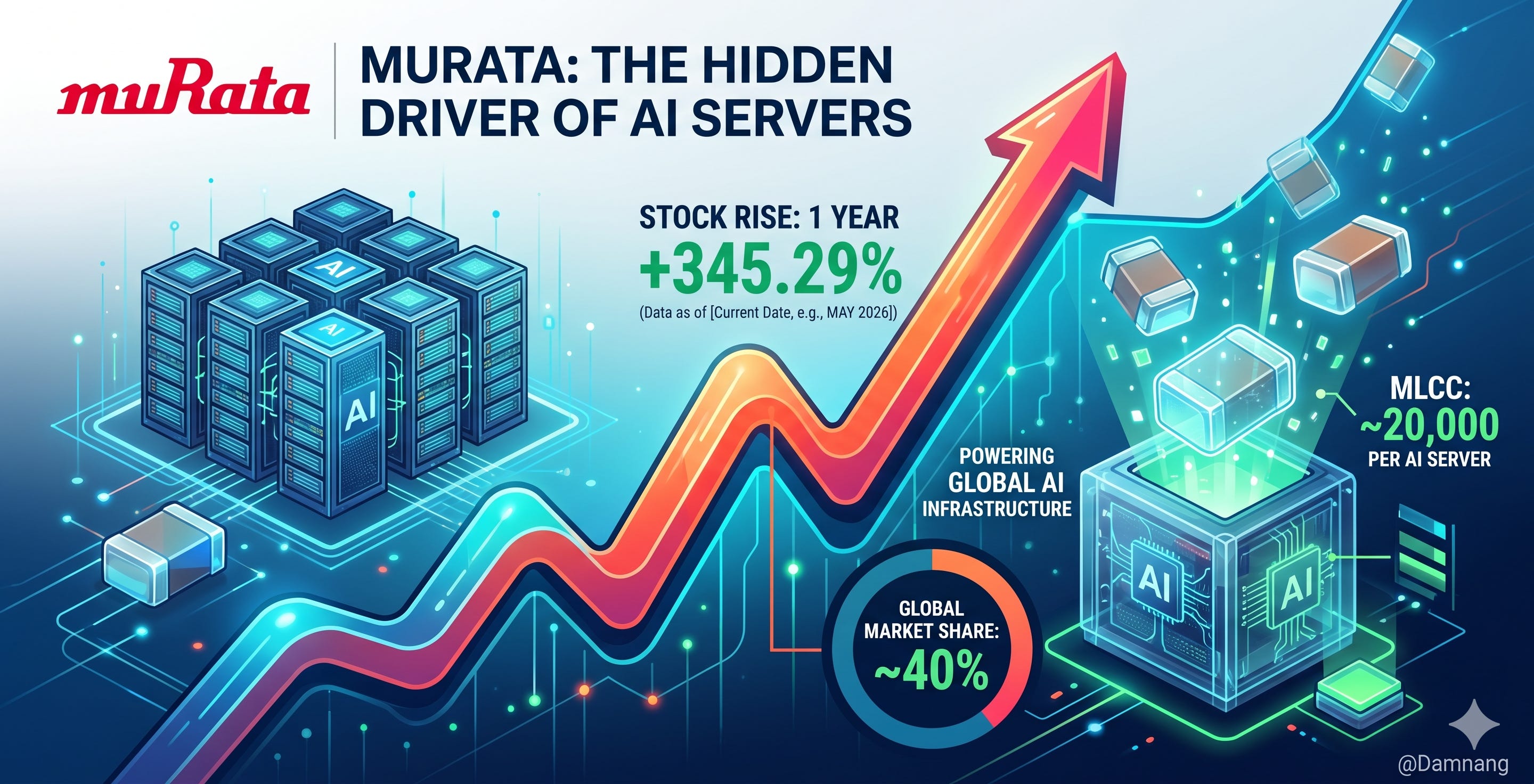

The Re-rating in AI Power Started Here

Of the 24 companies in the power investment map, the ones in the low-voltage tier have rallied the hardest. The return gap versus the high-voltage tier is more than 10x. The closest point to GPU TDP reacts first and overheats fastest.
Look at the power investment map I built, the low-voltage re-rating map, and one name stands out: Murata Manufacturing (TSE: 6981, OTCMKTS: MRAAY). While GPUs, HBM, and optical interconnects soaked up all the attention during the AI infrastructure boom, this stock quietly climbed more than 3x off its 52-week low.
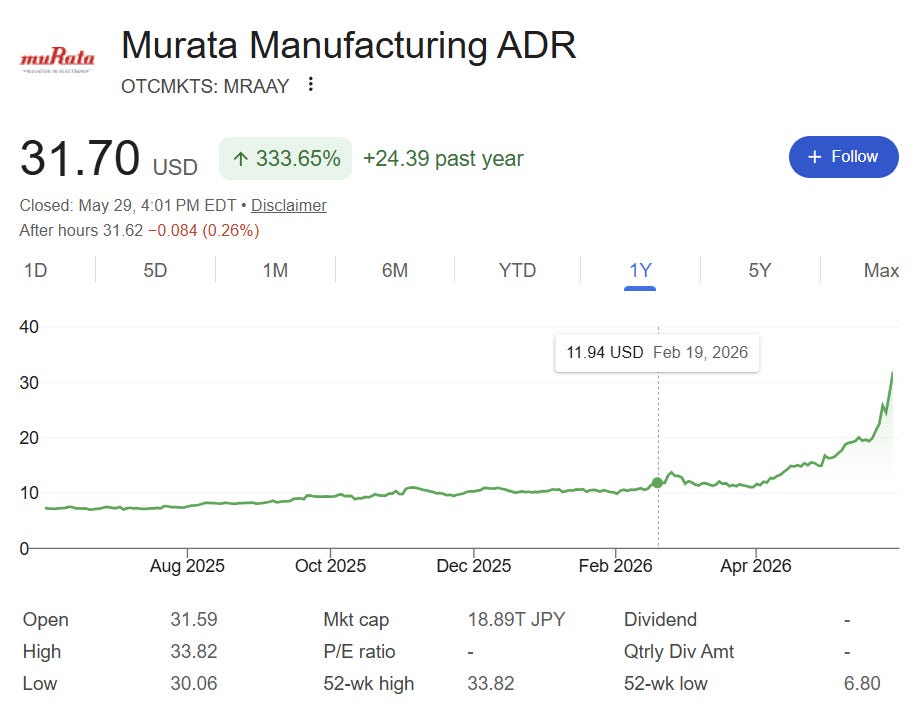
Murata’s core business is MLCCs.
What this component is, how the categories break down, which ones Murata makes, why it has suddenly become a bottleneck in the AI era, and what numbers Murata put in front of the market at its April 30, 2026 earnings call.
I’ll walk through each in order, written so you can follow it without a semiconductor background.
Disclaimer
This piece covers industry structure and company analysis. It is not investment advice. The names here are highly volatile, and the author may hold some of the stocks mentioned. All figures are based on public sources and the author’s own analysis, and responsibility for any investment decision and its outcome rests entirely with the reader.
MLCCs, Explained From Scratch
What Is a Capacitor
A capacitor stores electricity briefly and then releases it. A battery is for long-term storage; a capacitor is for pushing charge in and pulling it out over a very short instant.
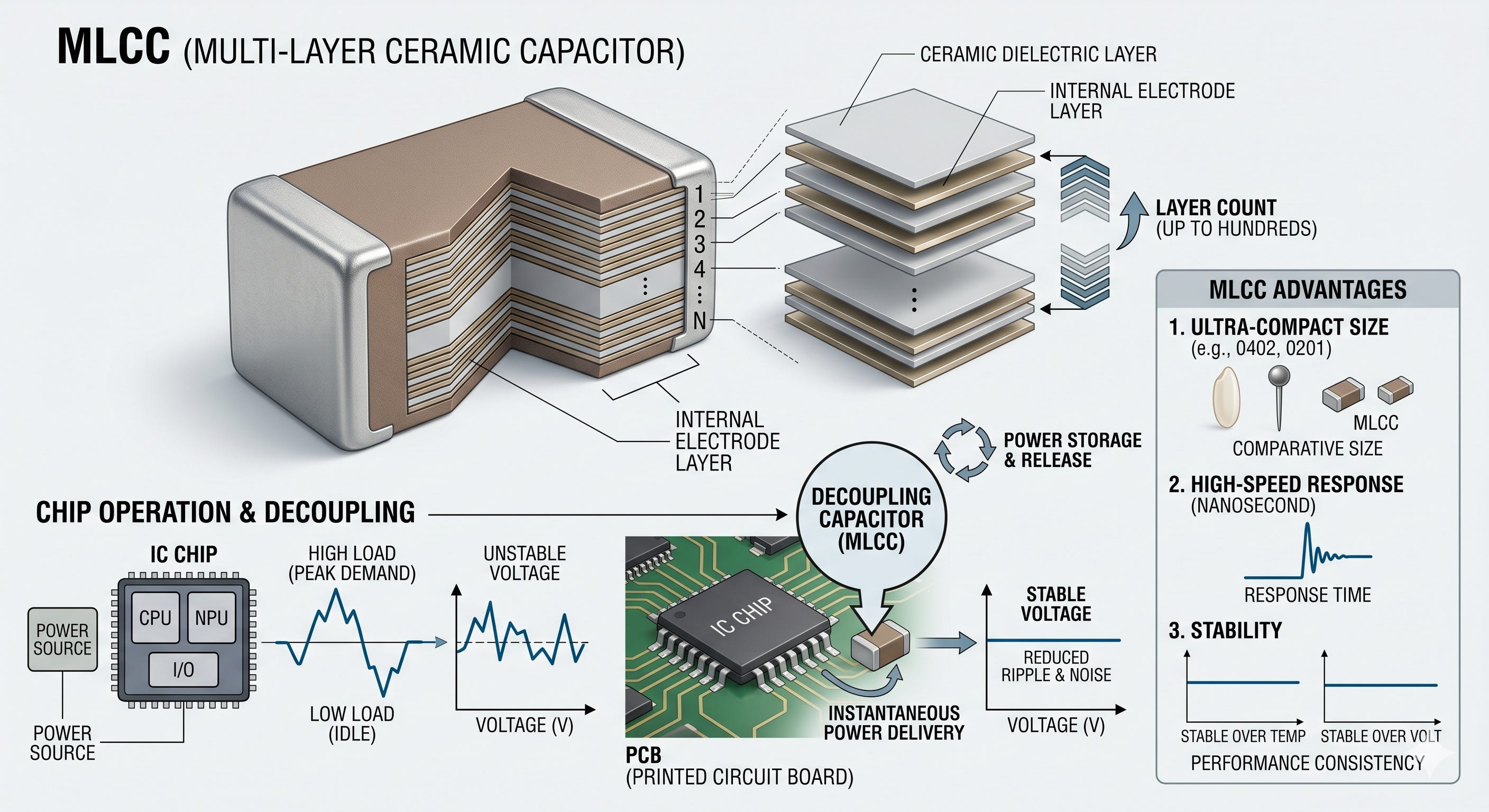
A chip’s current draw isn’t constant. During heavy computation it suddenly yanks a large amount of current, and at rest it uses almost none. That abrupt swing shakes the voltage, and when voltage swings, the chip misbehaves or dies. So you place a capacitor right next to the chip to top up the supply the moment a current spike hits. It’s like keeping a small water tank beside a faucet to hold up the pressure when it drops. The industry calls this role decoupling.
So What Is an MLCC
There are several kinds of capacitors: aluminum electrolytic, tantalum, film, ceramic. Among them, the MLCC is the Multi-Layer Ceramic Capacitor.
It’s a structure that stacks ceramic dielectric layers and metal electrode layers in alternating sequence, hundreds of layers deep. Picture a mille-feuille. Just as pastry and cream stack in layers, ceramic and electrode repeat hundreds of times, and the more layers you stack, the more electricity it holds. That’s where the “Multi-Layer” in the name comes from.
What sets the MLCC apart from other capacitors is size, speed, and stability. The most common 0402 size is 1.0mm x 0.5mm, smaller than a grain of rice, and the newest products go down to 01005 (0.4mm x 0.2mm). The response speed is in nanoseconds, and performance stays relatively steady even as temperature and voltage change. That makes it well suited to sit right beside a fast-switching chip and hold the voltage in place.
Class 1 and Class 2
MLCCs split into two broad families.
Class 1 (temperature-compensating, C0G/NP0 and the like) holds its capacitance, meaning its charge-storage capacity, almost perfectly steady across temperature and voltage. It goes into circuits where stability is everything, like RF, timing, and precision analog. The trade-off is that it holds less capacitance in the same footprint.
Class 2 (high-dielectric-constant, X5R/X7R/X7S and similar) holds far more capacitance in the same size. The trade-off is that the actual capacitance drops as temperature or voltage changes. It goes where you need a lot of capacitance, like power decoupling.
A car or an AI server uses both families together. But on the high-capacitance power-stabilization side, Class 2 carries the weight. The Murata 47μF product I’ll cover later is also a Class 2 (X5R/X6S) part.
Capacitance, Voltage, ESR, ESL
There are four specs you weigh when choosing an MLCC.
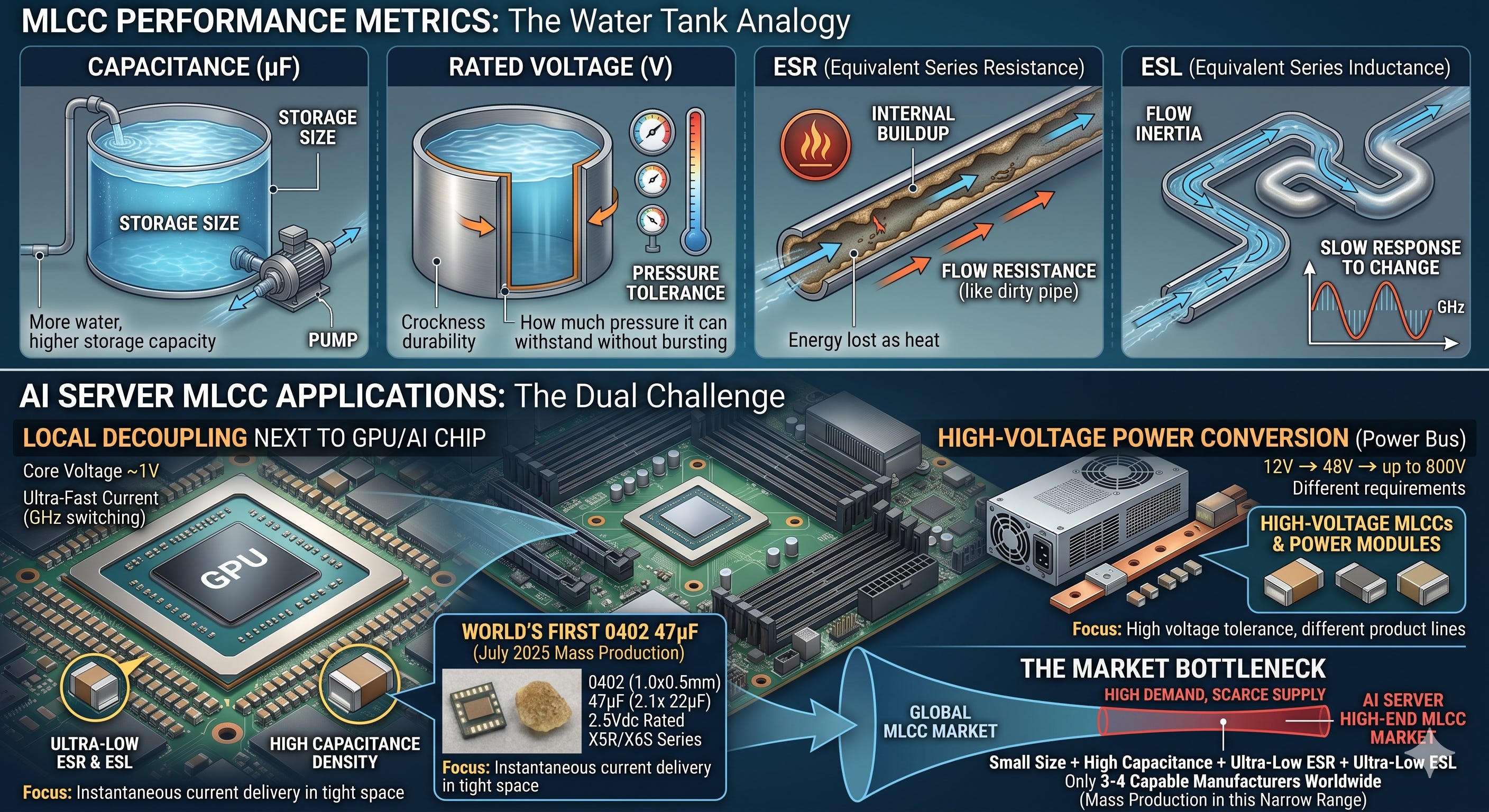
Capacitance is how much charge it holds (in μF, microfarads), and rated voltage is how high a voltage it can withstand.
The other two sound unfamiliar, but they get easy once you move back to the water tank.
ESR (equivalent series resistance) is the gunk clogging the drain. When it’s high, friction bleeds energy off as heat as you pull the water (current) out, and the capacitor can’t dump it cleanly at the moment you need it.
ESL (equivalent series inductance) is the inertia when the water has to change direction. When it’s high, the capacitor can’t keep up in the high-frequency conditions where current reverses direction at ultra-high speed.
Next to an AI chip blinking at several GHz, both of these have to be extremely low.
Even inside the same AI server, the problem a capacitor handles varies.
One is low-voltage local decoupling right next to the GPU. With the core voltage around 1V, you have to cram large capacitance into a tiny area to catch the current spike.
Murata’s 0402-size 47μF product, the world’s first to reach mass production in July 2025, targets exactly this domain. Rated at 2.5Vdc, in the X5R/X6S family, it carries roughly 2.1x the capacitance of the same-size 0402 22μF part. It’s a part for high-density power stabilization beside the IC, not for the high-voltage bus.
The other is the move to higher voltage in the power architecture. AI server power is climbing from 12V to 48V, and some next-generation systems go all the way to 800V.
This calls for a separate class of high-voltage MLCCs and power modules, a different beast from the low-voltage high-capacitance parts like the 47μF. You shouldn’t conflate them: low-voltage high-density decoupling and high-voltage conversion are served by different component families.
In the end, an AI-server MLCC is a high-end part that has to satisfy small size, high capacitance, low ESR, and low ESL all at once. The bottleneck isn’t the MLCC market as a whole; it sits in this narrow band, and only three or four companies in the world can mass-produce here.
Why So Many Go Into an AI Server
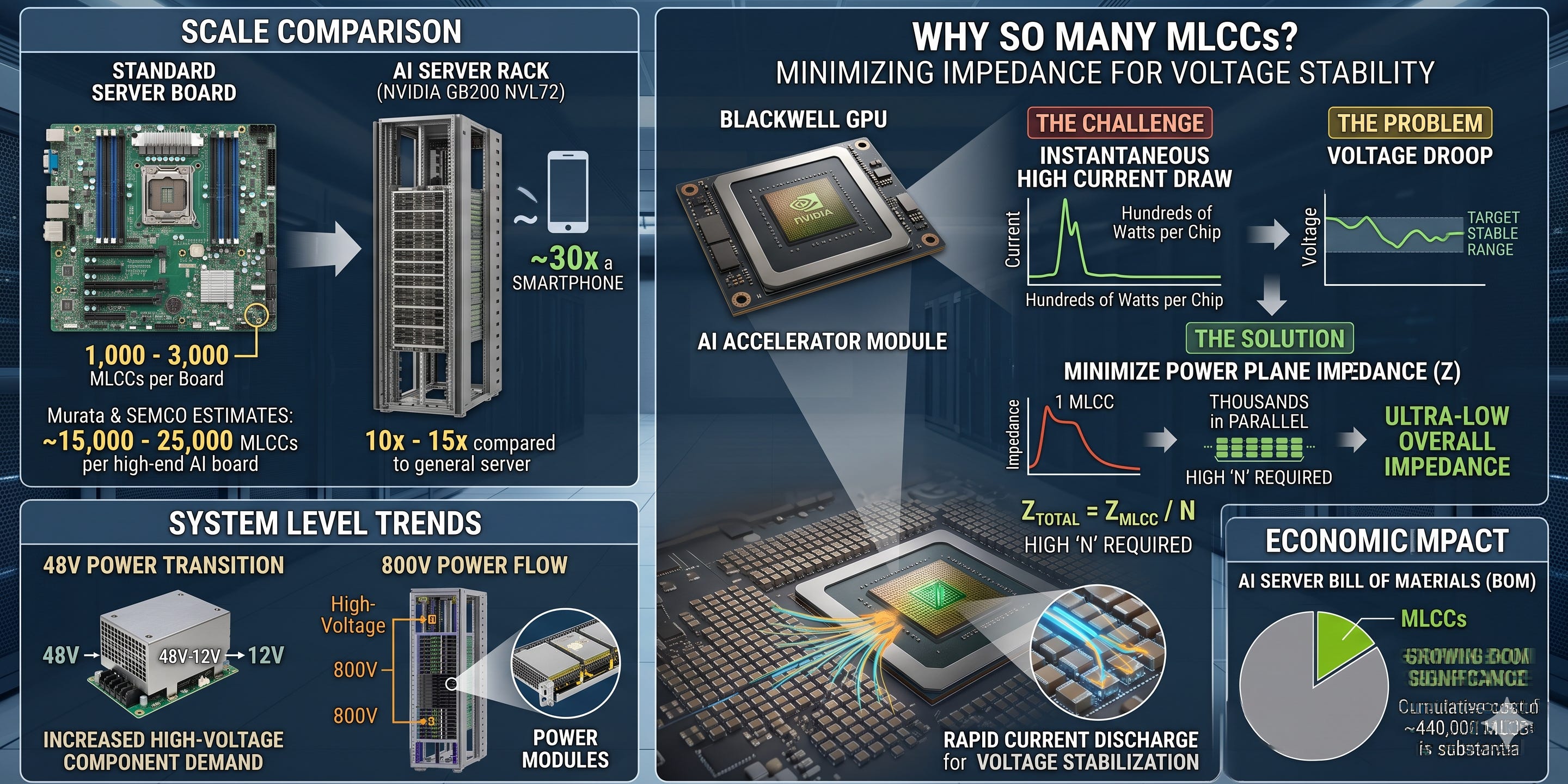
A typical server board uses somewhere between 1,000 and 3,000 MLCCs. An AI server is a different order of magnitude. A single NVIDIA GB200 NVL72 rack is estimated to use around 440,000, roughly 30x what goes into a smartphone. Murata president Norio Nakajima puts it at 15,000 to 25,000 per AI server, and SEMCO says 10 to 15x a standard server.
The reason for the count isn’t simply laying down more capacitors. It’s that the impedance has to be driven lower. Impedance is a resistance-like value that obstructs current flow, and the lower it gets, the faster and harder a capacitor can dump current. An AI accelerator draws hundreds of watts in a single chip, yanking current in an instant, and the voltage can’t swing much when it does. A single capacitor can’t drop the impedance enough, so you pack tens of thousands in parallel right beside the GPU to pull the total impedance down. Layer on the move to 48V and the flow of 800V, and demand for high-voltage parts and power modules swells alongside.
The per-unit price is just a few cents, but at 440,000 to a rack the combined total isn’t trivial. MLCCs have become a line item you can no longer ignore in an AI server’s BOM.
Which MLCCs Does Murata Make
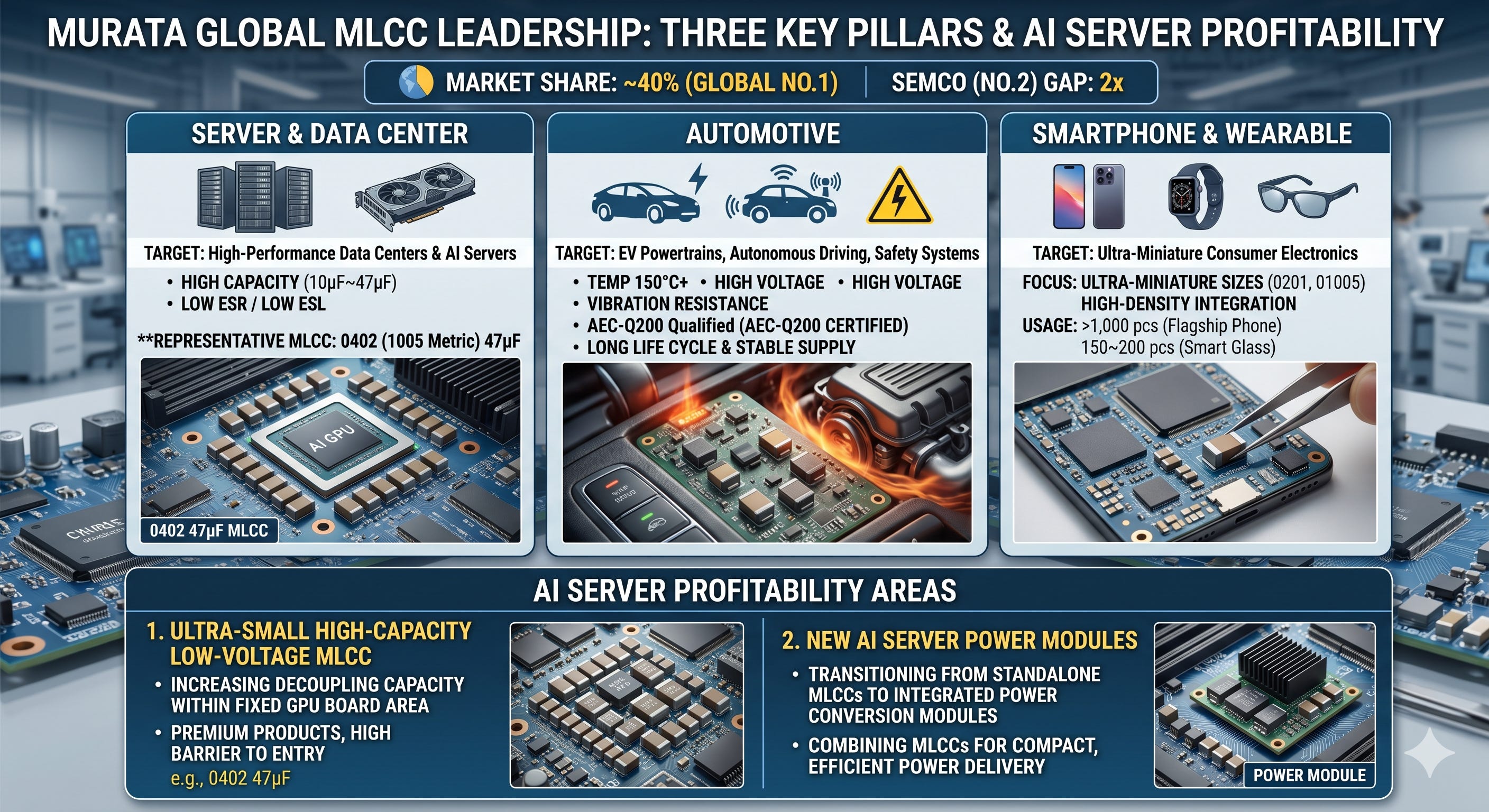
Murata’s lineup runs in three streams. The server and datacenter products are high-capacitance (10μF to 47μF) with low ESR and low ESL, and the 0402 47μF is the flagship. The automotive products withstand temperatures above 150 degrees, high voltage, and vibration; they have to pass AEC-Q200 qualification, which alone takes years, and once a part lands on a line it rarely gets swapped out. The smartphone and wearable products concentrate on ultra-small sizes like 0201 and 01005. A flagship phone takes more than 1,000, and a device like smart glasses takes 150 to 200 of the 01005 per unit.
Across all three streams Murata sits at number one with roughly 40% global share. Its lead over second-place SEMCO is close to 2x.
Of these, two are where the real money is in AI servers. The first is the ultra-small, high-capacitance, low-voltage part like the 0402 47μF. GPU board area is fixed while the decoupling capacitance needed keeps growing, so the product that fits more capacitance into the same footprint commands a premium. The second is the AI-server power module Murata is newly building out. Beyond selling discrete MLCCs, it’s expanding into bundling the power-conversion stage as a module. While commodity MLCCs face pricing pressure from Chinese makers, these two areas are where Murata can hold both margin and share.