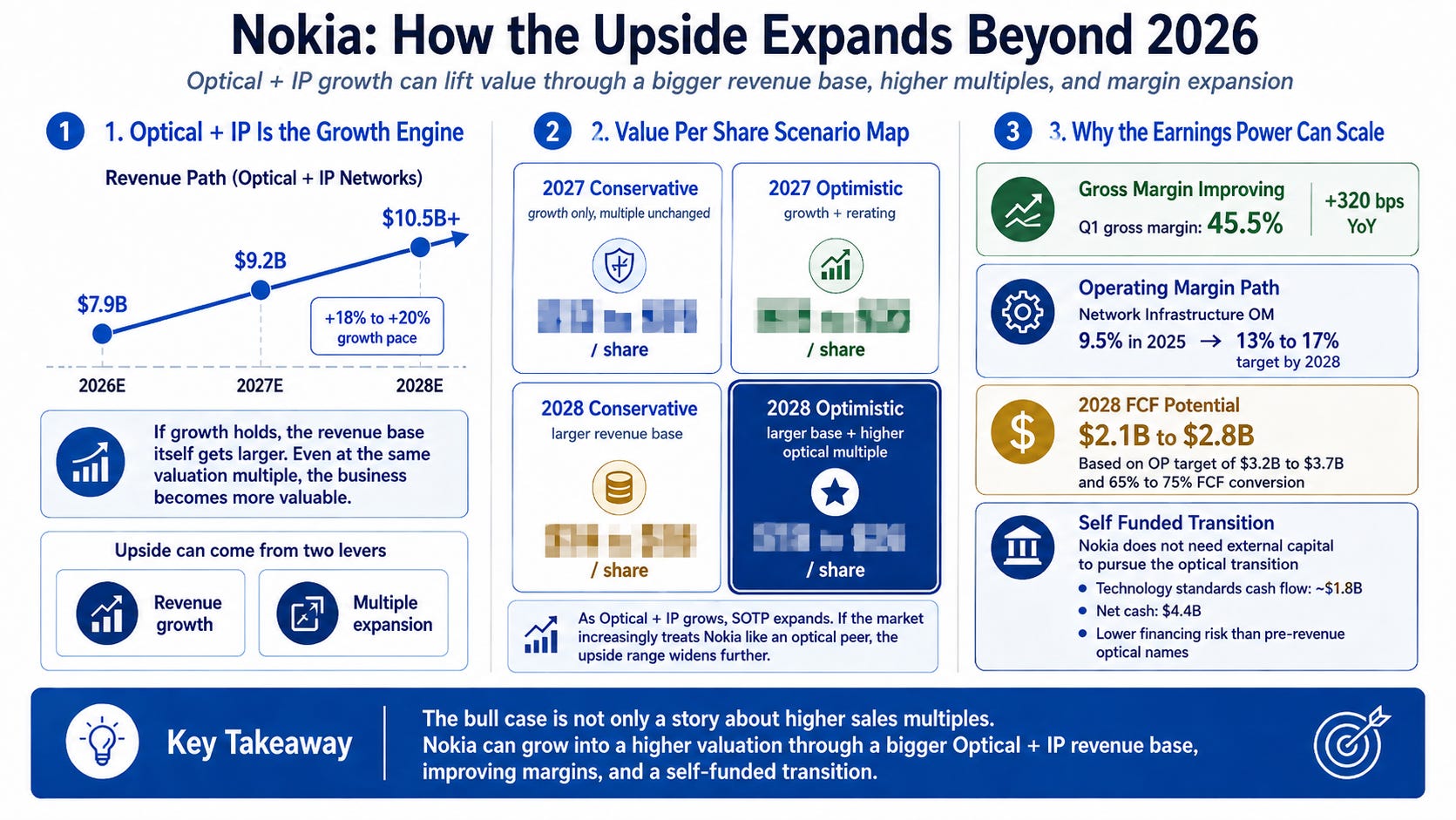
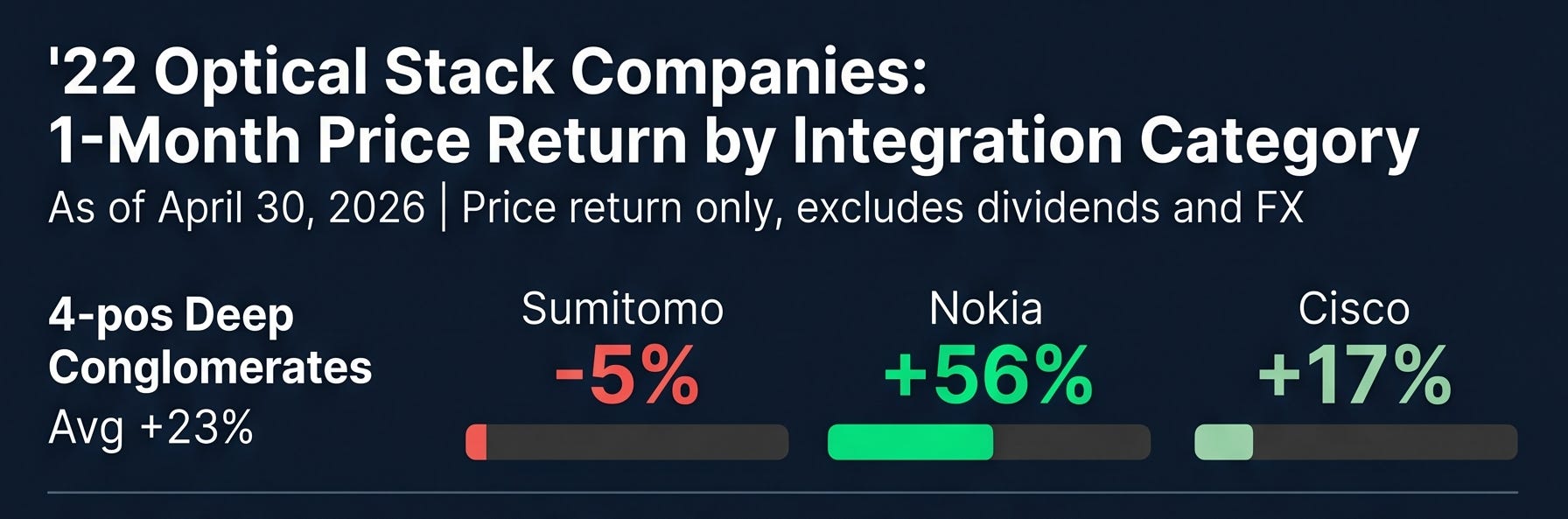
When I mapped 22 tickers across 7 layers and 6 archetypes in the Optical Investment Map, one paradox jumped out. The deepest vertically integrated group, 4-position deep (Sumitomo, Nokia, Cisco), had the lowest average return of all 22 names.
Conglomerate discount, size beta, and zero discovery premium stacked on top of each other, producing a structure where the deepest integration delivered the weakest returns.
A month later I pulled up the same matrix. (Returns are based on April 30, 2026 closing prices, trailing one-month price return)
Sumitomo was down 5%, Cisco up 17%, essentially flat. Nokia had ripped 56%, closing in on the Downstream IC-to-Photonics group (+73%).
Same archetype, same 4-position depth, but Nokia alone had punched through the conglomerate discount.

Why did Nokia move and the others didn’t?
Because having four positions is not the same as having the right four positions. And the player that confirmed the strategic value of those four positions with the biggest check was NVIDIA.
The core question is not simply “Is Nokia an AI beneficiary?” The more important question is whether the market has started reclassifying Nokia from a telecom equipment stock to an AI network infrastructure company.
This article breaks down what Nokia’s four-layer stack actually is from a technical standpoint, maps Nokia onto the $14B+ AI infrastructure investment landscape that NVIDIA has been building, and then breaks the company apart by business unit to calculate where the stock price can go when the peer group changes.
If you are working through an investment decision on Nokia, this article should help frame that judgment.
Disclaimer
This article represents personal analysis and is not investment advice. The author is not a licensed financial advisor, and any mention of specific securities should not be interpreted as a buy or sell recommendation. The author may hold positions in securities discussed and may change those positions without prior notice. Market size estimates, returns, and financial figures are sourced from research firms and public filings and may differ from actual results. Sections marked as personal estimates, along with outlooks on product roadmaps, acquisitions, and competitive dynamics, inherently contain uncertainty. Past performance does not guarantee future returns, and all securities discussed carry the risk of principal loss. Investment decisions should be made independently based on each individual’s financial circumstances and risk tolerance.
1. Nokia’s Four-Layer Stack
If you haven't read my Optical Investment Map yet, I'd strongly recommend going through it before diving into this section.
Damnang's Optical Investment Map v1.0

These days the market is drowning in words like optical, silicon photonics, and CPO. But most investors know the keywords without actually seeing the full picture of the value chain behind them.
Layer 1: The Vendor That Has Both InP and SiPh
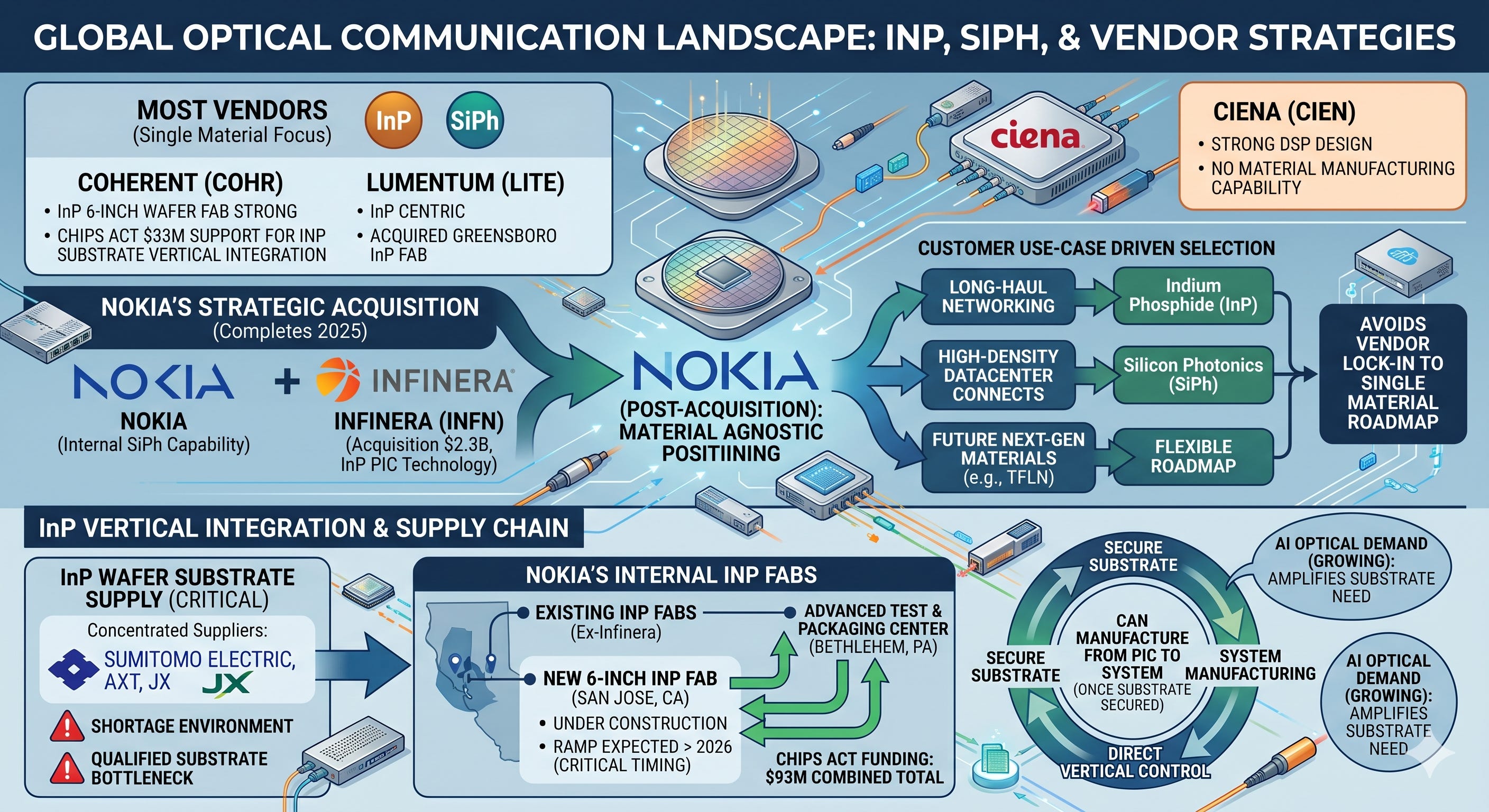
Most optical vendors have either InP or SiPh, not both.
Coherent (COHR) is strong in 6-inch InP wafer fabrication and is pursuing vertical integration into InP substrates with $33M in CHIPS Act funding.
Lumentum (LITE) is also InP-centric, having recently acquired a Greensboro InP fab.
Ciena (CIEN) designs its own DSP, a major strength, but has no material manufacturing capability of its own.
Nokia broke this dynamic with the Infinera acquisition ($2.3B, closed February 2025).
Nokia’s existing SiPh capability combined with Infinera’s InP PIC technology to complete a “material agnostic” positioning. If a customer needs long-haul, Nokia can offer InP. If they need high-density interconnect inside data centers, SiPh. If next-generation materials like TFLN become critical down the road, Nokia is less locked in than vendors tied to a single material platform.
Nokia currently operates the legacy InP fab inherited from Infinera and is building a new 6-inch InP fab in San Jose with ramp expected after 2026 (the exact timing is one of the key variables to watch).
In Bethlehem, Pennsylvania, Nokia also has an advanced test and packaging center backed by CHIPS Act funding ($93M total across both the San Jose fab and Bethlehem facility).
InP wafer substrate supply is concentrated among a handful of companies: Sumitomo Electric, AXT, and JX affiliates. As AI optical demand scales, securing qualified substrates is becoming a bottleneck.
In this shortage environment, operating your own InP fab means that once substrates are secured, you can manufacture everything from PIC to system internally.
Layer 2: The Strategic Asset Infinera Left Behind
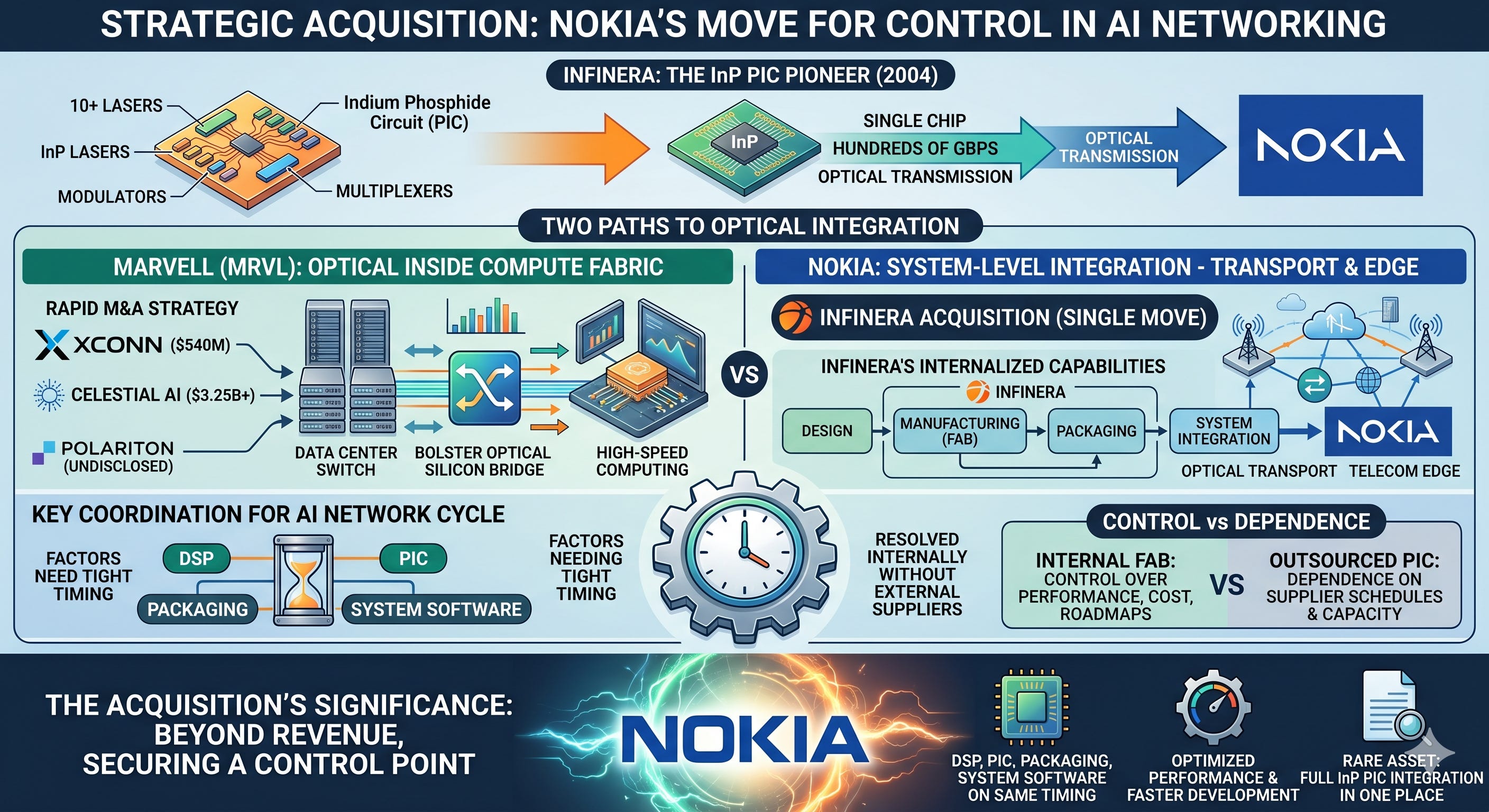
Infinera was the first company to ship a commercial large-scale InP PIC, back in 2004. The technology that integrated 10+ lasers, modulators, and multiplexers onto a single PIC chip to deliver hundreds of Gbps of optical transmission now belongs to Nokia.
Manufacturing PICs in your own fab means you control the performance and cost of the optical front end on your own roadmap. Vendors that source PICs externally are subject to their supplier’s release schedule and capacity allocation.
Marvell (MRVL) is solving this problem from a different angle. In a span of roughly one year, Marvell executed three acquisitions to rapidly build out its optical silicon bridge: XConn ($540M), Celestial AI ($3.25B+), and Polariton (undisclosed).
But Marvell’s approach is about pulling optics into the compute fabric, while Nokia’s is about binding optical transport and telecom edge at the system level. Different vectors entirely.
Nokia brought this system-level integration through a single acquisition. Infinera had already internalized the full cycle: InP PIC design, fabrication, and packaging, all in-house.
Viewing the Infinera deal as simply adding optical revenue undersells it. What Nokia acquired was not capacity. It was a control point. Synchronizing DSP, PIC, packaging, and system software on the same timeline is becoming increasingly critical in AI network cycles, and Nokia now has a structure that can execute this coordination without external supplier dependencies. A publicly traded optical asset offering this level of InP PIC design, fabrication, packaging, and system integration in one package is extremely rare.
Layer 3: Four DSPs Covering Campus to Subsea
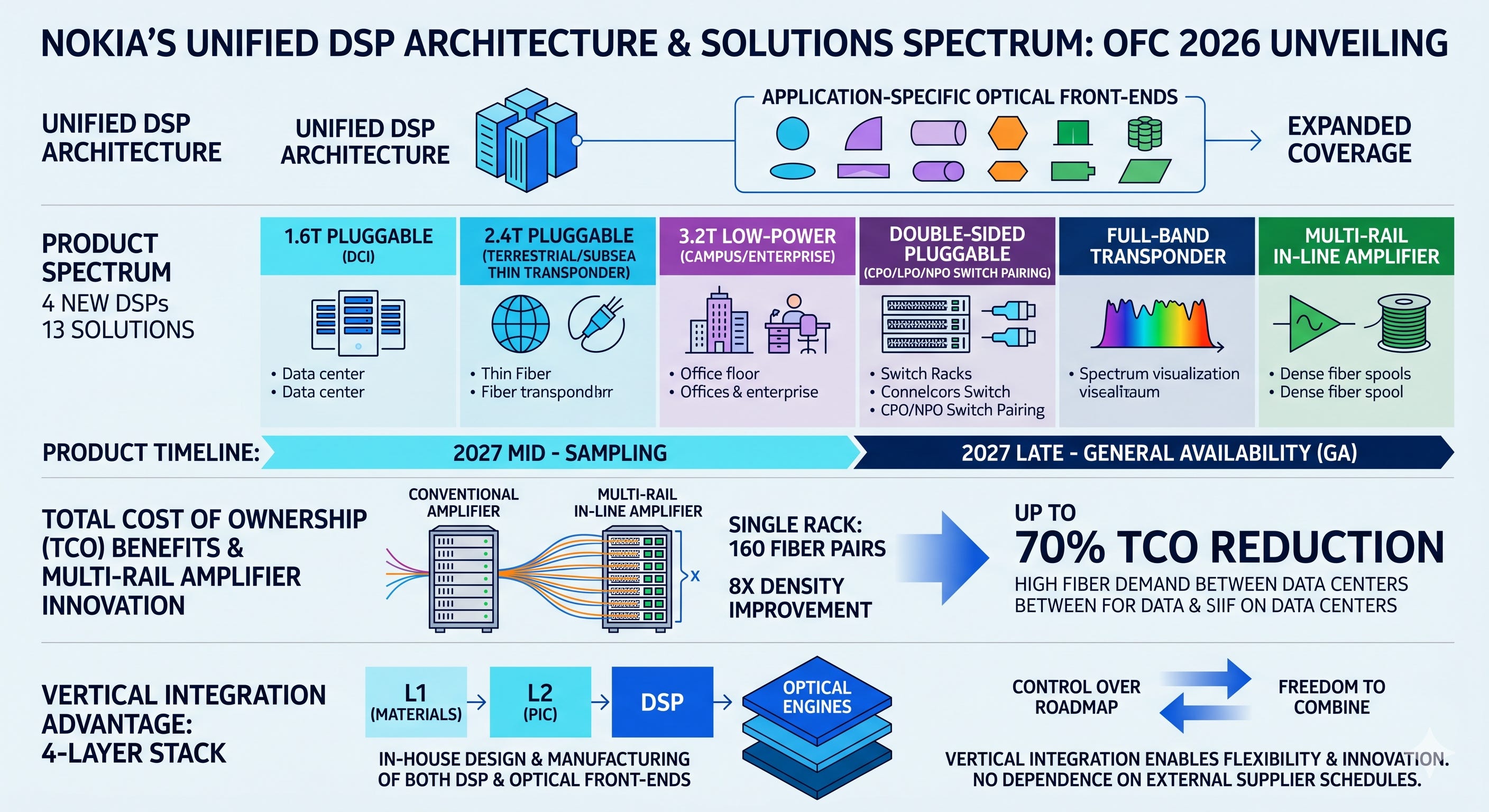
At OFC in March 2026, Nokia unveiled four new DSPs and 13 solutions built on them. The approach is a single DSP architecture paired with different optical front ends depending on the use case.
The product spectrum reveals the strategy. 1.6T pluggable (DCI), 2.4T pluggable (terrestrial/subsea thin transponder), 3.2T low-power (campus/enterprise), double-sided pluggable for CPO/LPO/NPO switch pairing, full-band transponder, and a multi-rail in-line amplifier (160 fiber pairs in a single rack, an 8x density improvement). Sampling mid-2027, general availability second half of 2027.
The TCO savings from the amplifier are significant. Hyperscalers are scaling data center interconnect fiber at an explosive rate, and fitting 8x more fibers into the same physical footprint matters. That is the core of Nokia’s claimed 70% TCO reduction.
This strategy works because Nokia designs and manufactures both the DSP and the optical front end internally. If either side depends on an external supplier, your product roadmap gets locked to their schedule.
Only a company that owns L1 (material) and L2 (PIC) can freely combine DSP and optical engine. Each layer of the four-layer stack needs the others.
Layer 4: What the Customer Actually Buys
The fourth layer is the system. Line systems, amplifiers, ROADMs, management software: the complete optical transport systems that hyperscalers and carriers actually deploy.
Post-Infinera, Nokia has moved into the top tier of the global optical transport market alongside Huawei and Ciena. Per Reuters, Nokia holds roughly 20% share, making it the second-largest optical networking vendor after Huawei. The coverage is broad: hyperscaler DCI, metro, long-haul, and submarine.
As AI workloads move beyond a single data center into multi-site distributed architectures, demand for this scale-across layer grows. Management noted that AI traffic already represents roughly 20% of total network traffic, about 80 exabytes per month, and that agentic AI will steepen the demand curve as machine-to-machine traffic accelerates.
Adjacent to transport is the IP Networks business (approximately €2.6B in 2025), which handles routing and switching. Nokia’s FP5 custom silicon delivers 6Tbps-class processing performance and is challenging the $20B hyperscale fabric market dominated by Cisco and Arista. Combined, Optical and IP account for roughly €5.8B (2025), about 29% of group revenue.
What the four-layer stack means at the system level: Nokia owns everything from material to system, so the product roadmap is not hostage to external suppliers.
CEO Hotard’s comment that “customers are visiting our fabs and packaging facilities to verify our scale capabilities” belongs in this context. Among publicly traded end-to-end optical transport vendors, this depth of stack is Nokia’s scarcest asset. It is not something money alone can replicate.
The story so far is that Nokia holds multiple layers of the optical value chain simultaneously. But that alone does not explain why the stock moved +56%. Sumitomo is equally deep in vertical integration, and Sumitomo was down 5% over the same period. Having a technical moat and having the market start pricing a premium for that moat are completely different things.
Over six months, NVIDIA deployed $14B+ into the AI infrastructure ecosystem. Coherent, Lumentum, Marvell, CoreWeave, Nebius, and Nokia.
Of these, Nokia is the only one that is different in nature. The rest are investments that supply components or deploy GPUs. Nokia does not fit cleanly into either category.
Once you understand exactly what NVIDIA bought at Nokia, the picture of where the stock price can go when you break the company apart by business unit starts to come into focus.
NVIDIA's Marvell Investment: What Lies Beneath

Let’s tally up what Jensen Huang spent in the last four months.