

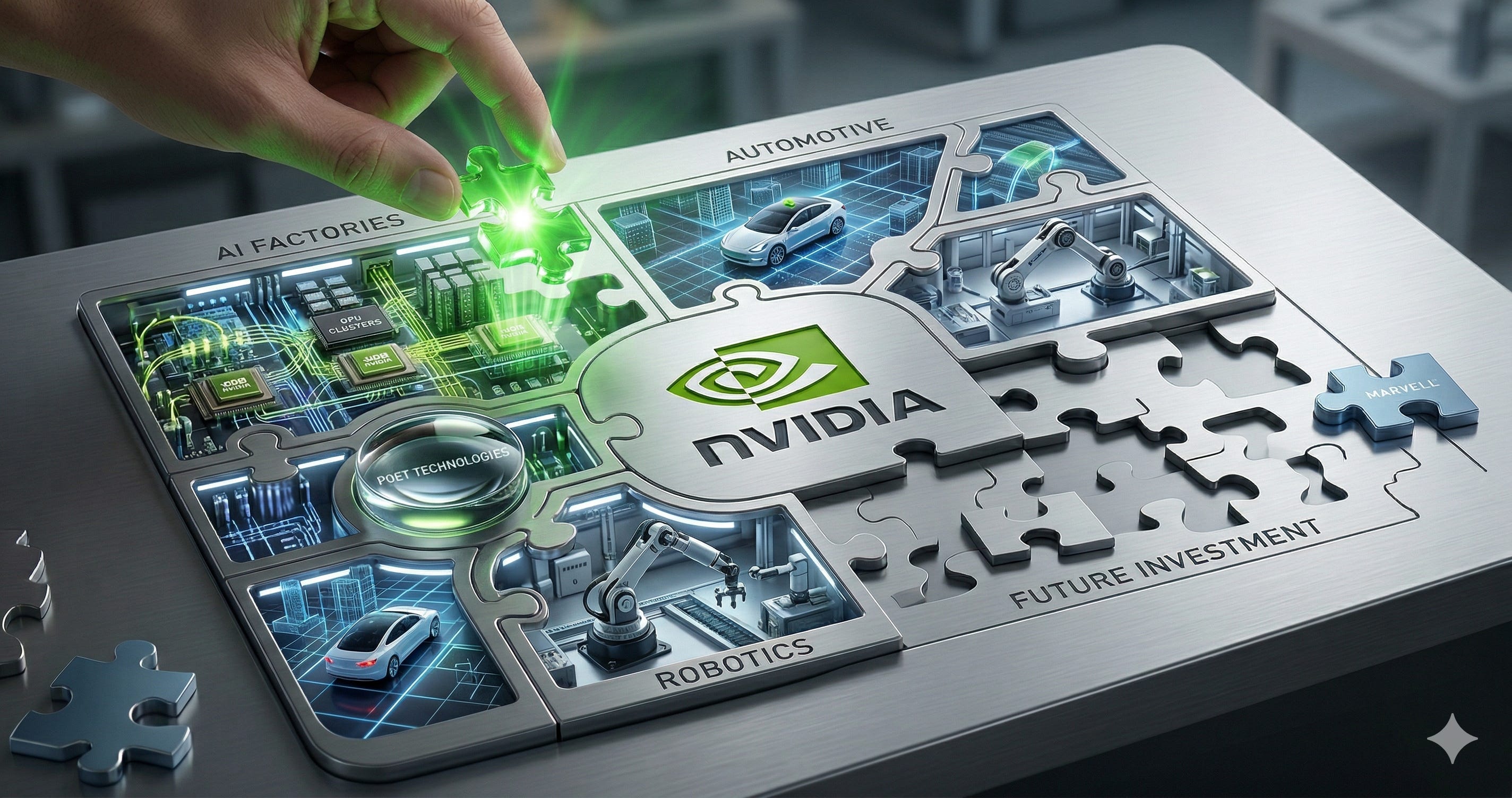
Let’s tally up what Jensen Huang spent in the last four months.
December 2025: $2B into Synopsys.
January 2026: $2B into CoreWeave.
March 2nd: $2B each into Coherent and Lumentum.
March 11th: $2B into Nebius.
March 31st: $2B into Marvell.
That’s more than $12B in four months, every check written for exactly $2B.
March alone was staggering.
Coherent, Lumentum, Nebius, and Marvell combined for $8B in a single month. Jensen Huang turned March 2026 into NVIDIA’s “AI ecosystem expansion month.”
Read each deal in isolation and you get the standard narrative: NVIDIA is spreading money around the AI ecosystem. That’s how most coverage treated it.
But read these investments as a system, and a completely different picture appears.
This article reads NVIDIA’s optical investments not as individual news items but as a single strategy.
Why did NVIDIA pour $6B into optics in one month?
What connects these investments to each other?
And where are the gaps in this supply chain that NVIDIA has not yet filled?
If you stopped at “NVIDIA invested in Marvell,” this piece will give you the full puzzle. If you follow optical stocks, you will find a map for identifying the next beneficiaries of NVIDIA’s build-out.
And if you have any interest in POET Technologies, this is where the Marvell investment’s hidden logic connects back to a story most investors have not yet found.
Section 1: The Marvell $2B Investment
Surface: “Ecosystem Expansion”
On March 31st, NVIDIA took a $2B stake in Marvell Technology, representing roughly 3 to 4 percent of Marvell’s market cap.
A non-controlling strategic investment. Jensen Huang went on CNBC and said,
“Marvell is a marvelous investment. Been dying to say that.”
On the surface, it looks simple. NVIDIA wants to integrate Marvell’s custom ASICs and networking gear into its own systems via a platform called NVLink Fusion. Marvell’s stock jumped 13% that day, and analysts moved their price targets up to $135.
The formal partnership structure, as announced, breaks down like this:
On top of the NVLink Fusion platform, Marvell provides custom XPUs and NVLink Fusion-compatible scale-up networking.
NVIDIA contributes the full infrastructure stack including the Vera CPU, ConnectX NIC, BlueField DPU, NVLink interconnect, and Spectrum-X switches.
Add to that silicon photonics co-development, advanced optical interconnects, and NVIDIA Aerial AI-RAN collaboration to convert 5G/6G telecom networks into AI infrastructure.
Marvell’s FY2026 datacenter revenue came in at $6.1B, up 46.5% year-over-year. Datacenters now account for 74.4% of total revenue. The FY2028 guidance targets $15B.
CEO Matt Murphy told CNBC that customer demand remains solid despite geopolitical headwinds.
That’s the surface.

The Subtext: The Real Target Isn’t Marvell. It’s Celestial AI.
To actually understand this deal, you have to go back to December 2025.
On December 2nd, Marvell announced it would acquire Celestial AI for $3.25B, with earn-out provisions that could push the total to $5.5B. Celestial AI is a startup that developed a technology called Photonic Fabric.
Here is what Photonic Fabric does.
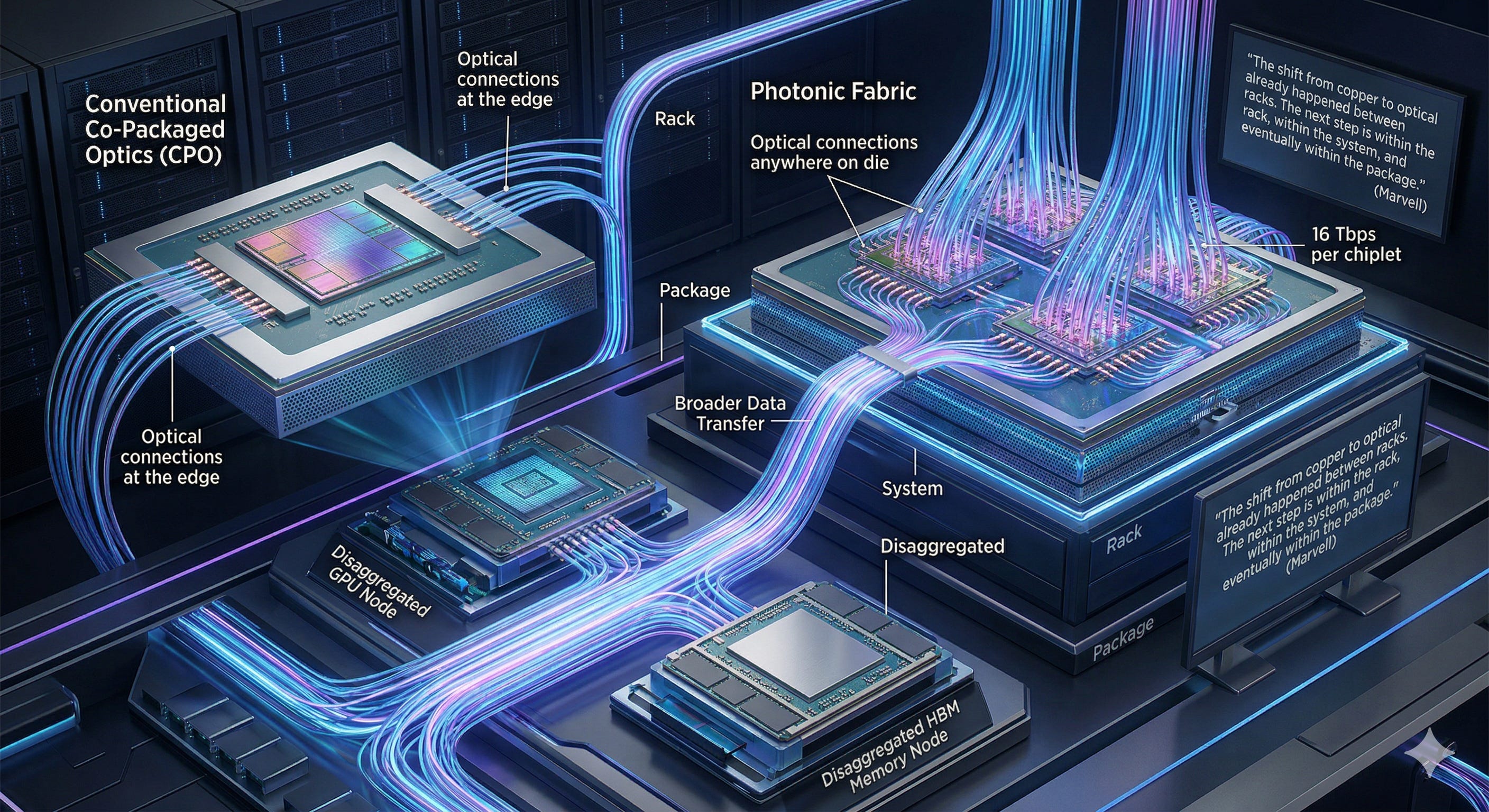
Conventional Co-Packaged Optics (CPO) creates optical connections at the edge of a processor. Photonic Fabric creates optical connections from anywhere on a processor die. A single chiplet delivers 16 Tbps of bandwidth, which is ten times the current state-of-the-art 1.6T port. More importantly, this architecture allows compute and memory to be disaggregated. The physical constraint that forces GPUs and HBM to live in the same package gets broken by optics. As Marvell put it, “the shift from copper to optical already happened between racks. The next step is within the rack, within the system, and eventually within the package.”
With this acquisition, Marvell added a scale-up layer (GPU-to-GPU connectivity) to a portfolio that previously covered scale-out (Ethernet/Inphi DSP) and scale-across (DCI). Without it, Marvell had no way into NVIDIA’s NVLink-controlled territory.
Three months after the Celestial AI deal closed, NVIDIA wrote Marvell a $2B check.
My read: NVIDIA did not invest in Marvell. NVIDIA bought access to Celestial AI’s Photonic Fabric. By pulling Marvell’s custom XPUs into its ecosystem through NVLink Fusion, NVIDIA simultaneously brought next-generation optical scale-up technology inside its own walls.
The UALink Dimension
This deal also has an ecosystem sovereignty angle. AMD, Broadcom, Intel, Google, Meta, Microsoft, and AWS are all backing a competing open interconnect standard called UALink, a consortium that is essentially “everyone except NVIDIA.”
Hyperscalers are pushing it as an escape route from NVLink’s lock-in. From NVIDIA’s perspective, it’s the scenario where its own ecosystem fragments.
NVLink Fusion is the answer. “You want to use custom ASICs? Fine. Use them on our platform.” It embraces competitors’ chips while drawing them inside NVIDIA’s gravitational field. Marvell was chosen because Marvell has the deepest technical bench in optical DSPs and silicon photonics, and the Celestial AI acquisition made that case even stronger.
FinancialContent’s analysis captures it well
“NVIDIA is internalizing semi-custom infrastructure through NVLink Fusion while converting potential rivals into partners. Marvell went from potential competitor to the critical bridge between NVIDIA’s ecosystem and the custom ASIC world.”
Section 2: March’s Deals, One by One
Here is the timeline of optical deals that landed in a single month.
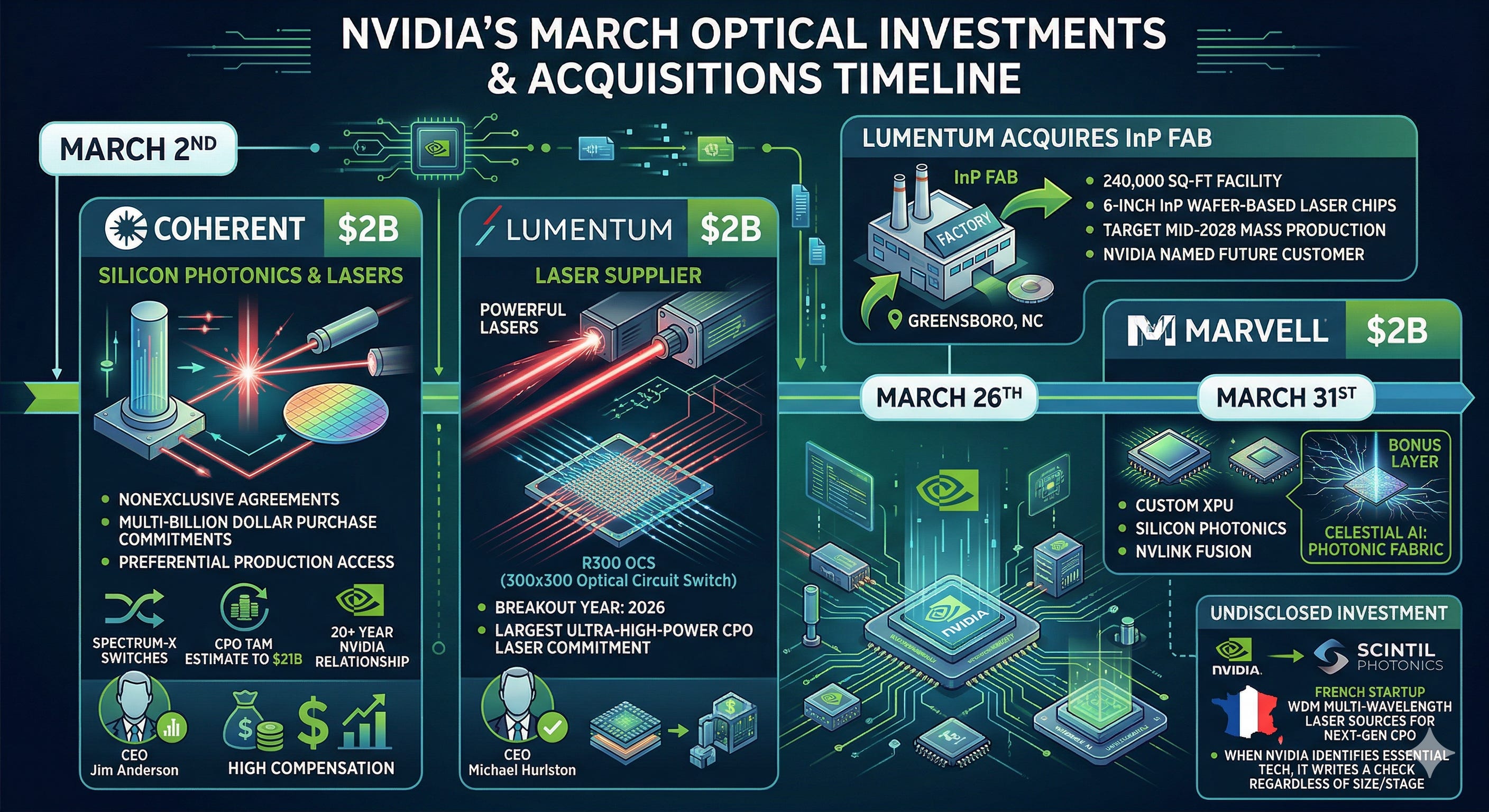
March 2nd: Coherent $2B + Lumentum $2B
Two optical companies got $2B each on the same day. Both are nonexclusive agreements, but each includes multi-billion dollar purchase commitments and preferential access to future production capacity.
Coherent is one of the two pillars of silicon photonics and laser technology. It already supplies silicon photonics for NVIDIA’s Spectrum-X switches, and at OFC 2026 it expanded its CPO TAM estimate to $21B. CEO Jim Anderson reportedly ranks among the highest-compensated CEOs in the country. NVIDIA’s relationship with Coherent goes back over 20 years.
Lumentum is the laser supplier. It provides lasers for NVIDIA’s CPO modules and is developing the R300 OCS, a 300x300 port Optical Circuit Switch. CEO Michael Hurlston called 2026 the “breakout year” for laser chip revenue and announced the largest ultra-high-power CPO laser purchase commitment in the company’s history.
The War of Light, A Laser Shortage

On March 2, 2026, NVIDIA invested $2B in Coherent and another $2B in Lumentum. Both companies make lasers. The two announcements came on the same day and included “multi-billion dollar purchase commitments” and “future capacity access rights.” Jensen Huang wasn’t just buying lasers. He was locking up the ability to make them.
March 26th: Lumentum Acquires InP Fab in Greensboro, NC
Lumentum acquired Qorvo’s 240,000 square-foot InP fab in Greensboro, North Carolina. The facility produces 6-inch InP wafer-based laser chips, with mass production targeted for mid-2028. The announcement explicitly named NVIDIA as a future customer. Section 4 goes deep on the strategic meaning here.
March 31st: Marvell $2B
Covered above in detail. Custom XPU plus silicon photonics plus NVLink Fusion, with Celestial AI’s Photonic Fabric as the bonus layer.
There is one more deal that got far less attention.
NVIDIA also invested in Scintil Photonics, a French startup developing WDM (wavelength-division multiplexing) multi-wavelength laser sources for next-generation CPO.
The amount was not disclosed. The key observation is this: When NVIDIA identifies a technology as essential to its supply chain, it will write a check regardless of the company’s size or stage.
Then,
what about a company like POET Technologies,
which supplies the core components for the Celestial AI that Marvell acquired?
That thread runs through the later sections.
Coherent, Lumentum, Marvell, Scintil. The next section maps where each of these sits in the optical supply chain and what the overall architecture looks like.
Section 3: The Three Layers of NVIDIA’s Optical Empire
Past the individual deals, here is NVIDIA’s optical architecture decomposed into three layers.
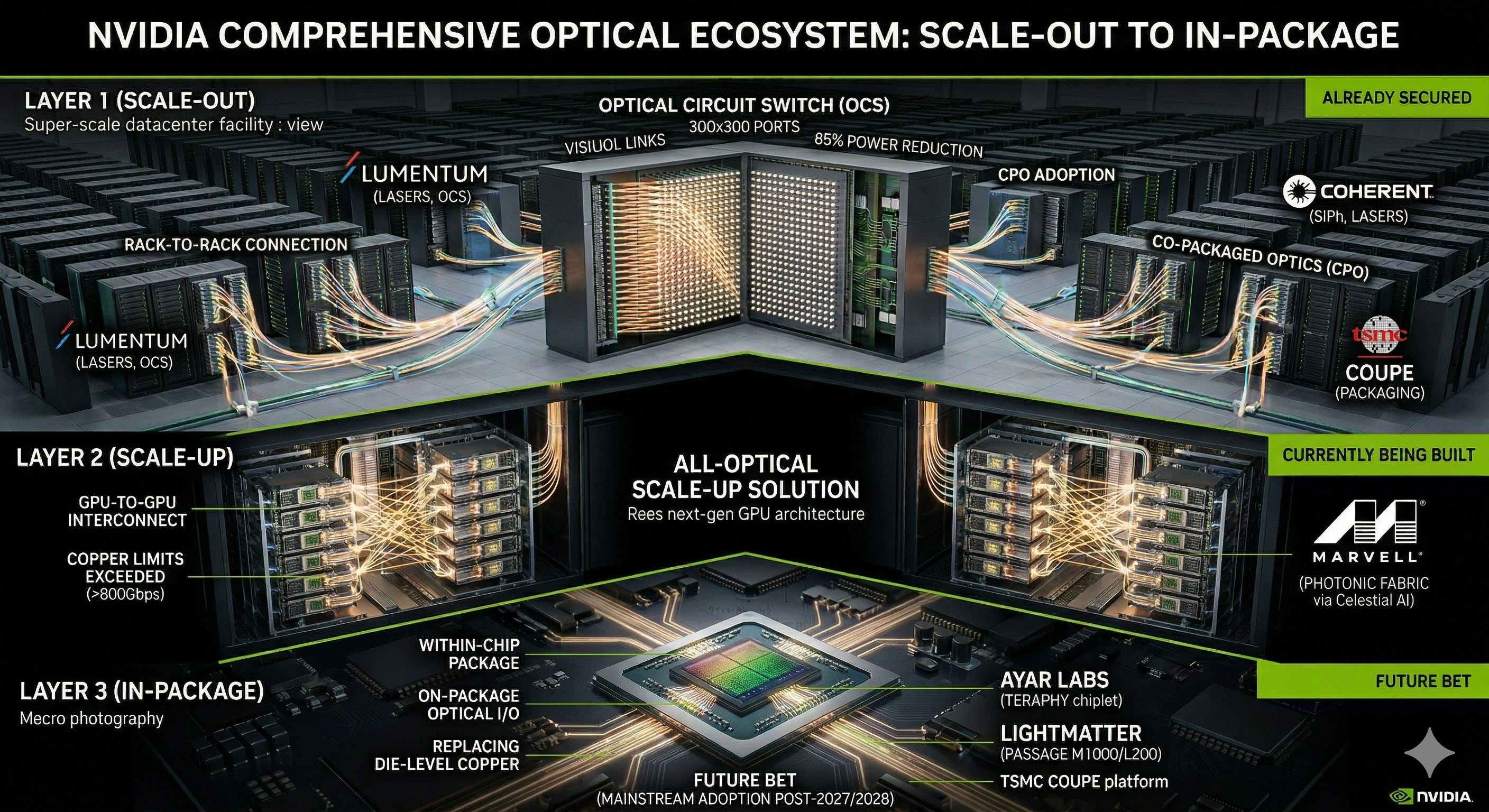
Layer 1: Scale-Out (rack-to-rack) —> Already Secured
This is the segment connecting racks within a datacenter. The copper-to-optical transition here is already done. Pluggable transceivers at 800G and 1.6T are mainstream. NVIDIA’s Spectrum-X Ethernet and Quantum-X InfiniBand switches handle this tier.
NVIDIA’s move in this layer was CPO:
Placing pluggable transceivers directly onto the switch ASIC package. NVIDIA’s own data puts the power efficiency gain at 3.5x versus pluggable. The COUPE (Compact Universal Photonic Engine)-based CPO revealed at GTC 2025 is scheduled to ship from 2026 to 2027.
Who makes the lasers for that CPO? Lumentum and Coherent. That is why NVIDIA put $4B into those two companies and layered multi-billion purchase commitments on top.
Lumentum’s R300 OCS is also central here. The 300x300 port optical circuit switch claims a 65% reduction in total network power and 5 to 10x lower latency in a 100,000-XPU cluster. Samples are already in the hands of multiple hyperscalers and cloud builders.
Layer 1 summary:
NVIDIA has this tier essentially wrapped up. Coherent for SiPh, Lumentum for lasers and OCS, TSMC COUPE for packaging.
Layer 2: Scale-Up (within the rack, GPU-to-GPU) —> Currently Being Built
This is the hottest front right now.
NVIDIA’s current NVL72 uses copper NVLink to connect GPUs within a single rack. Seventy-two GPUs, copper, one rack. The problem is that copper hits physical limits above 800 Gbps: maximum 2-meter transmission distance, mandatory retimers, and rapidly escalating power consumption.
The next-generation Rubin architecture needs bandwidth that copper cannot deliver. This is where optical scale-up interconnects become necessary. And the most advanced technology in this space is Celestial AI’s Photonic Fabric, now owned by Marvell. Marvell has announced that it will combine Celestial AI’s optical scale-up interconnect with its UALink scale-up switch roadmap to build what it calls “the industry’s first all-optical scale-up solution.”
This is why NVIDIA put $2B into Marvell. The first-generation semi-custom reference design combining Marvell’s 1.6T optical interconnect with NVIDIA’s next-generation Rubin GPU architecture is expected in Q3 2026. Full revenue contribution from Photonic Fabric is projected for late 2028, with a $1B annual run-rate target by end of 2029.
Layer 2 summary:
Marvell (Celestial AI Photonic Fabric) plus NVIDIA NVLink Fusion is the core axis for optical scale-up.
Layer 3: In-Package (within the chip) —> A Future Bet
This is the most forward-looking layer. The ultimate goal is to replace the connections inside the GPU die, or between the die and HBM, with optical.
One point that’s easy to confuse here: the products Ayar Labs and TSMC COUPE are shipping starting in 2026 are “CPO optical engines that attach to switches.” This is actually an evolution of Layer 1 (scale-out) — moving pluggable transceivers onto the switch package, not putting optics inside the GPU die.
However, this CPO technology becomes the foundation for Layer 3. Ayar Labs’ TeraPHY chiplet provides optical I/O that sits directly on the processor substrate. The first generation starts as switch-side CPO, but the same technology progressively migrates toward the GPU. In March 2026, Ayar Labs closed a $500M funding round with both NVIDIA and AMD participating, at a $3.75B valuation. TSMC’s COUPE platform serves as the manufacturing infrastructure for this technology.
Lightmatter is also worth watching. They’ve developed the Passage M1000, a 3D photonic interposer claiming 114 Tbps bandwidth. Valued at $4.4B with $822M raised to date.
To summarize the timeline:
Scale-out CPO (2026–2027, Layer 1 evolution) → Scale-up optical (2028–2029, Layer 2) → true in-package optical (2029+, Layer 3).
The closer the connection you’re replacing with optics, the higher the technical difficulty — which is why the higher the layer number, the later it arrives.
Section 4: How NVIDIA’s Investment Formula Actually Works
Section 2 mentioned Lumentum’s Greensboro fab acquisition in one line. Now let’s actually unpack it. This is where NVIDIA’s investment mechanics become visible.
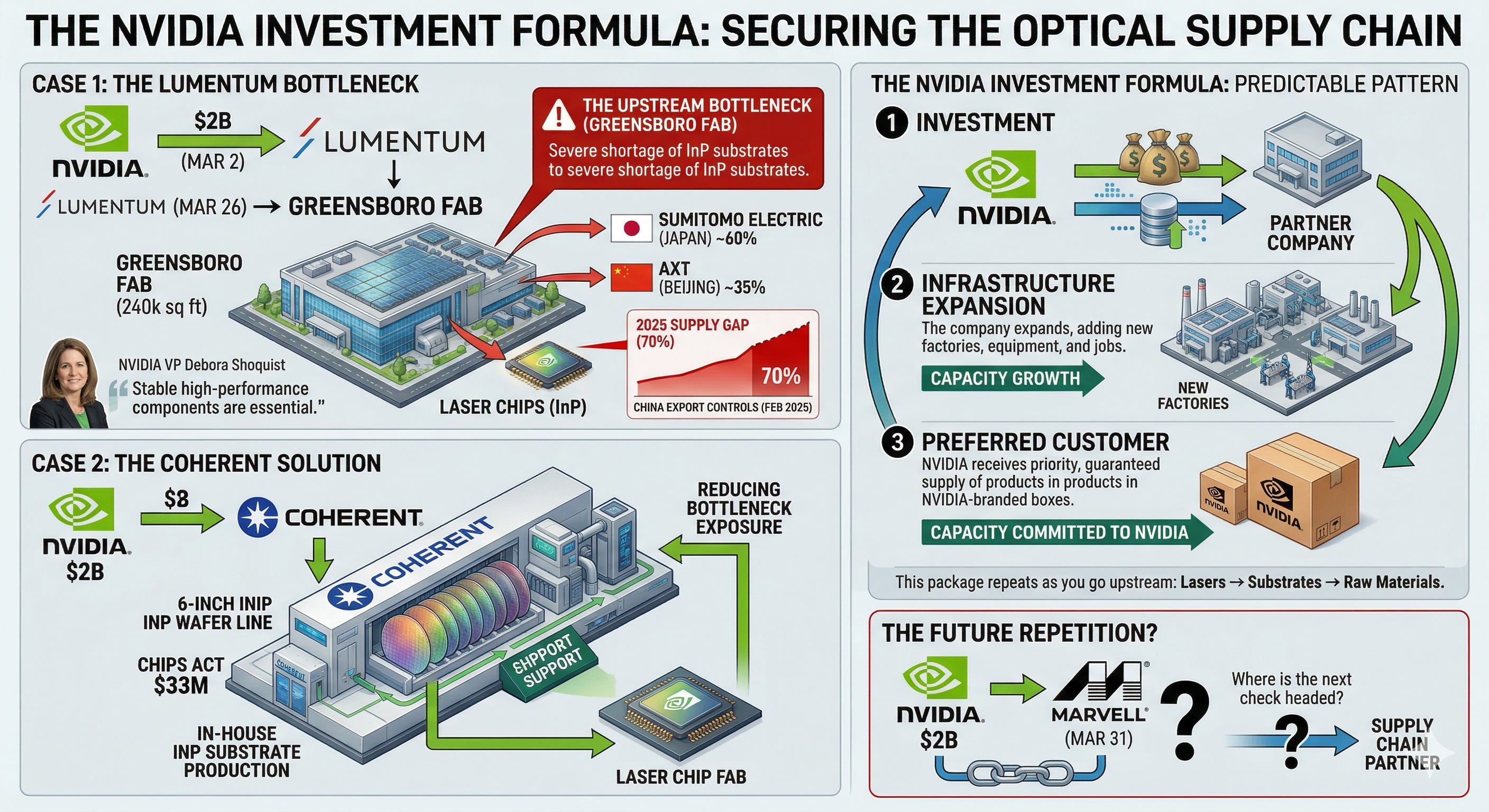
NVIDIA $2B → Lumentum → Greensboro Fab
NVIDIA’s Lumentum investment was announced March 2nd. Lumentum’s Greensboro acquisition was announced March 26th. Twenty-four days apart.
Go back to the original March 2nd investment statement: “NVIDIA is investing $2 billion in Lumentum to support R&D, future capacity and operations as the company builds out its U.S.-based manufacturing capabilities in a new fab.” The new fab was already explicitly named. Then in the Greensboro announcement, Lumentum referenced “previously announced strategic agreements.”
The fab acquisition was not a sudden decision triggered by the NVIDIA investment. The NVIDIA $2B package was designed with this fab as a prerequisite. Negotiations with Qorvo’s facility were almost certainly already in progress before the $2B deal was signed.
The Greensboro facility is 240,000 square feet. Lumentum will use it to produce CW and UHP laser chips from InP wafer inputs, with mass production targeted for mid-2028. NVIDIA VP of Operations Debora Shoquist noted that “stable access to high-performance optical components is essential.” The announcement included plans for hundreds of millions in additional investment and over 400 American manufacturing jobs.
Once this fab reaches full production, Lumentum’s laser manufacturing capacity expands substantially. And a significant portion of that expanded capacity will already be committed to NVIDIA’s multi-billion purchase agreement.
The Greensboro Fab Has Its Own Upstream Bottleneck
The Greensboro fab makes laser chips. Laser chips require InP (Indium Phosphide) wafer substrates as raw material. Who makes those?
Sumitomo Electric (Japan, approximately 60% market share) and AXT (U.S.-listed but manufactured in Beijing, approximately 35%). These two companies supply over 95% of global InP substrates. The market is in severe shortage: 2025 demand at roughly 2 million units against production capacity of 600,000. A 70% supply gap. In February 2025, China enacted export controls on indium-related compounds including InP, adding further instability to substrate supply.
NVIDIA is spending $6B to build a Western-based optical supply chain, but the InP wafers going into the Greensboro fab are 60% from Japan and 35% from China. The top of the chain is still exposed.
NVIDIA $2B → Coherent → InP Substrate Vertical Integration
The answer to this bottleneck is already in motion. Coherent, a recipient of the NVIDIA $2B investment, is simultaneously the world’s first company building a 6-inch InP wafer production line, supported by $33M in CHIPS Act funding to develop 150mm InP substrate capacity.
If NVIDIA’s $2B accelerates this vertical integration, Coherent ends up producing not just laser chips but the InP substrates that feed them. Lumentum could move in the same direction.
The Investment Formula
These two cases reveal a pattern.
Investment → manufacturing infrastructure expansion → NVIDIA becomes the preferential customer for the expanded capacity.
These three steps are a single package. And this package does not stop at one supply chain layer. It repeats as you go upstream. From lasers to substrates. Potentially from substrates to raw materials.
Once you understand this formula, reading future NVIDIA investments becomes more predictable.
When NVIDIA writes a $2B check to a company, expect a manufacturing expansion announcement from that company within weeks, with much of the expanded capacity already committed to NVIDIA. Conversely, if a supply chain company that NVIDIA has not yet invested in suddenly announces a major manufacturing expansion, that could be a signal for where the next check is headed.
If you followed the logic to this point, a question naturally surfaces. NVIDIA’s $2B into Marvell is not the end of the chain either. Marvell has its own supply chain to secure and expand. The company at the end of that chain is what the next sections pursue.