

In my late-March analysis of Aehr Test Systems (AEHR), I laid out three things the thesis still needed to prove: that bookings would convert to revenue, that gross margin would recover, and that customers in the evaluation stage would move into actual production.
The thesis at the time was that the economic value of burn-in testing is rising structurally, driven by the power density of AI processors, the optical stabilization requirements of silicon photonics, and the spread of hybrid bonding, and that AEHR sits on the receiving end of that demand with both wafer-level and package-level burn-in platforms.
Why AEHR Matters Right Now

The economics of early-stage semiconductor failures are changing fast. As AI data centers scale and optical interconnect architectures move from roadmap to reality, burn-in, once a process reserved mainly for high-reliability applications, is back at the center of manufacturing strategy. AI processors, silicon photonics, and advanced packaging are all converging to drive this shift.
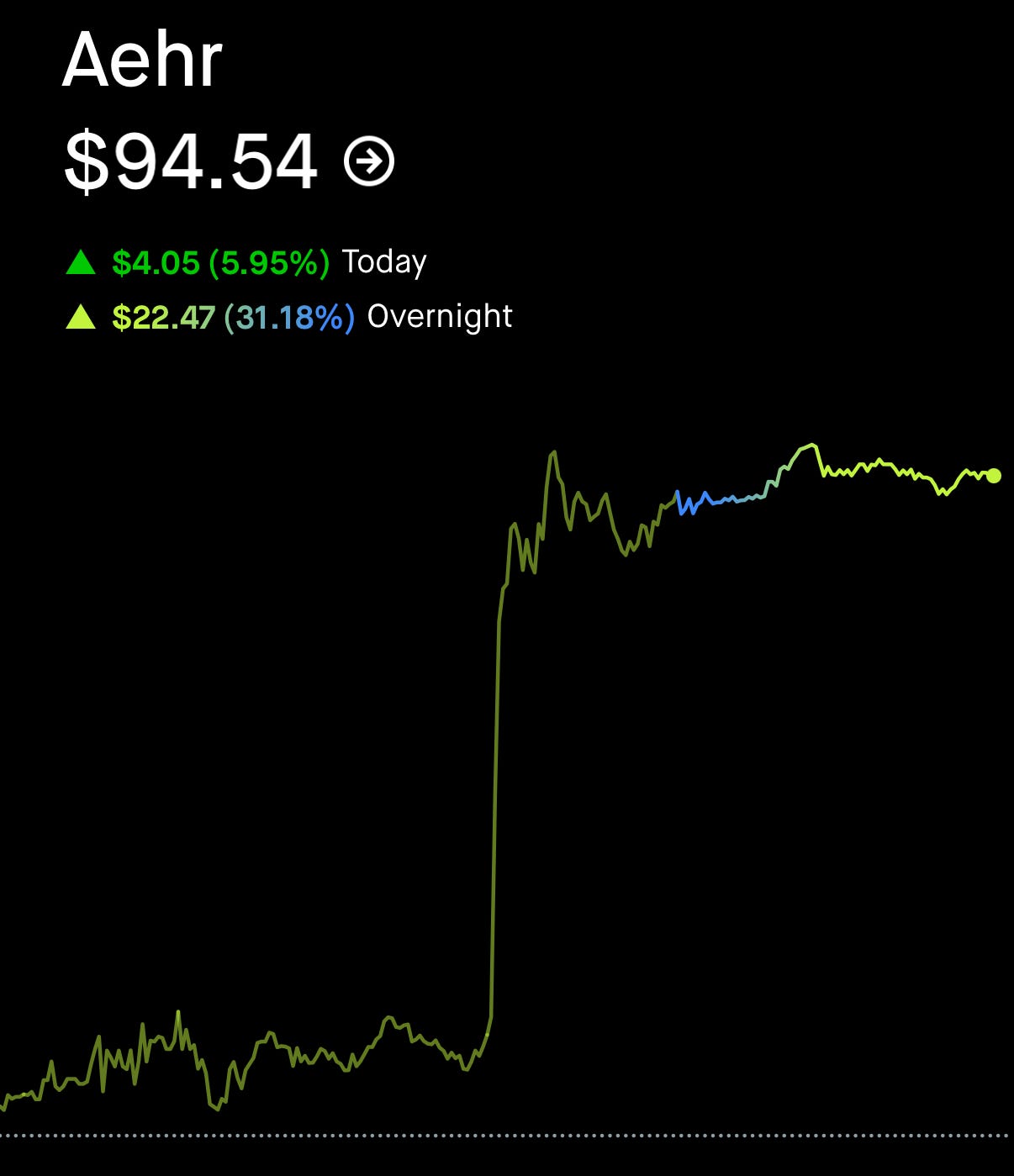
The fiscal 2026 fourth quarter results released on July 14 showed progress on all three. Quarterly bookings of $60.7M, an effective backlog of $100.6M, and fiscal 2027 revenue guidance of $130M to $150M, which is 2.6x to 3x the year just ended. The stock jumped 31% in after-hours trading.
This is not simply a recap of AEHR’s earnings release. It digs into what the numbers actually mean and extends from there to the changes underway across the entire optical value chain. What does this quarter tell us, how should an optical investor frame the next 12 to 24 months, and how should conviction be allocated across the layers of the value chain?
I hope this article helps you pressure-test your own conviction in optical investing.
Table of Contents
Checking the March Homework
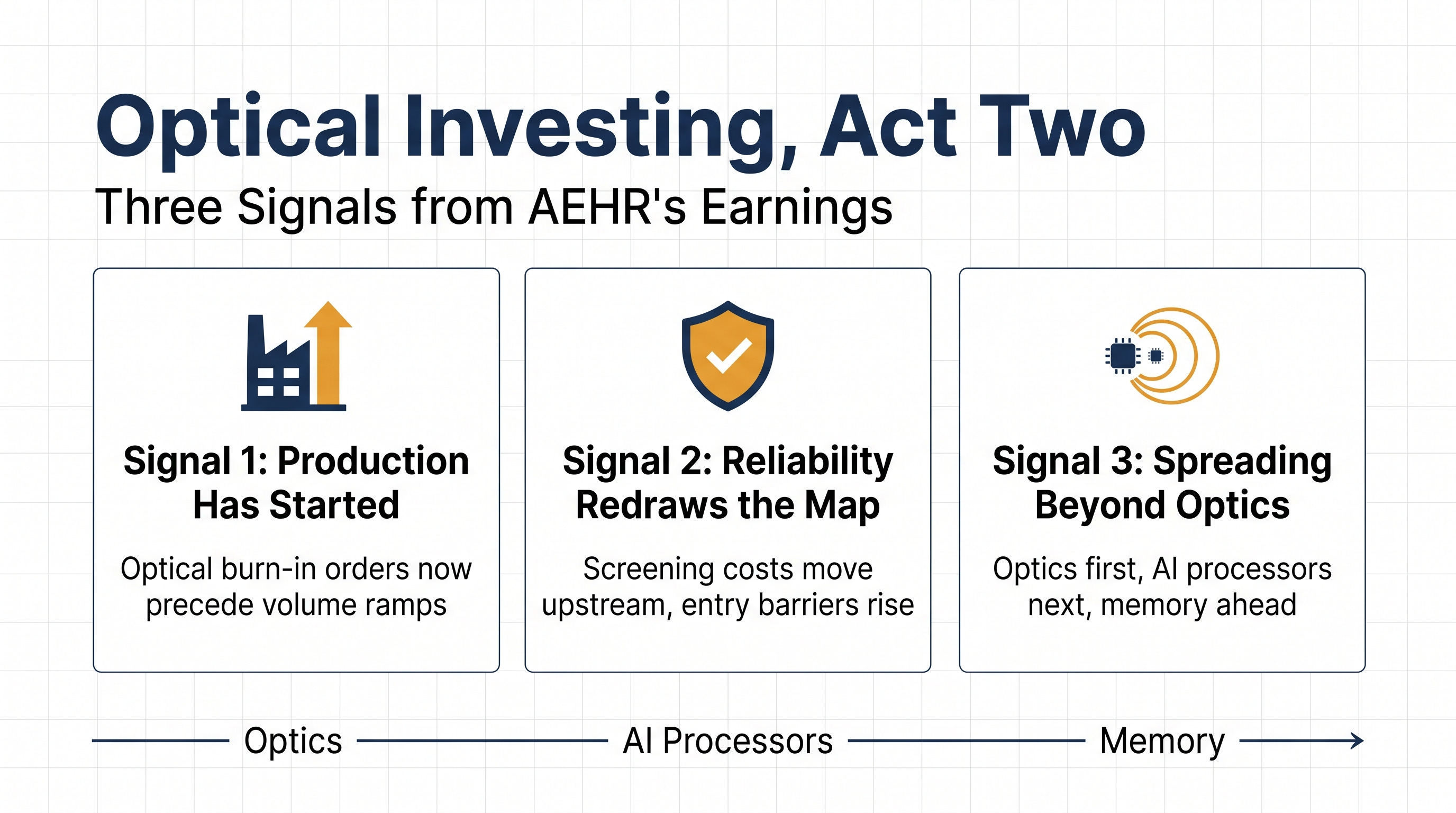
Signal 1: Where the Optical Production Cycle Stands
Signal 2: How Rising Reliability Requirements Reshape Cost Structures and Entry Barriers
Signal 3: The Spread Into Adjacent Markets
Layer-by-Layer Outlook: The Next 12 to 24 Months in Optics
Conclusion
Disclaimer
All figures cited in this article come from public sources, including the company’s earnings materials, conference call, and filings. Interpretations and forecasts are my personal analysis, and nothing here is a recommendation to buy or sell any security.
Checking the March Homework
First item, converting bookings to revenue. Fourth quarter bookings came in at $60.7M, more than five times the $11.1M a year earlier. Year-end backlog stood at $80.6M, and adding the $20M received in the weeks right after the fiscal year closed brings the effective backlog to $100.6M. With fiscal 2026 revenue at $50M, the backlog alone equals twice last year’s revenue. On that base, the company guided fiscal 2027 revenue to $130M to $150M, growth of 160% to 200%. Management said it is not capacity constrained even at the $150M level and sees room to raise guidance as additional orders firm up.
Second item, margin recovery. The question in March was whether gross margin, which had fallen into the 30s, could get back above 40%. Fourth quarter non-GAAP gross margin was 45%, up 10 points from 35% a year earlier, which the company attributed to higher revenue, better factory utilization, and favorable product mix. Full-year gross margin was still 38.5%, so one quarter does not settle the annual margin question. But with the company guiding fiscal 2027 non-GAAP pretax income to 18% to 22% of revenue, this quarter at least confirmed that gross margin can climb back into the mid-40s when volume recovers.
Third item, evaluation customers converting to production. This is where the progress was largest. A new silicon photonics customer, described as a global leader in networking, went from first contact last November to ordering two nine-wafer FOX test cells and two FOX NPs within months, and has told the company to expect additional systems this year to support next-generation hyperscale data center deployments.
On the AI processor side, a wafer-level burn-in benchmark with a top-tier semiconductor company that supplies AI accelerators, CPUs, and network processors was completed with results that exceeded the customer’s expectations. The benchmark was originally meant to qualify a next-generation device, but the customer has now asked to evaluate pulling the process into its current high-volume device and to run a second device in parallel. Meanwhile, the lead AI processor customer moved all of its production burn-in screening to wafer level and eliminated system-level screening entirely.
The caveats deserve equal clarity.
A full year of execution sits between guidance and realized revenue, and management itself acknowledged that this business will remain lumpy and cyclical. Three customers each accounted for more than 10% of fourth quarter revenue, and the hyperscale customer’s second device has already slipped once.
Even so, the fact that three items left unverified in March were largely confirmed within four months is very encouraging. And the reason this matters goes beyond the movement of one stock: AEHR’s order data serves as a progress indicator for the entire optical value chain.
Signal 1: Where the Optical Production Cycle Stands
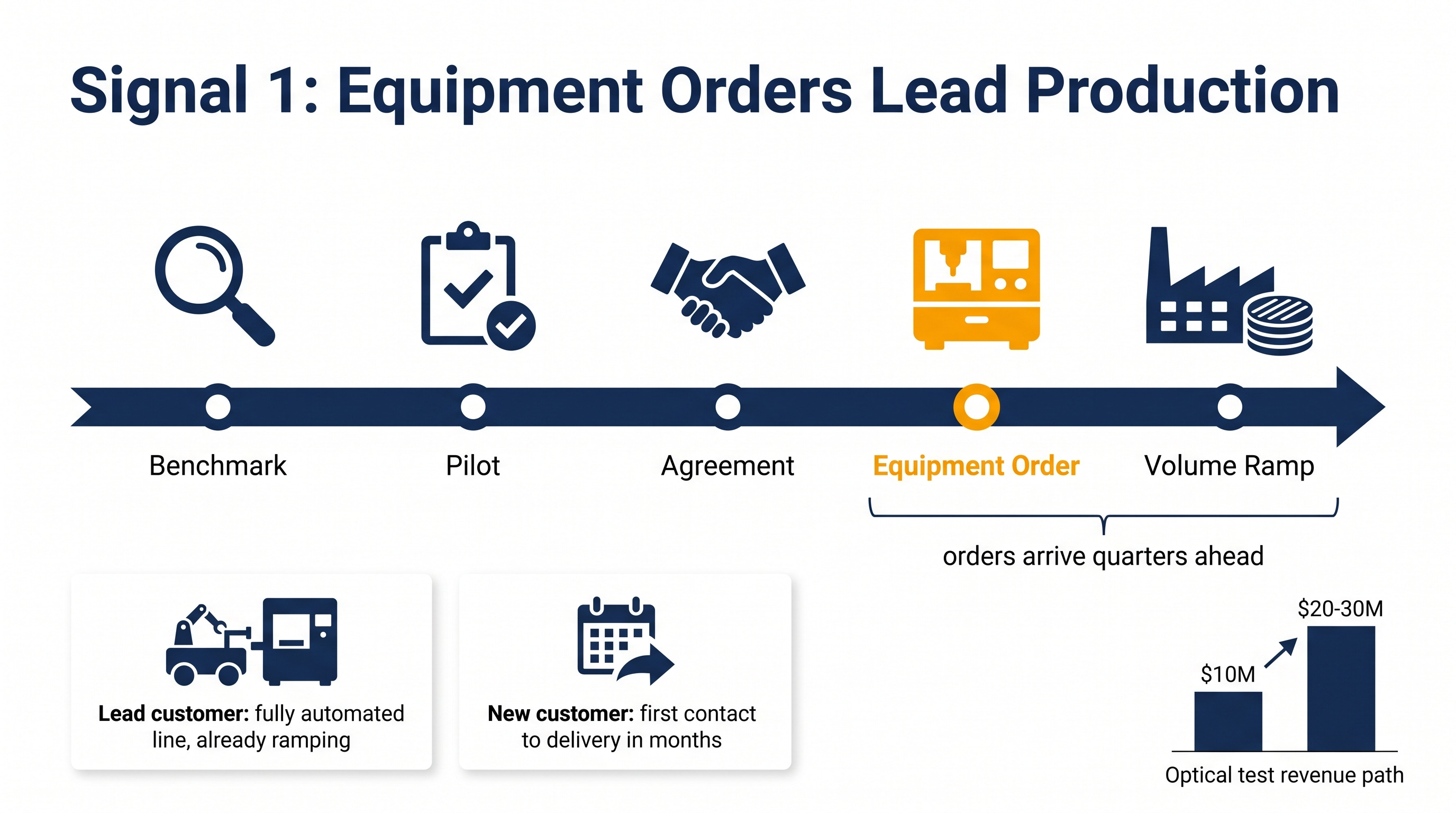
Burn-in equipment has to be purchased and installed before a customer starts volume production. Orders follow a sequence of benchmark, pilot qualification, and development agreement before production purchase orders arrive, and production begins only after the tools are on the line. Equipment bookings therefore lead customer production ramps by anywhere from a few quarters to more than a year, which means AEHR’s optical bookings offer an early read on when, and at what scale, optical device makers plan to produce.
The lead silicon photonics customer is already ramping, with follow-on orders over the past year and more placed in the current fiscal year. Its line is fully unmanned, with automated wafer handling integrated with AGVs (automated guided vehicles). This is not a couple of trial units; it is mass-production infrastructure that runs without human hands.
The new networking customer first met the company last November and, within months, ordered four systems and took delivery. New process technologies typically take years of customer persuasion. Adoption at this speed suggests wafer-level burn-in has moved past the unproven-technology stage in optics and is approaching standard-process status among lead customers. Management also noted that sales cycles are shortening across the industry.
On the numbers, fiscal 2026 revenue from optical device test and burn-in was roughly $10M, a figure that includes data center transceivers, chip-to-chip I/O, and HDD-related optical testing. Applying the company’s stated fiscal 2027 silicon photonics mix of 15% to 20% to the guidance range gives roughly $20M to $30M, a path where optical-related revenue at least doubles within a year.
800G transceivers are in their volume phase and the 1.6T transition has begun. CPO (co-packaged optics, which integrates optical components into the same package as the switch chip) and optical I/O are in hyperscaler pilots and early deployments, and the debate over commercialization timing continues. Yet test infrastructure orders are already being executed against both trends. The next volume phase of optics is moving beyond industry forecasts into concrete production equipment orders.
One point from the March analysis is worth restating. Optical burn-in performs defect screening and optical stabilization (aging) in a single step. Devices that contain lasers go through an early period where output power and wavelength drift, and burn-in walks them through that window so they ship in a stable state. In ordinary logic chips burn-in is purely a screen; in optics it is a required step of the production process itself. The lead customer’s fully automated line and the new customer’s rapid adoption are evidence that this process structure is taking hold on real production floors.