In June 2024, NVIDIA CEO Jensen Huang presented Physical AI as the next stage of AI in his COMPUTEX keynote. His vision was for AI to understand the laws of physics and work alongside people in shared spaces.
Yet for many of us, the term may bring little to mind beyond humanoid robots. What distinguishes the robots that have existed for decades from the Physical AI being discussed today?
How could Physical AI change our society?
And which parts of this emerging field deserve closer attention before it becomes widespread?
This article begins with a detailed explanation of what Physical AI is and how it works.
It thened divides the technology into layers, connecting each layer’s role with the semiconductors it requires and the companies that supply them.
Finally, it uses that technical foundation to develop a practical perspective on investing in the field. For anyone interested in the future of AI investing, this is a useful place to start.
Disclaimer
This article is for informational purposes and does not recommend buying or selling any security. Company and market figures are drawn from public sources. Readers are responsible for their own investment decisions.
1. Physical AI turns perception and decisions into machine movement
Physical AI systems use sensors to understand their surroundings and AI to decide how a machine should move.
Cameras and other sensors provide information, AI determines an action, and control systems translate that action into physical movement.
Sensors then measure the result so the system can adjust its next action.
Adding AI perception and decision making to automation allows machines to adjust their behavior to changing conditions instead of simply repeating a fixed sequence. Because these systems move physical machines, response time and safety matter alongside the accuracy of their decisions.
These capabilities apply to vehicles and industrial equipment as well as humanoid robots.
2. Commercial deployment and revenue across machine categories
The installed base of industrial robots exceeds five million
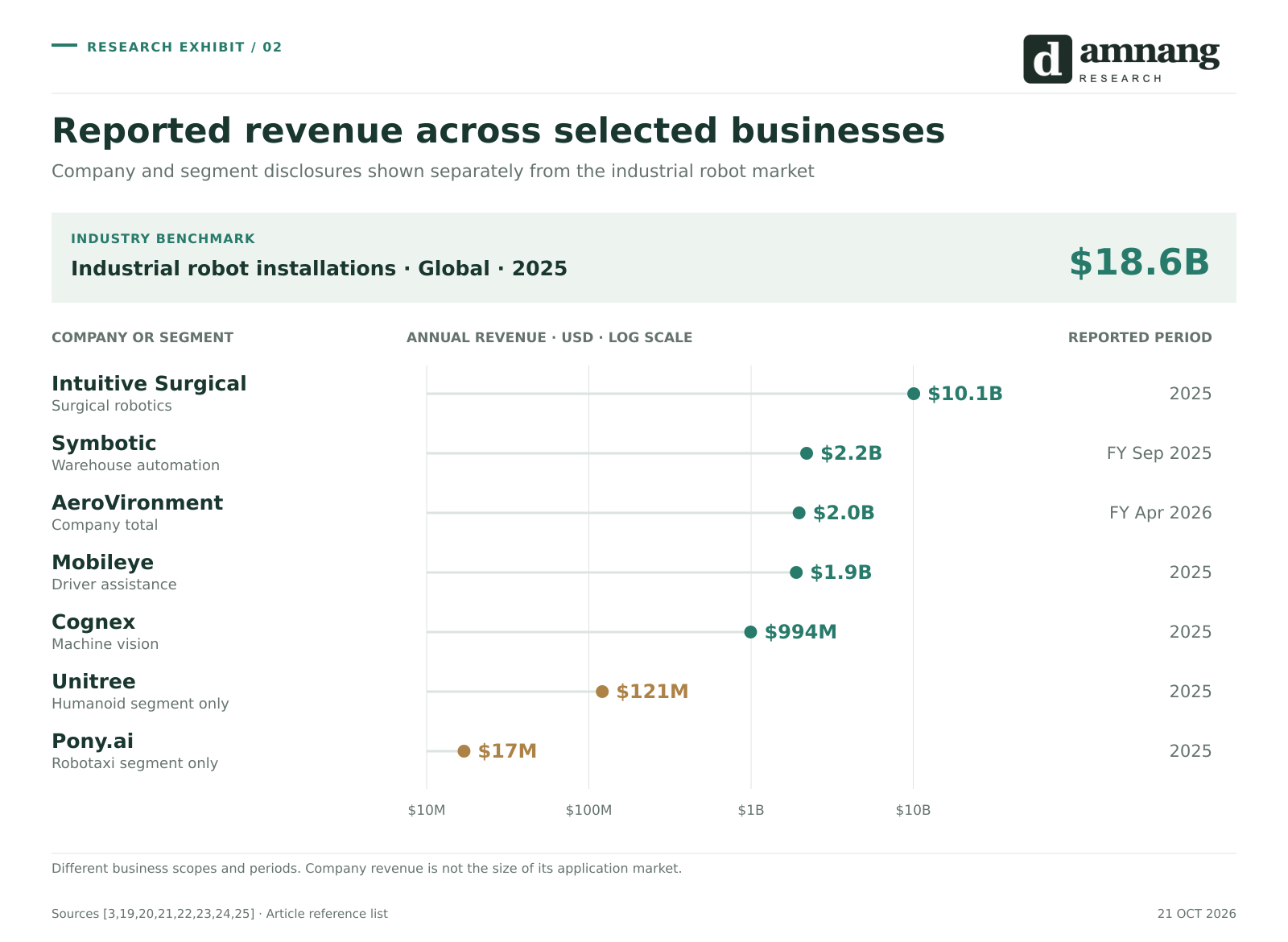
Industrial robots that perform repetitive factory tasks already have a substantial installed base. New installations reached 603,307 units in 2025, worth $18.6 billion, while more than five million robots were in operation. These figures cover the entire industrial robot market, including conventional automation. Robots that use general purpose learned models to carry out complex tasks are still being demonstrated and validated in the field.
Driver assistance chips ship at scale as robotaxis expand commercial service
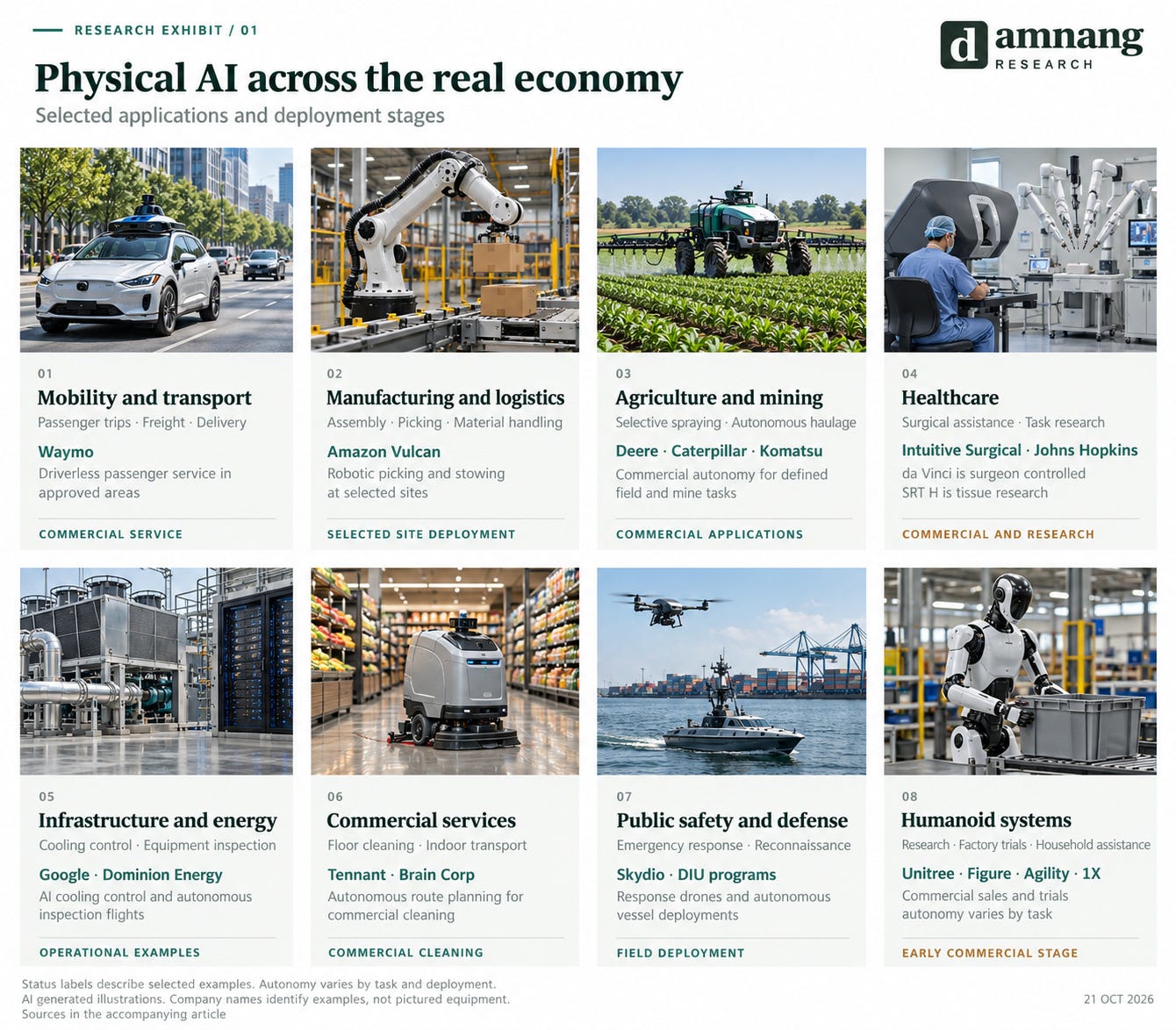
In automobiles, semiconductors for driver assistance functions are already shipping in large volumes. Mobileye shipped 10 million driver assistance chips in the second quarter of 2026, and its total company revenue was $508 million.
Robotaxis without drivers are also expanding commercial operations. Waymo provides at least 500,000 paid rides per week in 15 US cities. Tesla also operates a paid robotaxi service in parts of Texas and Florida.
Transport and cleaning lead deployment in logistics and service robots
Warehouses offer favorable conditions for deploying the same automation equipment repeatedly because work areas, routes and the range of goods handled can be defined and limited. Amazon has deployed more than one million robots since 2012. Symbotic, a supplier of warehouse automation equipment, reported revenue of $720.8 million for the quarter ended June 2026, up 22% from a year earlier.
Moving goods and cleaning floors are major applications in commercial buildings and workplaces. The IFR reported approximately 250,000 professional service robots sold in 2025, an increase of 24%. Transport robots accounted for 117,500 units, or 47% of the total.
Research and education account for a large share of humanoid shipments
Humanoids use a body structure similar to the human form so they can operate in spaces and use tools designed for people. According to CCID, global shipments rose from approximately 17,000 units in 2025 to about 19,100 in the first half of 2026 alone. These totals include products for research and education. More than 70% of the 5,215 humanoids Unitree sold in 2025 were intended for those uses.
Drones generate commercial revenue in defense and public safety
Drones are used for reconnaissance, infrastructure inspection and emergency response, with substantial revenue accruing to suppliers serving defense demand. AeroVironment reported revenue of $1.9768 billion for the fiscal year ended April 2026. Its uncrewed systems segment, which includes drones, contributed 77% of fourth quarter revenue. In public safety, Skydio says it supplies drones to more than 1,200 police and fire agencies in the United States.
Automation of specific tasks is expanding in agriculture and mining
In agriculture, AI identifies weeds so chemicals can be sprayed only where needed. Deere’s See & Spray was used on more than five million acres during the 2025 growing season and, according to the company, reduced herbicide use by an average of about 50%. In mining, large trucks operate without drivers within defined work areas. Komatsu put its 1,000th autonomous haul truck into service in April 2026.
Surgeon controlled systems dominate the commercial surgical robot market
Today’s surgical robot market is centered on systems operated directly by surgeons. The global installed base of da Vinci systems reached 12,094 at the end of September 2026. Their manufacturer, Intuitive Surgical, reported revenue of $10.0647 billion in 2025. Research into autonomous surgery includes systems that perform selected tasks on tissue outside the body.
In stationary equipment, AI is used for visual inspection and cooling control
In factories, machine vision that uses cameras and image processing to check product defects or positions is widely used. Cognex, which supplies related equipment and software, had revenue of $994 million in 2025. One application that directly controls equipment is data center cooling, and Google has used AI to control cooling equipment since 2018.
Industry Insight
Amazon’s plans for humanoid robots in the home
According to an Amazon AI engineer I recently met, Amazon is actively pursuing humanoid robots for the home, with internal goals of launching within three years and completing the rollout within five years. The engineer said its AI research is also placing more weight on the general purpose AI model team in line with this direction.
Tesla’s plan?
People in the industry say Tesla may also have some interesting news about humanoid robots before the end of this year. If it shows what Optimus can do in real environments without human assistance, we may get a clearer idea of how close it is to commercial use.
Apple?
Another interesting story involves Apple. There is talk that Apple is developing a home device that adds a robotic arm to its recently announced HomeView, responding to a user’s voice and turning its screen toward them. Considering Apple’s ecosystem connecting the iPhone, Siri, and devices around the home, this seems like a fairly plausible direction.
3. Eight technology layers and their semiconductor requirements
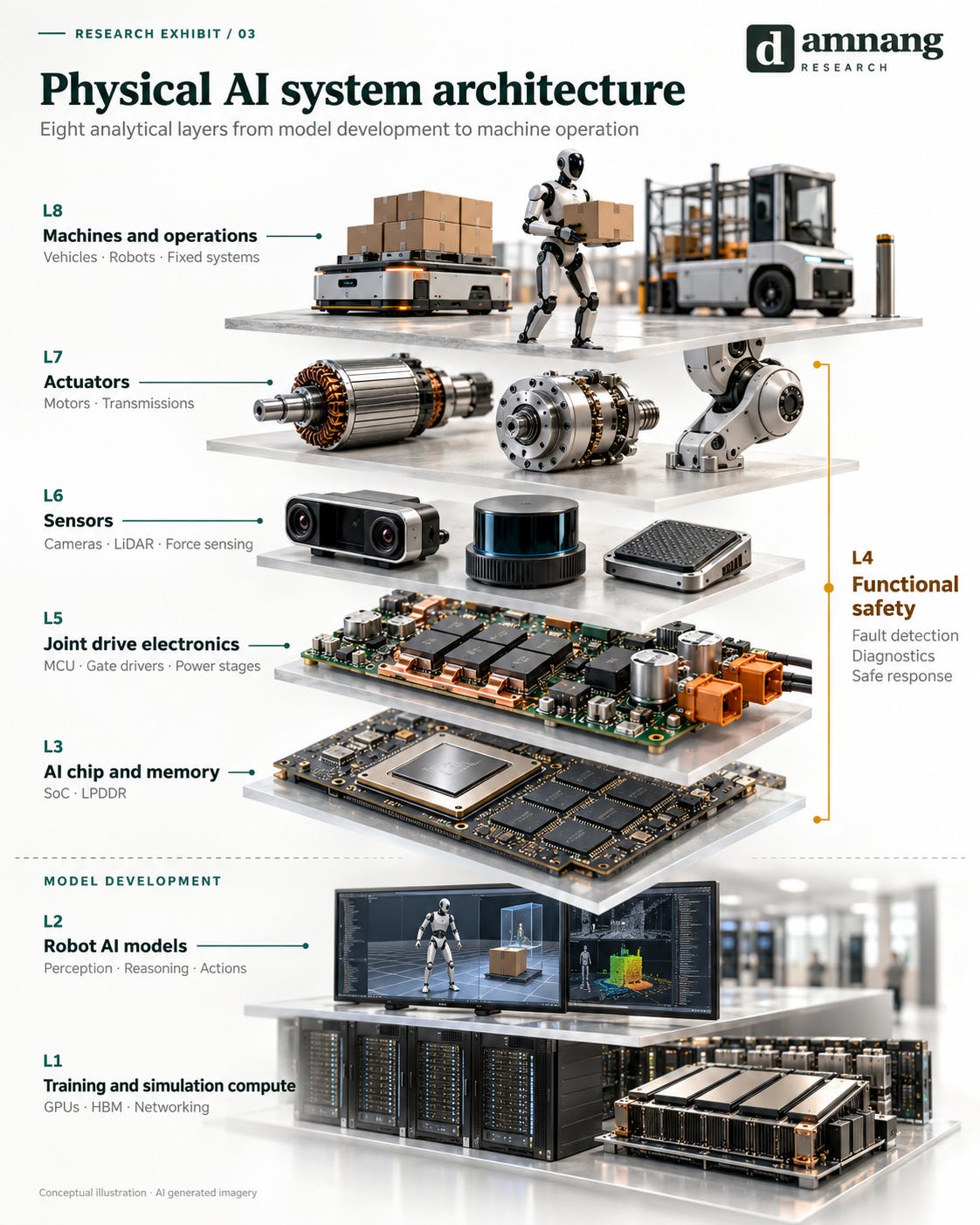
The structure below divides everything from training infrastructure to the operation of finished machines into eight technology areas.
The sensors, computing performance, number of driven axes and safety architecture required depend on the machine’s use, so the actual component configuration does not follow this division exactly.