

OFC (Optical Fiber Communications Conference) 2026 ran March 16 through 19 at the LA Convention Center. Think of it as the CES of the optical communications industry. Every year, companies from across the global optics and photonics space gather to demonstrate technology, schedule customer meetings, and hash out next-generation standards.
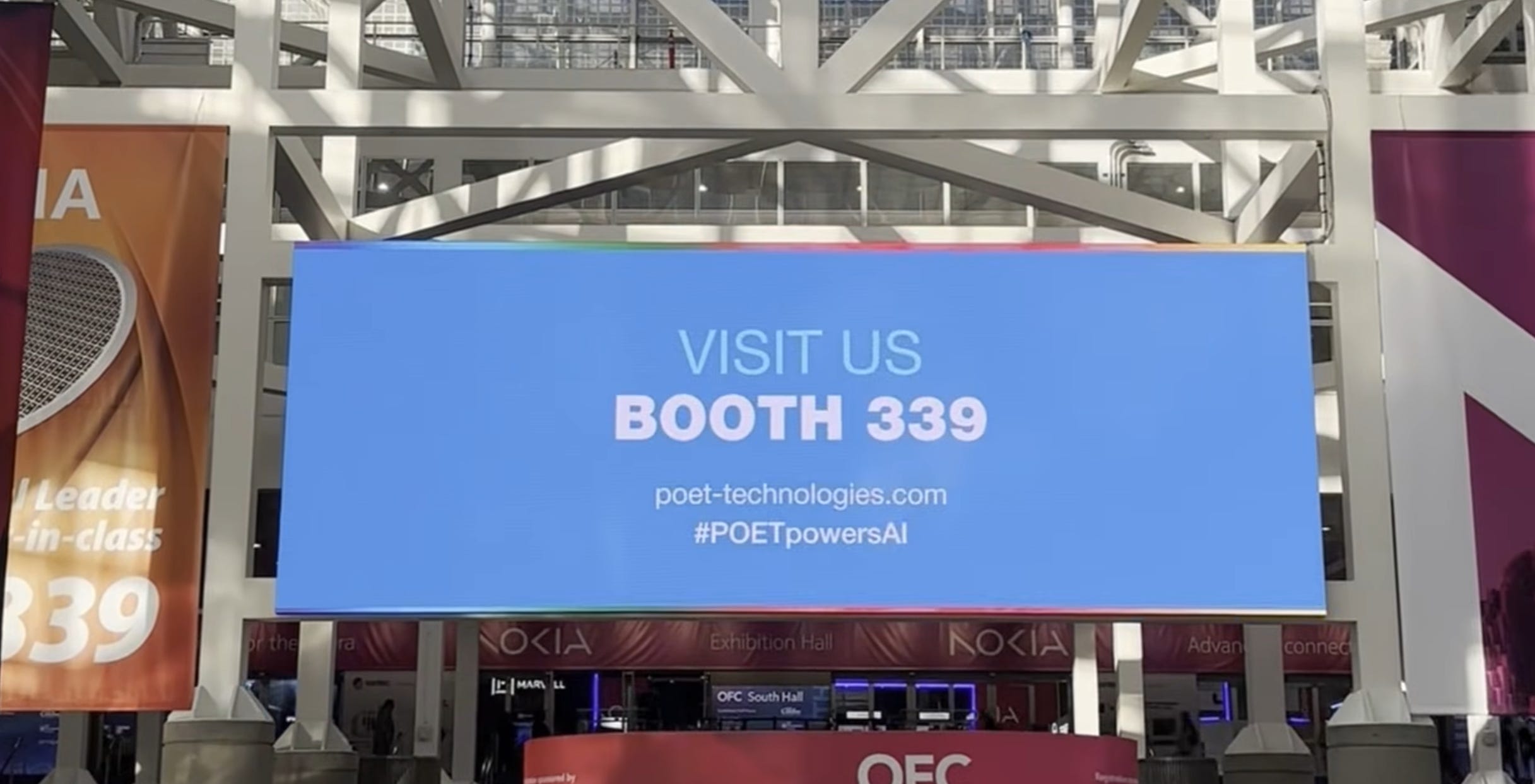
POET Technologies ran its largest booth ever at this year’s OFC, booth 339.
The company did its first public live demo of the Blazar hybrid laser, unveiled the next-generation Starlight engine, and won a Lightwave Innovation Reviews score of 4.5 with the Teralight 1.6T engine, one of the highest scores the award has ever given. During the conference, the company announced back-to-back partnerships with LITEON and Lessengers.
By any measure, POET did everything a company can do at a technical conference. And yet POET’s stock dropped roughly 9% during OFC week, closing at $6.18 on March 19.
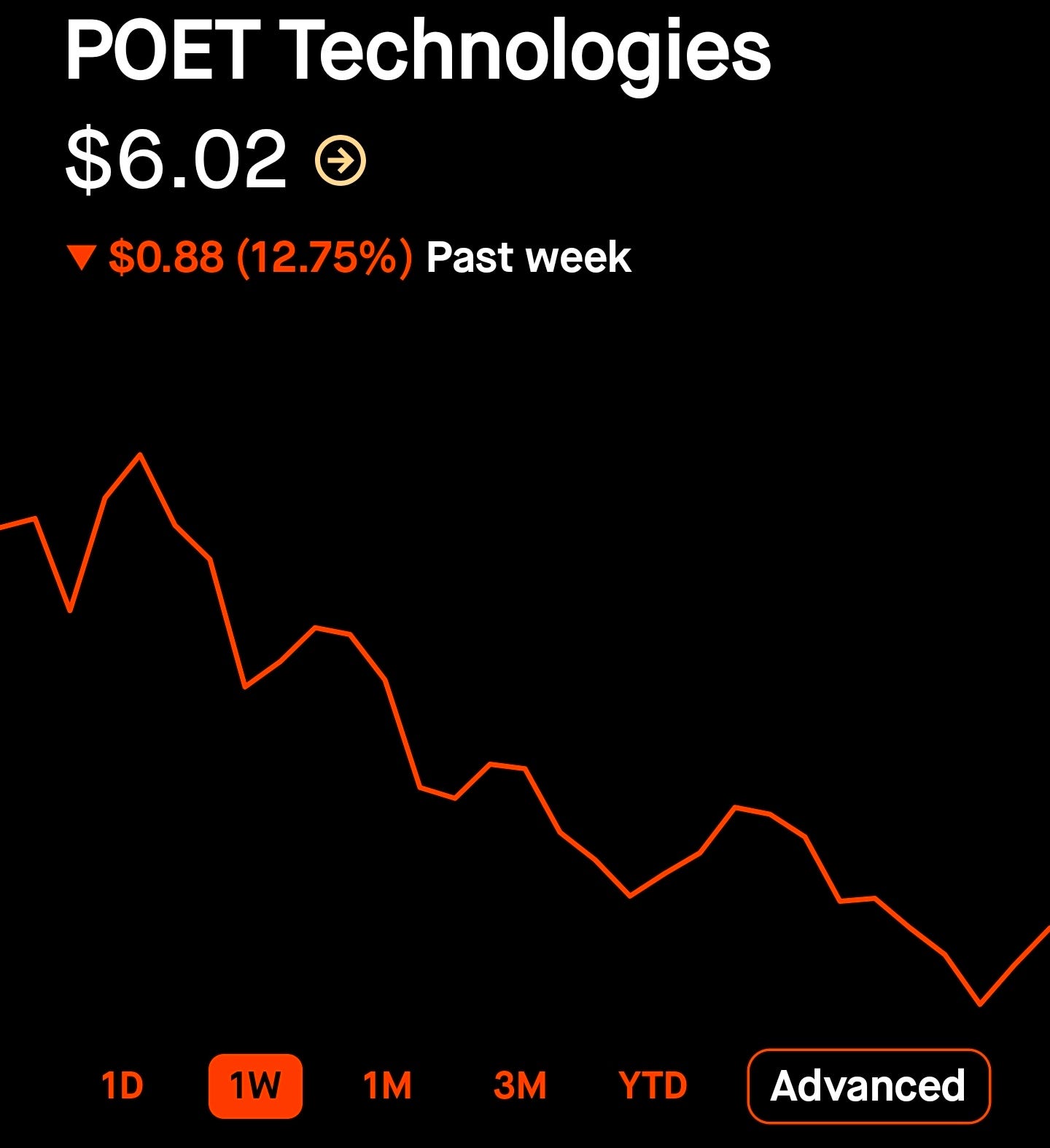
Then, sometime around March 26, Q4 2025 earnings are expected. External revenue estimates cluster around $2.2M, though they vary by source. What’s consistent is that the market is expecting a multiple of the prior quarter’s $298K. That gap, and this timing, contain everything you need to know about where POET stands and where it’s headed.
Is POET a brilliant opportunity or pure wishful thinking?

Market cap around $1 billion. Last quarter’s revenue: $298,434.
1. What POET Showed at OFC 2026
Let me go through the product lineup POET brought to OFC in technical detail. The company runs two parallel lines of business.
One is optical engines, the core chipsets that generate, modulate, and receive light, built on top of a platform called the Optical Interposer.
The other is ELS (External Light Source), standalone laser modules.
The main event for live demos at OFC 2026 was ELS. The Blazar and Starlight ELS products were front and center in the booth, while Teralight was the awards and display focus.
First: What Is the Optical Interposer
An “interposer” in the semiconductor industry is an intermediate substrate that mounts multiple chips in one package and lets them communicate with each other. Electrical interposers have been around for years. HBM memory getting placed next to a GPU runs on a silicon interposer. TSMC’s CoWoS is the canonical example.
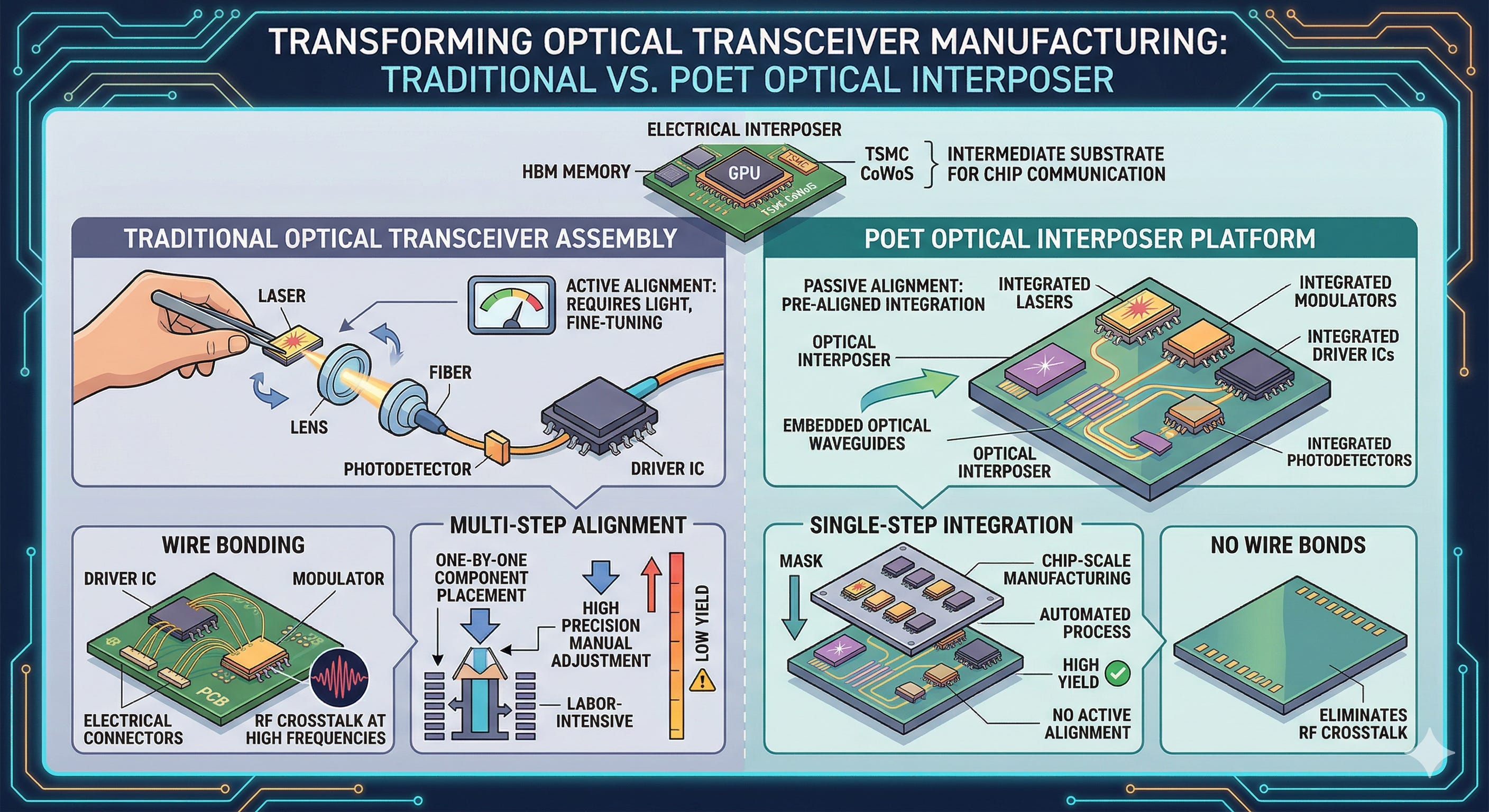
POET’s Optical Interposer takes that concept into the domain of light. Instead of routing electrical signals, it routes optical signals on the chip. Lasers, modulators (the devices that encode data onto light), photodetectors (which convert received light back into electrical signals), and driver ICs (the electronics that drive the lasers and modulators) are all integrated onto a single interposer platform and connected through embedded optical waveguides, the channels that carry light.
This Optical Interposer is the foundation of everything POET builds. Understanding it makes every product much clearer.
Product 1: Blazar — Hybrid ELS
Blazar is POET’s ELS product. To understand why ELS exists: as the industry moves toward CPO (Co-Packaged Optics, where optical engines are placed in the same package as the switch chip), putting a laser inside that package becomes a serious problem. GPUs and switch chips dump hundreds of watts of heat. Lasers are extremely temperature-sensitive. If the wavelength drifts, data transmission breaks down entirely. So you pull the laser out of the package, put it in a thermally isolated module. That’s ELS.
CPO, Fully Dissected [CPO Special Part 2]
![CPO, Fully Dissected [CPO Special Part 2]](https://substackcdn.com/image/fetch/$s_!LFif!,w_1300,h_650,c_fill,f_webp,q_auto:good,fl_progressive:steep,g_auto/https%3A%2F%2Fsubstack-post-media.s3.amazonaws.com%2Fpublic%2Fimages%2Fd2df124c-d6b0-4142-833c-908be262ab7c_900x491.jpeg)
Part 1 answered the question of why CPO exists. Now we move to the next question. If you crack open a chip package with CPO, what’s actually inside? What does each component do, and how do they all connect? And once you’ve solved the problem for switches, where does the technology go from there?
Blazar takes a structurally different approach from DFB (Distributed Feedback) lasers, the current mainstream for ELS. A DFB laser has a diffraction grating etched inside the chip itself, a microstructure that amplifies only a specific wavelength. It’s proven technology, but building it means assembling and testing each laser individually, which keeps costs high and scalability limited.
Blazar separates that structure. The optical gain portion of the laser (the InP-based gain medium) is split from the wavelength-selection portion (the grating), and the grating is etched directly into the Optical Interposer’s waveguide. The InP chip handles optical amplification only; everything else is handled by the interposer. That’s why it’s called a hybrid laser.
Three advantages follow from this. The InP chip is smaller, so you get more chips from the same wafer, improving InP utilization (InP is a globally constrained rare material). Wafer-level packaging (WLCSP) makes it possible, and POET claims costs come down by an order of magnitude compared to DFB. The design supports channel outputs above 100mW and multi-wavelength operation simultaneously.
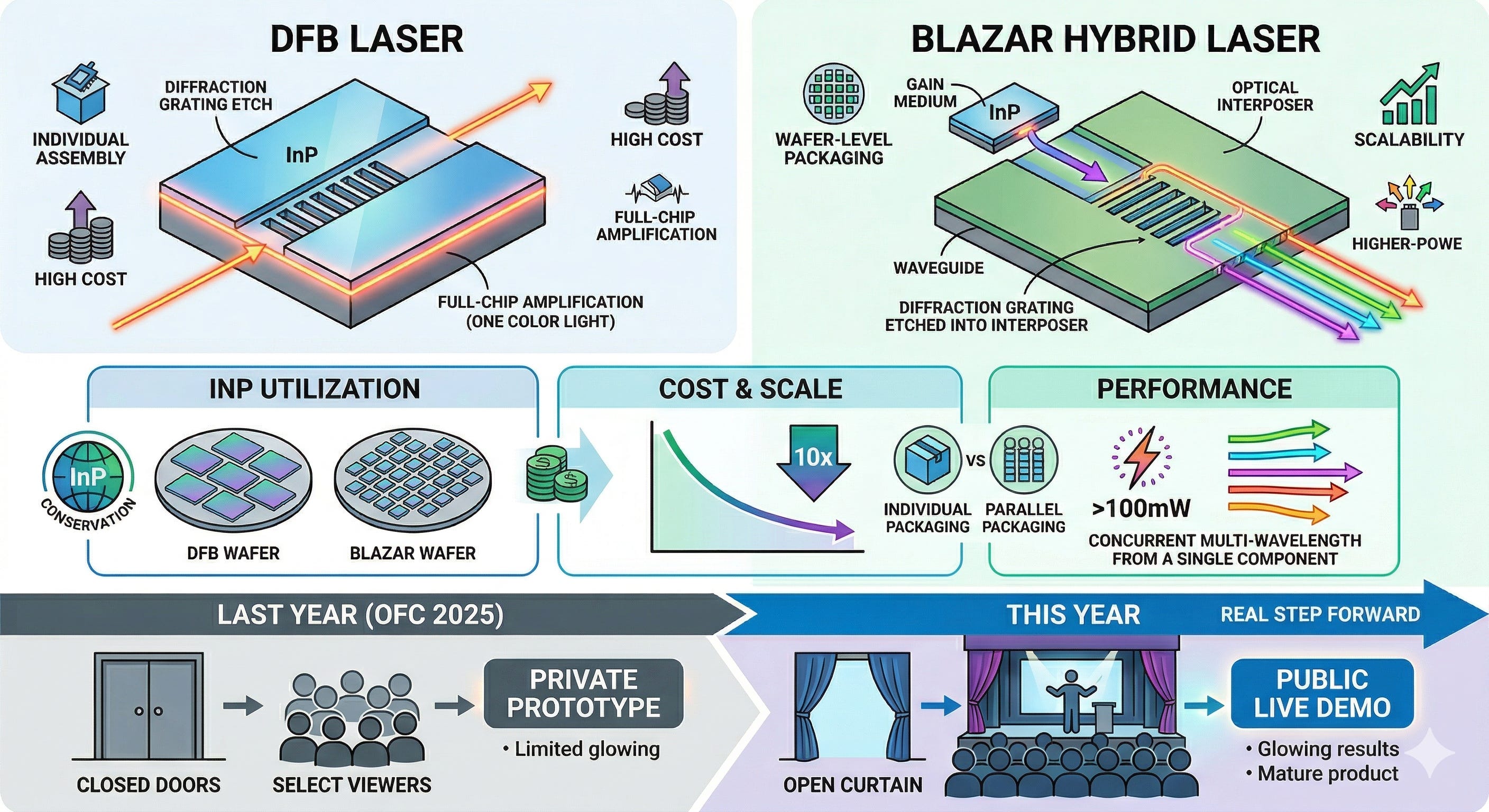
What changed from OFC 2025: Last year, Blazar was shown only to select customers behind closed doors. This year was the first public live demo. In twelve months, the technology maturity went from “private prototype” to “public demo.” That’s one real step forward.
Product 2: Starlight — 8-Channel Compact ELS
Starlight is the upgraded successor to POET’s first ELS product. It sits in the same ELS category as Blazar but is positioned differently.
Blazar is a “next-generation architecture” product designed for CPO and chip-to-chip links. Starlight is an “industry standard” product, built to the ELSFP (External Light Source Form Factor Pluggable) specification that the industry is currently standardizing around. It packages eight high-power laser channels into a single compact engine and was demoed integrated into a working optical engine.
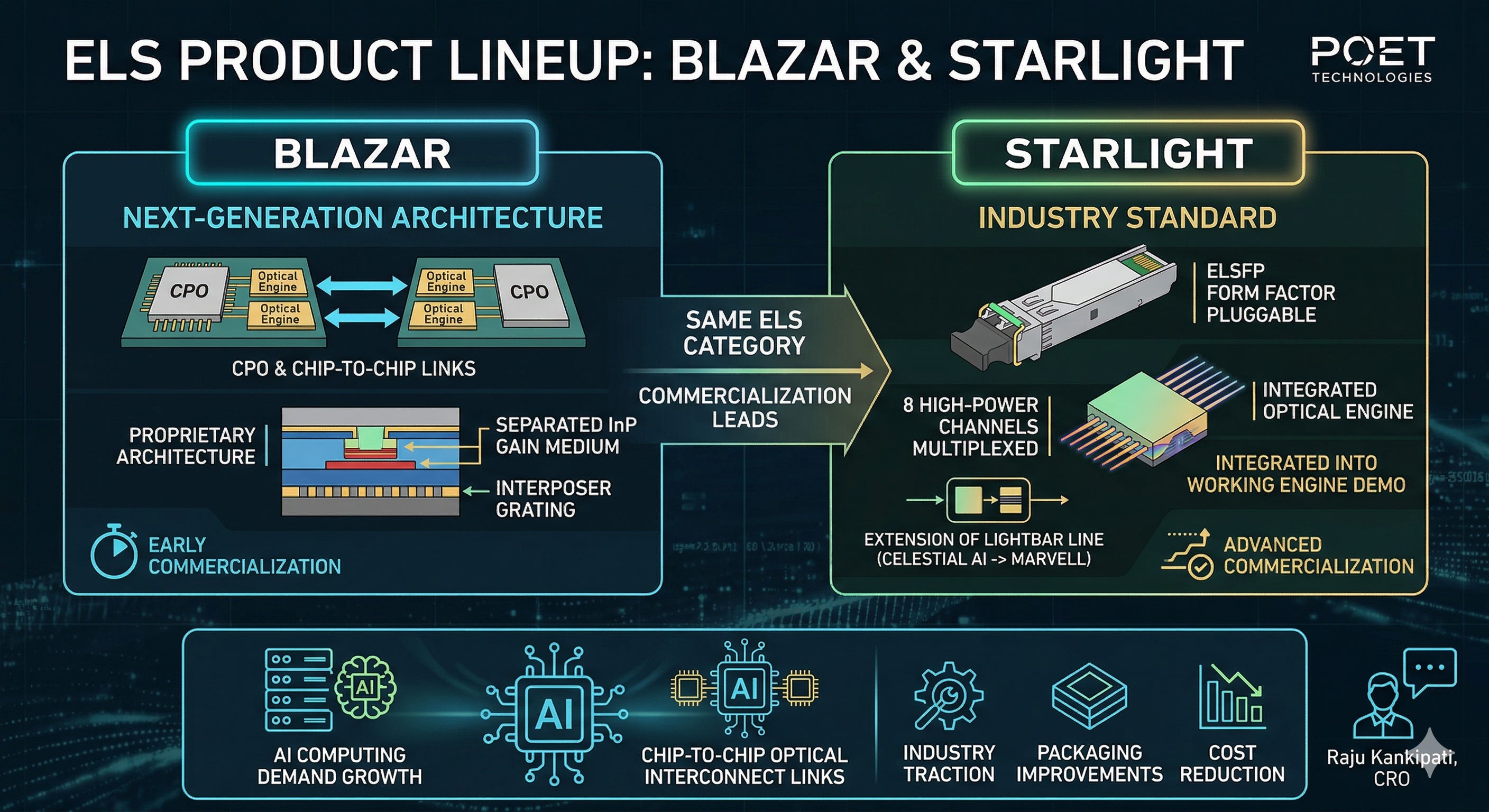
The difference between Blazar and Starlight in short:
Blazar targets CPO and chip-to-chip links. It’s based on POET’s proprietary architecture, with a separated InP gain medium and interposer grating. Still early in commercialization.
Starlight is compatible with the pluggable ELS standard (ELSFP), built around eight multiplexed channels, and is an extension of the lightbar line already being supplied to Celestial AI (now Marvell). Commercially, it’s ahead of Blazar.
Product 3: Teralight 1.6T — The Main Optical Engine That Keeps Winning Awards
Teralight is not an ELS. It’s a complete optical engine that generates light, transmits data by encoding it onto that light, and receives incoming optical signals and decodes them back into data.
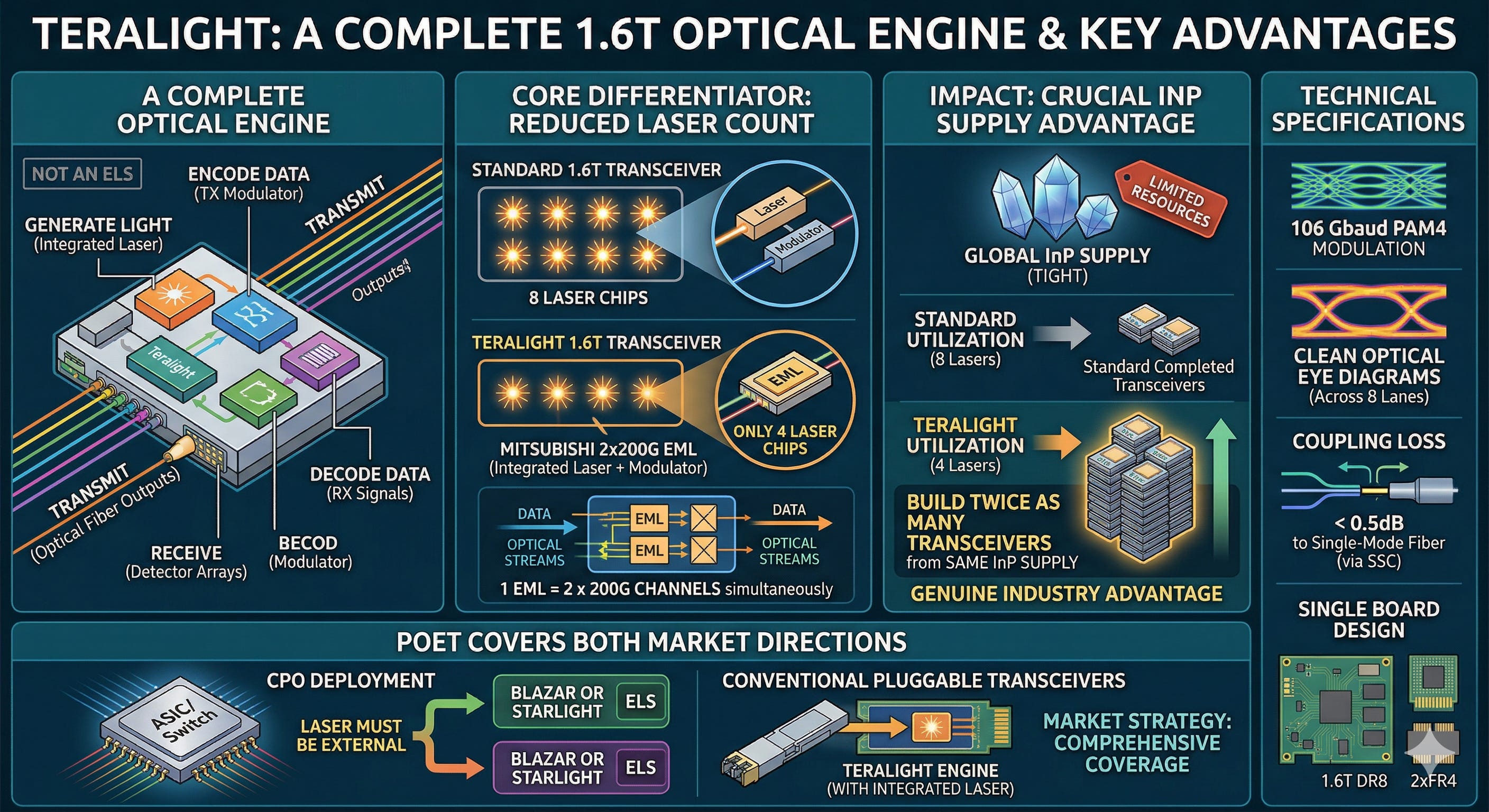
Co-developed with Mitsubishi Electric, this 1.6T (1.6 Terabit/s) transceiver engine’s core differentiator is that the 1.6T transmit engine uses only four laser chips instead of eight. That’s possible because of Mitsubishi’s 2x200G EML (Electro-absorption Modulated Laser) design, where the laser and modulator are integrated into a single chip, with one EML handling two 200G channels simultaneously. You’re cutting the count of the most expensive component in the transceiver in half.
Why that matters: With InP supply tight globally, cutting laser count in half means you can build twice as many transceivers from the same InP supply. In a market where InP constraints are a real problem across the industry, that’s a genuine advantage, not a marketing bullet.
Technical specs: 106 Gbaud PAM4 modulation, clean optical eye diagrams across all eight lanes, coupling loss below 0.5dB to single-mode fiber via a Spot-Size Converter (SSC), and a single board design that supports both 1.6T DR8 and 2xFR4 pluggable modules.
How Teralight relates to Blazar and Starlight: Teralight includes the laser inside the engine. Blazar and Starlight are the laser pulled out and packaged separately. In CPO deployments, the laser has to move outside the package, so you need Blazar or Starlight. In conventional pluggable transceivers, you need Teralight with the laser included. POET covers both directions of where the market is going.
Award history: Best Product Innovation at the January 2026 Infostone Awards in China, Lightwave Innovation Reviews Elite Score of 4.5 in February (among the highest scores given to any submission). The award ceremony was held at OFC 2026.
2. Two Partnerships That Landed During OFC Week
March 16: Strategic Collaboration with LITEON Technology
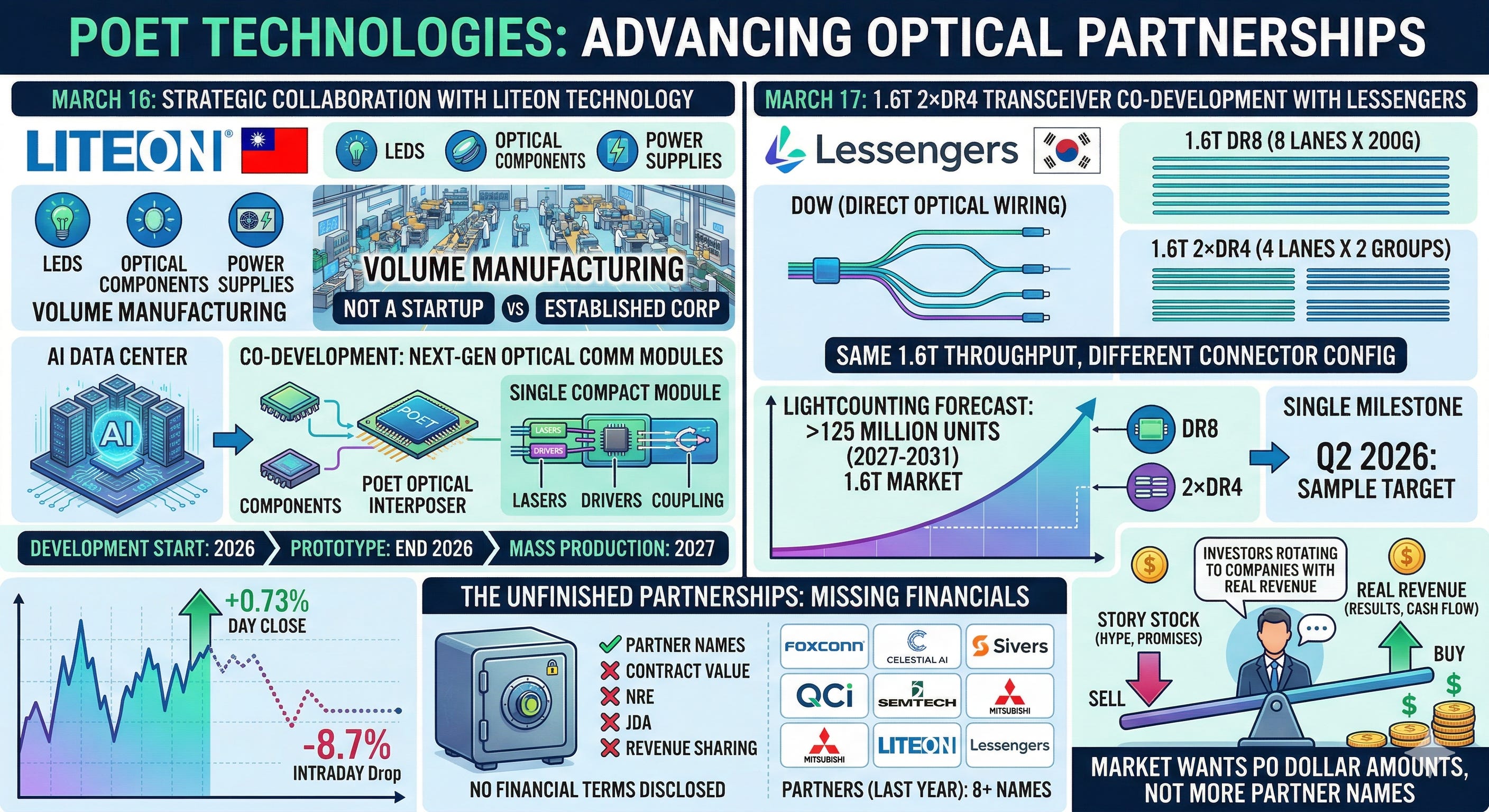
LITEON is a large Taiwanese optoelectronics company. They make LEDs, optical components, and power supplies, and they have actual volume manufacturing infrastructure. This isn’t a startup partnership.
The collaboration: co-develop next-generation optical communications modules for AI data centers, built on POET’s Optical Interposer platform. The design integrates lasers, optical components, driver electronics, and coupling structures into a single compact module. Timeline is development starting in 2026, prototype by end of 2026, and mass production in 2027. The stock moved +0.73% on the announcement day, though it hit -8.7% intraday at one point.
March 17: 1.6T 2×DR4 Transceiver Co-Development with Lessengers
Lessengers is a South Korean optical connectivity technology company. Their core technology is DOW (Direct Optical Wiring), which simplifies packaging by routing optical component connections flexibly.
The two companies are building a 1.6T 2×DR4 transceiver module. The difference between DR8 and 2×DR4: DR8 carries 200G per lane across eight lanes to reach 1.6T. 2×DR4 organizes four lanes into two groups. Same 1.6T throughput, different connector configuration. LightCounting forecasts the 1.6T DR8 market at over 125 million units from 2027 to 2031, and 2×DR4 attacks the same market with a different connector arrangement. Sample target is Q2 2026.
What Both Announcements Have in Common: No Financial Terms
Neither partnership disclosed the contract value, whether it’s structured as NRE (Non-Recurring Engineering fees), a JDA (Joint Development Agreement), or what revenue sharing looks like at production scale. Nothing.
Over the past year, POET has announced partnerships with Foxconn, Celestial AI, Sivers Semiconductors, QCi, Semtech, Mitsubishi Electric, and now LITEON and Lessengers. Eight or more names. Motley Fool captured the market’s reaction precisely in a March 19 article: investors are rotating toward companies that generate real revenue, and POET still gets treated as a story stock. The pattern of the stock selling off after AI partnership announcements keeps repeating. The market doesn’t want partner names. It wants PO dollar amounts.
3. What the Numbers Say
Let me look directly at the gap between the technology and the financial statements.
Revenue Trend, Last Five Quarters
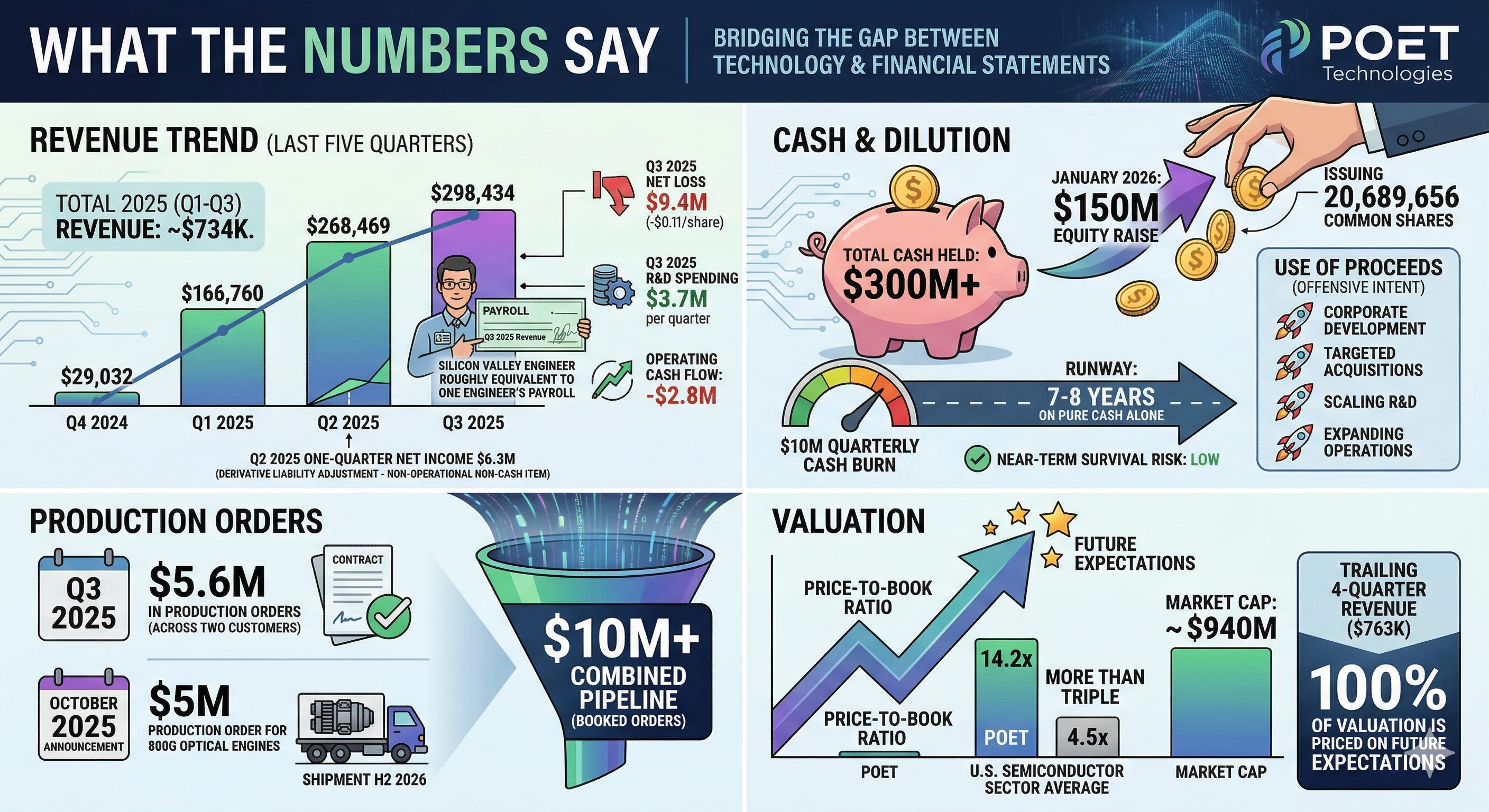
The direction is up. But the absolute scale is tiny. $298K in Q3 2025 is roughly the payroll for one silicon valley engineer. Q1 through Q3 2025 combined revenue is around $734K.
Q3 2025 net loss: $9.4M (-$0.11 per share). R&D spending alone is $3.7M per quarter. Operating cash flow: -$2.8M. Q2 2025 showed a one-quarter net income of $6.3M due to a derivative liability adjustment, but that was a non-cash item with no operational significance.
Cash and Dilution
POET completed a $150M equity raise in January 2026, issuing 20,689,656 common shares. Combined with previous cash, the company holds $300M or more. At roughly $10M quarterly cash burn, that’s seven to eight years of runway on pure cash alone. Near-term survival risk is low.
That said, the Use of Proceeds disclosure for the $150M raise lists “corporate development, targeted acquisitions, scaling R&D, and expanding operations.” This is not a defensive raise. There’s an offensive intent here, including the possibility of acquisitions.
Production Orders
Q3 2025 included $5.6M in production orders across two customers. In October 2025, POET announced a separate $5M production order for 800G optical engines, with shipment scheduled for H2 2026. Combined pipeline: $10M or more in booked orders.
Valuation
Market cap: approximately $940M. Price-to-book: 14.2x (more than triple the U.S. semiconductor sector average of 4.5x). For a company with $763K in trailing four-quarter revenue, a sub-billion-dollar market cap means 100% of the valuation is priced on future expectations.
4. Where Each Product Actually Stands
Now let me combine the OFC information and partnership details to assess where each product actually is in the market. Not “here’s what the technology does” but “who puts this in their BOM, why, and under what conditions.”