

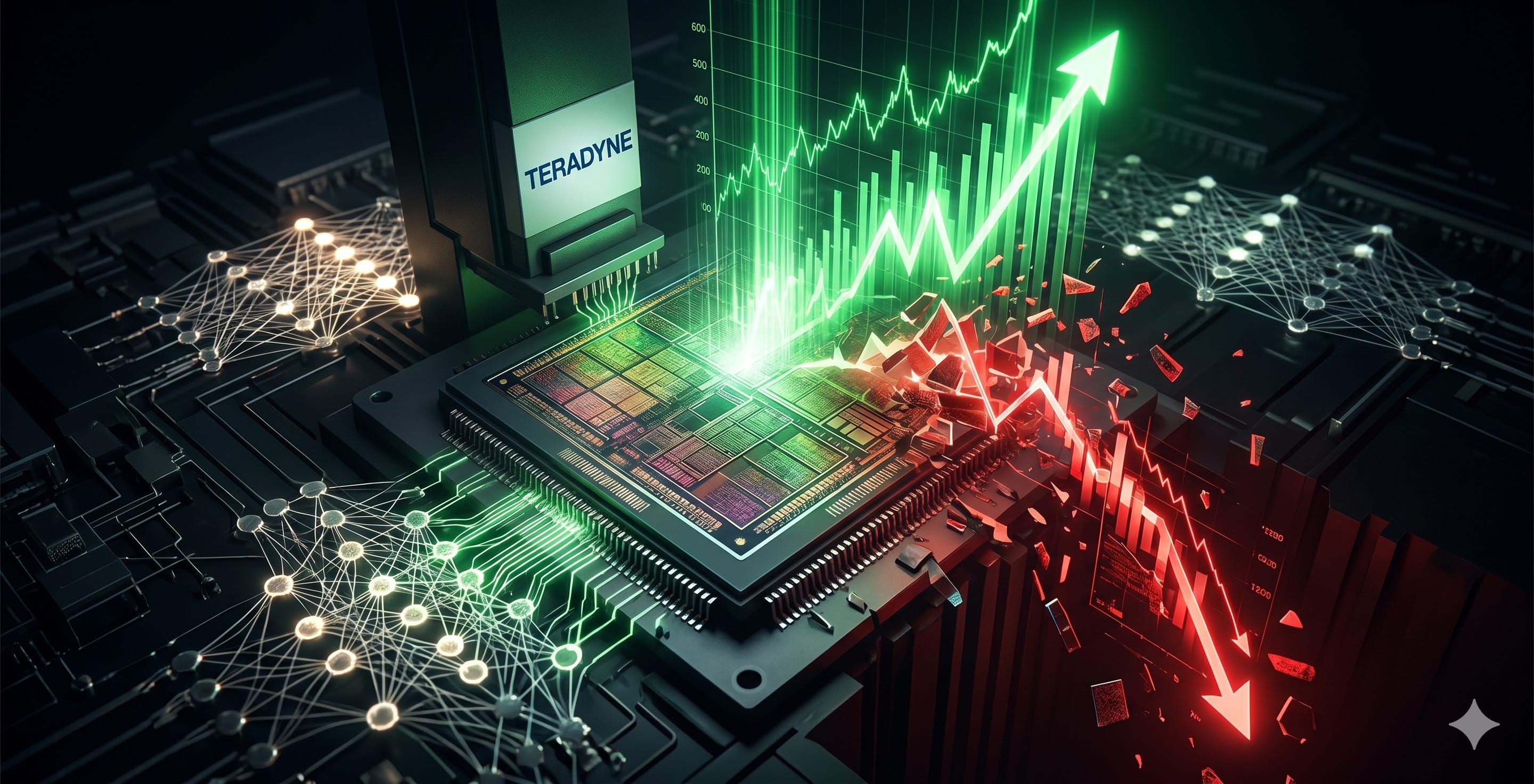
Teradyne posted its largest quarter ever in Q1 2026. Revenue grew 87% year over year. EPS blew past consensus. The CEO said roughly 70% of the quarter’s revenue was tied to AI demand. Look at the numbers and Teradyne reads like a textbook AI infrastructure beneficiary.
The stock did the opposite. After the print, shares dropped about 8.7% in after-hours trading. Including the regular session decline, a heavy wave of selling hit the name in a single day.
What happened?
Was the market less interested in the good Q1 number than in the slope of the next one.
This piece works through why Teradyne fell, and whether this company should be viewed as a plain ATE cycle stock, or as a test layer that becomes more important the more complex AI infrastructure gets.
Disclaimer
This article is for informational and analytical purposes. It is not a recommendation to buy or sell any specific security. All investment decisions are the reader’s own responsibility.
Table of contents
Why an 8% drop on a record print
What Teradyne actually does
One-time burst, or structural bottleneck
When testing one AI accelerator becomes an insurance premium
The HBM4 wafer sort win and a turning point for the memory business
Wafer to data center stack: from ATE company to test infrastructure company
Conclusion and watch list
1. Why an 8% drop on a record print
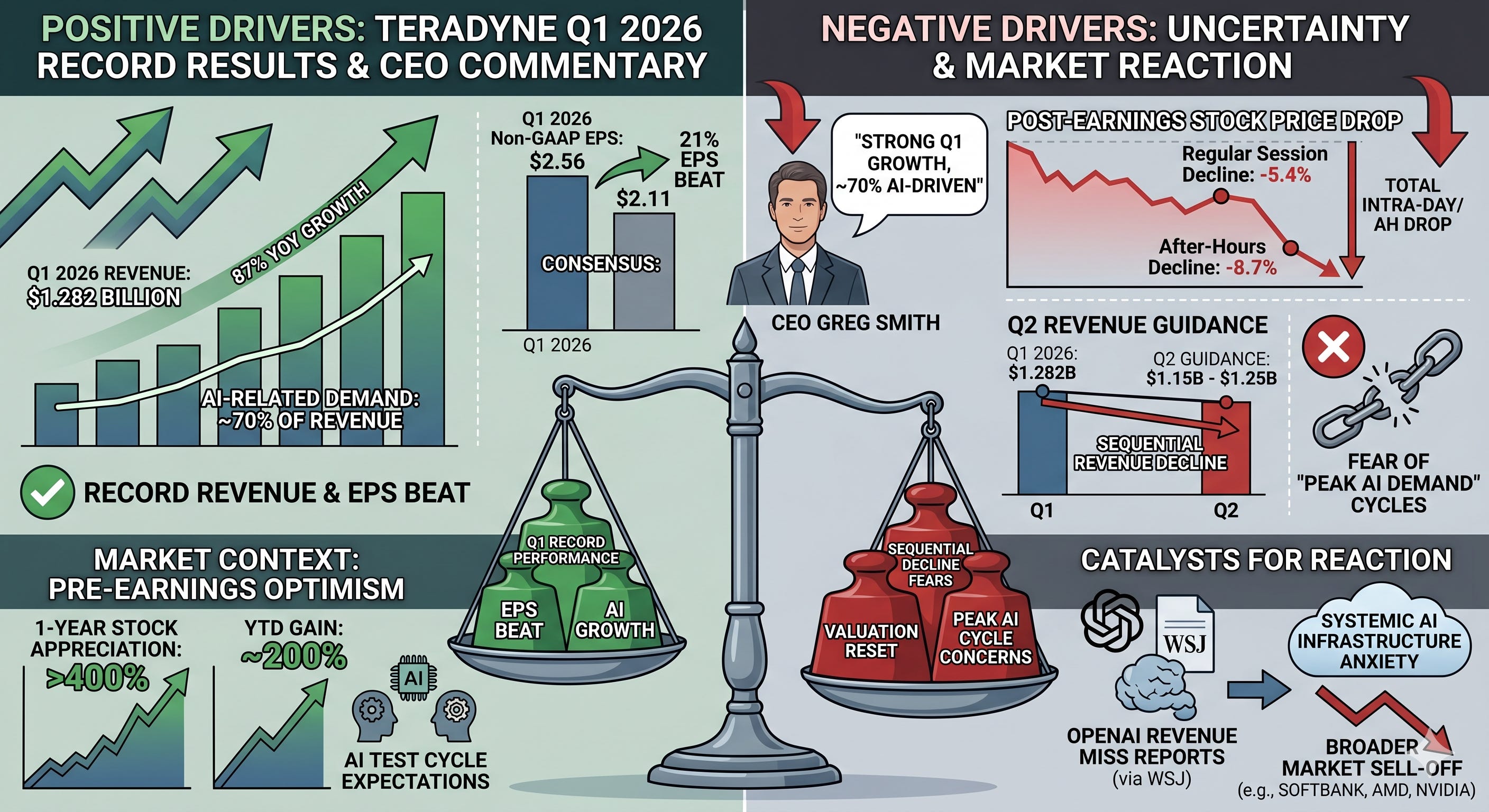
Teradyne reported its largest quarter ever on April 28. Q1 2026 revenue came in at $1.282B, up 87% year over year. Non-GAAP EPS hit $2.56, beating the $2.11 consensus by 21%. In the press release, CEO Greg Smith said about 70% of the quarter’s revenue was linked to AI demand.
By the numbers it was hard to find a flaw. The market reaction said the opposite. After the print Teradyne fell about 8.7% in the after-hours session. Combined with the 5.4% drop already booked in the regular session, the one-day selling pressure was significant.
The reason isn’t that Q1 was bad. Q1 was too good. The problem is what comes next.
Teradyne guided Q2 revenue to a range of $1.15B to $1.25B. Midpoint is roughly $1.2B. In absolute terms, still very strong. Year over year, that’s 75%-plus growth. In the ATE industry, that kind of growth rate isn’t common.
But the market wasn’t looking at the absolute number. It was looking at the direction. Q1 revenue was $1.282B. Q2 guidance midpoint is $1.2B. Translated into plain English, the company essentially said, “Next quarter is still good, but it could be lower than this one.” That’s a sequential decline. Year over year still high growth, but quarter over quarter the line is bending down.
In a normal setup that’s not a big deal. But Teradyne had already run hard on AI test optimism. The stock was up more than 400% over the past year and had nearly doubled YTD. When a name has already moved that much, the bar shifts. Good earnings aren’t enough. The market also wants confidence that the next quarter will be better. The Q2 guide didn’t deliver that confidence.
Then OpenAI added fuel. The same day, the WSJ reported that OpenAI was missing its revenue targets. SoftBank fell nearly 10% in Tokyo. Oracle, CoreWeave, AMD, Nvidia, basically the entire AI infra basket, traded heavy. The market started asking the question again. Can the AI capex spent so far actually convert into revenue and profit.
Teradyne’s drop was the overlap of those two things. The Q1 numbers themselves were strong. The Q2 guide created the worry that “this quarter might have been the short-term peak,” and the OpenAI news scaled that worry up to AI infrastructure as a whole.
So what the market was selling wasn’t Q1. It was uncertainty about H2.
Now the real question is one thing. Is this drop a simple valuation reset on a stock that ran too far, or is it a signal that the AI test cycle is actually approaching peak. To answer that, you have to stop looking at Teradyne as just an ATE equipment maker, and start looking at it as the test layer that AI infrastructure has to pass through.
2. What Teradyne actually does
A semiconductor can’t be sold the moment it leaves the fab. Each die on the wafer has to be checked. After packaging, it has to be checked again. If it’s an advanced package with HBM bonded to a logic die, the assembled package has to be verified. AI accelerators with high power and heat get one more round of validation under conditions closer to the real system.
The equipment that runs this work is ATE. ATE stands for Automated Test Equipment, the gear that pushes signals into a chip and automatically verifies that the expected response comes back.
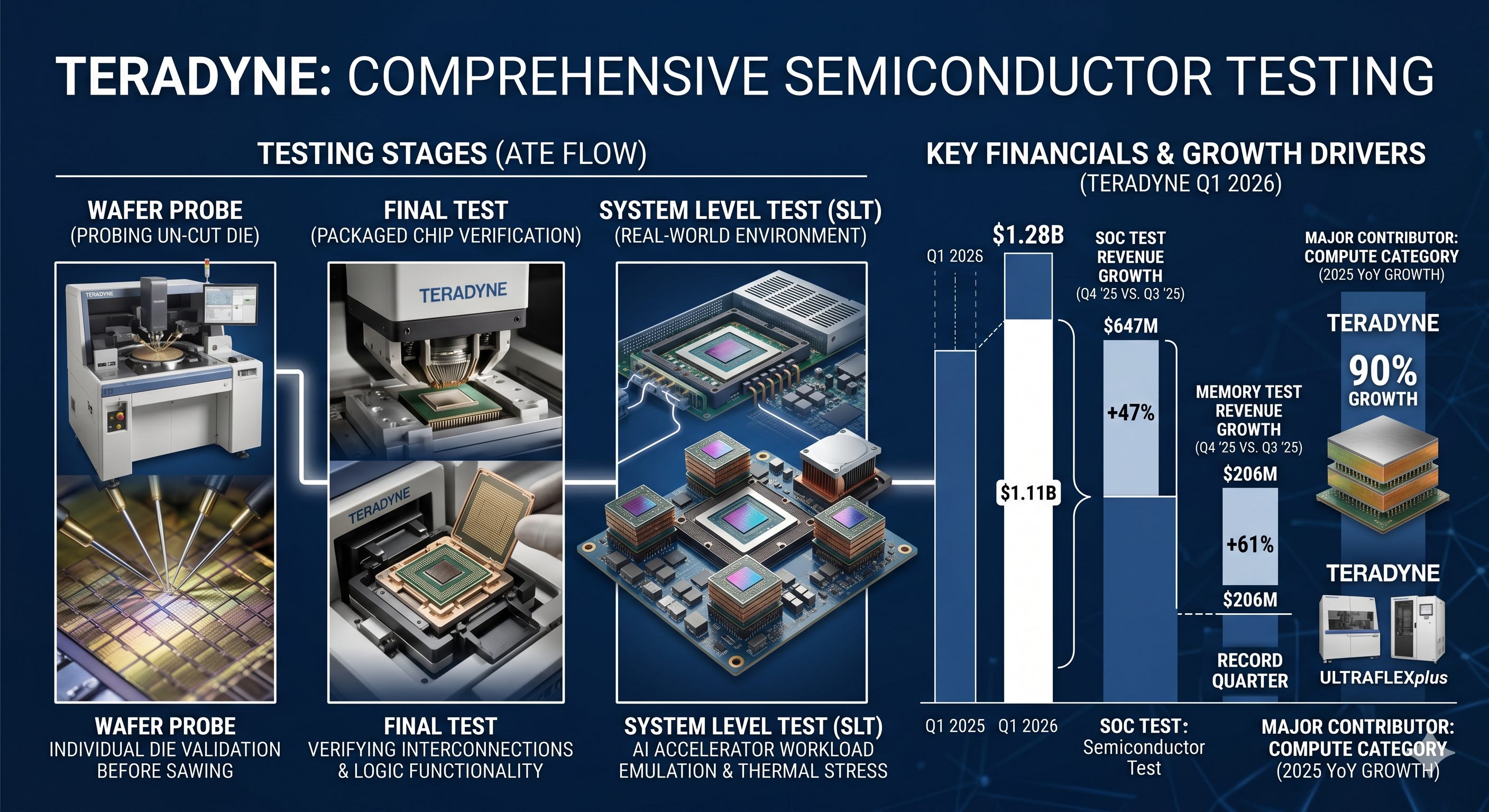
Testing happens at multiple stages. Wafer probe is the step that checks each die on the wafer before it’s diced. A die is the individual chip cut from the wafer. Final test is the step that checks the chip after packaging. SLT, or System Level Test, runs the chip on a board or in a system, under conditions close to real operation.
In the past, wafer probe and final test could catch most issues. With AI accelerators the story shifts. Dies are getting bigger. HBM is bonded on top. High-speed I/O lanes multiply. Power and heat climb. Some failures don’t show up at the chip-level test. They only appear once the chip is on a board, running something close to a real workload. That’s why SLT is becoming more important.
Look at Teradyne’s revenue mix and you can see this shift in the numbers. Of Q1 2026’s $1.282B revenue, Semiconductor Test was $1.111B, or 87% of the total. In the past, mobile SoC test was a major leg of the business. Today, the center of gravity is moving to AI accelerator SoCs and HBM memory. In Q4 2025, SoC test revenue was $647M, up 47% sequentially. Memory test revenue was $206M, up 61% sequentially, an all-time quarterly high. For full-year 2025, the Compute category grew 90% year over year and became the largest contributor.
Teradyne’s core platforms map to this trend. UltraFLEXplus is used for high-performance SoCs and AI accelerator test. The Magnum series handles high-bandwidth memory test like HBM. SLT solutions sit on top of these, extending coverage from the chip level into system-level verification.
3. One-time burst, or structural bottleneck
The question narrows to one thing.
Are Teradyne’s recent numbers a temporary burst from AI capex landing all at once, or are they structural test demand that has to keep growing as AI chips get bigger, more expensive, and more complex.
The difference matters. If the answer is the first one, Teradyne is a textbook cycle stock. Customers pile in tools for a stretch, then enter a digestion phase, and revenue rolls over. The market reacted strongly to the Q2 guide for exactly this reason. With the stock already up sharply, the doubt crept in: “Was Q1 the peak.”
If the answer is the second one, the story is different. As AI infrastructure grows, test stops being a cost line that gets squeezed and becomes a more important bottleneck. The more expensive a GPU gets, the taller the HBM stack, the more complex the package, the more high-speed I/O lanes there are, the higher the cost of catching a failure late. Customers end up testing at more steps, in conditions closer to real operation, and for longer.
From here, this article works through that question. Why some customers are starting to view 100% SLT as the cheapest option. Why HBM4 is creating new test insertions. And why Teradyne’s moves over the last 13 months point in the same direction.