

Since the middle of this year, I have been preparing to cover is how the semiconductor industry changes as AI compute shifts from training toward inference.
One thing that I’ve convinced through the conversations with people working across the industry was,
Custom ASICs will account for a growing share of AI compute.
And the interesting point that NVIDIA has also been preparing for this shift through NVLink and NVHBM. In an article I published in August, I argued that the industry’s focus would move from GPUs to HBM, and then from HBM to interconnects and many people began discussing that perspective after the article came out.

Then last week brought an unexpected event, Jensen Huang’s resignation.
Sure, we have to wait to see what happens next.
But I believe the first things to reassess are NVIDIA’s business and supply chain, along with the dynamics of ASIC programs already in development.
If the supply commitments and customer financing that Jensen championed change, will customers accelerate their adoption of custom ASICs? How will bargaining power shift among NVIDIA, its competitors and memory suppliers?
This article first explains why custom ASIC adoption is growing and how customers, design partners and suppliers work together. I then examine how Jensen’s resignation could affect that trend, present my GPU and ASIC demand outlook through 2028, and discuss the position and prospects of each company. I will also explain how I approach these businesses and what I am hearing from people working in the industry.
I spoke with many semiconductor professionals in Silicon Valley while preparing this article, and I would like to thank them again for their help. I hope this piece gives you a useful way to reassess the semiconductor industry in 2027 and 2028, including the growth opportunities for individual companies and the factors that could change those expectations.
Disclaimer
This article reflects the author’s personal analysis and estimates and does not represent the views of any company. It is not investment advice. Forecasts and estimates may differ from actual outcomes.
1. Why NVIDIA’s customers are building their own chips
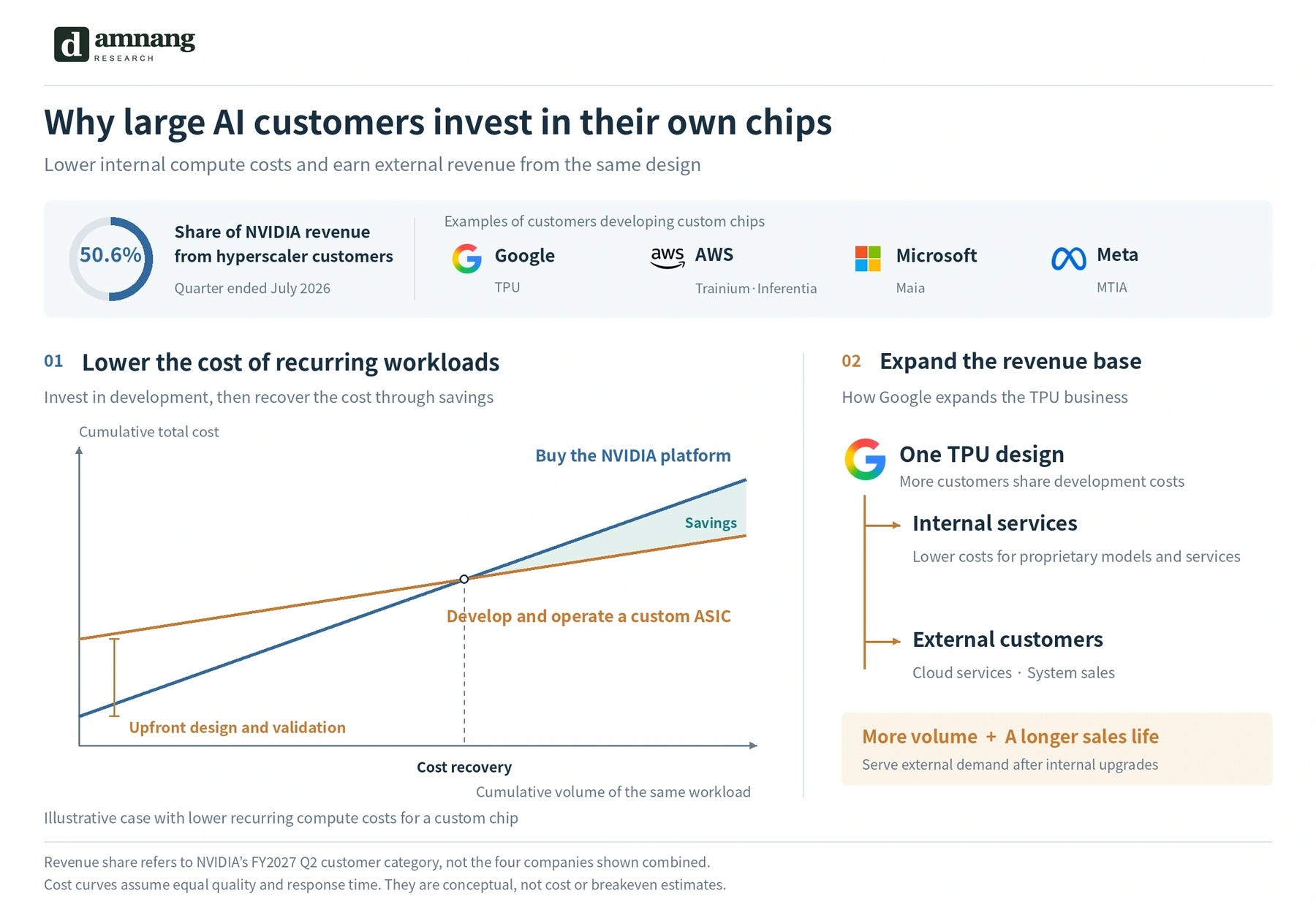
The reason large NVIDIA customers are investing in custom chips is straightforward. They want to lower the compute cost of their AI services.
NVIDIA reported a companywide gross margin of 75% for the quarter ended July 26, 2026. Its offering combines CUDA, system integration and access to supply, allowing it to maintain high profitability.
That is not necessarily welcome news for customers that already run their own models, software and data centers. Wherever possible, they want to bring work in house and retain some of the margin that currently goes to NVIDIA.
Custom chips can also reduce operating expenses, not just purchase costs. After buying GPUs, customers continue paying for power, cooling and maintenance. When service usage exceeds the capacity of their existing equipment, they need more servers. As services grow, the savings from handling the same work with fewer systems and less power become larger. Designing the chip and software together can therefore reduce both equipment spending and operating costs.
Large companies running their own models and AI services have another reason to design custom chips. They understand their most common workloads better than anyone else. That allows them to optimize compute units, memory configurations and data movement around those workloads, reducing power consumption in the process. Comparing NVIDIA’s GPU architecture with Google’s TPU makes this easier to understand.
NVIDIA GPUs combine general compute units with Tensor Cores for matrix operations, allowing them to handle a wide range of tasks. Google TPUs arrange compute units in arrays optimized for the repeated matrix calculations used in AI. Data moves between neighboring units and is reused within the array, instead of being fetched repeatedly from memory. This reduces the energy spent moving data. By matching the architecture to their own models, customers can perform more work within the same power budget.
This is why we call these chips ASICs, or application specific integrated circuits.
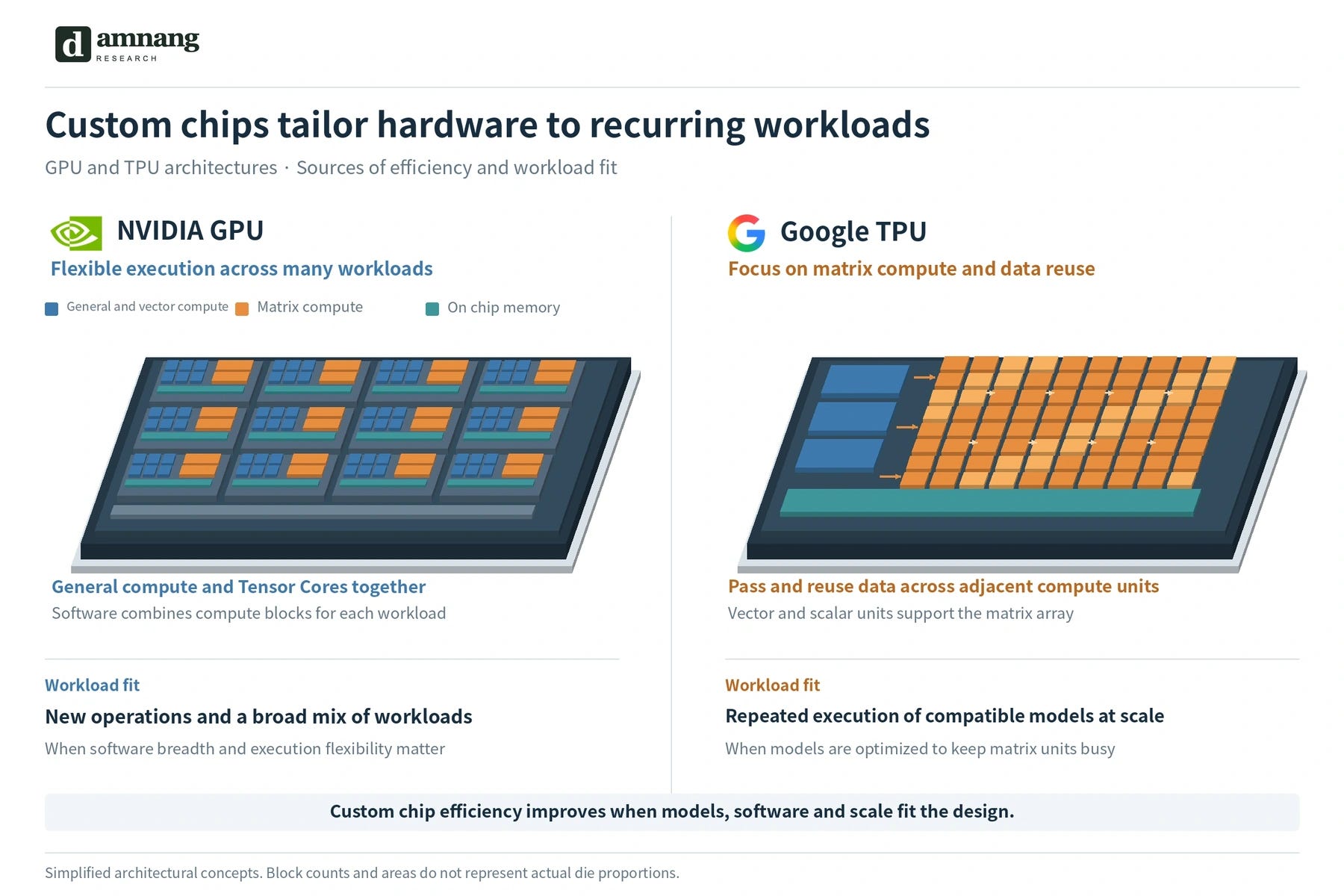
The tradeoff is that a design optimized for particular calculations supports a narrower range of operations and execution patterns. Workloads that do not fit the architecture may fail to deliver the expected efficiency. The most economical starting point is therefore often to optimize established models with large, recurring usage for the custom chip, rather than moving every new model onto it immediately.
For cloud providers, a custom chip is both a way to reduce internal costs and a product they can sell to external customers. Google earns usage revenue from installing and operating TPUs, but it is also expanding into supplying TPU systems directly to customers’ data centers. Customers can operate those systems in their own facilities or in contracted data centers.
This lets Google expand the TPU business without building a corresponding amount of data center space and power infrastructure itself. Put simply, Google is moving into business territory that NVIDIA already occupies.
I have been discussing these ASIC business models and their implications for NVIDIA’s influence with industry professionals for some time.
Most expected this trend to accelerate as AI compute spread across more inference workloads and agent services such as workflow automation attracted sufficient demand. The market is moving in that direction, and many industry specialists expect XPUs to keep gaining share relative to GPUs. In this article, XPU refers collectively to AI accelerators other than GPUs.
I will return to the demand outlook in Section 4.
2. Why custom chip developers still need ASIC suppliers
If customers are designing custom chips to save money, why do they pay ASIC design companies to build them? Why not handle all of the design work themselves?
The most obvious answer, unfortunately, is that their own chip design capabilities still fall well short of what is required. Google, AWS and Meta began as software companies. They have far less experience in hardware design than established fabless semiconductor companies, and that gap cannot be closed overnight.
What exactly does chip design capability mean here?
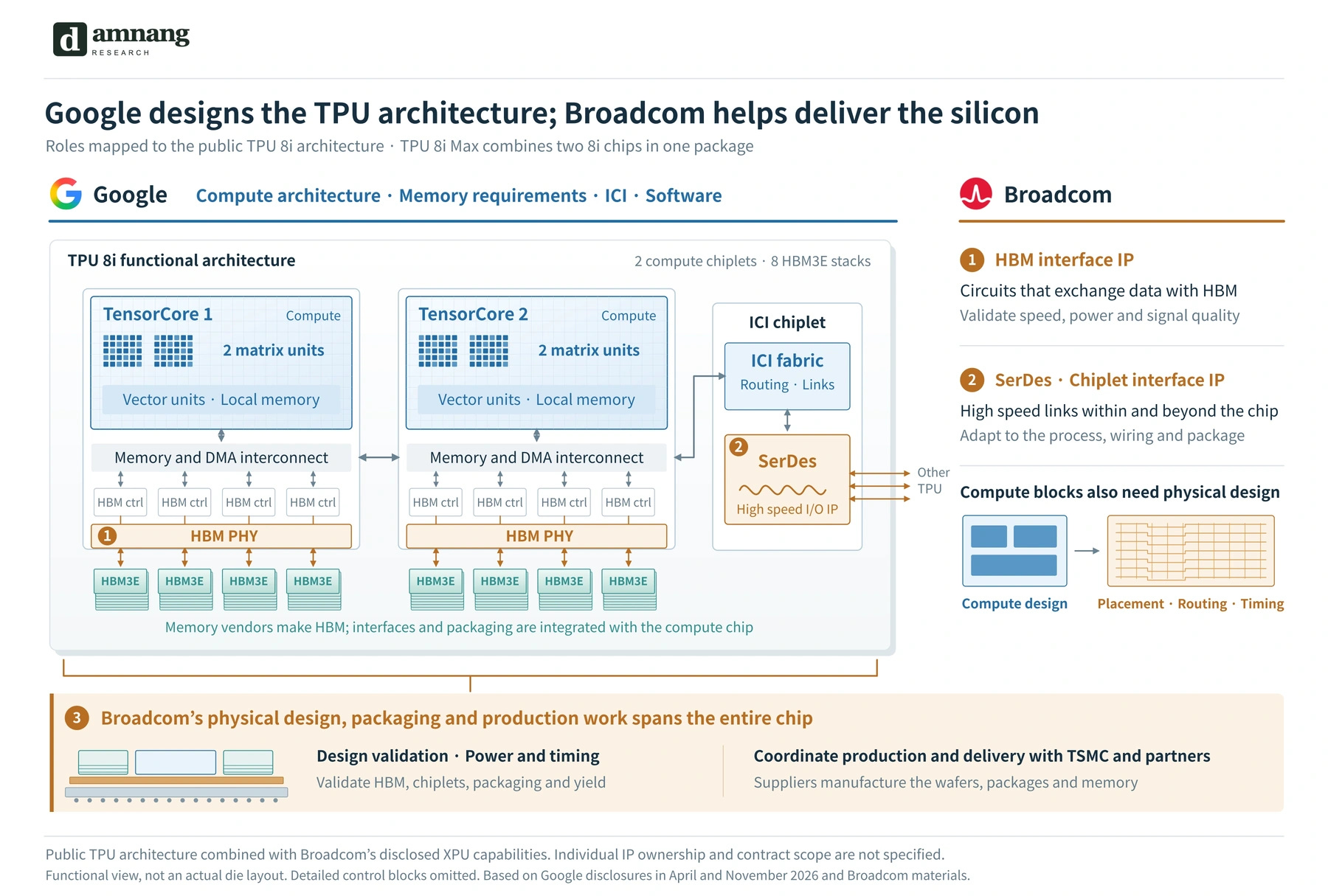
Suppose Google defines the compute architecture of its next TPU. Turning that architecture into working silicon requires more than designing the compute blocks.
The team must implement and validate the circuits connecting the TPU to memory, the links between chips, physical placement and routing, and the package itself. Google continues working with ASIC suppliers such as Broadcom despite having its own TPU design team because Broadcom brings decades of accumulated PHY and SerDes IP, manufacturing and packaging work with foundries such as TSMC, and experience in volume production.
Those assets are difficult to replace. Working with an ASIC supplier can be cheaper in several respects than recreating everything internally, which is why these relationships persist.
That naturally raises another question.
If customers build custom chips to replace NVIDIA GPUs and save money, does paying an ASIC supplier simply leave them facing the same problem of additional external costs?
Building a custom chip does not eliminate payments to outside companies. But it can still make economic sense if total costs, including the ASIC supplier’s fees, are lower than buying NVIDIA GPUs to operate the same service.
When customers own the compute architecture and software while purchasing the necessary IP, implementation and production services, they replace part of the product and system that NVIDIA would otherwise supply.
They can also optimize chip and memory configurations for their services, reducing the equipment and power required. At sufficient volume, development costs are spread across more chips. The ASIC supplier still earns a profit, but the customer aims to save more on equipment and operations than it pays for those services.
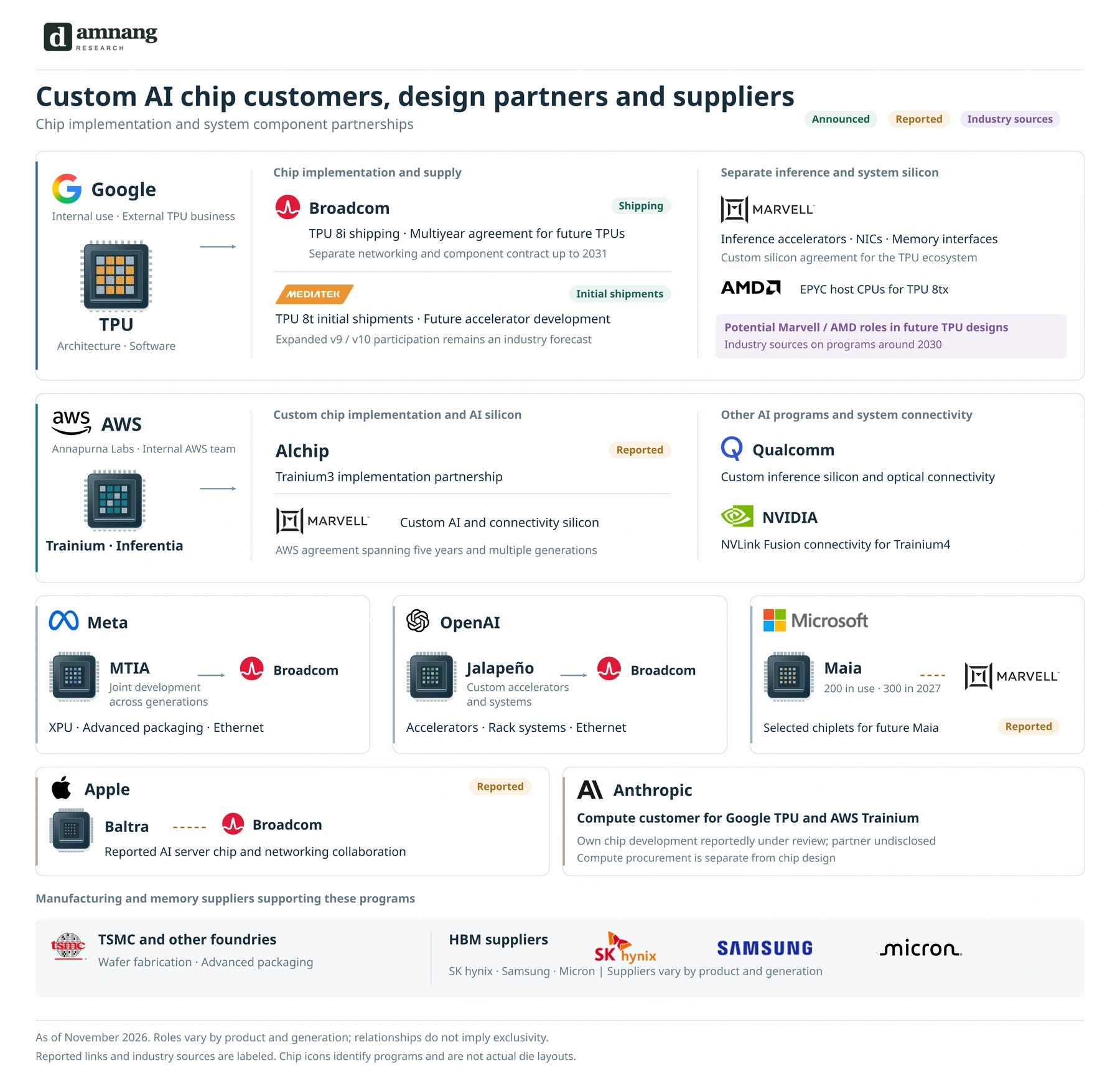
At the same time, hyperscalers are diversifying their partners to reduce the fees involved in developing custom chips. Google, for example, maintains future TPU development arrangements with Broadcom and MediaTek. I am also hearing about plans to use Marvell and AMD for programs beyond TPU 10 around 2030. Adding suppliers is a way to spread supply risk while improving the customer’s ability to negotiate ASIC costs.
Industry Insight
Recent conversations in the industry suggest that Google is strengthening its own design and validation capabilities while adding external partners. I am hearing that it is preparing to take on more direct coordination with TSMC after 2030, covering parts of the implementation, validation and production discussions previously handled by ASIC suppliers. Google is reportedly hiring aggressively for TPU roles to support that effort. The plan, as I understand it, is to expand its design capabilities gradually, take responsibility for more work internally, and reduce both outside spending and supplier dependence.
3. Could Jensen’s absence accelerate the shift to ASICs?
There is a common thread in the customer strategies discussed so far. They are building custom chips to reduce what they spend on NVIDIA GPUs, then expanding the design and procurement work they handle themselves within those programs. The next question is how they will divide the budget for their next expansion between NVIDIA GPUs and custom chips.
Reports that Jensen Huang is considering a return are emerging as I write, so the outcome remains uncertain. Nevertheless, following his resignation, I believe this event could give customers an additional reason to accelerate the validation and procurement of alternatives they have already been developing.
Customers making long term infrastructure commitments to NVIDIA may reassess whether product development and supply expansion will continue at the same pace without Jensen’s leadership. If it takes time for the next management team’s investment priorities and contracting approach to become clear, customers may see accelerating existing ASIC programs and deployment validation as a way to reduce risk. Reducing dependence on one supplier could become an additional motivation for ASIC projects that were originally driven by cost savings.
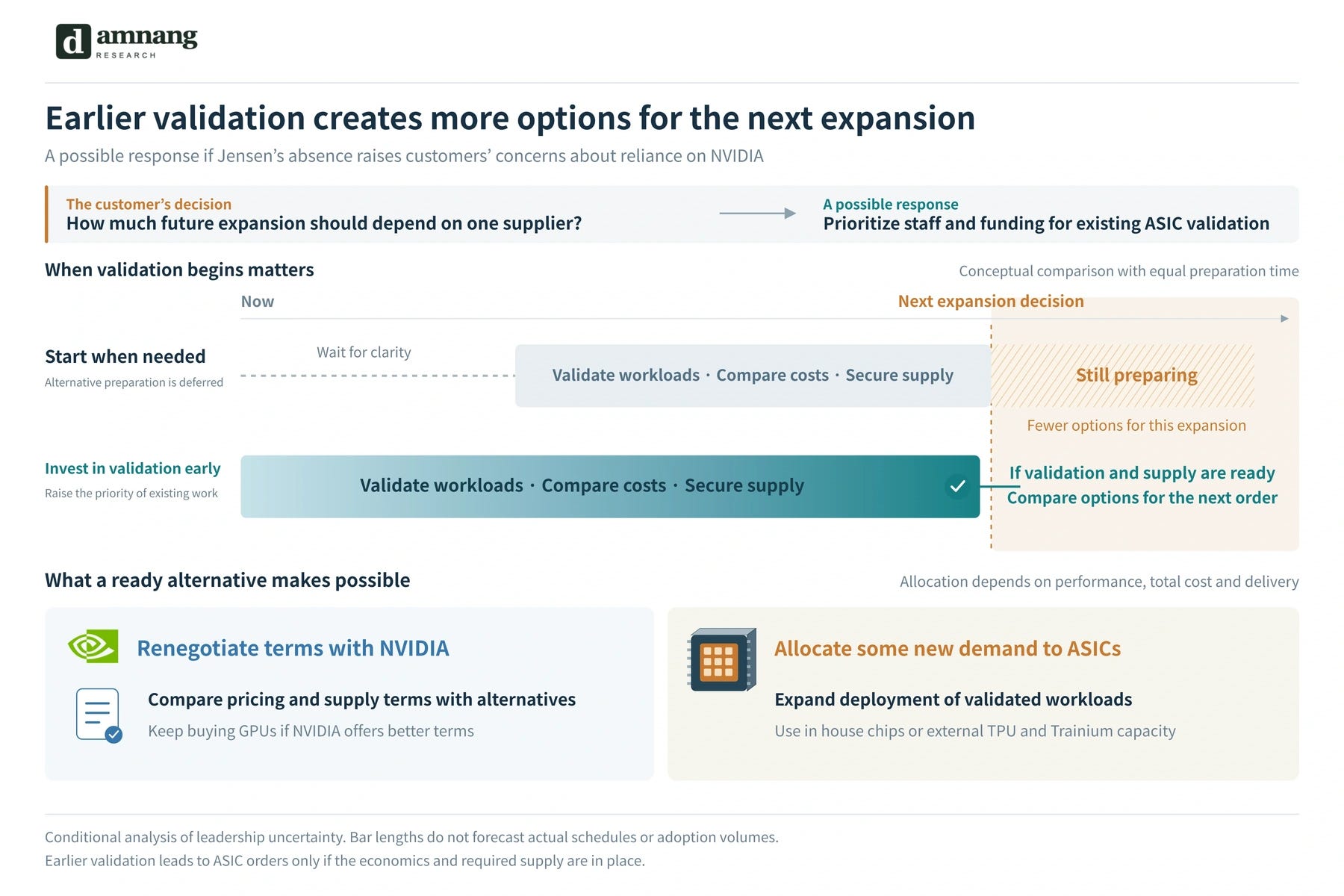
Those alternatives can also affect negotiations. If customers can operate services reliably on other chips and obtain the volume they need, they can compare NVIDIA’s prices and supply terms against credible options. They may keep buying GPUs where NVIDIA offers the better terms, while allocating additional demand to ASICs for workloads with a more attractive total cost and delivery schedule. If Jensen’s absence continues, I will be watching whether customers give validation and supply commitments greater priority, and whether that eventually changes actual new orders.
From here, I will first put numbers around GPU and ASIC demand through 2028, then examine what hyperscalers and semiconductor companies are doing to capture it. Combining public business plans with what I hear in the industry, I will assess which companies can win additional orders and earn a profit from them, and what could change that outlook.
Coming next
ASIC and GPU demand through 2028
Hyperscalers and AI companies seek more control over cost and supply
Broadcom expands connectivity while MediaTek grows TPU volume
Marvell targets both Google and NVIDIA
AMD prepares for GPU substitution and customer ASICs
Supply access and customer funding will separate the winners in 2028