

If you work in semiconductors, you can’t avoid Cadence.
They make the design software, the EDA (Electronic Design Automation) tools, that engineers use to build chips. On April 15 at CadenceLIVE Silicon Valley 2026, Cadence made two announcements that matter.
First, an expanded partnership with NVIDIA.
Second, a collaboration with Google Cloud.
The market reacted right away. CDNS closed up more than 4% on the day.
That’s the surface story. The real story isn’t in the announcements themselves.
Over the past few months, in conversations with semiconductor people across Silicon Valley, Cadence has come up again and again. At first the pieces sounded like isolated anecdotes. Then they started to line up. Specific things happening inside specific big-tech companies.
Specific senior people moving into specific orgs.
M&A pointing in a specific direction.
Once you put the pieces side by side, they’re all aimed at the same place.
And if that picture is right, the way the market currently values Cadence needs to be reframed entirely.
This article is an attempt to put that puzzle together.
The actual weight of the CadenceLIVE announcements. Where the Cadence M&A track is heading. The quiet shift happening inside the EDA market. And the field-level chatter that doesn’t show up in public filings.
At the end I’ll lay it all out from an investor’s perspective with the specific numbers.
What’s in this article:
What EDA Is, and Where Cadence Sits in It
CadenceLIVE Announcement: Confirmed Facts and Interpretation
Where Cadence Is Heading
What’s Being Sensed in the Field
How Big Is This Market
If This Scenario Is Right, What Changes Structurally
Risks
Investor View: Where the Numbers Put This Right Now
Conclusion
Disclaimer
This piece weaves together public material and what I’m hearing on the ground. It’s a personal analysis. Speculation and analysis are mixed in. For investment decisions, please verify against the company’s official disclosures and use your own judgment.
What EDA Is, and Where Cadence Sits in It
To understand the Cadence story, you have to start with the EDA market structure.
EDA is the umbrella term for chip design software. Every step of building a chip, from spec definition to RTL coding, functional verification, synthesis, physical design, tape-out, and post-silicon test, has an engineer sitting in front of an EDA tool. Modern semiconductors don’t get built without EDA.
The market is effectively a three-way oligopoly. Synopsys, Cadence, and Siemens EDA (the former Mentor). Synopsys and Cadence are the top two, and in practice a single company’s chip design flow uses tools from both. Each has different strengths.
From Transistor to Chip: RTL2GDS

Semiconductor design might sound like an intimidating, highly specialized field, and honestly, it is. It’s not easy to approach without an electrical engineering background.
Synopsys is strong on the front end. VCS for RTL simulation, Fusion Compiler for synthesis, PrimeTime for static timing analysis. The IP portfolio is much larger, and after acquiring Ansys for $35 billion in 2025, Synopsys also extended into multiphysics simulation.
Cadence is strong on the back end and in analog. Virtuoso for analog and custom IC design, Innovus for P&R. The IP business is smaller than Synopsys but growing fast.
In adjacent areas, physical verification (LVS, DRC) belongs to Siemens Calibre. EM/IR analysis belongs to Ansys RedHawk (now under Synopsys). Emulation is a three-way fight.
Simplified: Cadence has historically been the back-end and analog leader. And in the AI chip boom, the money is flowing hardest into the front end and IP, exactly where Cadence is weakest. Almost everything Cadence has done over the past few years is a move to fix that gap. The CadenceLIVE announcements are an interim result of that effort.
CadenceLIVE Announcement: Confirmed Facts and Interpretation
Three things were officially confirmed in the announcement.
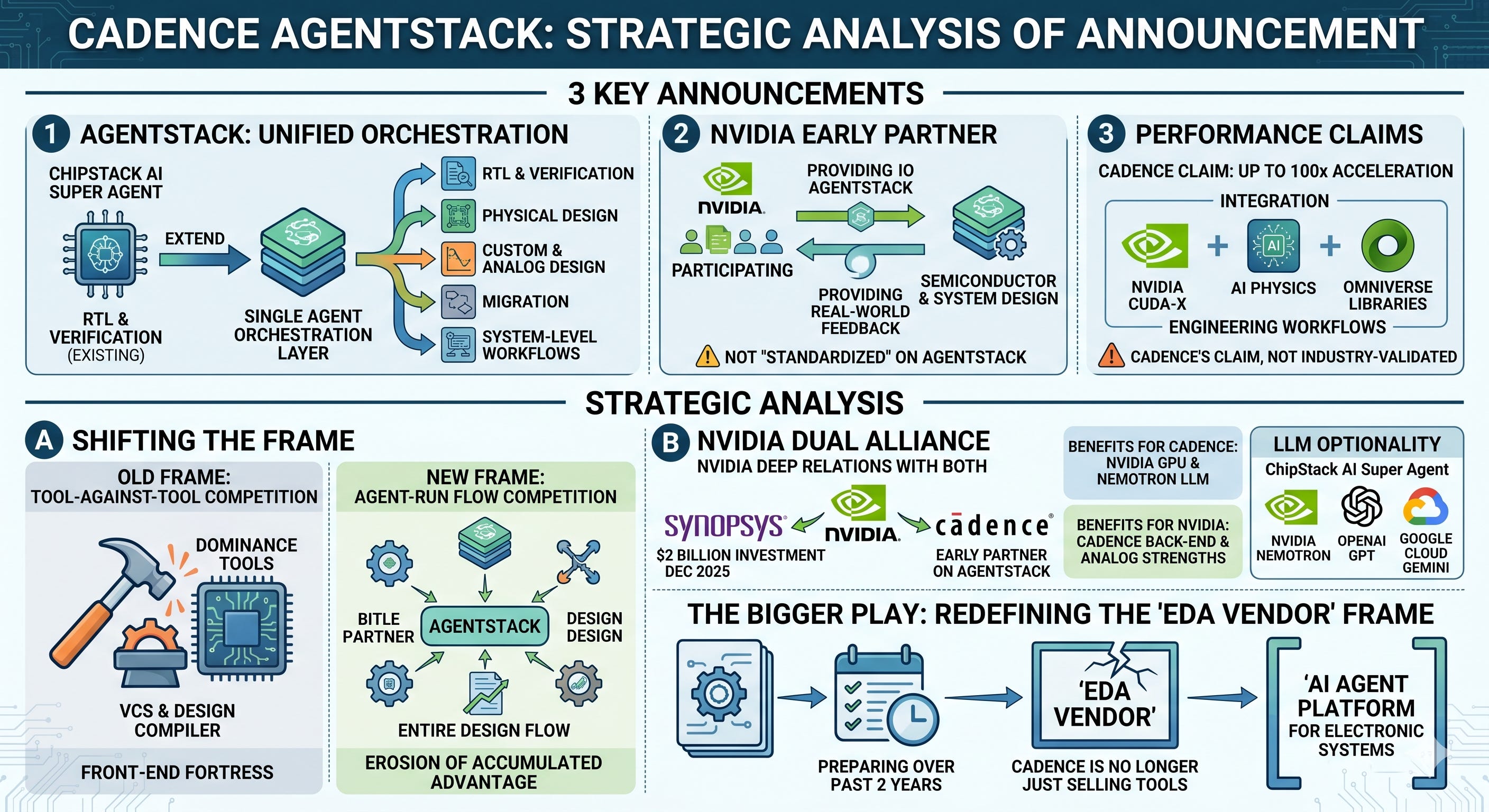
One, Cadence introduced a new system called AgentStack. AgentStack extends the existing ChipStack AI Super Agent so that not just RTL and verification, but also physical design, custom and analog design, migration, and system-level workflows are all wrapped in a single agent orchestration layer.
Two, NVIDIA is participating as an early partner for AgentStack, applying it to its own semiconductor and system design flows and providing real-world feedback. That’s the official wording. It’s not “NVIDIA has standardized on AgentStack.”
Three, Cadence claimed that integration with NVIDIA CUDA-X, AI Physics, and Omniverse libraries can deliver up to 100x acceleration for engineering workflows. This is Cadence’s own claim, not an industry-validated number.
How you read these three depends on the reader. Here’s how I read them.
First, AgentStack looks less like a frontal assault on Synopsys’s front-end fortress and more like an attempt to change the frame of the game. Beating decades of accumulated VCS and Design Compiler dominance tool-against-tool is close to impossible. But AgentStack shifts the competition from “which tool runs faster” to “can an agent run the entire design flow for you.” If that frame shift takes hold, the relative value of the accumulated front-end advantage erodes. Whether it actually takes hold is a separate question.
Second, NVIDIA’s early-partner participation is a meaningful signal but needs careful reading. NVIDIA already invested $2 billion in Synopsys in December 2025 and signed a strategic partnership. So this isn’t NVIDIA leaving Synopsys for Cadence. NVIDIA is keeping deep relationships with both companies and adding itself as an early partner on AgentStack. For Cadence, the gain is being able to combine NVIDIA’s GPU infrastructure and Nemotron LLM into its own AI agent products. For NVIDIA, the gain is the ability to mix Cadence’s back-end and analog strengths into its design flow.
Third, the Google Cloud and Gemini integration broadens Cadence’s LLM optionality. ChipStack AI Super Agent already supports a range of frontier models, including NVIDIA Nemotron and OpenAI GPT. Adding Gemini strengthens Cadence’s positioning as an agent platform that isn’t locked into any single LLM vendor.
That covers the surface-level announcement content.
But the real weight of AgentStack isn’t in the announcement itself.
It shows up when you connect it to the bigger play Cadence has been quietly preparing over the past two years.
If that connection holds, Cadence is no longer a company that just sells tools.
And at that point, the “EDA vendor” frame the market currently applies has to be rewritten too.