

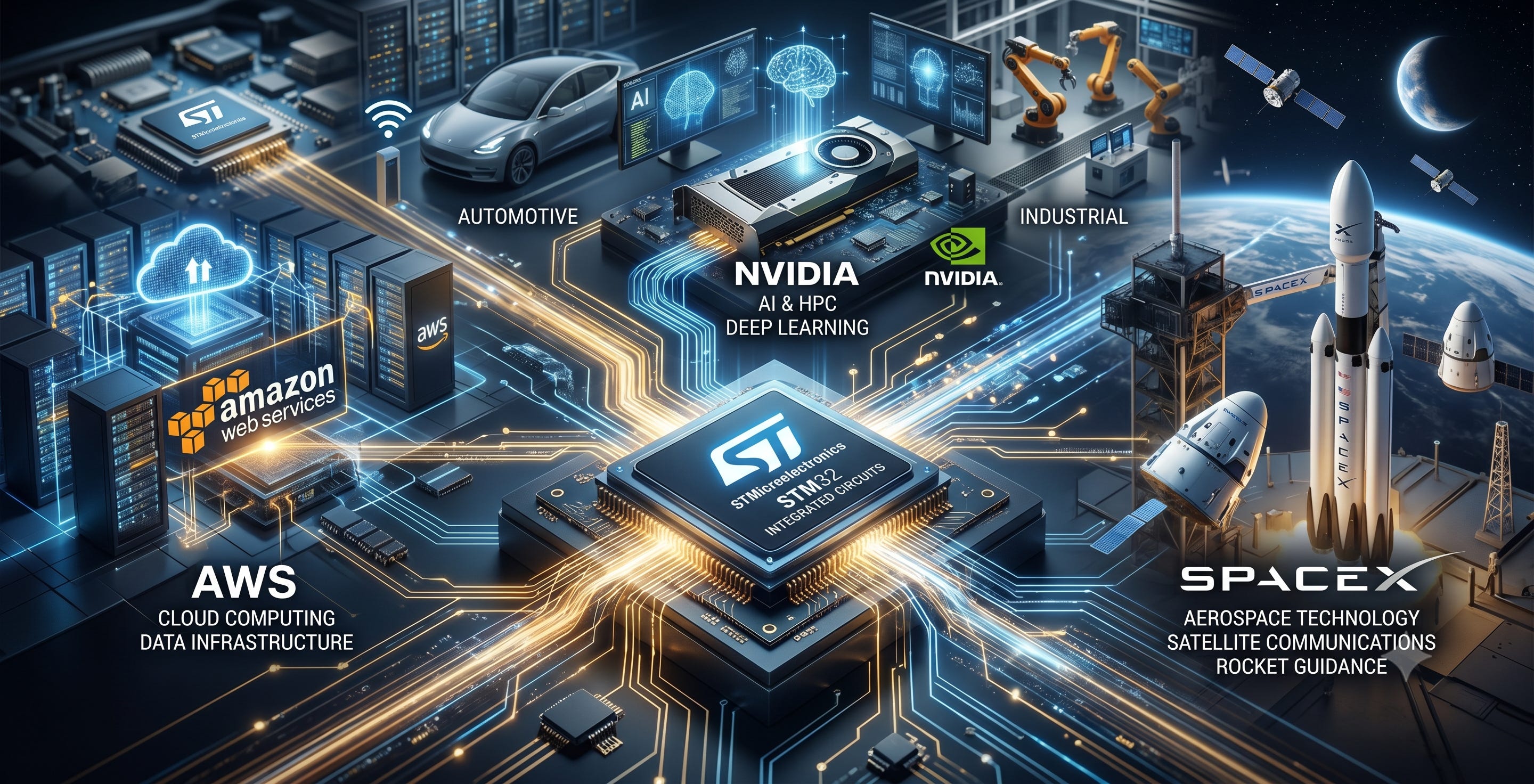
If you do semiconductor research, there’s a company you keep running into for no obvious reason.
Dig through SiC (silicon carbide) papers and it’s there.
Track GaN (gallium nitride) power devices and it shows up again.
Look at the MCU ecosystem and the STM32 is effectively the standard, and when you search MEMS sensors it’s the share leader.
A humanoid robot video filmed at NVIDIA’s headquarters had this company’s parts in it.
SpaceX Starlink satellites, AWS datacenter infrastructure, both have this company’s chips embedded in them.
It’s rare for one company to pop up in this many places at once.
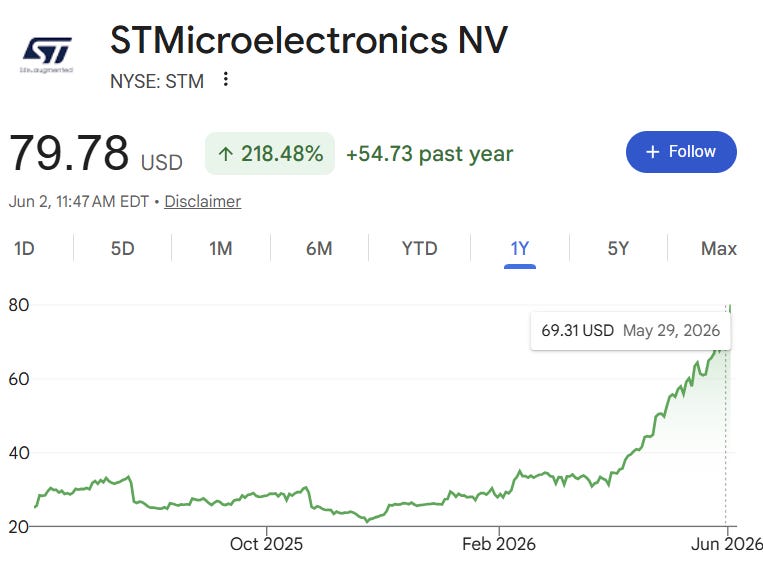
STMicroelectronics (NYSE: STM). A large European IDM, one of the biggest semiconductor companies in Europe. For all its scale, investor attention stayed lukewarm for a long time. A “European semiconductor” label tended to dampen interest. That perception is breaking down fast in 2026. The market cap has already crossed $70B, and the stock keeps printing new highs.
This piece answers two questions.
Why does this company turn up no matter where you dig? And after more than doubling, what should you be watching to buy or sell now?
Here’s the answer up front. The market buys STM under a different name every day.
One day it’s a SpaceX IPO play, the next an AWS datacenter supply chain name, the next an NVIDIA robotics parts stock, and the next the SiC market leader.
But strip away all those labels and the question collapses into one. How high a margin can this company convert its rising AI capex cycle revenue into?
The current price is betting not on the customer list but on the speed of margin recovery.
Disclaimer
This article is written for informational purposes and does not recommend buying or selling any specific security. The analysis and outlook reflect the author’s personal view based on publicly available financial data, IR disclosures, and industry data, and are based on information available at the time of writing. Cited prices, guidance, and analyst targets are based on public reporting and may change. All investment decisions and their outcomes are the responsibility of the investor.
1. What Kind of Company Is STM
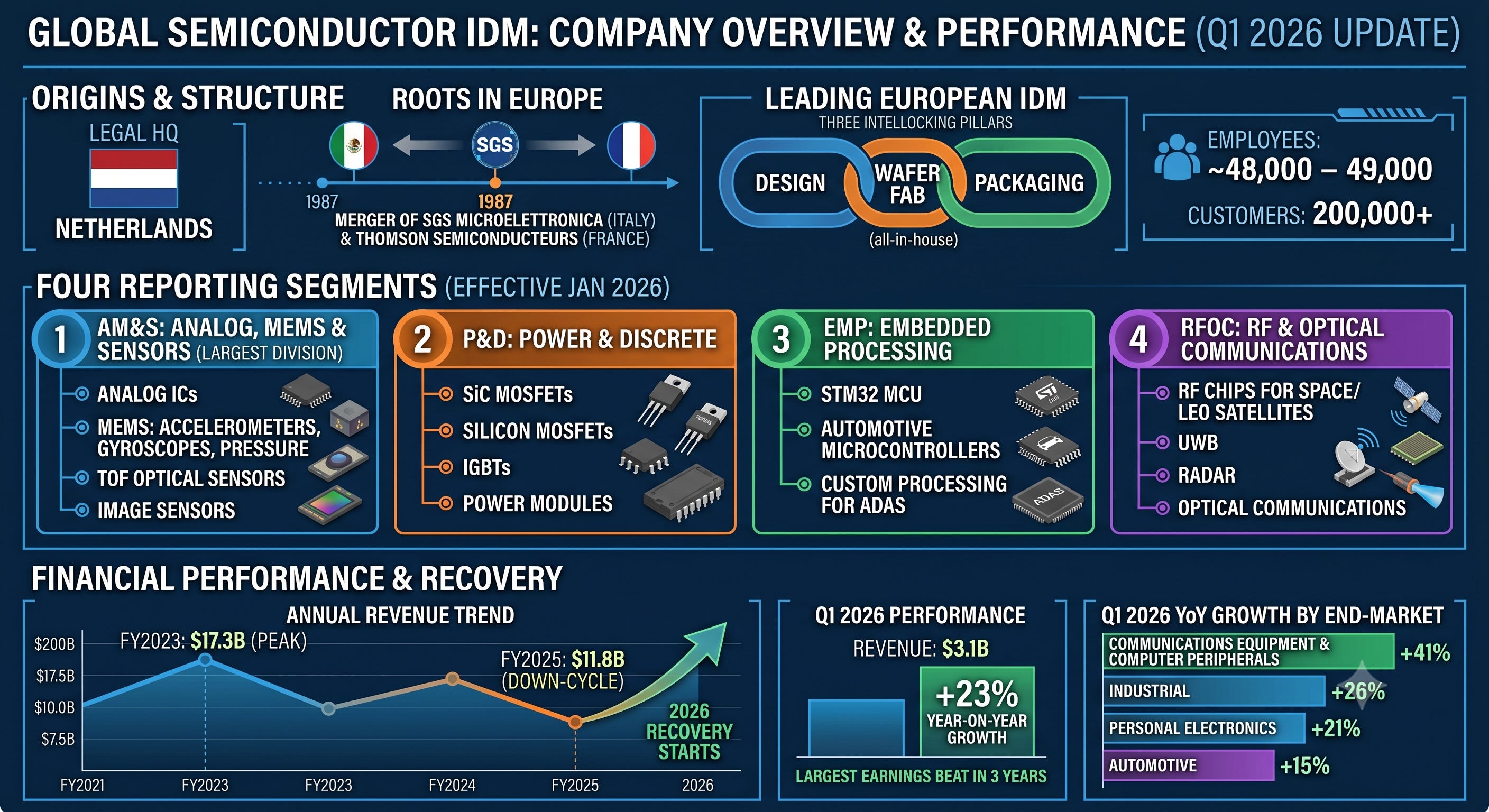
The entity is based in the Netherlands, but its real roots are the 1987 merger of Italy’s SGS Microelettronica and France’s Thomson Semiconducteurs.
As a flagship European IDM (Integrated Device Manufacturer), it handles everything in-house, from design to wafer fabrication to packaging. Roughly 48,000 to 49,000 employees, over 200,000 customers.
Starting January 2026, the reporting segments were restructured into four.
AM&S (Analog, MEMS & Sensors) is the largest division, covering analog ICs, MEMS accelerometers, gyroscopes, pressure sensors, ToF optical sensors, and image sensors.
P&D (Power & Discrete) makes SiC MOSFETs, silicon MOSFETs, IGBTs, and power modules. EMP (Embedded Processing) includes STM32 MCUs, automotive microcontrollers, and custom processing for ADAS. RFOC (RF & Optical Communications) handles RF chips for space and LEO satellites, UWB, radar, and optical communications.
FY2025 annual revenue was $11.8B.
That’s the number after coming down from the 2023 peak ($17.3B) through a downcycle.
That bottom is turning in 2026. Q1 2026 revenue was $3.1B, up 23% year over year, the biggest earnings beat in three years.
By end market, Communications Equipment & Computer Peripherals grew fastest at 41% YoY, followed by Industrial at 26%, Personal Electronics at 21%, and Automotive at 15%.
Note that Automotive is the slowest. There’s a gap between the market’s perception of STM as an “automotive semiconductor company” and the actual growth driver. That gap comes up again later.
Q2 2026 guidance is revenue of $3.45B (QoQ +11.6%, YoY +25%) and GAAP gross margin of 34.8%.
That well exceeds the FactSet consensus of $3.18B. There’s still roughly 100bps of unused capacity charge baked in, so margins have room to rise further once that drops out.
2. Why It Keeps Showing Up: Anatomy of the Technology Portfolio
The reason STM appears every time you research is simple. The breadth of its technology portfolio is abnormally wide. Few semiconductor companies hold number-one or number-two positions in this many distinct technology areas at the same time.
SiC power: global number one
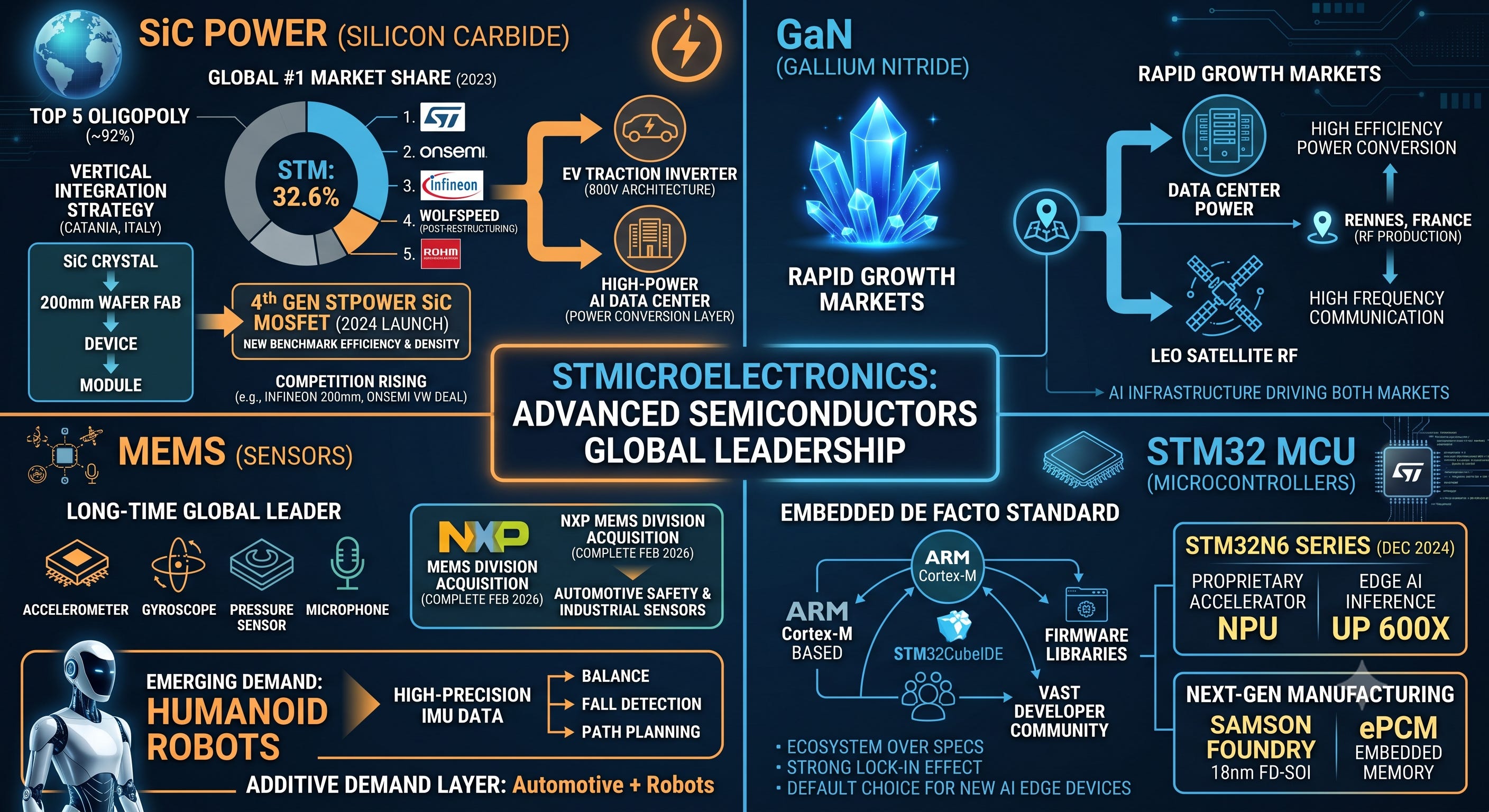
As of 2023, STM led global SiC power device share at 32.6%. With onsemi at number two, Infineon at three, Wolfspeed at four (restarting after a Chapter 11 restructuring), and ROHM at five, the top five hold roughly 92% of the total in an oligopolistic structure.
STM’s SiC strategy is vertical integration. It’s building a 200mm SiC wafer fab in Catania, Italy, and controls everything directly from SiC crystal raw material through wafers, devices, and modules. In 2024 it launched the 4th-generation STPOWER SiC MOSFET, setting a new benchmark for power efficiency and power density.
The core demand source for SiC is the EV traction inverter. As the shift to 800V architectures accelerates, fitting SiC MOSFETs has become effectively mandatory. That said, competition is intensifying.
Infineon began shipping 200mm SiC products in 2025, and onsemi signed a multi-year supply agreement with VW for its EliteSiC portfolio. If Wolfspeed comes out of restructuring and ramps a 200mm line, there’s also oversupply risk.
From an investment standpoint, tying SiC purely to the EV theme misses the other side. The power conversion layer needed when high-power AI datacenters physically scale is exactly this technology, and STM’s SiC sits in a position to capture demand from both automotive and datacenters at once.
GaN: a two-front play across datacenters and satellites
GaN has a smaller market than SiC but grows faster. STM runs GaN in two directions. One is datacenter power (high-efficiency power conversion), the other is LEO satellite RF (high-frequency communications). The Rennes plant in France is the key hub for GaN RF production. Both demand sources happen to be areas lifted by AI infrastructure investment, so GaN becomes a channel through which STM targets two different exits, datacenters and satellites, with the same technology.
MEMS: expanding scope through the NXP acquisition
STM has long been a global MEMS leader. Accelerometers, gyroscopes, pressure sensors, and microphones are the mainstays. Completing the acquisition of NXP’s MEMS business in February 2026 extended its reach into automotive safety sensors and industrial sensors.
The reason MEMS is drawing fresh attention from an investment angle is humanoid robots. For a robot to balance, detect falls, and plan its gait, it needs a constant stream of high-precision inertial data, and what produces that data is the MEMS IMU. Sensor demand layers one more time, from automotive onto robotics.
STM32 MCU: the de facto standard of the embedded world
The STM32 series sits close to a standard within the embedded developer community. STM32CubeIDE, firmware libraries, and a vast developer ecosystem combine to create a strong lock-in effect. It offers a full lineup based on ARM Cortex-M.
In December 2024, STM announced the STM32N6 series. As the first MCU in the STM32 family with an in-house Neural-ART Accelerator NPU, its edge AI inference performance is said to be 600 times better than before. A next-generation MCU combining an 18nm FD-SOI process co-developed with Samsung Foundry and ePCM is also in the works.
The center of gravity for the STM32 sits less in the chip specs themselves than in the ecosystem stacked on top of them. The more complex robotics, sensors, and motor control become, the stronger the inertia for developers to work on top of an MCU they already know, and that inertia becomes switching cost directly. That’s why the STM32 is likely to be the default choice as new AI edge devices proliferate.
All of this technology sits inside one company. From sensors (MEMS, ToF, image) to the brain (MCU), the muscle (SiC/GaN power), and communications (RF, UWB), a system-level solution can be sourced from a single vendor. This is why platform companies like NVIDIA collaborate deeply with STM.