

Marvell Technology

Most people have heard the name but couldn’t tell you what the company actually does or what technologies it holds. It’s not a company that shows up in the news the way Broadcom or NVIDIA does.
But right now, every time you send a question to ChatGPT, Claude, or Gemini, the answer that comes back requires data moving constantly between GPUs, between servers, between racks. Wherever fiber optic cables are used inside a large AI data center, the modules carrying those signals need critical chips like DSPs to restore and correct the signal. Which vendor’s chips end up inside which service is rarely made public, but Marvell occupies an extremely important position in the optical DSP and data center interconnect space.
Three numbers from the earnings report
Marvell reported on March 5th. Three things worth noting.
First, quarterly revenue of $2.219 billion. It beat the midpoint of guidance and came in above Wall Street consensus. That’s 22% growth year over year. Non-GAAP EPS of $0.80, also above the $0.79 expectation.
Second, full-year revenue of $8.195 billion. An all-time high. Two years ago this company was doing roughly $5.5 billion.
Third, the data center revenue mix. Q4 data center end market revenue hit $1.651 billion, representing about 74% of total revenue. Nearly three quarters of Marvell’s business now comes from AI data centers. The old image of a storage chip company is completely gone.
Ten years ago, this was a completely different company
Marvell built its name on hard disk drive controllers. Storage device chips, WiFi chips, consumer electronics chips. That was the company up through 2016. Then Matt Murphy came in as CEO and everything changed. He aggressively wound down low-margin consumer businesses and began a strategic pivot to go all-in on cloud and 5G infrastructure.
The acquisition history tells the story of this transformation.
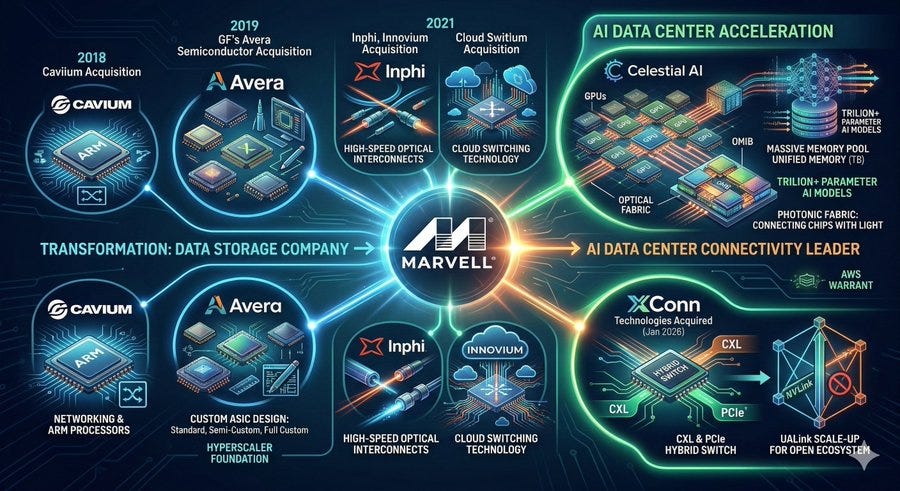
2018: Cavium acquisition, securing networking and ARM processor capabilities.
2019: GF’s Avera Semiconductor acquisition, bringing standard, semi-custom, and full custom ASIC design capability under one roof. This is what gave Marvell the foundation to pitch custom silicon to hyperscalers.
2021: Inphi and Innovium acquisitions, adding high-speed optical interconnect technology and cloud switching.
And the two biggest cards Murphy has played most recently.
Celestial AI acquisition: connecting GPUs with light
Announced in December 2025, closed in February 2026. Initial acquisition price of $3.25 billion, with contingent consideration tied to revenue milestones bringing the potential total to $5.5 billion. Celestial AI is now part of Marvell.
Celestial AI’s Photonic Fabric connects chips to each other using light. Inside the package, a technology called OMIB (Optical Multi-Die Interconnect Bridge) links multiple large dies optically.
Why does this matter? As AI models move into the trillion-parameter era, you need to bind tens or hundreds of GPUs together into a single massive computer. At that scale, the bandwidth of GPU-to-GPU connections and total memory capacity become the ceiling on performance. Photonic Fabric raises that ceiling by an order of magnitude. The vision is memory that can also be connected optically, enabling a unified memory pool of 33TB or more.
Revenue contribution isn’t expected until late 2028, but Marvell management sees it ramping quickly to $1 billion in annual revenue by the end of 2029. AWS has already reportedly entered a warrant agreement related to the technology, which means the first major customer is essentially locked in.
XConn acquisition: filling the gap in CXL switching
One month after Celestial AI, in January 2026, Marvell acquired XConn Technologies for roughly $540 million. XConn built the industry’s first hybrid switch supporting both CXL and PCIe from a single chip. The team developing scale-up switches for UALink, the open alternative to NVIDIA’s NVLink, also came with the deal.
It took ten years, but Marvell has fully transformed from a company that stores data into one of the companies with the broadest coverage of AI data center connectivity infrastructure.
Murphy’s acquisition formula has been consistent throughout: buy the technology that will be absolutely essential in the next generation before anyone else is paying attention.
So what does Marvell’s portfolio actually look like today?
It doesn’t matter how fast a GPU is if the data can’t get to it on time. GPUs are the brain, but for the brain to work, the nerves (interconnects) and blood vessels (memory channels) have to run without bottlenecks. What Marvell builds is exactly that: the nerves and blood vessels.
Inside an AI data center, the technology required depends on how far data needs to travel. The industry generally breaks this into three zones. Scale-Up covers GPU-to-GPU communication within a package or rack. Scale-Out covers rack-to-rack connections via Ethernet. Scale-Across covers data center to data center connections over fiber. Marvell has its own technology across nearly all three.
Pluggable optical module DSP
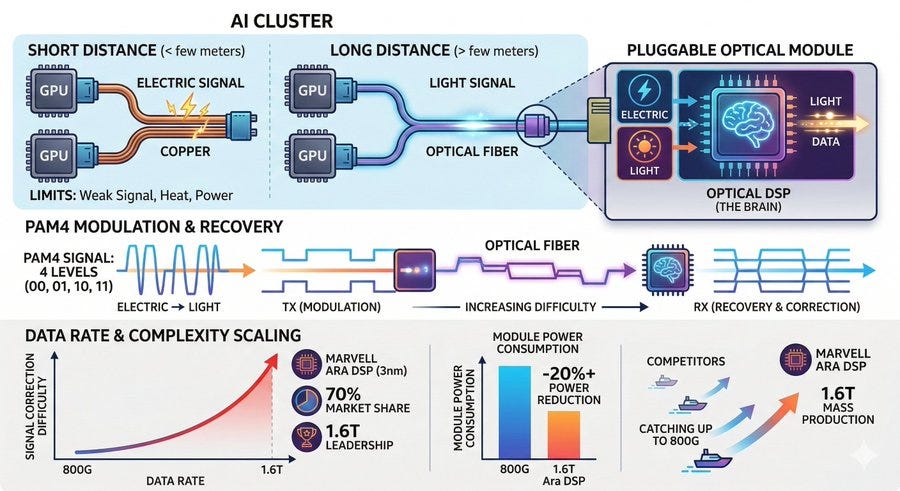
Inside an AI cluster, copper works fine for short distances between GPUs. But beyond a few meters, copper hits its limits. Signal degrades, heat builds up, power consumption rises. That’s where optical cables come in, carrying light instead of electricity. The problem is that GPUs produce electrical signals. You need something that converts electricity to light and light back to electricity.
That’s what optical modules do. Inside the module, components like laser drivers and photodetectors handle the physical conversion. The DSP on top of that plays the role of the brain: on the transmit side it modulates the data into a form that can ride on light, and on the receive side it recovers the weakened and distorted signal back into the original data. This is not straightforward work. Using a modulation scheme called PAM4, a single light channel carries four amplitude levels simultaneously, packing data incredibly densely. The denser the packing, the harder the recovery becomes.
Marvell holds roughly 70% market share in the optical DSP space. The industry is transitioning from 800G to 1.6T (terabit), and as speeds go up, the complexity of signal correction increases nonlinearly. Marvell’s latest Ara DSP is built on a 3nm process, the industry’s first 1.6T product, and cuts overall module power by more than 20%. By the time competitors are catching up to 800G, Marvell is already in production on 1.6T.
SerDes
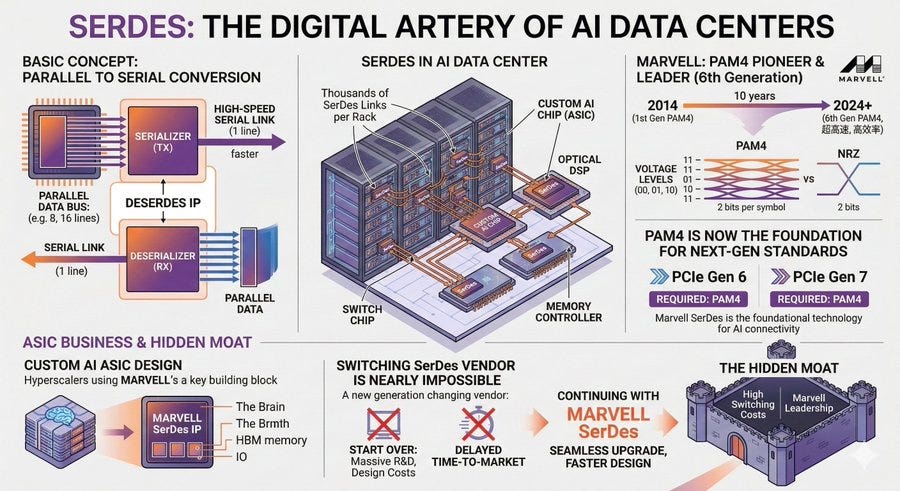
There’s a technology called SerDes (Serializer/Deserializer). The name sounds technical but the function is intuitive. Data inside a chip is processed in parallel across many lanes. When it leaves the chip, it gets bundled and sent serially at high speed. SerDes handles that conversion in both directions.
Why does this matter? Every high-speed chip in an AI data center has SerDes inside it. Switch chips, custom AI chips, optical DSPs, memory controllers, all of them. A single hyperscale data center rack contains tens of thousands of SerDes links. Marvell is the industry leader in SerDes IP, having pioneered PAM4 modulation ten years ago and maintained leadership through six generations. As next-generation high-speed specifications like PCIe Gen 6 and Gen 7 all mandatorily adopt PAM4, Marvell’s SerDes has effectively become the foundational high-speed connectivity technology for AI data centers.
This connects directly to the custom ASIC business. When a hyperscaler designs their own AI chip using Marvell’s SerDes, switching SerDes vendors in the next generation becomes nearly impossible. It’s essentially a full redesign from scratch. That switching cost is Marvell’s hidden moat.
CPO
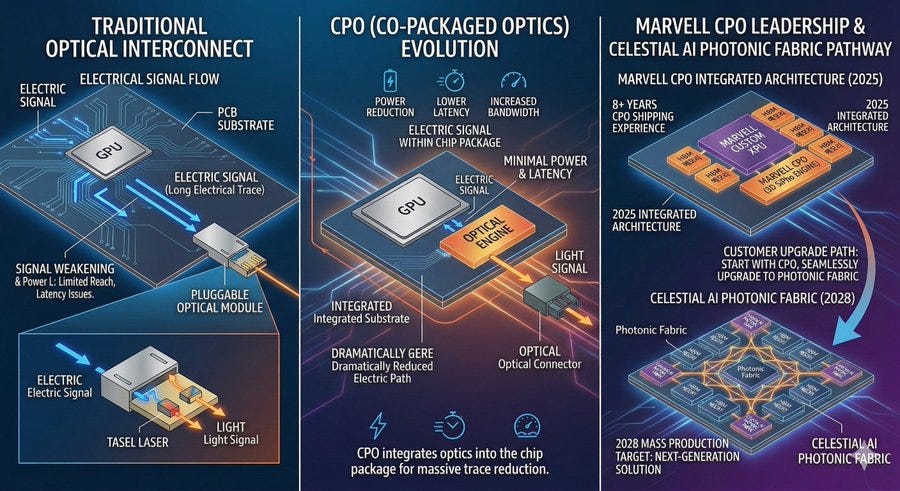
Until now, optical connectivity has worked like this. A GPU generates an electrical signal. That signal travels across the board to the edge, where a pluggable optical module converts it to light. The problem is that the distance it travels across the board is quite long. The longer the distance, the weaker the signal and the more power it consumes.
CPO (Co-Packaged Optics) pulls the optical module inside the chip package itself, dramatically shortening the distance electrical signals have to travel and improving both power and latency. Marvell has been shipping its own CPO technology, the 3D SiPho Engine, for over eight years. In 2025 it announced an architecture integrating a custom XPU, HBM memory, and CPO on a single substrate. If Celestial AI’s Photonic Fabric is the “next generation” targeting 2028 production, the existing CPO is the “current generation” solution available to customers today. The path Marvell is building: start with CPO now, and naturally upgrade to Photonic Fabric when it arrives.
Photonic Fabric
If CPO is about attaching optics to the edge of a chip package, Celestial AI’s Photonic Fabric goes a step further. It stacks optical chiplets directly on top of chip dies in 3D. OMIB connects multiple large dies optically within the package, and PFLink and PFSwitch extend that connectivity to rack-to-rack links outside the package. The vision is binding thousands of GPUs optically into a single massive computer while disaggregating memory optically to create a unified pool of 33TB or more.
It’s pre-production, with revenue expected to begin in late 2028. But AWS has already signed a contract, and Marvell is targeting $1 billion in annual revenue by the end of 2029.
AEC and Golden Cable
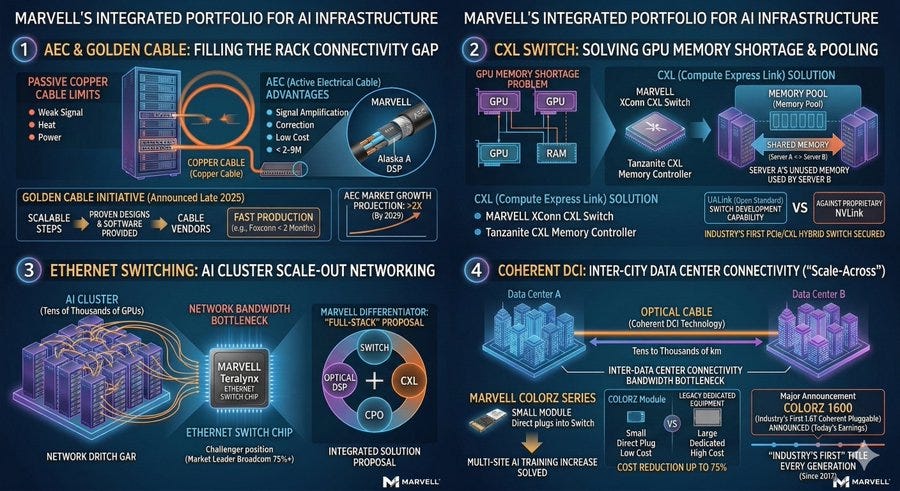
Marvell isn’t only playing in optics. For the 2 to 9 meter distances connecting servers and switches within a rack, copper is still the norm. But as speeds increase, passive copper cables hit their limits, and optical cables are overkill for these distances cost-wise. AEC (Active Electrical Cable) fills that gap. The cable has a chip inside it that amplifies and corrects the signal. That chip is Marvell’s Alaska A DSP.
In late 2025, Marvell announced an initiative called Golden Cable. Rather than just selling chips, the idea is to provide cable vendors with validated designs and software as a platform. Foxconn used this to ship its first product in two months. The AEC market itself is projected to more than double by 2029.
CXL switching
As AI models scale up, there isn’t enough memory to attach to a single GPU. One solution to this problem is CXL (Compute Express Link). Traditionally, memory has to be physically attached right next to the processor. With CXL, you can disaggregate memory and create a shared memory pool across multiple processors: server A can use idle memory from server B.
Marvell gained the industry’s first hybrid switch supporting both CXL and PCIe from the XConn acquisition, and combining that with the CXL memory controller from its earlier Tanzanite acquisition gives Marvell the most comprehensive portfolio in this space. The capability to develop switches for UALink, the open-standard alternative to NVIDIA’s proprietary NVLink, also came from XConn.
Ethernet switching
When an AI cluster scales to tens of thousands of GPUs, the bandwidth of the network connecting servers and racks becomes the bottleneck for the entire system. The Ethernet switch chip is the backbone of that scale-out network. Broadcom dominates more than 75% of this market, so Marvell’s Teralynx is in the challenger position. But Marvell’s differentiation is that it isn’t just selling a switch. It can offer a full stack integrating optical DSP, CXL, and CPO together.
Coherent DCI
From here, distances jump to tens or thousands of kilometers. Multiple data centers within a city, or across different cities, need to be connected via fiber optic cable. That’s where coherent DCI (Data Center Interconnect) technology comes in. Marvell’s COLORZ series serves this market with compact modules that plug directly into switches, cutting costs by up to 75% compared to traditional dedicated appliances.
Marvell has claimed “industry first” in this market every generation since 2017, and alongside today’s earnings announcement it launched COLORZ 1600, the industry’s first 1.6T coherent pluggable. As multi-site AI training grows, the bandwidth between data centers is emerging as a new bottleneck. Marvell calls this layer Scale-Across.
Custom AI ASICs
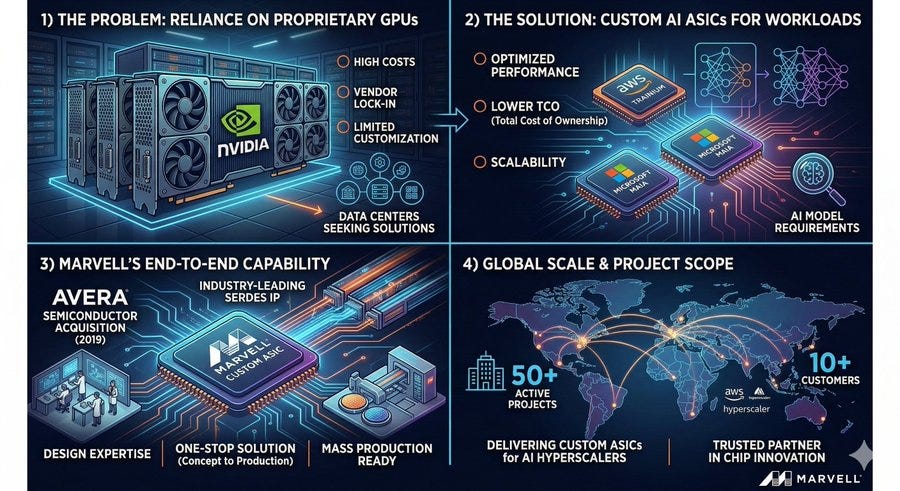
You’ve probably heard of AWS Trainium or Microsoft Maia. Big tech companies are building their own AI chips to reduce dependence on NVIDIA GPUs, but they aren’t doing the design work entirely in-house. A significant portion of the chip design gets outsourced to companies like Marvell. Marvell built this custom chip design capability through the 2019 Avera Semiconductor acquisition, and combined with its industry-leading SerDes IP, it can now offer hyperscalers a one-stop solution from design through production. The company currently has over 50 projects in progress with more than 10 customers.