

Disclaimer
This piece is for informational purposes only and is not investment advice. Every company and security mentioned is a subject of analysis, not a buy or sell recommendation. All investment decisions and their consequences rest entirely with the investor. The figures in this piece are based on publicly available data as of the time of writing and may change afterward.
1. Meta’s Move Into the Cloud: Is It Really Bad News?
On July 1, Bloomberg reported Meta’s plans for a cloud business. The plan involves standing up a new division to sell surplus AI compute capacity externally, with monetization coming through two routes: selling access to Meta’s Muse Spark models (a structure similar to AWS Bedrock), and bare metal sales, meaning a neocloud-style product that leases raw GPU hardware access without any management layer on top.
This wasn’t actually new news.
The organization called Meta Compute was already stood up back in January. It started as a buildout initiative to construct tens of gigawatts of compute capacity over this decade, and in late May, Zuckerberg publicly noted the company was exploring a cloud business to compete with AWS and Azure.
So how did the market take it? Meta ran up more than 10% intraday before closing up 8.8%. On the other side, though, CoreWeave fell 14%, with Nebius, IREN, and Applied Digital following. In semiconductors, the SOXX dropped 4.7% and Micron fell 8.2%, while NVIDIA, AMD, Marvell, TSMC, and ASML all sold off together.
The reasons for the rise and the fall are each clear enough. Meta rose because, for the first time, its annual capex of $125 billion to $145 billion was presented with a concrete business path to recoup it.
The other side fell because the same information was read as two separate fears.
For the neoclouds, it read as a competitive threat: a hyperscaler with incomparably deeper capital was now going to sell the same product.
For semiconductors, it read as a peak signal, that if surplus exists, then the growth rate of hyperscaler capex must be rolling over.
Does this news really mean hyperscaler capex is topping out and the neoclouds are losing their market?
My view is that this day’s selloff was, in part, the market over-reading the story.
Start with the capex fear.
Meta is by no means a company drowning in spare compute. On its Q1 earnings call this year, it added $107 billion in contractual commitments in a single quarter, and in March it signed a deal with Nebius worth up to $27 billion over five years. On top of that, per a late-June FT report, Google told Meta around March that it couldn’t supply all of the Gemini capacity Meta wanted to buy, citing its own compute shortage. Meta responded by telling employees to conserve token usage, and some internal AI projects slipped. A company that can’t buy all the compute it wants, and is being rationed, is not at the stage of worrying about surplus.
What about the neoclouds?
Here the direction of the fear isn’t wrong, but the timing is too early. Through at least 2027, when its own data center capacity steps up, Meta is a net buyer, and until then the competitive threat is an option, not a reality.
But as it always does, the market seized on a single fragment of the news and turned to selling. On the strength of one word, surplus, companies performing entirely different functions in the supply chain all sold off in the same direction. The result is that companies genuinely exposed to this news and companies that simply fell alongside them are now mixed together in one price band.
There have been many cases where selling like this turned into opportunity once the interpretation settled, but capturing that opportunity requires first sorting out which layer is exposed to this news, and by how much.
So in this piece, I want to treat this selloff as a single investment opportunity, and work through the AI compute infrastructure supply chain layer by layer, from the neoclouds down through servers, integration, and semiconductors.
2. The Structure of the Map: Five Layers From GPU to Token
If you divide AI compute infrastructure not by nationality or sector but by supply chain function, five layers emerge. Follow the path by which a single GPU converts into revenue and it looks like this.
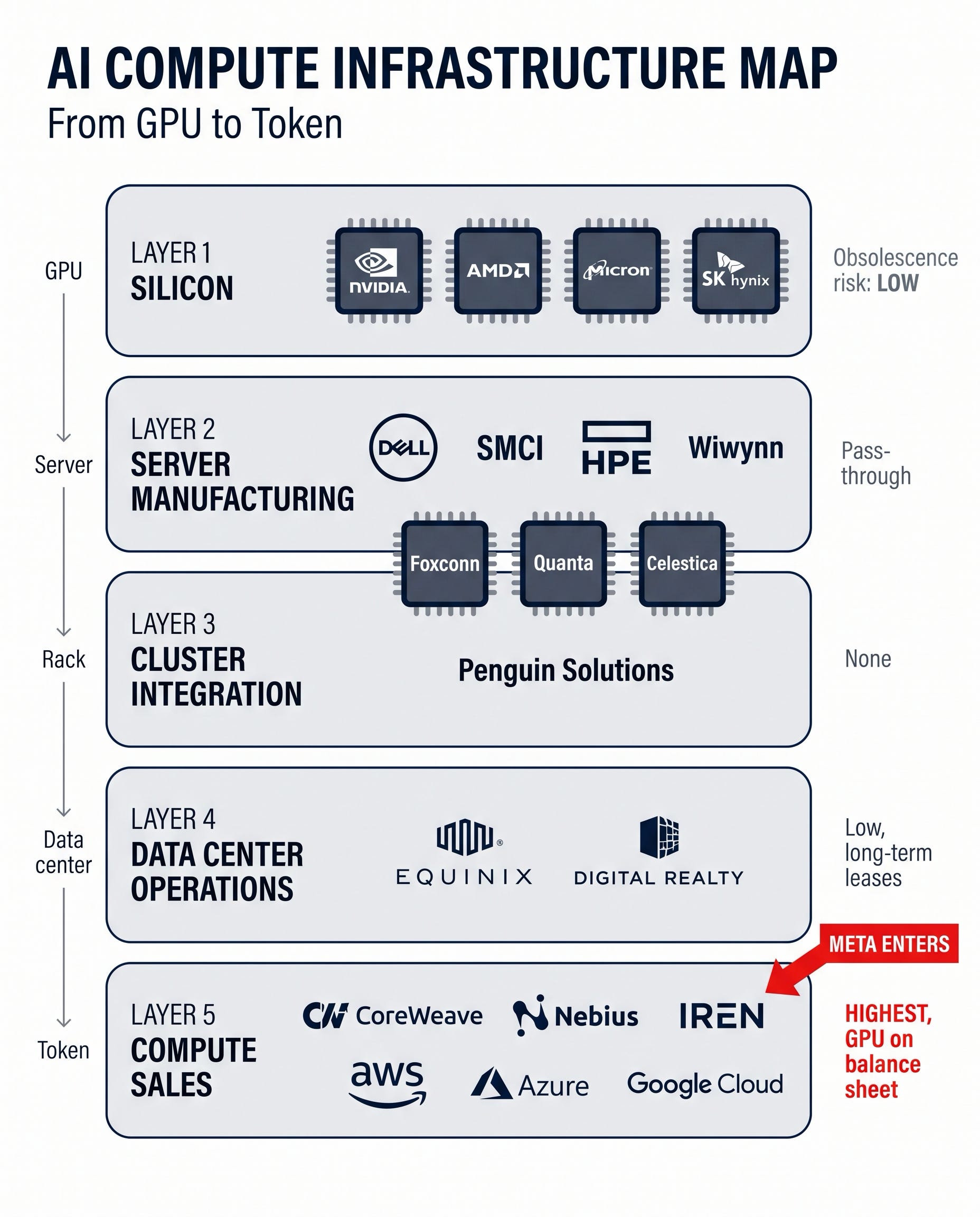
Layer 1 is semiconductors.
GPUs, custom ASICs, HBM, networking chips. NVIDIA, AMD, Micron, and SK Hynix live here. Their results are determined by the total capex of the layers below, so the analytical question collapses to one thing: is total buildout holding up?
Layer 2 is server manufacturing.
This is the stage that takes semiconductors and turns them into server systems, and it splits in two. On one side are the OEMs that sell under their own brand (Dell, SMCI, HPE). On the other are the ODM/EMS contract manufacturers that take hyperscalers’ designs and handle production and assembly on their behalf (Quanta, Wiwynn, Foxconn, Celestica, Flex, Jabil). Within the same layer, the OEMs make margin on attach services and financing, while the ODMs make it on volume.
Layer 3 is cluster integration.
This is the stage that bundles servers into racks and racks into clusters. As rack-scale architectures like the NVL72 class became the standard, the technical difficulty of this stage rose sharply, and liquid-cooling manifolds, backplane cabling, and rack-level power distribution are all decided here. The volume workhorses are the large ODMs like Foxconn and Quanta, and EMS players like Celestica, Flex, and Jabil have moved up into this stage as well.
These are the same names that appear in Layer 2, but the two layers are a distinction of function rather than of company, so the same firm often straddles both, and it is the weight of Layer 3 function in the revenue mix that separates the margins and the multiples. The representative case of a multiple re-rated on this mix shift is Celestica. Penguin Solutions has a server brand too, but the center of its business is the design, buildout, and operational management of clusters as a service, which makes it the company closest to this layer.
Layer 4 is data center operation.
The colocation providers and REITs that supply the land, power, cooling, and buildings (Equinix, Digital Realty) sit here. Because of the long-lived nature of the assets and the long-term lease contracts, this layer serves as the benchmark for gauging just how different the neocloud business structure is, given that neoclouds are also in the infrastructure-leasing business.
Layer 5 is compute sales.
This is the stage that sells GPU hours to the end customer, where the hyperscalers (AWS, Azure, Google Cloud, and now Meta) compete with the neoclouds (CoreWeave, Nebius, Crusoe, Lambda, IREN, Applied Digital).
Three criteria separate these five layers.
First, who owns the assets.
Second, who bears the GPU obsolescence risk.
Third, does the contract structure protect the margin.
The answers to these three questions differ by layer, and those differences either justify or undercut the difference in valuation multiples.
The key thing in this table is where the obsolescence risk sits, meaning the risk that an asset loses its economic value faster than its book life once a newer model arrives.
A GPU as an asset is depreciated over four to six years on the books, but NVIDIA’s product cycle effectively turns on an annual basis. Every time a new GPU ships, the hourly lease rate on the older GPU drops. Among the listed pure-play names across the five layers, the only one that carries this risk at the center of its revenue model is the neocloud. Colocation holds assets with lives of 20 years or more, in buildings and power, and locks in cash flow with long-term leases. The server OEMs bear the risk only for as long as inventory turns. The ODMs barely bear it at all.
Using this map, the sections below work through the exposure of each layer at the company level.
Has the investment case for the neoclouds really been damaged, and if so, which company by how much? And among the names that fell alongside them that day for no particular reason, where should you look first?
From here on, I’ve laid out the company-level numbers, the criteria for judgment, and what to watch in each name that are needed to translate this correction into an actual trading decision.