Right after the close, Qualcomm’s stock first reacted to the downside. The Q3 guide was soft, and handset recovery still wasn’t clear. Just looking at the numbers, the market’s first reaction was understandable.
Then the earnings call shifted the mood completely. After-hours moved sharply higher, a move that weak guidance alone couldn’t explain. What the market was starting to reprice wasn’t next quarter’s handset numbers. It was Qualcomm’s possible entry into the data center.
The trigger was one line buried in CEO Cristiano Amon’s commentary.
“A leading hyperscaler custom silicon engagement is on track for initial shipments later this calendar year.”
This piece starts from that sentence.
First we separate the headline numbers from what’s actually happening in the business, then we walk through Qualcomm’s data center strategy, the LPDDR-based inference architecture, and what the Alphawave and Ventana acquisitions actually mean.
Finally, drawing on what’s circulating in the field and what’s available in public filings, we take a shot at identifying the anonymous hyperscaler, and then we lay out what needs to be confirmed for this thesis to translate into actual revenue.
Table of Contents
Earnings: surface numbers and what’s underneath
What that one line actually means
LPDDR and the ASIC full stack
Who is the anonymous hyperscaler
Risks and checkpoints
Disclaimer
This article is for informational purposes only and is not a recommendation to buy or sell any security. All investment decisions and the outcomes that follow are the reader’s own. Market estimates and the speculation on the anonymous hyperscaler’s identity reflect the author’s personal interpretation of public materials. They may diverge from the company’s official statements or actual outcomes.
Earnings: surface numbers and what’s underneath
Headline-wise, this print wasn’t bad.
Revenue $10.6B, Non-GAAP EPS $2.65. Versus prior guidance, revenue landed mid-range and EPS at the high end. Slightly above Street consensus. As a standalone print, it’s a clean beat.
The reason the market initially turned cold was also clear. Next quarter’s guide came in light. Q3 revenue was set at $9.2B to $10B, below the StreetAccount consensus of $10.19B. The weakness was concentrated in one place. Handsets.
Handsets revenue was $6.024B, down 13% year over year. Memory tightness, rising LPDDR and NAND prices, and softer demand from Chinese OEMs all hit at once, pressuring premium smartphone shipments and mix. The largest contributor to Qualcomm’s revenue still hasn’t bottomed. The market reflexively selling first was natural enough.
So why did the stock turn around?
A while back, I mapped the CPU cycle into six scenarios and flagged QCOM as the main investment bet in two of them. One was AI inference explosion, the other was Auto SoC. What’s striking is that this print touched both at the same time.
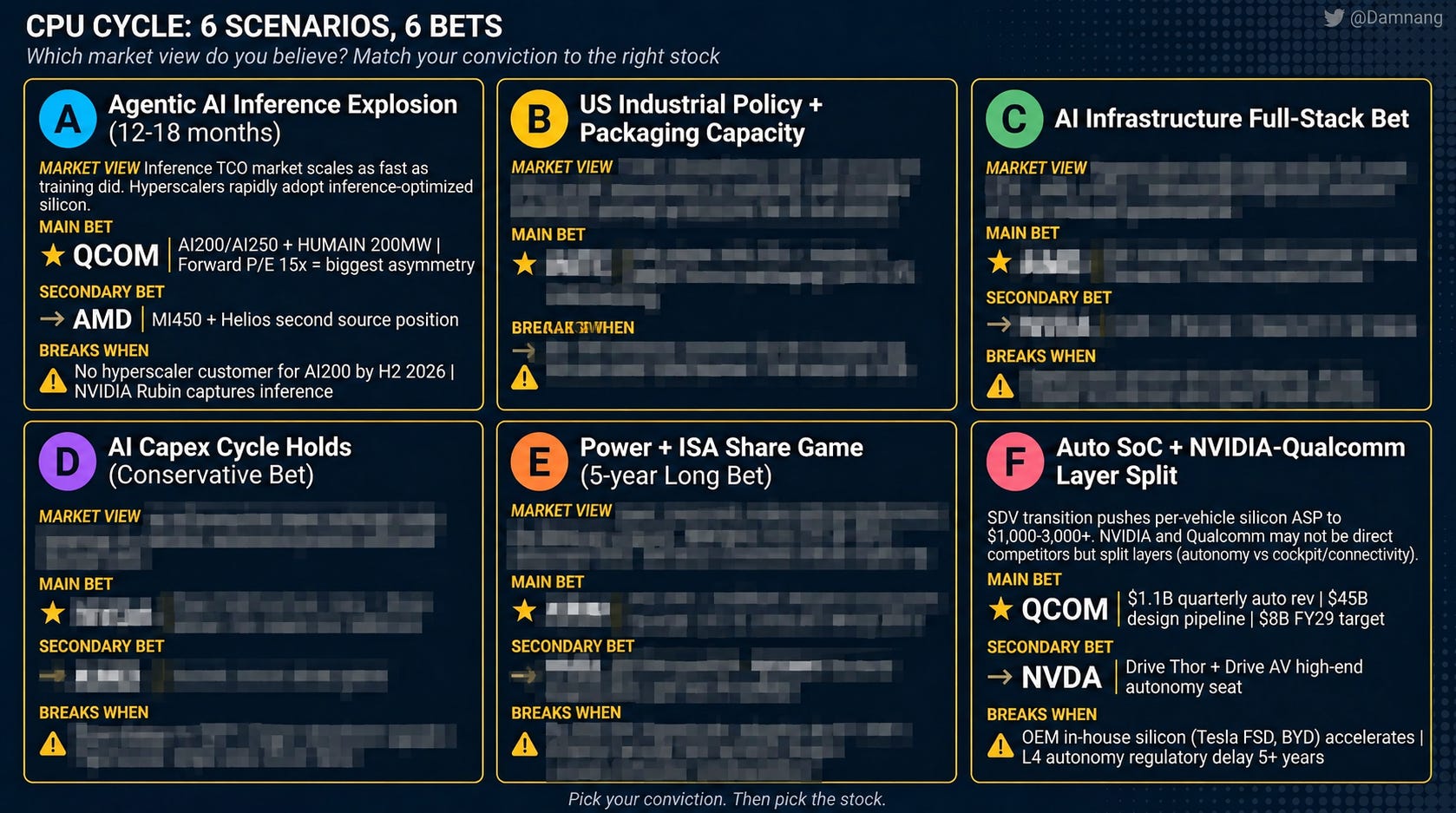
The CPU Bottleneck Trade: Who Actually Gets Paid in the Agentic AI Era?

After the close on April 23, 2026, Intel CEO Lip-Bu Tan said something that mattered on the Q1 earnings call.
Automotive came in at $1.326B, up 38% year over year, a record quarter. IoT grew 9%. The structure of Auto and IoT meaningfully filling the gap left by handsets showed up clearly for the first time. The diversification story the company has been pushing on slides for years is now starting to print on the actual P&L.
What’s even more notable is that on top of this quarter’s 38% growth, the next quarter is guided to grow roughly 50% year over year. Growth isn’t decelerating, it’s accelerating. That can be read as the $45B automotive design win pipeline starting to convert into revenue. Back when I worked there, Qualcomm went through a major internal reorg specifically to push harder into Automotive. So I think the Auto track deserves more attention going forward.
That covers the first of the two bets, the Auto track showing up directly in the print.
The second bet, data center AI inference, is where this piece focuses.
The real shift in the stock came from a single line in Amon’s commentary.
What that one line actually means
The sentence in the earnings release was this.
“We are equally excited by our entry into the data center, where a leading hyperscaler custom silicon engagement is on track for initial shipments later this calendar year.”
The phrase to focus on is custom silicon engagement. It can mean at least three different things.
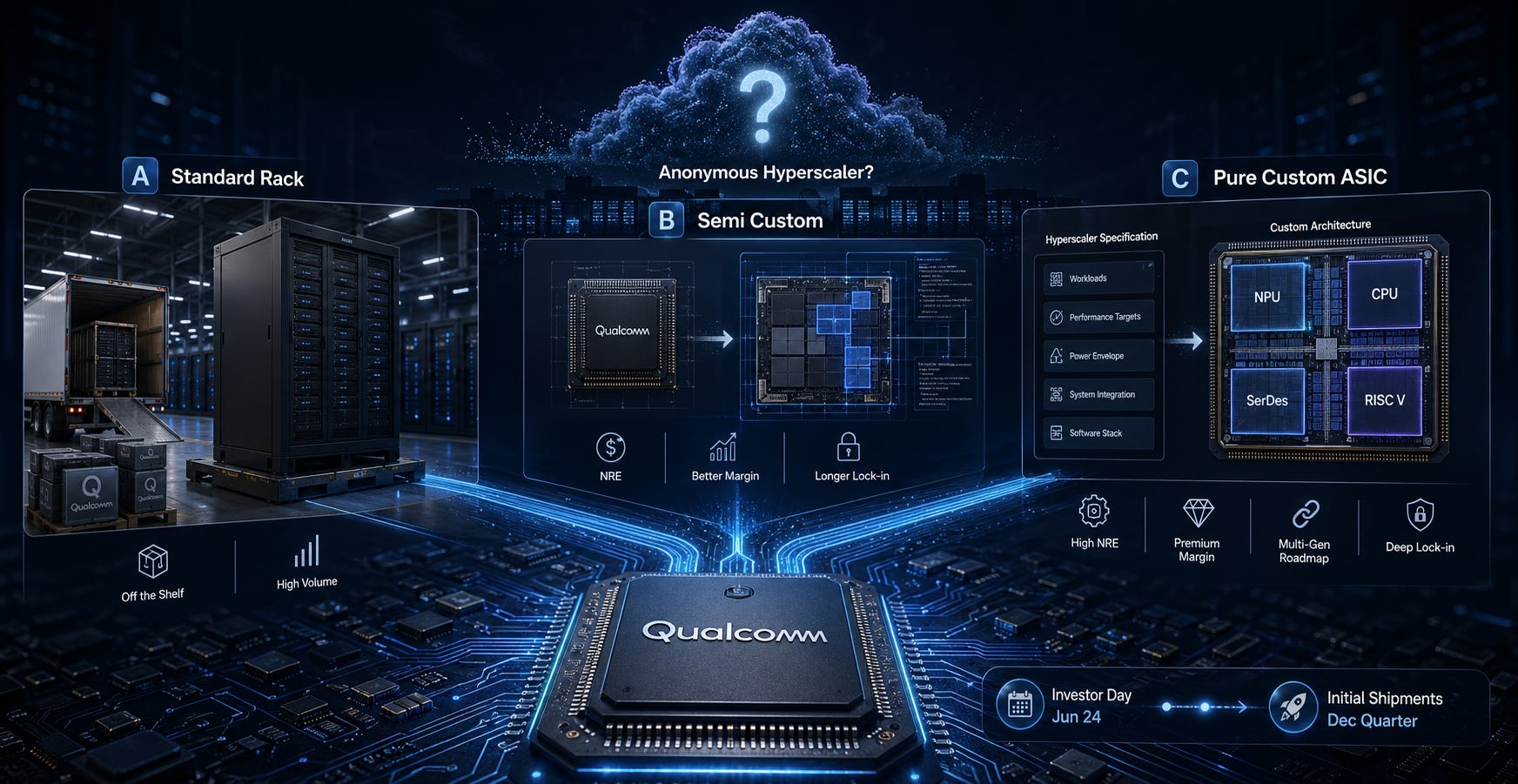
Scenario A: Standard rack purchase.
The hyperscaler buys AI200/AI250 as off-the-shelf product and integrates it into its own data centers. Same structure as the HUMAIN 200MW deal. In this case revenue math is straightforward: ASP times volume.
Scenario B: Semi-custom derivative.
The hyperscaler hands over its workload spec, and Qualcomm builds a derivative chip on top of the AI200/AI250 base, customizing some blocks. NRE (non-recurring engineering) revenue gets layered in, and margin runs better than standard. Design-win lock-in extends.
Scenario C: Pure custom ASIC.
The hyperscaler provides the full chip spec, and Qualcomm composes a customer-specific ASIC by combining its IP blocks. This is closer to the business model of established ASIC design service providers. Customer lock-in and long-dated revenue visibility are far stronger than simple product sales. Amon himself used the phrase “multi-generation engagement” on the call. And it’s the case where keeping the customer’s name confidential is most natural.
In my read, the most likely answer sits somewhere between B and C. If it were a plain standard rack purchase, there’d be little reason to keep things anonymous. Deals with high PR value, like HUMAIN, usually go out with the name attached. Insisting on anonymity points to one of two things: (1) the hyperscaler doesn’t want to telegraph anything to competitors, or (2) it wants to position this carefully relative to its existing ASIC partnerships. Either case fits a customized engagement better than a standard product sale.
Amon also got more specific about timing in the prepared remarks. “We expect initial shipments in the December quarter.” That’s an entire quarter, not a single month, of meaningful shipments potentially starting. Investor Day on June 24 is roughly two months out. There’s a reasonable chance more detail on the engagement structure and the customer’s identity surfaces in that window.
Which leaves the question. Who is the anonymous hyperscaler.
The next sections work toward that picture step by step. Why LPDDR is central to this game, how the Alphawave and Ventana acquisitions form the skeleton of a customer-specific ASIC business, and most importantly, who that anonymous hyperscaler is most likely to be, drawing together what’s circulating in the field and what’s in the public record.