


Of the 24 companies in the power investment map, the ones in the low-voltage tier have rallied the hardest. The return gap versus the high-voltage tier is more than 10x. The closest point to GPU TDP reacts first and overheats fastest.
But this tier requires a different approach to investing than the others. In the high-voltage tier, buying Eaton and GE Vernova together is diversification. They move in the same direction.
In this low-voltage tier, stocks under the same “AI power” label can cancel each other out. Some combinations pit opposing bets against each other inside a portfolio, leaving you paying fees on a net-zero position. Others look like diversification but are actually buying the same scenario twice.
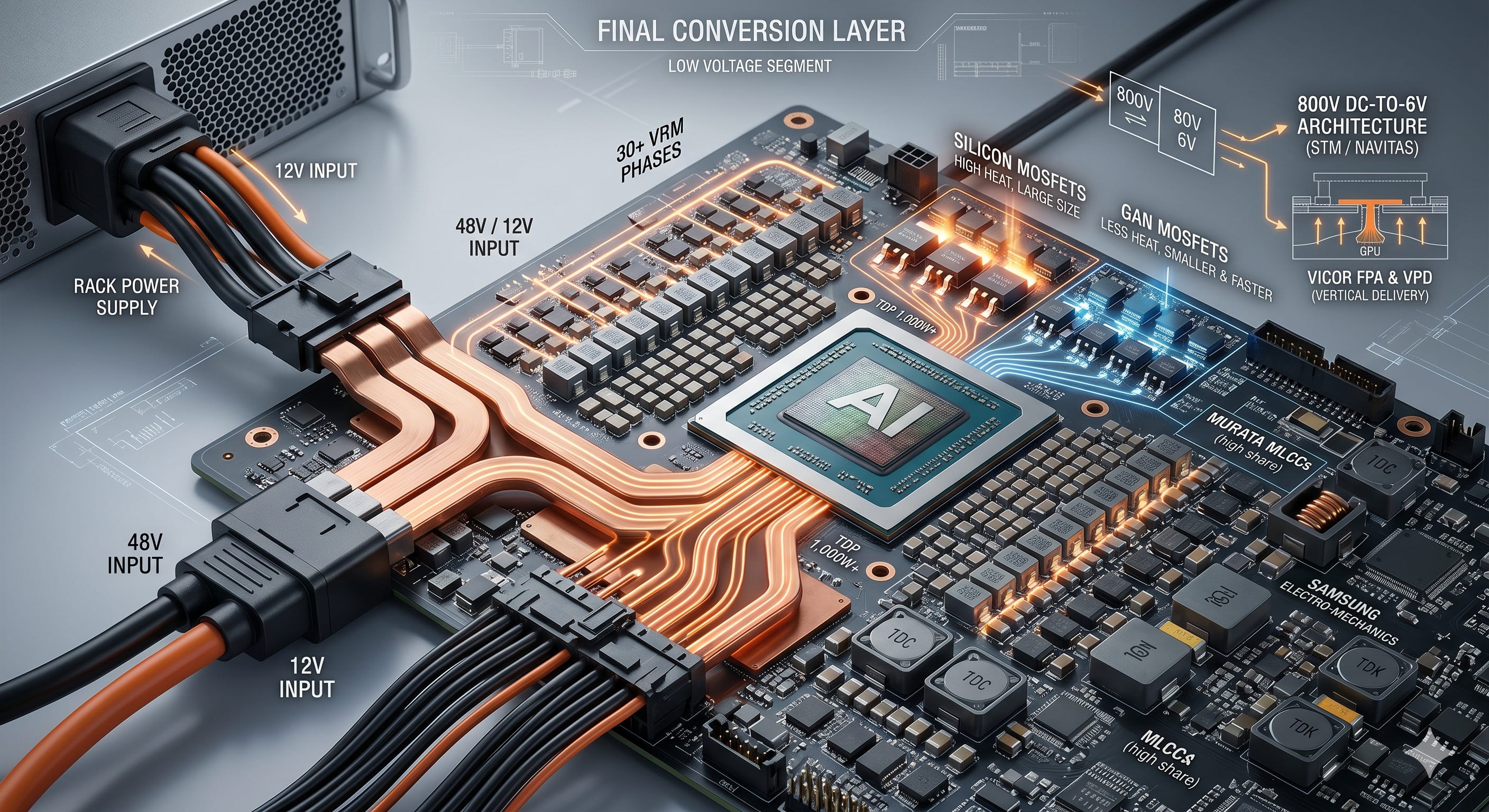
This article dissects the technical architecture of the low-voltage layers in the power investment map:
⑦ VRM, ⑧ Next-gen power semiconductor, and ⑨ Passive components.
It maps how each technology interlocks, and separates the names the market has overpriced from the ones it hasn’t fully seen yet.
This tier cannot be bought as a basket under the AI power theme.
Investing in it efficiently requires understanding the structure and linkages of each technology, identifying which scenarios you're doubling up on, and building a portfolio on top of that awareness.

Disclaimer
This article does not recommend buying or selling any specific security. All content is based on publicly available information and is written to help readers understand the AI datacenter power chain. Investment decisions should be made independently based on your own research, risk tolerance, and investment horizon.
Conclusion First: Where to Invest in This Tier
This section reflects my personal perspective and does not recommend buying or selling any specific security. The technical proof for each conclusion follows in later sections.
This tier breaks into three buckets.
MLCC is the cleanest beneficiary, indifferent to whether 12V or 48V wins.
Renesas and ADI are current beneficiaries the market hasn’t fully priced as AI power plays.
Vicor and Navitas are the hottest names, but together they may be a duplicate bet on the same acceleration scenario, not diversification.