

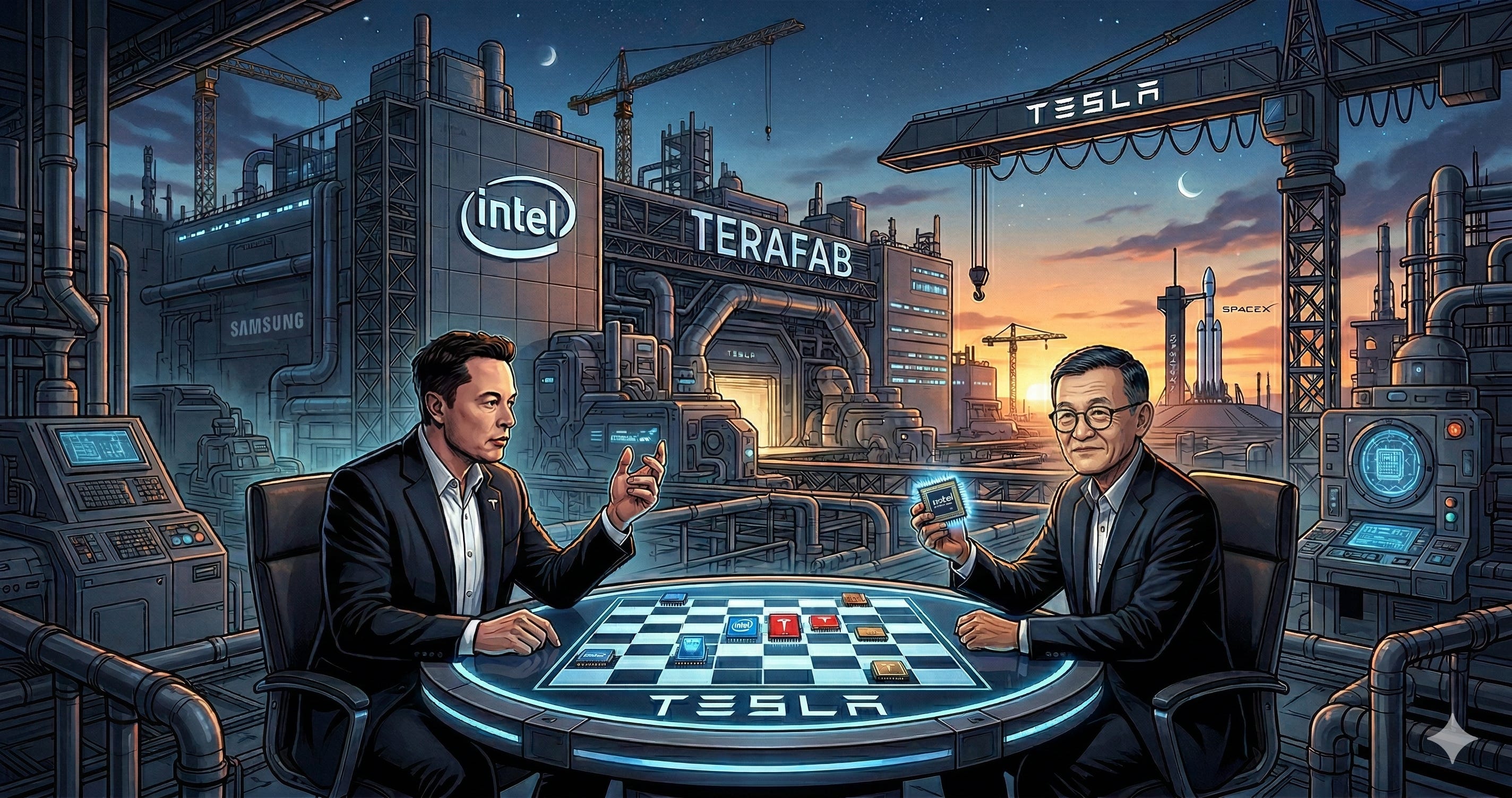
On the morning of April 7, Intel posted a single line on X. “Intel is proud to join the Terafab project with SpaceX, xAI, and Tesla to help refactor silicon fab technology.”
It was a strangely quiet announcement.
No press release.
No SEC filing.
On the surface, it looks simple.
Intel joined Terafab, and the market liked it.
Intel could get Tesla volume, so the stock went up. End of story.
But this deal has too many weird angles for that kind of read.
SpaceX filed a confidential IPO with the SEC on April 1. The target valuation was reported at over $1.75 trillion, with a fundraising goal around $75 billion.
Meanwhile, Samsung had already locked in a $16.5 billion long-term AI6 chip supply contract with Tesla.
And then Intel slid into the middle.
What makes it more interesting is Intel’s own position. Intel Foundry posted $17.8 billion in revenue for 2025 but recorded $10.3 billion in operating losses, and external customer revenue was just $307 million.
Why would a company in that shape react so sharply to this deal?
Reading this as simply “good news for Intel” is one-dimensional.
Behind the surface announcement, a much bigger game is playing out.
In this piece, I want to unpack the real calculus behind the Intel and Terafab news, drawing on publicly available facts and what I’m hearing on the ground in Silicon Valley.
Articles worth reading together:

The Age of the TSMC Bottleneck

In March 2026, Broadcom’s Natarajan Ramachandran stood in front of reporters and said something that would have been unthinkable a few years ago.
Intel Foundry: A Last Chance

In Q4 2025, Intel Foundry posted revenue of $4.5 billion alongside an operating loss of $2.5 billion. CEO Lip-Bu Tan admitted that “the company invested too much, too fast, without sufficient demand,” and Intel’s SEC filing included risk language to the effect that the company has yet to secure meaningful external foundry customers at scale on any of it…
Why Intel Foundry Is All-In on This Deal
According to Intel’s annual report, Intel Foundry’s external customer revenue in 2025 was $307 million. That is 1.7% of its total foundry revenue of $17.8 billion. The rest is essentially internal volume. Annual operating loss was $10.3 billion. With a structure like that, it is very hard to convince the market that the foundry can stand on its own without external customers. Whether it is a spinoff or an IPO, what the market ultimately wants to see is an answer to one question:
“Is this really a foundry that other companies would trust with their chips?”
So what Intel Foundry needs most right now is not a technology demo.
It needs customers. Not names on a slide, but anchor customers who commit volume over time and generate real revenue. Microsoft is already public as an Intel Foundry customer, and AWS announced a collaboration on custom AI chips based on Intel 18A in 2024. But those are still more symbolic than substantial. To genuinely shift the narrative for Intel Foundry, it needs large-scale, sustained external demand.
In that context, Terafab is not just another collaboration headline for Intel. It is the closest thing to the anchor customer that Intel so desperately needs right now. Of course, there are caveats. The information that has been made public so far amounts to a “joining” announcement. Key contract details like wafer volumes, capex sharing, and long-term capacity guarantees are nowhere to be seen.
The phrase in Intel’s post, “help refactor silicon fab technology,” suggests something deeper than simple wafer supply. But the fact that this was announced through a single X post with no press release or SEC filing also suggests this has not yet reached the stage of a formal contract.
So you should not read this as a confirmed order.
At this stage, Terafab is closer to a possibility than a contract.
So What Does Intel Actually Get Right Now?
If there is no formal contract yet, what does Intel actually gain from this deal? I see two things.
The first is credibility. This may not translate to revenue right away, but for Intel Foundry, credibility is what matters most at this moment. Under Lip-Bu Tan, Intel has been restructuring its manufacturing control and capital structure. On April 1, Intel repurchased a 49% stake in its Ireland Fab 34 from Apollo for $14.2 billion, regaining full control of the fab. Add CHIPS funding and government capital on top of that, and Intel has at least secured enough staying power along with the image of being a national strategic asset.
The technology side is not standing still either. The perception that “Intel is coming up faster than expected” has started to form in parts of the market, and it is at that exact moment that the Terafab name got attached. That sends a signal to both the market and Washington: “Intel has at least secured a seat at the table for the U.S. AI manufacturing hub.”
Here is my bigger read on this. The short-term value of Terafab is not about how many wafers Intel prints right away.
It is about repositioning Intel Foundry as
“the U.S. AI manufacturing platform that Tesla and SpaceX put their names on.”
For a foundry starved of external customers, this alone can function as a qualification event. Real large-scale revenue is a later problem. What Intel needs first is a reason for other potential customers to take a second look. In that sense, Terafab is both a pipeline story and a sales story.
The second is packaging. This is far more tangible than credibility. If you only look at Terafab through the lens of process nodes, you miss the point. The area where Intel can contribute most immediately, and monetize most quickly, is likely advanced packaging.
EMIB: Intel Foundry's Best Hope

The bottleneck in the semiconductor industry has shifted. For a long time, almost everything came down to how small you could make a transistor. That’s no longer the whole story. Increasingly, what matters is how fast and efficiently you can connect multiple chips inside a single package. Packaging has become a critical competitive axis.
Intel’s Foveros and EMIB are still considered top-tier capabilities in the industry. Meanwhile, the real bottleneck in the market has been showing up more often in advanced packaging than in the node itself. TSMC’s CoWoS being capacity-constrained is practically an open secret, and even Nvidia has dealt with shipment bottlenecks due to packaging capacity limits. What matters in the AI chip race right now is not just cutting transistors smaller. It is how you attach HBM, how you connect chiplets, how you manage power delivery and thermals. Those are the factors that determine real-world performance and shipment volumes. In that sense, Intel’s packaging capabilities are an asset that can convert to revenue faster than 18A itself.
So the short-term picture probably looks more like this. AI6 wafer production is already pointed at Samsung’s Taylor facility, and AI5 is reportedly going to TSMC. Intel enters initially through packaging services and process co-development. Rather than a sudden flood of external wafer revenue, the progression is more likely to start with advanced packaging and enablement, with logic wafer opportunities following after.
Reading this as Intel taking over Terafab’s manufacturing operations at this stage would be getting ahead of the story.