

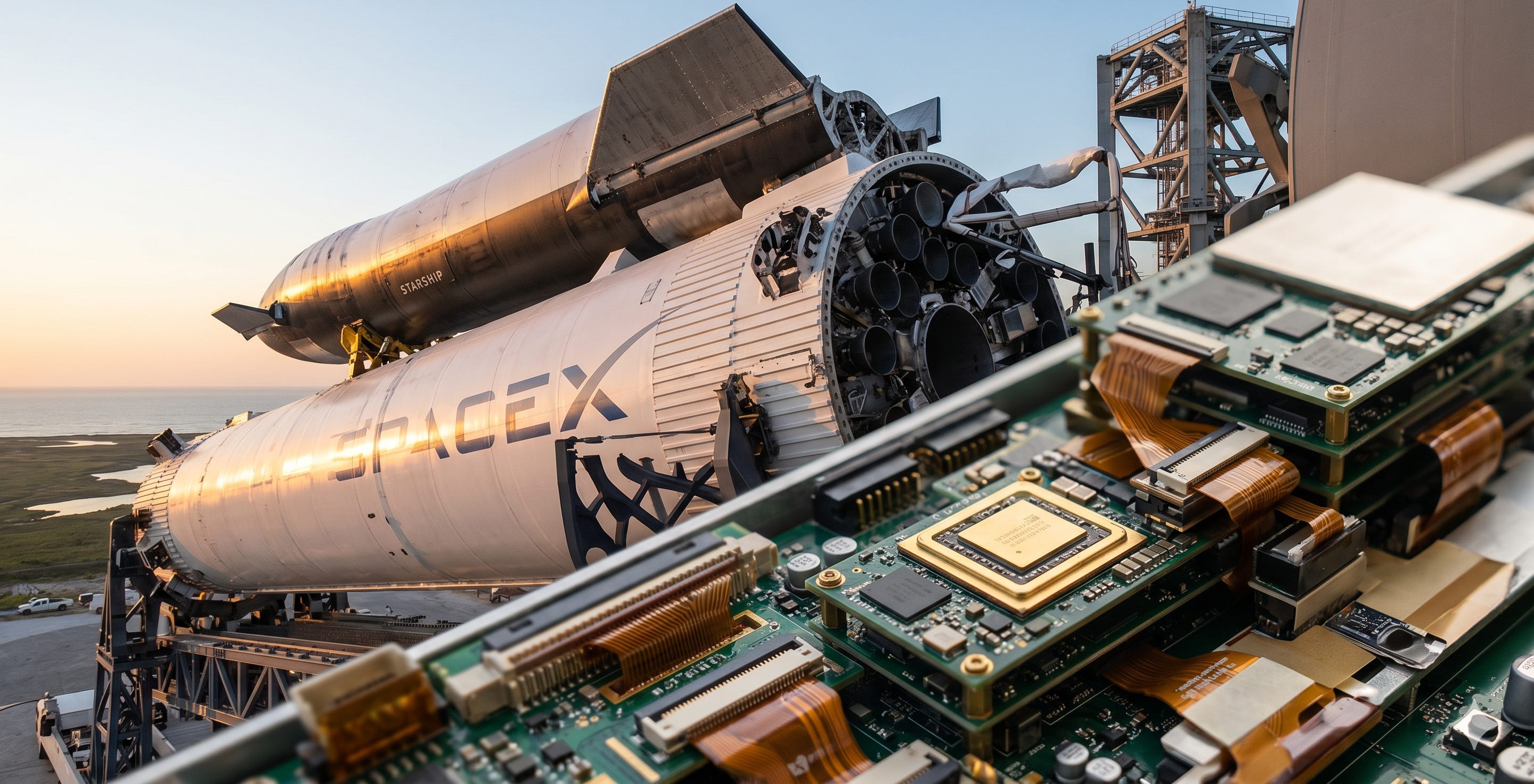
The largest IPO in history kicks off in June.
SpaceX. Target valuation: $1.75T. Capital raise target: $75B.
According to Reuters, the roadshow is targeted for June 4, pricing for June 11, and the first day of Nasdaq trading for June 12.
The ticker is SPCX.
The SEC review wrapped up faster than expected, pulling the entire timeline forward. SpaceX IPO analyses are already flooding in from everywhere. Starlink subscriber counts, Starship launch success rates, xAI merger synergies.
But there’s something people are missing about SpaceX. Before it’s a satellite company, SpaceX is a major semiconductor buyer. Terminals, satellites, and ground station infrastructure all run on chips, and the consumption scale is larger than the market thinks.
Knowing this, however, doesn’t translate directly into an investable edge. Space-related semiconductor names are being thrown around ahead of the SpaceX IPO, but the number of companies with a confirmed supply relationship and real revenue leverage is small. The rest are indirect beneficiaries, or still just optionality with no revenue attached. If you can’t make this distinction, the SpaceX IPO becomes a theme chase, not an opportunity.
This article covers the full spectrum. I dissect the SpaceX semiconductor ecosystem layer by layer, lay out the criteria that separate confirmed suppliers, indirect beneficiaries, and pure optionality plays. I use publicly available numbers to reverse-engineer the Starlink terminal’s semiconductor BOM, and analyze scenario by scenario who gets squeezed first if SpaceX starts building its own chips.
If you want to understand the full picture of semiconductors tied to SpaceX, I’m confident this article will be worth your time.
The analysis in this article is based on publicly available information and industry-level inference, reflecting the author’s perspective. It is not a buy or sell recommendation for any specific stock.
1. Starlink Is Not a Satellite Service. It’s a Semiconductor Consumption Machine.
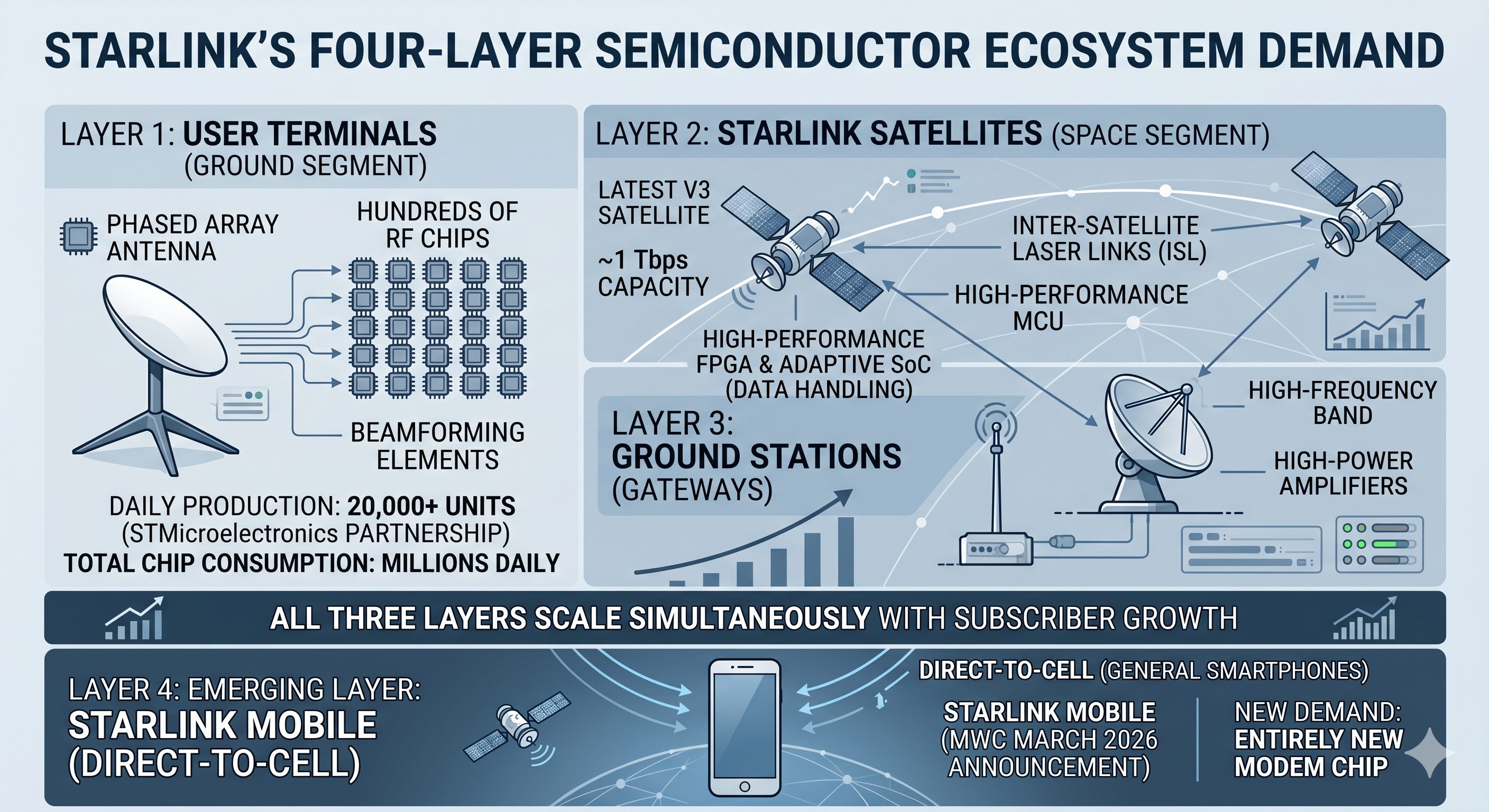
A single Starlink terminal uses hundreds of RF chips. These are beamforming elements that make up the phased array antenna. According to STMicroelectronics and SpaceX’s official partnership announcement, SpaceX is producing over 20,000 Starlink terminals per day. In RF chips alone, that’s millions consumed daily.
Satellites eat chips too. The latest V3 satellites handle roughly 1 Tbps of capacity. Processing that data requires high-performance FPGAs and adaptive SoCs. High-performance MCUs go into the inter-satellite laser links. Ground stations need high-power amplifiers operating in high-frequency bands.
Terminals, satellites, ground stations. Three layers, each consuming different types of chips in volume. As subscribers grow, all three layers scale simultaneously.
A fourth layer is opening up. Starlink Mobile, announced at MWC in March 2026. It’s a Direct-to-Cell service that lets ordinary smartphones connect directly to Starlink satellites without a dedicated terminal. Once this ramps, it creates an entirely new semiconductor demand category: receive-side modems.
When the S-1 drops, the COGS (Cost of Goods Sold) structure will be revealed for the first time. That’s when the market will finally see, in hard numbers, just how many chips SpaceX buys. I’m laying out the map before that happens.
2. The Map First: Who Has Real SpaceX Leverage
Before tearing apart the supply chain one by one, let’s look at the full picture. The SpaceX linkage strength of the eight companies below varies widely. Some are officially confirmed suppliers. Some are based on industry-level inference. Some are still pure optionality.
I evaluate each company against four questions.
Does it actually sell chips to SpaceX? Whether there is official confirmation is the first filter. Without this distinction, the “SpaceX beneficiary” framing creates false impressions.
How material is SpaceX revenue to the company? Even among confirmed suppliers, revenue sensitivity differs dramatically.
What happens if SpaceX builds it in-house? Bastrop, Terafab, internal RF module development. The scope and timeline of insourcing changes the risk profile.
How much has the market priced this in? The S-1 could be the catalyst that closes the perception gap.
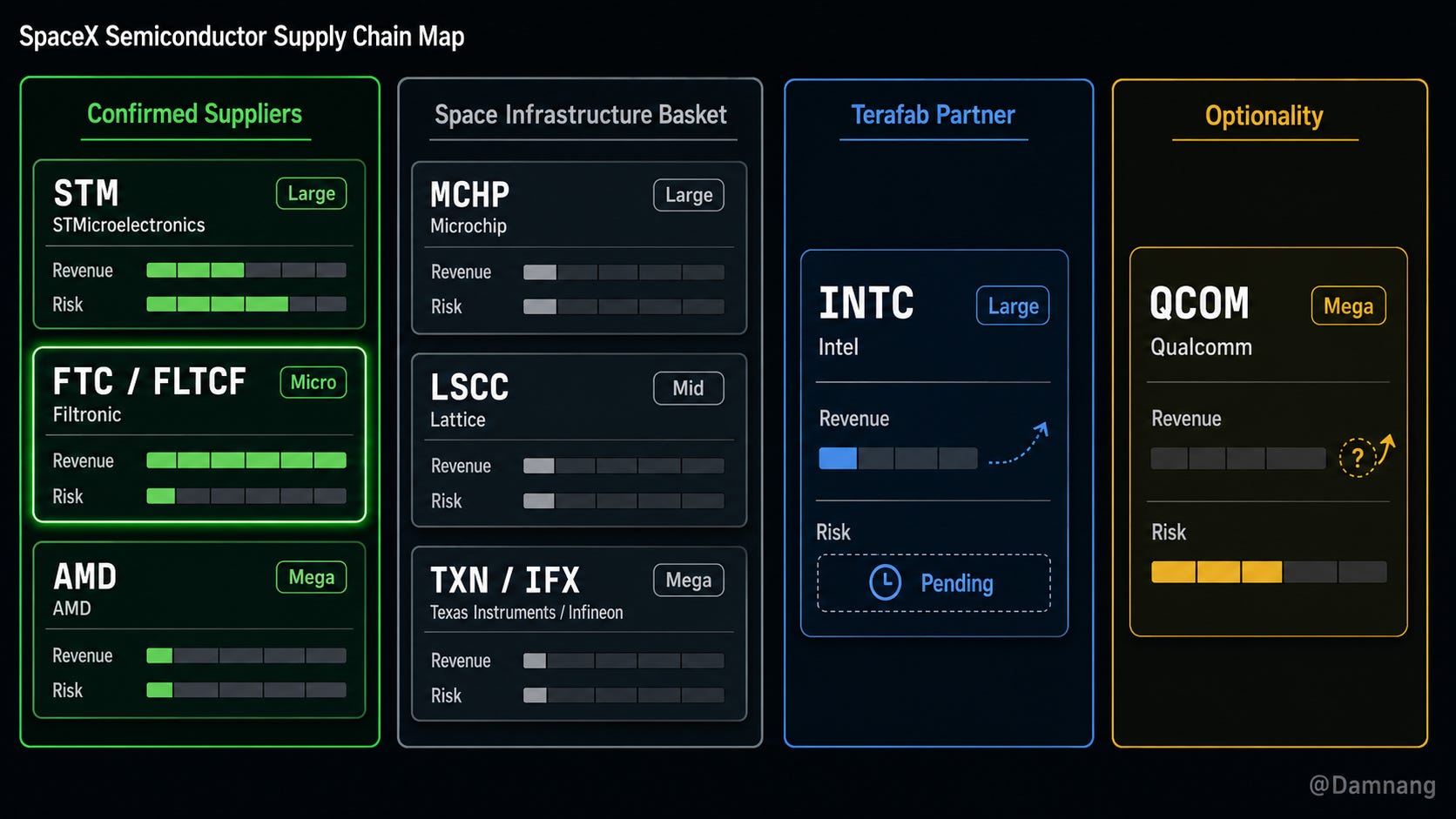
Revenue Sensitivity: How much of each company’s total revenue is tied to SpaceX. A higher gauge means SpaceX growth directly impacts the company’s top line. A low gauge means SpaceX may be a customer, but the revenue isn’t large enough to move the stock.
Internalization Risk: The risk that SpaceX brings chip production in-house (via Bastrop packaging, Terafab, or self-designed RF modules), potentially reducing demand from existing suppliers. A higher gauge means the company is more exposed to SpaceX’s vertical integration efforts.
The companies with the strongest SpaceX leverage are STM and Filtronic. These two are the only ones with “officially confirmed” evidence levels. The rest drop off sharply in confirmation strength. This table is a snapshot of the current state. When the S-1 comes out, some cells will need updating.
From here, I separate three categories. Companies that are actually selling to SpaceX. Companies whose names will move alongside the IPO hype. And companies that will face the most pressure if SpaceX starts building things internally. If you can’t distinguish between these three groups, the SpaceX IPO becomes a theme chase, not an opportunity.