

On March 12, 2026, three separate optical MSAs launched on the same day. Part 1 covered what each MSA is standardizing and which parts of the value chain benefit. This piece goes one layer deeper.
The War of Light Has Begun

On March 12, 2026, three separate optical-related MSAs dropped on the same day. That does not happen by coincidence. It means the entire industry has converged on the same conclusion: the physical layer of AI infrastructure needs to change, and it needs to change now. Call it the opening shot of the Optical War.
An MSA is not just a technical working group. Who sits at the table determines who gets to write the spec in their own favor. And sometimes, the names that aren’t at the table send the louder signal.
Three things to cover here: why these specific companies joined these specific MSAs, what the absences mean, and which beneficiaries the market hasn’t properly priced yet, with a timeline for how to think about each.
Why MSA Membership Matters: What History Tells Us
Being a founding member isn’t about putting your logo on a press release. It means writing the first draft of the spec. Whoever writes the first draft gets to tilt the technical requirements toward their own architecture. Companies that join later are playing on a board someone else designed.
History is consistent on this. The OSFP effort that Arista helped shape is still a useful example of how early ecosystem leadership can influence form factor adoption. Go back further, and you have USB versus FireWire: Intel’s USB coalition beat Apple’s FireWire not because the technology was obviously superior, but because they built a broader ecosystem faster. Technical merit matters less than who can close the ecosystem gap first.
These three MSAs may work in a similar way. The companies sitting at the table today are at least better positioned to shape the rules for optical interconnect through 2027 and beyond.
OCI MSA: Why NVIDIA and AMD Are Sitting Together
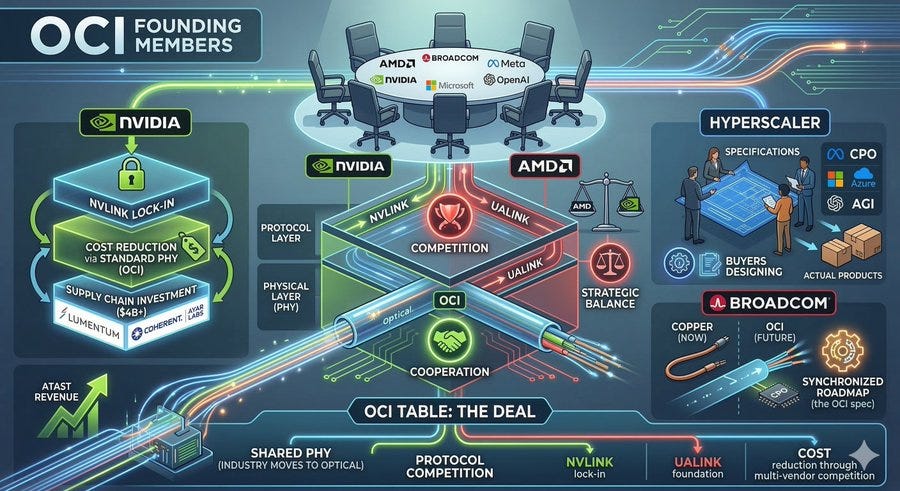
The founding member list for OCI is unusual. AMD, Broadcom, Meta, Microsoft, NVIDIA, OpenAI. Three hardware vendors and three hyperscalers (plus an AI lab) in the same room.
The most striking fact is that NVIDIA and AMD are at the same table. They’re competing at the protocol layer, NVLink versus UALink, while cooperating on the physical layer (PHY) that both protocols run on. That’s not an accident.
Think through NVIDIA’s logic. NVLink is a protocol. OCI is a PHY. If you keep your protocol proprietary while opening up the PHY, you get two things at once: a multi-vendor optical supply chain that drives down component costs, and you keep the NVLink lock-in intact. A standardized optical PHY actually helps NVLink scale, because now NVLink can run on top of a broader optical ecosystem rather than depending on a single optical vendor.
This maps directly to what NVIDIA has been doing with capital. The $2B investments into Lumentum and Coherent, plus the Series E participation in Ayar Labs, add up to more than $4B committed to the optical supply chain. The strategy is layered: lock in supply through investment, drive down component costs through standardization, and maintain the protocol lock-in on top. Three levels, each reinforcing the others.
AMD’s position is different. AMD is no longer starting from zero in optics after its Enosemi acquisition, even if its commercial position still trails NVIDIA and Broadcom. Their value at the OCI table is as a counterweight, making sure the PHY spec doesn’t get tilted toward any single vendor’s architecture. For UALink to work on equal footing with OCI, the PHY spec can’t contain anything that advantages NVLink-style integration. AMD is there less for technical contribution than for strategic balance.
The three hyperscalers, Meta, Microsoft, and OpenAI, represent something that older standards bodies didn’t have: the buyers writing the spec themselves. Meta has already deployed CPO in its own switches. Microsoft has been public about its Azure optical scale-up roadmap. OpenAI, through its hardware team led by Richard Ho, is designing its own infrastructure, and at the OCI announcement stated that OCI is “critical to building AI systems for AGI.” When demand-side players are this aggressive, the standard is much more likely to show up in actual product roadmaps.
Broadcom’s position is the most layered. They’re a founding OCI member, but a week earlier they were publicly saying they’d push copper in scale-up for as long as possible. The apparent contradiction resolves once you recognize it’s a sequencing strategy. Extract maximum revenue from copper now, while simultaneously making sure the OCI spec aligns with their CPO architecture on the Tomahawk roadmap. Broadcom’s Near Margalit said OCI “allows seamless integration with existing electrical SerDes-based ASICs while providing a path to direct ASIC integration.” The Broadcom CPO roadmap and the OCI spec were synchronized from the start.
The OCI table, in summary, is a deal: everyone agrees the industry is moving to optical, but protocol competition stays alive. Share the PHY, differentiate on protocol. Under that arrangement, NVIDIA’s NVLink lock-in holds, AMD gets the physical foundation for UALink to compete, and hyperscalers can play both sides against each other to drive down optical component costs. Everyone had their own reason to show up.
Open CPX MSA: Why Marvell Is In and Broadcom Is Out
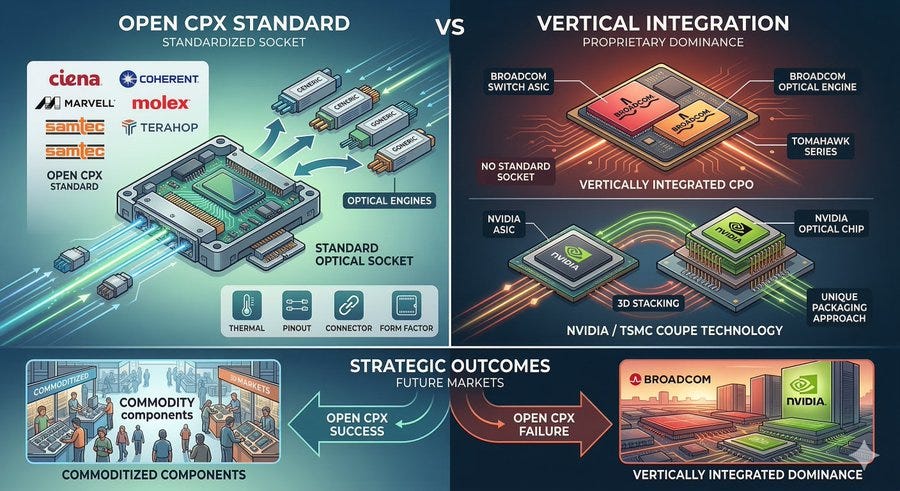
Open CPX looks different. Ciena, Coherent, Marvell, Molex, Samtec, TeraHop. No hyperscalers. No NVIDIA, no Broadcom, no AMD. This is an optical engine and packaging hardware group.
The question is why Marvell is here and Broadcom isn’t.
Marvell closed the $3.25B acquisition of Celestial AI in February 2026. Celestial AI’s Photonic Fabric technology is one of the core approaches to optical engine design. Open CPX is standardizing the physical socket for that optical engine: the connector, thermal management, electrical pinout, and mechanical form factors. For Marvell, one plausible strategic benefit of joining Open CPX is the ability to influence how a standard optical engine interface gets defined around the kinds of technologies it now owns through Celestial AI.
Broadcom’s absence can be read in the opposite direction. Broadcom’s CPO architecture, already three generations deep in the Tomahawk series, is vertically integrated with their own switch ASICs. They don’t need to agree with anyone else on what the optical engine socket looks like. Worse, if a standard socket gets defined, it undercuts the integration advantage that Broadcom has spent years building.
NVIDIA’s absence may reflect a similar logic. NVIDIA is building Spectrum-X Photonics and Quantum-X Photonics on TSMC’s COUPE technology, which uses SoIC-based 3D stacking. That’s a fundamentally different approach from the socket-and-connector model Open CPX is defining. NVIDIA participates in OCI for the PHY standard and keeps its own packaging approach through TSMC.
Open CPX looks more like an attempt to build an open optical engine ecosystem outside the fully vertically integrated CPO model. Marvell, Ciena, Coherent, and the others are trying to build a multi-vendor optical engine socket standard that gives them something to compete against the Broadcom and NVIDIA vertical integration models. If Open CPX succeeds, optical engines become commodity components. If it fails, the vertically integrated players dominate.
One detail worth flagging here: Molex and Samtec, both connector and socket companies, are founding members of an MSA that defines the physical interface for CPO optical engines. That signals CPO sockets are emerging as a high-value component category in their own right. Both companies are private (Molex is a Koch Industries subsidiary, Samtec is a private Indiana-based company), but the publicly traded angle on this theme comes up in the next section.
XPO MSA: Why Arista Needs Pluggables to Stay Relevant
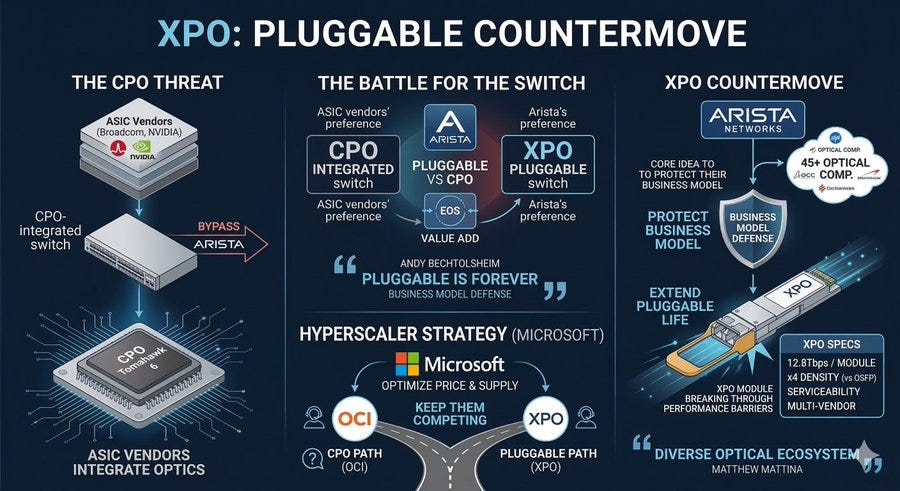
XPO is a different animal entirely. Arista Networks is leading it, with more than 45 optical module companies signed on. The goal is to push pluggable optics into the next generation before CPO renders the form factor obsolete.
Arista doesn’t make switch ASICs. They build EOS, their operating system, on top of Broadcom’s Tomahawk and NVIDIA’s Spectrum, and sell the system. If CPO becomes the dominant paradigm, the ASIC vendors, who would be integrating optics directly into their silicon, could effectively bypass Arista by selling complete, optically integrated switching platforms. Broadcom demonstrating a CPO-integrated Tomahawk 6 switch points exactly in that direction.
XPO is Arista’s countermove. By creating a next-generation pluggable form factor that breaks through the current density and cooling limits, they extend the life of pluggable optics and keep the ecosystem where Arista’s value-add still applies. The specs are serious: 12.8Tbps per module, four times the front-panel density of OSFP, while maintaining the key pluggable advantages of serviceability and multi-vendor compatibility. Andy Bechtolsheim’s line that “pluggable is forever” at the XPO announcement wasn’t a technical claim. It was a business model defense.
One additional signal: Microsoft’s Matthew Mattina offered public support at the XPO announcement, calling it a form factor that could “enable a diverse optical ecosystem.” Microsoft backing both OCI (the CPO path) and XPO (the pluggable path) simultaneously is textbook hyperscaler strategy: don’t commit to either technology, keep them competing, and optimize on price and supply.
What the Absences Mean
Three names stand out across all three MSAs by their absence.
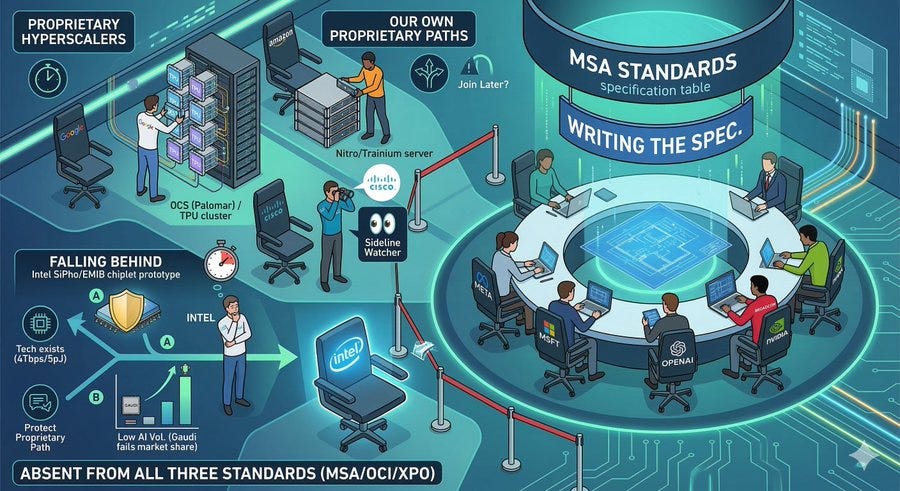
Intel. Intel isn’t in any of the three. That’s a significant omission. At OFC 2024, Intel demonstrated an Optical Compute Interconnect chiplet prototype, hitting 4Tbps bidirectional throughput at roughly 5pJ/bit. Their silicon photonics patent portfolio is among the deepest in the industry. The technology exists. The table seat doesn’t.
Two readings are possible. First, Intel may be holding back to protect its own proprietary CPO path, since joining a standards body means opening up technology and conforming to specs that may not match your own architecture. Intel could be betting on its SiPho platform and EMIB-based integration as a differentiated standalone approach.
The second reading is more straightforward. Intel is not a meaningful player in the AI infrastructure market right now. OCI’s founding members are companies that actually buy or build AI clusters at scale. With Gaudi failing to gain real market share, Intel may simply not have been on the invite list, or prioritized below the companies driving real volume. Either way, the outcome is the same: Intel is falling behind in the standards race, and there’s a large gap between joining after the spec is written and writing the spec yourself.
Cisco. Also absent from all three. Cisco has coherent optics through the Acacia acquisition, and competes directly with Arista in data center networking. But AI scale-up optical is territory Cisco hasn’t seriously entered. The absence reflects a company that’s still watching this war from the sideline.
Google and Amazon. Among hyperscalers, Meta, Microsoft, and OpenAI are present; Google and Amazon aren’t. Google is already deploying Lumentum’s Palomar OCS in TPU clusters at scale and has its own optical infrastructure strategy. Amazon is designing networking for Nitro and Trainium infrastructure in-house. Both may simply have enough proprietary runway that participation in a multi-vendor standard offers limited upside. Neither absence is permanent; both could join later.
What TeraHop Actually Is: The Key Finding in This Article
Part 1 flagged that TeraHop appeared as a founding member in both Open CPX and XPO. At OFC 2026, they showed the world’s first 12.8Tbps XPO optical transceiver and a separate 6.4Tbps pluggable NPO. They claim more than 12 million silicon photonics-based optical transceivers shipped.
The question is who TeraHop actually is.
TeraHop is the Singapore-based overseas subsidiary of InnoLight Technology. InnoLight Technology Pte. Limited holds the TeraHop trademark, and InnoLight holds a 67.7% stake in TeraHop. In November 2025, TeraHop completed a $517M capital raise with participation from ADIA (Abu Dhabi Investment Authority) and Temasek.
InnoLight is China’s largest optical transceiver manufacturer and a major supplier of NVIDIA’s 800G optical module volume. The Singapore entity, TeraHop, is the face they’re putting forward for Western hyperscaler engagements where a Chinese brand name creates friction. Operations span the US, Thailand, Taiwan, and Suzhou, China.
Why this matters: TeraHop’s founding membership in two MSAs means InnoLight is a participant in shaping Western optical interconnect standards, operating through a Singapore vehicle. China’s largest optical module company is at the table, just with a different name on the badge. That’s a meaningful geopolitical and competitive dynamic, and the market isn’t discussing it.
For investors, InnoLight trades on the Shenzhen A-share market, which limits direct accessibility for most Western investors, though exposure is possible through mainland Chinese brokerage accounts or select ETFs. The more interesting structural point is that TeraHop has positioned itself on both sides of the pluggable-to-CPO transition, showing pluggable XPO products and NPO products at the same time.
What the Market Hasn’t Priced Yet
The first-order optical plays, Broadcom, Marvell, Lumentum, Coherent, are already on the market’s radar. What follows are the names where the optical transition thesis is either under-discussed or not yet reflected in how the stock is valued. These assessments are based on public information and the author’s own analysis; actual company strategies and customer mixes may differ.
Connectors and Sockets: Amphenol (APH)
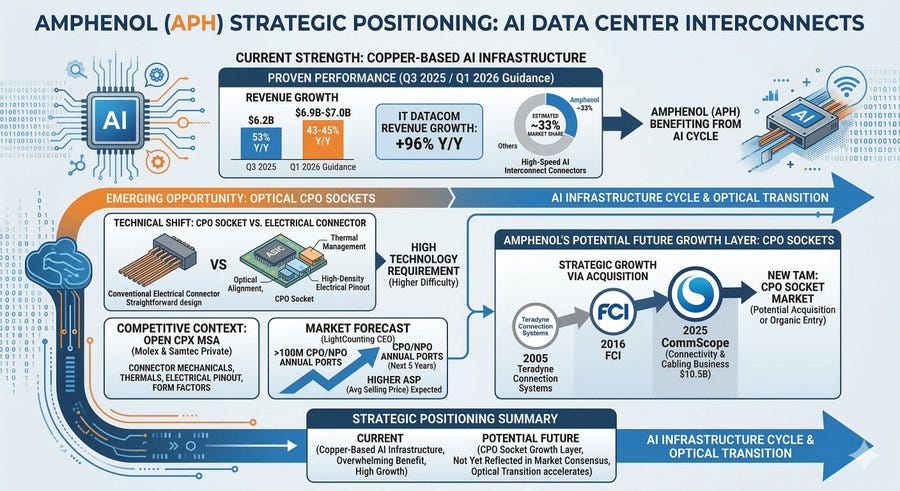
Molex and Samtec are both founding members of Open CPX, which is defining the physical interface for CPO optical engines. Both companies are private. The publicly traded way to access this theme is Amphenol.
Amphenol is estimated to hold roughly 33% market share in high-speed interconnect connectors for AI data centers. The numbers back this up: Q3 2025 revenue was $6.2B, up 53% year-over-year, with the IT Datacom segment growing 96% and Communications Solutions operating margins reaching 32.7%. Q1 2026 guidance came in at $6.9B to $7.0B, or 43 to 45% growth. The company is already demonstrating structural leverage to the AI infrastructure cycle.
The less-discussed angle is CPO sockets as a new component category. When optical engines physically plug into a slot next to the ASIC, that socket needs to do things no traditional electrical connector does: precise optical alignment, high thermal throughput, and dense electrical pinout simultaneously. Open CPX is standardizing exactly these requirements: “connector mechanicals, thermals, electrical pinout, mechanical form factors.”
LightCounting’s CEO has estimated over one billion CPO/NPO port shipments annually within five years. If that materializes, each port needs a socket, and the ASP for an optical socket should carry a meaningful premium over a standard electrical connector, given the alignment and thermal requirements. Exact pricing hasn’t been publicly established yet.
Whether Amphenol enters this market organically or through acquisition is still an open question. Their history suggests they move into high-growth connector categories through acquisition: Teradyne Connection Systems in 2005, FCI in 2016, and the $10.5B CommScope connectors and cables business in 2025. There’s no reason to assume they’d sit out a new TAM in high-value optical sockets, but Amphenol hasn’t publicly articulated a CPO socket strategy, so this is speculative.
The current case for Amphenol is layered. They’re getting maximum benefit from copper-based AI infrastructure today, with CPO sockets as a potential second growth layer as the transition unfolds. The second layer isn’t in market consensus yet.
Test and Measurement: Aehr Test (AEHR), Keysight (KEYS), FormFactor (FORM)
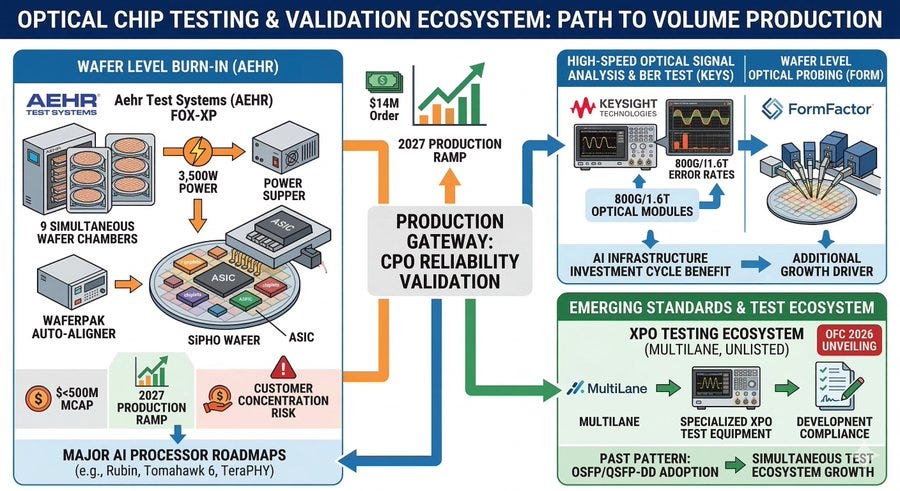
Optical chips, like any other semiconductor, have to pass qualification before they go into volume production. CPO’s path to mass manufacturing runs through reliability verification, which puts test equipment in a structural growth position.
Aehr Test Systems is the most direct optical leverage play in this category. Aehr makes wafer-level burn-in (WLBI) and test equipment, and silicon photonics has emerged as a core growth driver.
The recent progress is concrete. In February 2026, Aehr announced a $14M follow-on order for FOX-XP wafer-level burn-in systems from a lead AI processor customer. In the same month, they separately announced a follow-on order for “fully automated WLBI systems for AI Optical I/O and data center interconnects.” On the Q2 FY2026 earnings call, management said: “The lead silicon photonics customer’s production ramp is confirmed, with manufacturing starting at the beginning of next fiscal year. This appears tied to a recently announced major AI processor product, with orders expected in 2026 and deliveries in late 2026 to early 2027.” They also confirmed a forecast with another large customer targeting silicon photonics devices for data centers, with a roadmap extending into optical I/O.
Aehr didn’t name the customer. But considering the companies that have put CPO and optical I/O chiplets on their roadmaps recently (NVIDIA Rubin, Broadcom Tomahawk 6, Ayar Labs TeraPHY), the directional bet on structural SiPho burn-in demand looks sound.
Aehr’s FOX-XP can apply up to 3,500W per wafer while burning in nine wafers simultaneously. They’ve also added a WaferPak Auto-Aligner for fully automated contact across an entire 300mm SiPho wafer. Market cap is currently below $500M, and H1 FY2026 revenue has been below expectations, with H2 guidance at $25M to $30M, making the stock highly volatile. But if SiPho volume production ramps from 2027 onward, the operating leverage is significant. The flip side: small revenue base means high customer concentration risk, which is a real risk to track.
Keysight (KEYS) leads in high-speed optical signal analysis and BER testing, with their equipment used in qualifying 800G and 1.6T optical modules. FormFactor (FORM) provides wafer-level optical probing solutions. Neither company is a pure optical play given their size, but both benefit from the overall AI infrastructure investment cycle, with optical as an incremental growth driver rather than a transformation.
One name that came up at OFC 2026 worth tracking: MultiLane, a private test equipment company, unveiled what they called the industry’s first XPO test ecosystem. New form factors always require new test and compliance infrastructure; the pattern of test equipment ecosystems expanding alongside new optical standards repeated with both OSFP and QSFP-DD.
SiPho Foundry: Tower Semiconductor (TSEM)
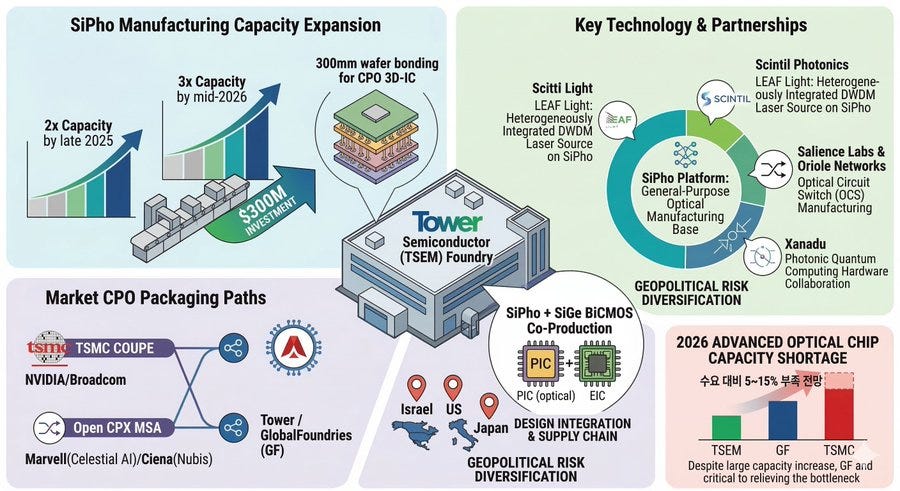
Tower Semiconductor is one of the leading silicon photonics foundries, but the market still tends to categorize them as an analog/specialty foundry. Recent developments put some pressure on that framing.
Tower is mid-way through a $300M capacity expansion that doubles SiPho manufacturing capacity by end of 2025 and triples it by mid-2026. They’ve announced plans to extend 300mm wafer bonding technology into 3D-IC for CPO applications.
The partnership announcements coming out of Tower ahead of OFC 2026 were significant in volume and scope. In February 2026, Tower and Scintil Photonics announced the commercialization of the world’s first heterogeneously integrated DWDM laser source, called LEAF Light, built on Tower’s SiPho platform. DWDM lasers are a critical CPO component, so manufacturing them on Tower’s platform is meaningful. In the same month, Tower announced an OCS manufacturing partnership with Salience Labs and a photonic quantum computing hardware collaboration with Xanadu. On March 16, they added a nanosecond optical circuit switching collaboration with Oriole Networks.
The thread connecting these announcements is that Tower’s SiPho platform is evolving beyond transceivers into CPO, OCS, and quantum photonics. Tower’s OFC 2026 positioning explicitly encompasses all of these, alongside scale-out networking and telecom.
Tower’s differentiation is the ability to produce SiPho and SiGe BiCMOS on the same fab. If a customer can get their photonic IC and high-speed electronic IC from the same foundry, that simplifies both design integration and supply chain management. Fab locations in Israel, the US, Japan, and Italy offer geographic diversification as well.
There’s an interesting competitive dynamic in the foundry space. NVIDIA and Broadcom’s CPO paths run through TSMC’s COUPE technology. The Marvell (Celestial AI) and Ciena (Nubis) camp, which is the Open CPX coalition, is on a different packaging path. It’s reasonable to expect that Tower and GlobalFoundries would be the natural SiPho foundry choices for the non-TSMC side of this market. Specific customer contracts aren’t public, but Tower’s description of their capex as “customer-supported” suggests the demand underpinning that $300M is already identified.
Industry estimates suggest that even with 80%-plus growth in advanced optical chip production capacity in 2026, supply could still run 5 to 15% short of demand. If that range is accurate, SiPho foundry capacity becomes the binding constraint, and Tower, GlobalFoundries, and TSMC are the companies with direct leverage on that bottleneck.
TSMC (TSM): The Optical Layer on Top
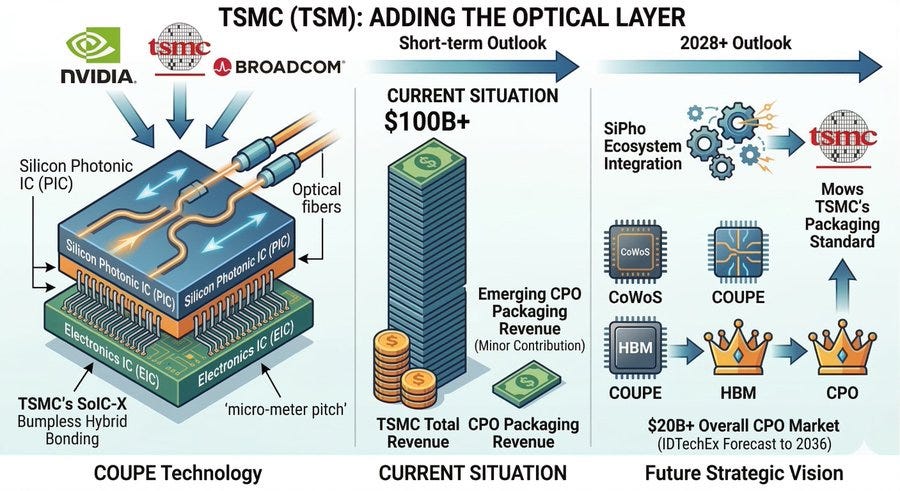
TSMC’s COUPE (Compact Universal Photonics Engine) technology is their answer to CPO from an advanced packaging perspective. Using SoIC X bumpless hybrid bonding, they stack PIC and EIC at micron-scale pitch. NVIDIA’s Spectrum-X and Quantum-X Photonics switches, the Rubin platform, and Broadcom’s Tomahawk series are all understood to use this technology.
The fact that both major CPO paths, NVIDIA’s and Broadcom’s, run through TSMC is structurally important. But this is unlikely to be a meaningful near-term catalyst for TSMC’s stock. CPO packaging revenue, against a $100B+ TSMC revenue base, will remain immaterial for years. IDTechEx projects the entire CPO market growing to over $20B by 2036; TSMC’s share of that packaging is a rounding error in their P&L today.
The longer-range scenario is more interesting. If COUPE establishes itself as the CPO packaging standard the way CoWoS became the HBM packaging standard, then the entire optical component supply chain, SiPho and otherwise, starts getting pulled into the TSMC packaging ecosystem. That’s a 2028 and beyond story, and it’s not guaranteed, but the directional logic is worth watching.
Upstream Materials: AXT (AXTI)
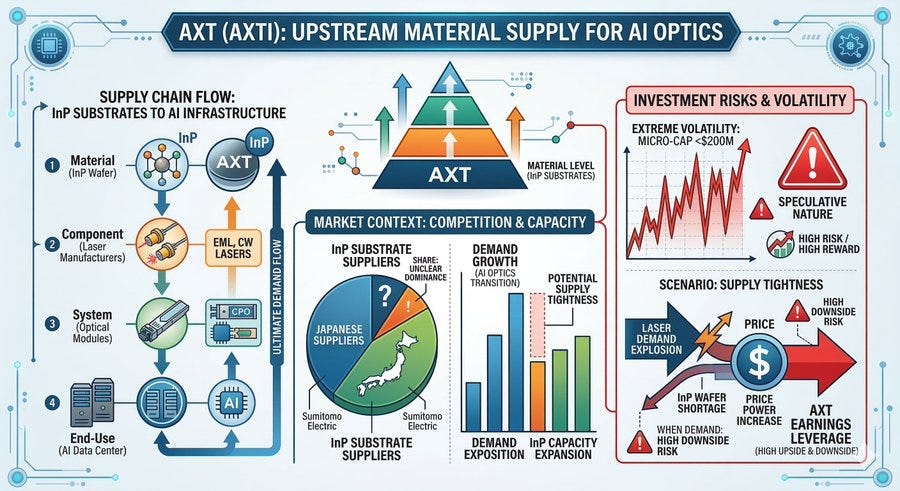
AXT is one of the primary suppliers of InP (indium phosphide) substrates. Whether you’re building CPO or pluggable optics, high-performance lasers (EML, CW) require InP as a base material. As Lumentum and Coherent scale laser production, InP substrate demand grows with it.
AXT has a market cap below $2B, which means volatility is extreme. They’re structurally positioned upstream in a supply chain that should see volume growth, but InP substrates aren’t a monopoly; Sumitomo Electric and other Japanese suppliers are also in this market, and AXT’s specific pricing power is unclear.
The scenario where AXT sees meaningful upside is a supply-demand crunch in InP, where laser capacity additions outrun substrate availability. In that situation, small upstream materials suppliers can see significant operating leverage and temporary pricing power. The reverse is also true: if demand disappoints or supply is more elastic than expected, the downside on a small-cap materials play is sharp. This one belongs in the speculative bucket.
Arista Networks (ANET): Leading XPO While Exposed to CPO
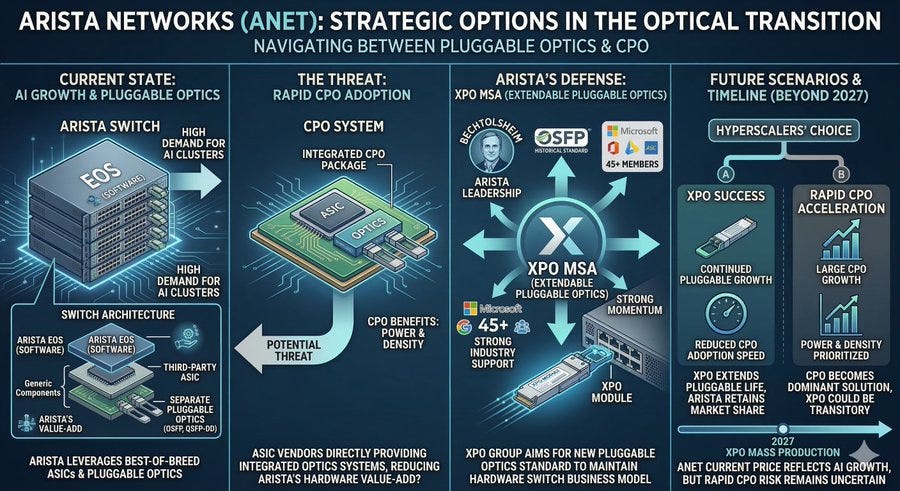
Arista is a well-known AI networking play. The angle that’s missing from most existing analysis is what XPO means for how to think about Arista’s risk profile over the next two to three years.
As discussed above, Arista doesn’t manufacture switch ASICs. Their business model depends on ASIC vendors, primarily Broadcom and NVIDIA, not vertically integrating optical into a turnkey system that bypasses Arista’s layer. Broadcom’s CPO-integrated Tomahawk 6 is a direct threat to that model.
XPO is Arista’s play to extend the pluggable era and keep the ecosystem structure intact. The 45-plus founding members and Microsoft’s public support give XPO real momentum. And Bechtolsheim has done this before: the OSFP MSA he led in 2016 became the pluggable standard. XPO could follow the same trajectory.
But XPO’s success isn’t guaranteed. If hyperscalers ultimately choose CPO for the power efficiency and bandwidth density advantages, XPO is a transitional product, not a permanent one. Arista’s stock currently reflects the “AI networking growth” story. What it doesn’t seem to fully reflect is the question of what happens to Arista if CPO accelerates faster than the market expects. That tension is likely to become more visible around the 2027 XPO volume ramp.
How to Read the MSA Table
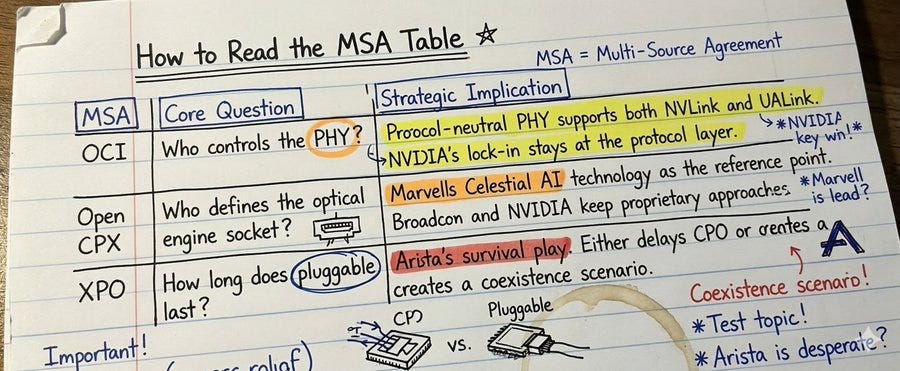
Three MSAs, three different layers being standardized, but one underlying question: in the transition from copper to optical, who writes the rules and who plays on the board someone else designed. The gap between those who are at the table and those who aren’t will show up as market value over the next two to three years.
Disclaimer: This article is based on publicly available announcements, company press releases, and media reporting, and does not include any proprietary or inside information. Analysis and projections reflect the author’s personal views and do not constitute investment advice.
“AXT has a market cap below $200M, which means volatility is extreme.” Typo?
As usual great article Damnang! Even though AAOI, CRDO and TSEM are all great in their own right and only AAOI and CRDO compete to some extent, if you were looking to add money in the next few weeks, which one of these three would you select and why?