This article is the work of Damnang Research and is protected by copyright law. Reproduction, distribution, republication, derivative use or use for AI training without the prior written consent of the copyright holder is prohibited, and unauthorized use will be pursued through legal proceedings.
There are all kinds of rumors about HBM4. The market was shaken by the news that it was despec’d from 12-high to 8-high, and on top of that, news of 4-high was going around for a while.
Then came the story that it is going back up to 12-high again (I was probably almost the first to say this).
On the other hand, there is also talk that SK hynix, which held the upper hand in HBM3, is not able to show its real strength when it comes to HBM4.
Some exaggerated rumors even go as far as saying that the relationship between TSMC and SK hynix has soured because of this (Maybe it is not true)
What on earth is true? What is going on in HBM4? I am not an insider either, so I do not know exactly. But as I listened to many stories from the field, from analysts and experts, and studied the actual technical structure of HBM, the puzzle seems to be coming together in my own way.

In this article I will try to write up the HBM4 story as I have reconstructed it in my own way. I will also try to forecast what comes next with my own HBM modeling data. I am confident that after reading this article you will easily understand what has been happening in HBM4 and what will happen.

Disclaimer
This article is my inference based on public reporting and stories heard in the industry, and it is for informational purposes. It does not recommend buying or selling any particular stock, and every model number in the text is my own assumption. I may hold the stocks mentioned or change my positions. Investment decisions and responsibility are your own. NFA, DYOR.
SK hynix won through HBM3E with MR-MUF
SK hynix won an overwhelming victory over Samsung in HBM3.
The biggest difference cited is the bonding difference for HBM stacking: the MR MUF method SK hynix uses was pointed to as performing better than Samsung’s TC NCF method, and that was named as the reason.
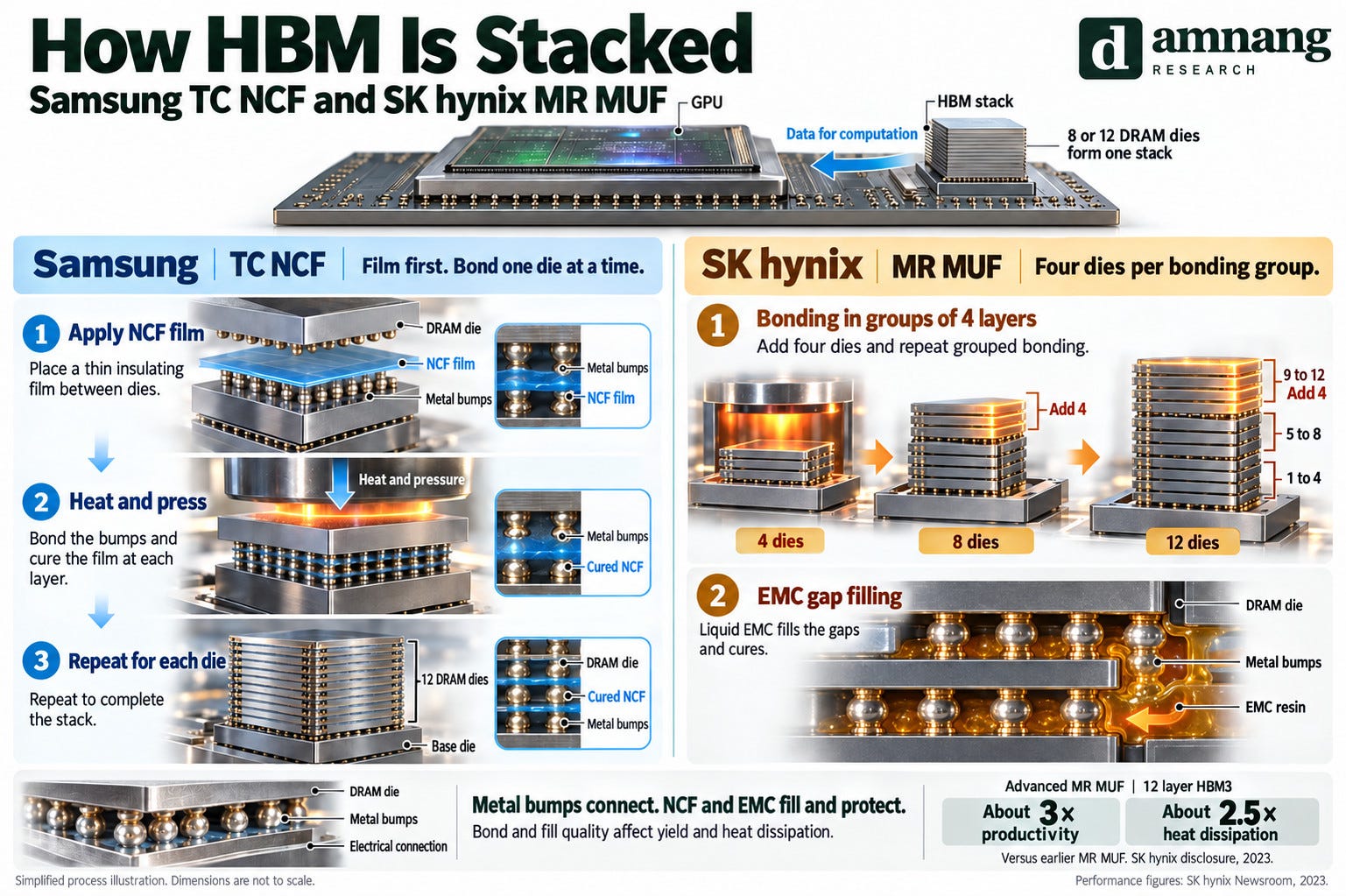
It is a very complicated process, but to explain it simply, Samsung’s TC-NCF puts a film between the chips and presses them on one at a time, while SK hynix’s MR-MUF stacks all the chips first, bonds them at once, and fills the gaps with a liquid protective material that is then cured.
According to SK hynix, the Advanced MR-MUF used in 12-high HBM3 improves productivity by about 3 times and heat dissipation by about 2.5 times over the previous process.
In fact, I myself, back when I worked at AMD, had to take part in a lot of silicon debug over this Samsung HBM3 heat issue. That is how hard a heat issue in HBM is to solve. In any case, because of this difference in the bonding process, Samsung passed NVIDIA’s quality test a full year later than SK hynix due to heat problems, and that is why SK hynix was able to take most of NVIDIA’s HBM volume.
NVIDIA raised the Rubin HBM4 spec
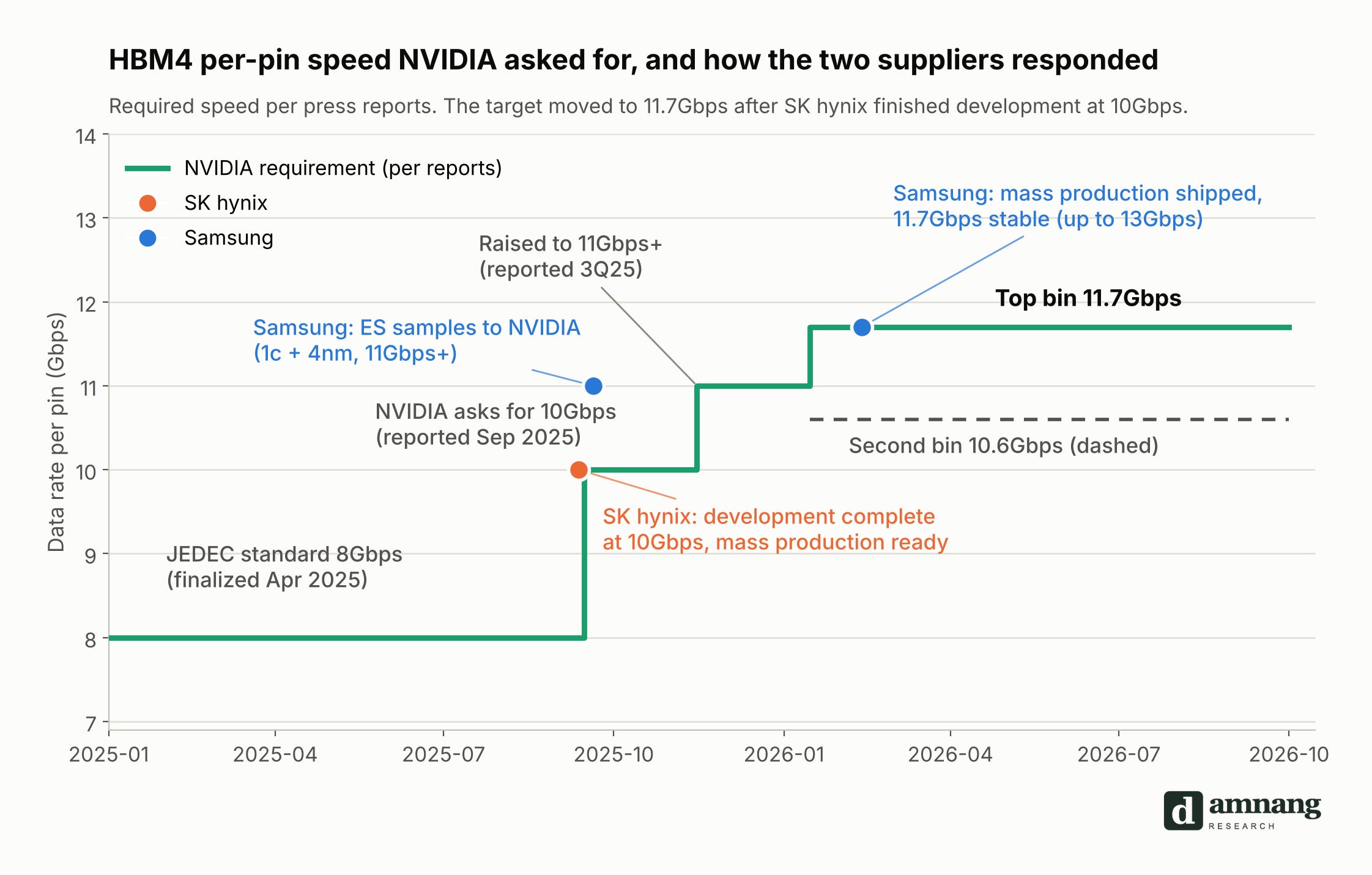
The pin speed in the JEDEC standard at the time HBM4 was first designed was 8Gbps.
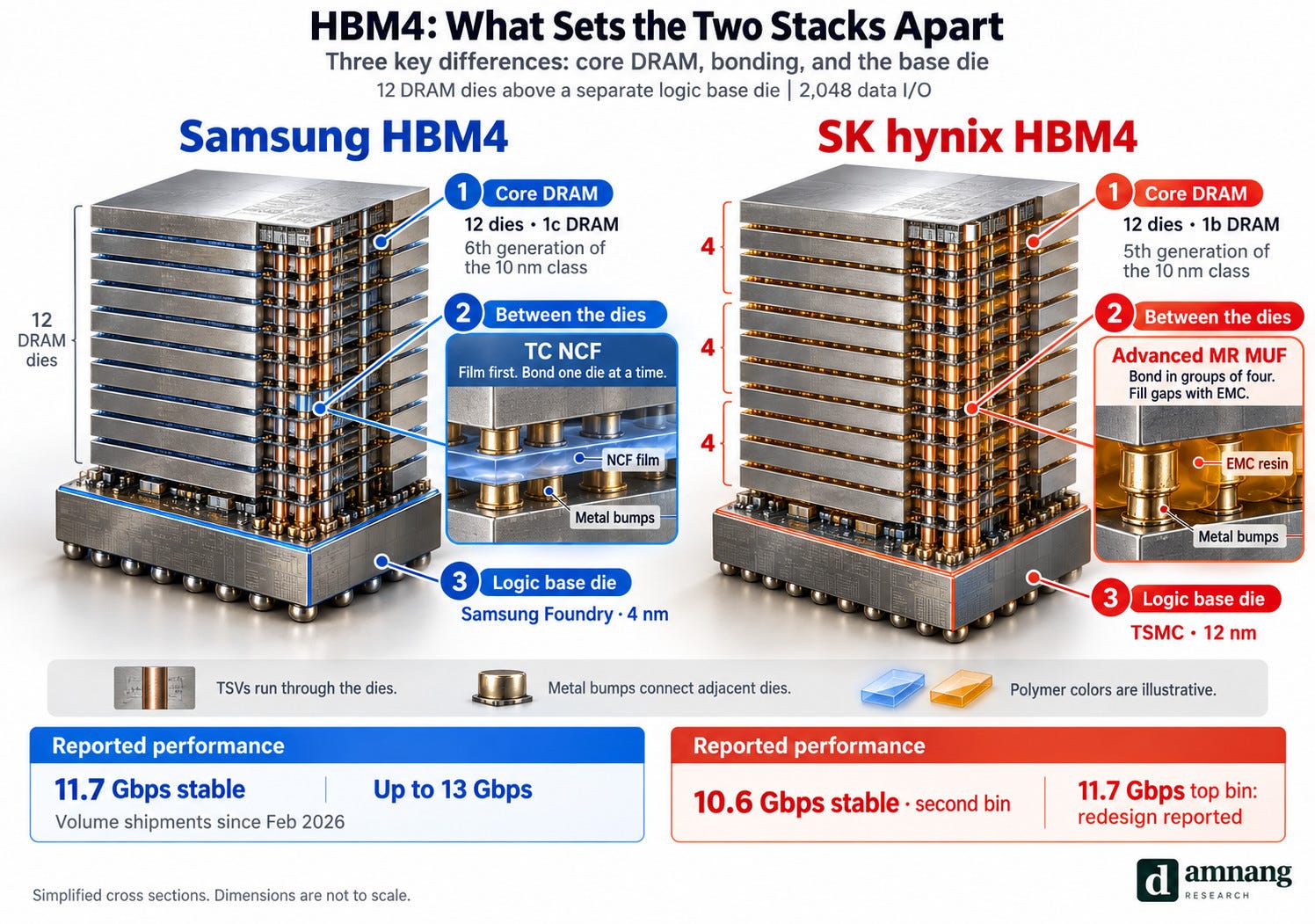
SK hynix designed for 10Gbps, 25% faster than the standard at the time, and decided to use the same 1b process as HBM3E for the DRAM dies being stacked, TSMC’s legacy 12nm process for the base die that sits at the bottom and talks to the GPU, and Advanced MR-MUF for the stacking process.
Having already succeeded with HBM3E, they saw no need to take on a new challenge, and judged that reusing the method proven in HBM3E as it was would cause no problems.
The problem is that NVIDIA raised the required speed of HBM4 for Rubin.
In the third quarter of 2025, NVIDIA raised the per-pin speed requirement to 10Gbps and then to over 11Gbps, and the mood in the field at the time saw competition with AMD’s MI450 as the reason. This came right after September 2025, when SK hynix announced it had finished development targeting 10Gbps, and all three companies had to send samples again.
The interesting part is that Samsung, having suffered a crushing defeat in HBM3, was gritting its teeth and made an extremely aggressive choice to secure share in HBM4.
It moved the DRAM die to the one-generation-newer 1c process and the base die to Samsung Foundry’s 4nm. This choice was made in 2024, a year before NVIDIA raised the spec, and Samsung has said it targeted a speed above the standard from the start of HBM4 development.

At the time this was called a reckless choice, but as a result, making this choice gave Samsung the headroom to meet NVIDIA’s raised spec. A finer process uses less power and produces less heat at the same speed. Samsung announced mass-production shipments at 11.7Gbps in February this year. The figure above shows the order in which the required speed went up and when the two companies responded.