

If you have been subscribing to my Substack for a while, you know I have been hard at work on concept articles about optics since March. Back then I wrote a three-part technical series on what CPO is and why it is needed, plus articles on the MSAs that companies formed to actually put optical interconnects into use. All of these articles are now free, so if you need the technical background, I encourage you to read them first.


Note: You can read lots of articles about optics for free at map.damnang.com!
Eight months later, CPO is finally being put to use in many ways across the industry.
In November, Lambda shared results from running more than 10,000 Blackwell Ultra GPUs connected through Nvidia CPO switches
Nvidia started volume production of its Ethernet CPO switch in August and named six early adopters, including Microsoft, Oracle and CoreWeave
Broadcom delivered the 51.2T Bailly to customers in 2024 and is now shipping the third-generation 102.4T Davisson to early hyperscaler customers.
Among laser makers, Coherent secured a five-year contract worth about $20 billion, and Lumentum secured CPO and NPO purchase commitments of more than $5 billion.
In this article, I want to take an in-depth look at optical interconnects, which have started to be deployed in earnest across the data center industry, and at CPO in particular: where they stand today and their technology and revenue outlook through 2030. Where my earlier optics articles focused mostly on technical concepts, this time I go through each company’s progress, roadmap and role in the supply chain one by one, and go as far as projecting which companies will see revenue and when.
For this article, I talked with a number of experts in the optics industry about the technology and the outlook.
Thank you to everyone who took the time to talk with me.
Disclaimer
It does not recommend buying or selling any security, and the forecast figures are scenarios from the author’s model. Investment decisions and their consequences are the reader’s own responsibility.
0. Everything you need to know about scale-out and scale-up
Before we start, let’s go over a few basics. For details, I recommend reading the articles I mentioned above. If you are short on time, I hope the short explanation below is enough.
To understand how AI data centers are connected, the two concepts you should know first are scale-up and scale-out.
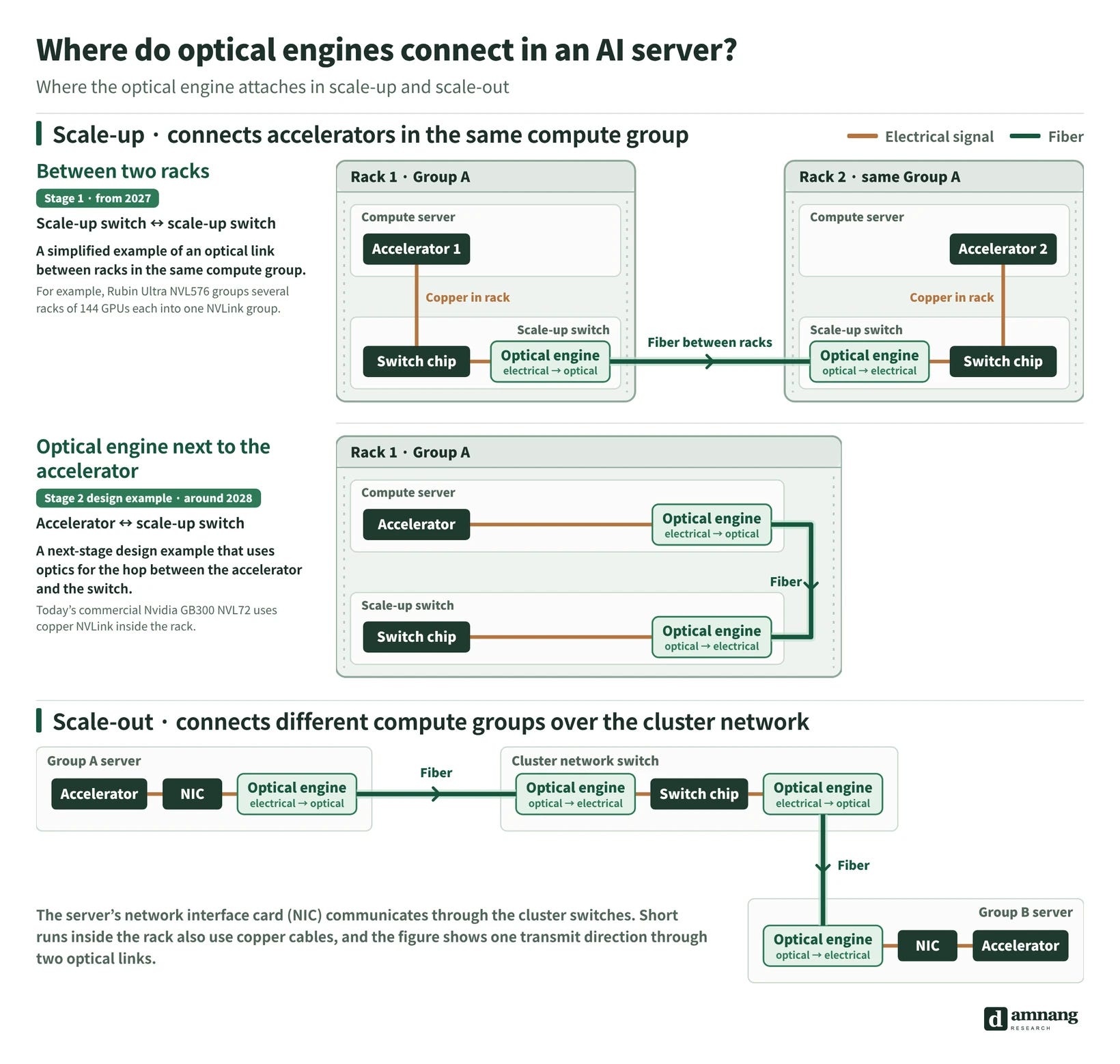
Scale-up is the connection over which accelerators in the same compute group exchange data directly. Nvidia’s NVLink is the best-known example, and until now these links have mostly run over copper inside a single rack.
Scale-out is that the connection over different compute groups through a server’s network interface card (NIC) and Ethernet or InfiniBand switches.
The figure below shows where the optical engine, which turns electrical signals into light, attaches in each of the two connections.
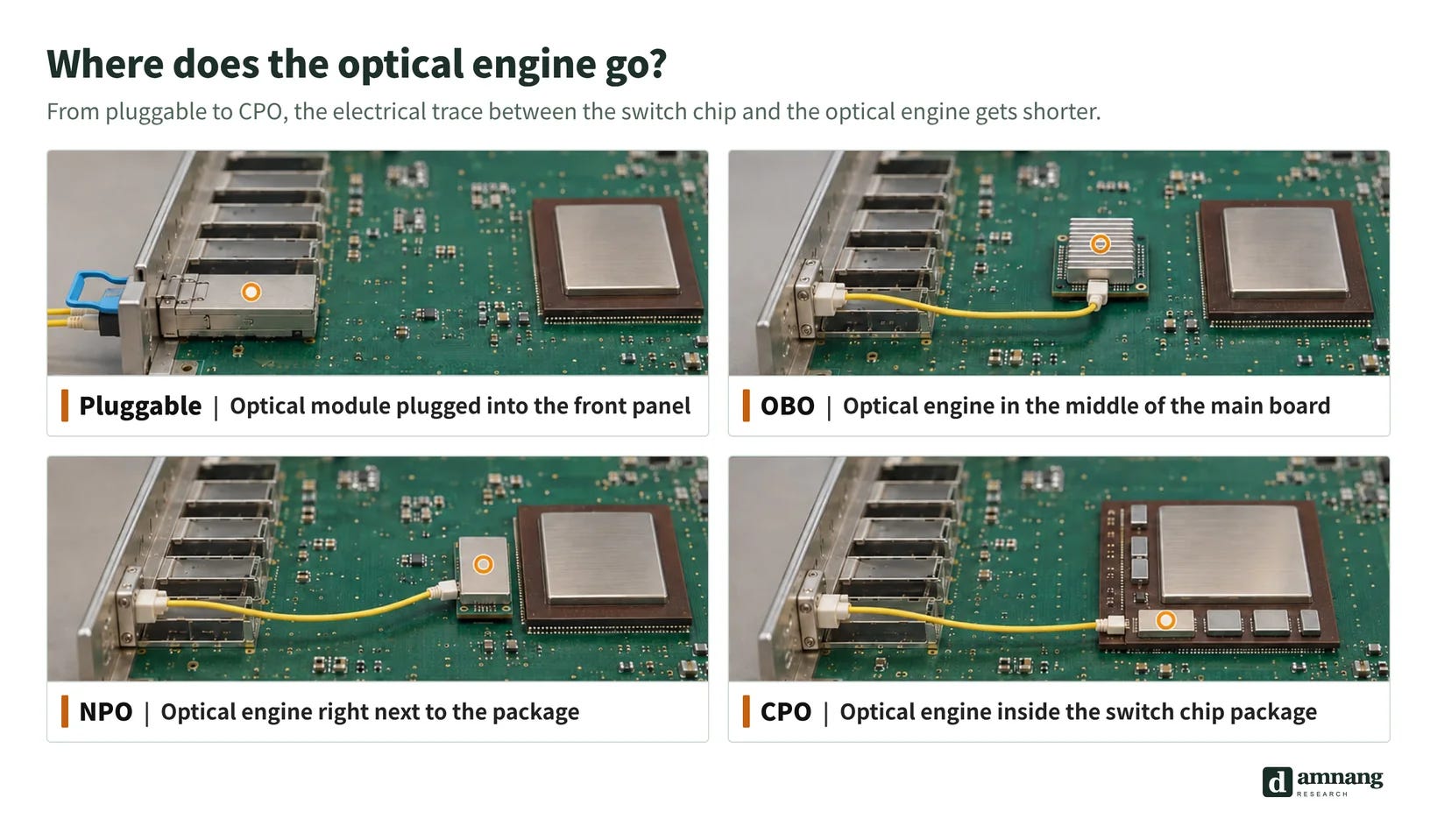
There are four places where the electrical signal from the switch chip can be converted into light.
From farthest to closest to the chip,
they are the pluggable at the front of the equipment,
OBO (On-Board Optics) on the main board,
NPO (Near Packaged Optics) right next to the chip package,
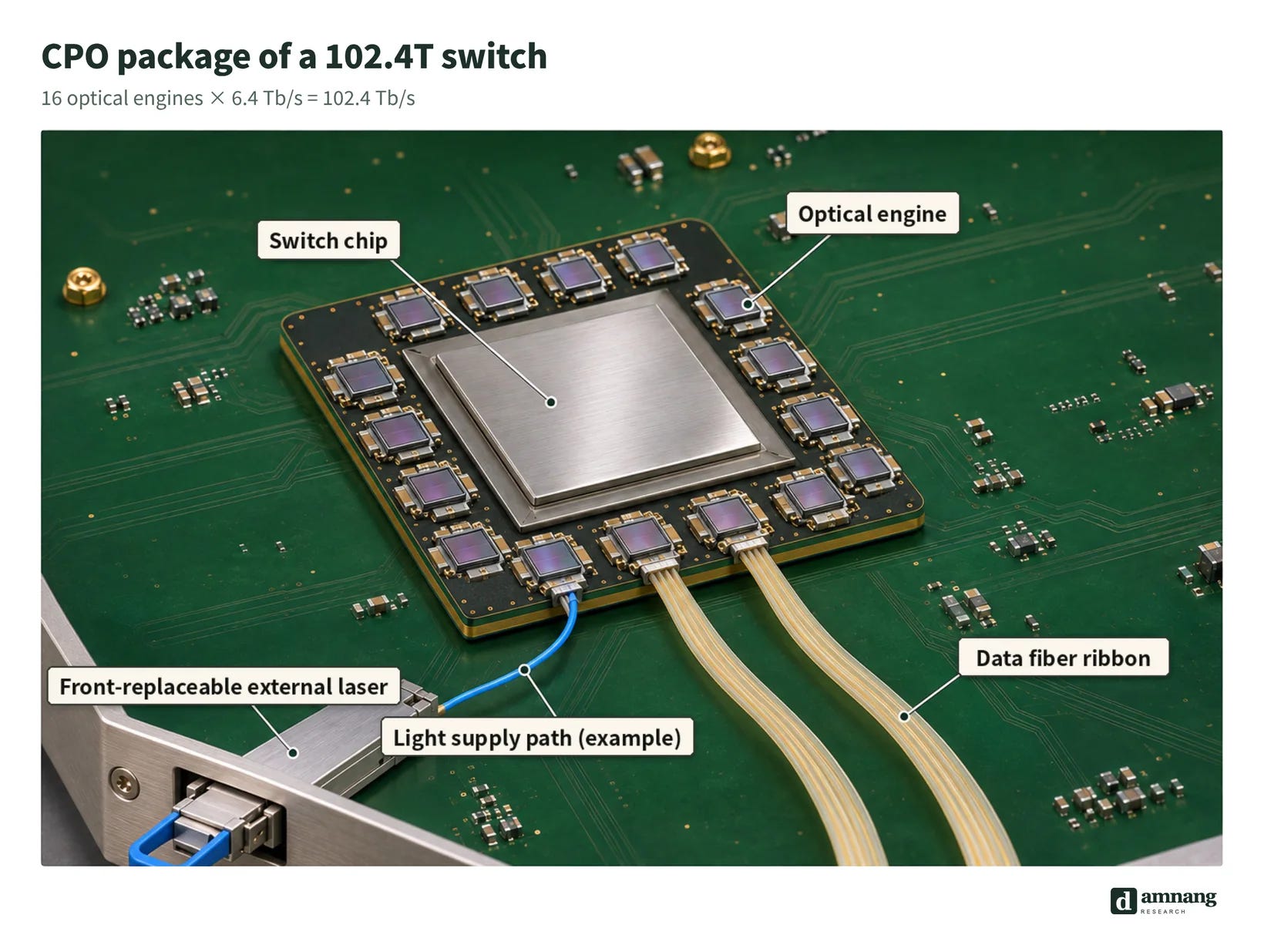
and CPO (Co Packaged Optics) inside the package.
The closer to the chip, the shorter the distance the electrical signal travels and the lower the power, but the optics have to be assembled and tested together with the chip.
So where does the industry stand today on scale-up and scale-out?
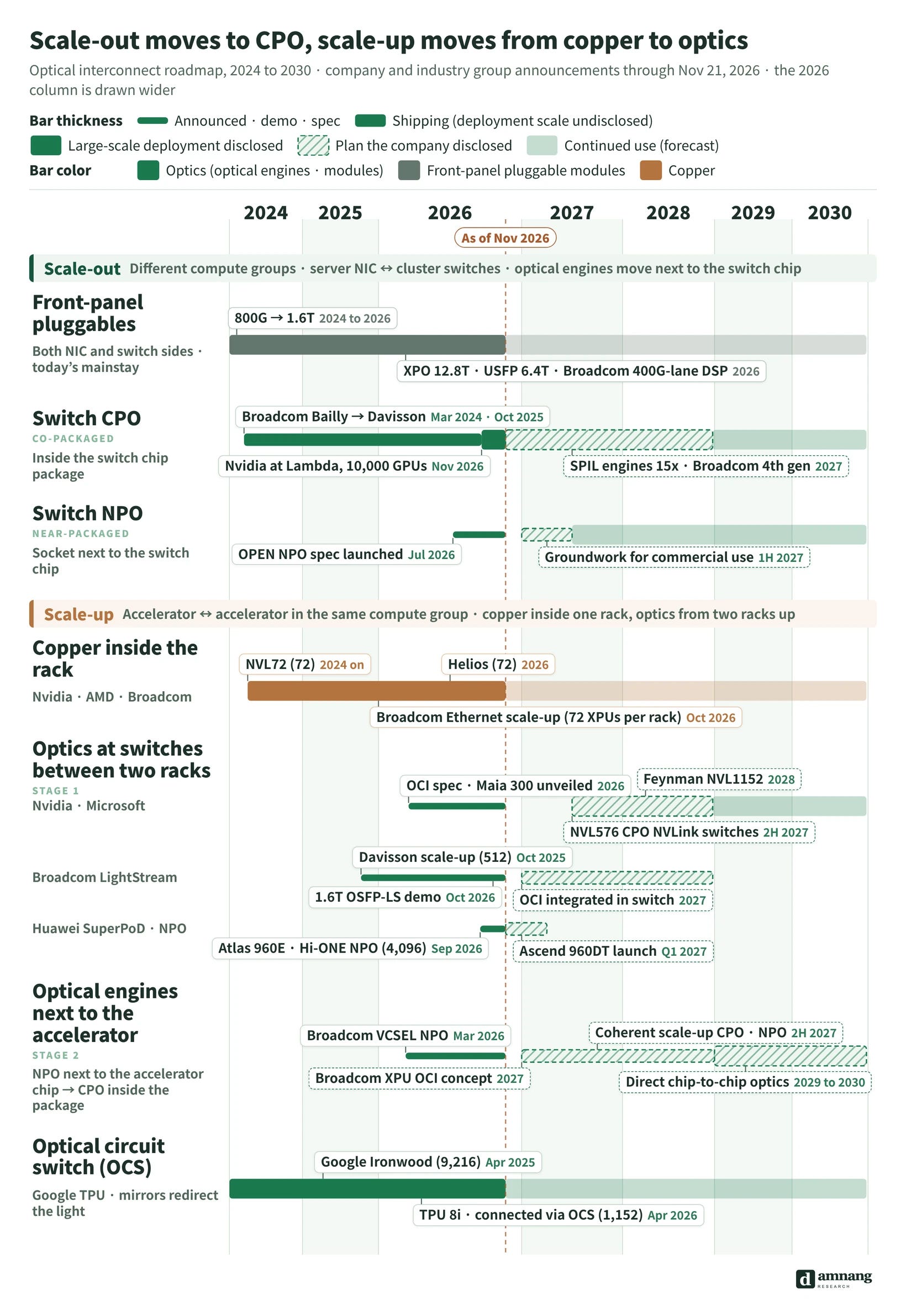
Pluggable optical modules are still the mainstay in scale-out, but CPO has already entered volume production and real deployment. Switch CPO, which puts the optical engines next to the switch chip, has been shipping from Broadcom since 2024 and from Nvidia since 2026, and volumes are expected to grow sharply through 2028.
Scale-up has now started to move from copper to optics. Once a group grows beyond one rack, copper cannot cover the distance, so optics will come in first at the switches between two racks in 2027, and accelerator CPO, which puts the optical engine next to the accelerator chip, is expected to be adopted in earnest around 2028.
Most of the talk in the news and from many experts about CPO being delayed applies to this accelerator side, scale-up CPO.
And they expect that in early scale-up optics, pluggables or NPO plugged into a socket next to the package will grow before CPO does.
The figure below puts the optical transition timelines for both connections through 2030 on one page. Every copper segment that moves to optics creates optical revenue that did not exist before.
Damnang’s take
The optical circuit switch (OCS) at the bottom of the figure is a different approach that Google uses. A regular switch converts light into electricity so that a chip can read where the data is going, then converts it back into light, but an OCS only changes the path of the light by moving mirrors. Optical modules still sit at both ends of an OCS. For more details, I recommend reading the article on OCS by Nutty and PhotonCap.


From here on, I lay out the actual progress in scale-out and scale-up and the CPO analysis I am hearing from the field, and go through in detail the AI optical interconnect revenue outlook through 2030, including CPO, that I discussed with experts in the field.
According to the model I built, AI optical interconnect revenue will more than triple over the four years to 2030 to about $100 billion, and about 40% of the increase will come from scale-up. From here, I will analyze one by one when this money starts turning into revenue, for which companies, and how it grows.
Contents
1. Switch optics have already entered the CPO stage
2. Accelerator optics expand beyond the rack
3. The CPO supply chain splits into Nvidia-style division of labor and Broadcom-style vertical integration
4. AI optical interconnect revenue grows to about $100 billion in 2030